TorchSim/torch-sim
GitHub: TorchSim/torch-sim
基于 PyTorch 的下一代原子模拟引擎,通过 GPU 加速和自动批处理大幅提升机器学习势函数的计算效率。
Stars: 477 | Forks: 102
# TorchSim
[](https://github.com/torchsim/torch-sim/actions/workflows/test.yml)
[](https://codecov.io/gh/torchsim/torch-sim)
[](https://python.org/downloads)
[](https://pypi.org/project/torch-sim-atomistic)
[][zenodo]
TorchSim 是一款面向 MLIP 时代的下一代开源原子模拟引擎。通过使用 Pytorch 重写原子模拟的核心原语,它能够将流行的机器学习势函数加速数个数量级。
* 自动 batch 处理与 GPU 内存管理,可实现显著的模拟加速
* 支持 MACE、Fairchem、SevenNet、ORB、MatterSim、metatomic 和 Nequix MLIP 模型
* 支持经典的 Lennard-Jones、Morse 和 soft-sphere 势函数
* 分子动力学积分方案,如 NVE、NVT Langevin 和 NPT Langevin
* 使用梯度下降和 FIRE 对原子位置和晶胞进行弛豫
* 交换 Monte Carlo 和混合交换 Monte Carlo 算法
* 可扩展的二进制轨迹写入格式,支持任意属性
* 为新用户提供简单直观的高阶 API
* 与 ASE、Pymatgen 和 Phonopy 集成
* 以及更多功能:可微模拟、弹性属性、自定义 workflow...
## 快速开始
这里快速演示了 TorchSim 的许多核心功能:
原生支持 GPU、MLIP 模型、ASE 集成、简单的 API、
自动 batch 和轨迹报告,所有这些都在 40 行代码以内。
### 运行批量 MD
```
import torch
import torch_sim as ts
# 在 gpus 上原生运行
device = torch.device("cuda" if torch.cuda.is_available() else "cpu")
# 轻松地从 mace-mp 加载模型
from mace.calculators.foundations_models import mace_mp
from torch_sim.models.mace import MaceModel
mace = mace_mp(model="small", return_raw_model=True)
mace_model = MaceModel(model=mace, device=device)
from ase.build import bulk
cu_atoms = bulk("Cu", "fcc", a=3.58, cubic=True).repeat((2, 2, 2))
many_cu_atoms = [cu_atoms] * 50
trajectory_files = [f"Cu_traj_{i}.h5md" for i in range(len(many_cu_atoms))]
# 通过 batching 同时运行它们
final_state = ts.integrate(
system=many_cu_atoms,
model=mace_model,
n_steps=50,
timestep=0.002,
temperature=1000,
integrator=ts.Integrator.nvt_langevin,
trajectory_reporter=dict(filenames=trajectory_files, state_frequency=10),
)
final_atoms_list = final_state.to_atoms()
# 从 trajectory file 中提取最终能量
final_energies = []
for filename in trajectory_files:
with ts.TorchSimTrajectory(filename) as traj:
final_energies.append(traj.get_array("potential_energy")[-1])
print(final_energies)
```
### 运行批量弛豫
然后使用 FIRE 弛豫这些结构只需要几行代码。
```
# relax 所有高温状态
relaxed_state = ts.optimize(
system=final_state,
model=mace_model,
optimizer=ts.Optimizer.fire,
autobatcher=True,
init_kwargs=dict(cell_filter=ts.CellFilter.frechet),
)
print(relaxed_state.energy)
```
## 加速
与使用热门 MLIP 的 ASE 相比,TorchSim 实现了高达 100 倍的加速。
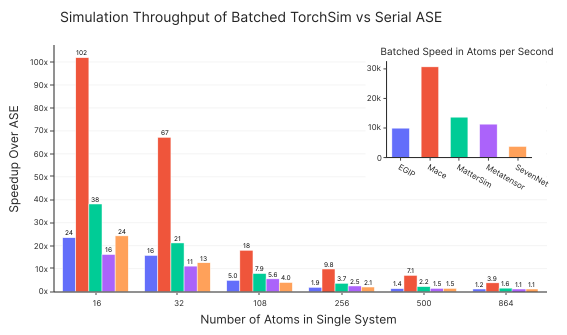 此图比较了 ASE 和 `torch_sim` 的单原子耗时。单原子耗时定义为
原子数 / 总时间。虽然 ASE 只能运行单个 `n_atoms`(在 $x$ 轴上)的系统,
但 `torch_sim` 可以运行内存允许范围内的尽可能多的系统。在一张 H100 80 GB 显卡上,
内存能够容纳的最大原子数对于 [EGIP](https://github.com/FAIR-Chem/fairchem) 约为 8,000,
对于 [MACE-MPA-0](https://github.com/ACEsuit/mace) 约为 10,000,对于 [Mattersim V1 1M](https://github.com/microsoft/mattersim) 约为 22,000,
对于 [SevenNet](https://github.com/MDIL-SNU/SevenNet) 约为 2,500,对于 [PET-MAD](https://github.com/lab-cosmo/pet-mad) 约为 9000。
该指标通过同时捕获速度和内存使用情况来描述模型性能。
## 安装
### PyPI 安装
```
pip install torch-sim-atomistic
```
### 从源码安装
```
git clone https://github.com/TorchSim/torch-sim
cd torch-sim
pip install .
```
## 示例
要了解 TorchSim 的工作原理,请从文档中的[综合教程](https://torchsim.github.io/torch-sim/user/overview.html)开始。
## 核心模块
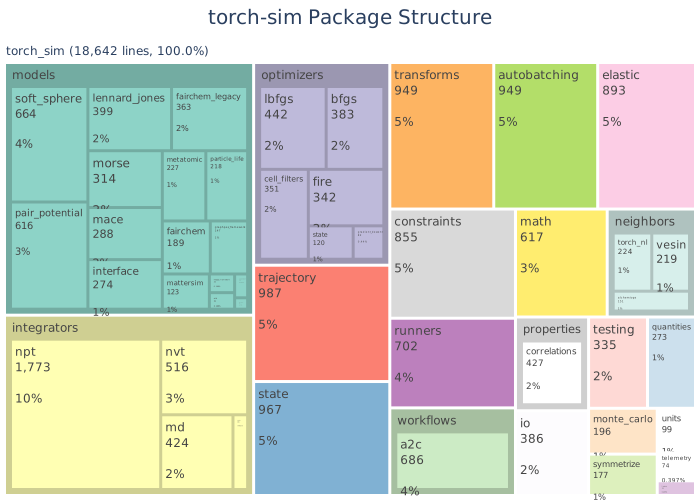
TorchSim 的包结构在 [API 参考](https://torchsim.github.io/torch-sim/reference/index.html)文档中进行了总结,并在下方以矩形树图的形式展示。
## 许可证
TorchSim 采用 [MIT 许可证](LICENSE)发布。
## 引用
如果您在研究中使用了 TorchSim,请引用我们的[出版物](https://iopscience.iop.org/article/10.1088/3050-287X/ae1799)。
```
@article{cohen2025torchsim,
title={TorchSim: An efficient atomistic simulation engine in PyTorch},
author={Cohen, Orion and Riebesell, Janosh and Goodall, Rhys and Kolluru, Adeesh and Falletta, Stefano and Krause, Joseph and Colindres, Jorge and Ceder, Gerbrand and Gangan, Abhijeet S},
journal={AI for Science},
volume={1},
number={2},
pages={025003},
year={2025},
publisher={IOP Publishing},
doi={10.1088/3050-287X/ae1799}
}
```
## 致谢
我们旨在为 TorchSim 所基于的数十年工作致以所有的 [duecredit](https://github.com/duecredit/duecredit)。通过运行 `DUECREDIT_ENABLE=yes uv run --with-editable . --extra docs --extra test python -m duecredit <(printf 'import pytest\nraise SystemExit(pytest.main(["-q"]))\n')`,可以获取该包的自动参考文献列表。此列表尚不完整,我们欢迎提交 PR 来帮助改善我们的引用覆盖率。
要收集特定教程运行(例如 autobatching)的引用,请使用:
```
DUECREDIT_ENABLE=yes uv run --with-editable . --extra docs --extra test python -m duecredit examples/tutorials/autobatching_tutorial.py
```
此图比较了 ASE 和 `torch_sim` 的单原子耗时。单原子耗时定义为
原子数 / 总时间。虽然 ASE 只能运行单个 `n_atoms`(在 $x$ 轴上)的系统,
但 `torch_sim` 可以运行内存允许范围内的尽可能多的系统。在一张 H100 80 GB 显卡上,
内存能够容纳的最大原子数对于 [EGIP](https://github.com/FAIR-Chem/fairchem) 约为 8,000,
对于 [MACE-MPA-0](https://github.com/ACEsuit/mace) 约为 10,000,对于 [Mattersim V1 1M](https://github.com/microsoft/mattersim) 约为 22,000,
对于 [SevenNet](https://github.com/MDIL-SNU/SevenNet) 约为 2,500,对于 [PET-MAD](https://github.com/lab-cosmo/pet-mad) 约为 9000。
该指标通过同时捕获速度和内存使用情况来描述模型性能。
## 安装
### PyPI 安装
```
pip install torch-sim-atomistic
```
### 从源码安装
```
git clone https://github.com/TorchSim/torch-sim
cd torch-sim
pip install .
```
## 示例
要了解 TorchSim 的工作原理,请从文档中的[综合教程](https://torchsim.github.io/torch-sim/user/overview.html)开始。
## 核心模块
TorchSim 的包结构在 [API 参考](https://torchsim.github.io/torch-sim/reference/index.html)文档中进行了总结,并在下方以矩形树图的形式展示。

## 许可证
TorchSim 采用 [MIT 许可证](LICENSE)发布。
## 引用
如果您在研究中使用了 TorchSim,请引用我们的[出版物](https://iopscience.iop.org/article/10.1088/3050-287X/ae1799)。
```
@article{cohen2025torchsim,
title={TorchSim: An efficient atomistic simulation engine in PyTorch},
author={Cohen, Orion and Riebesell, Janosh and Goodall, Rhys and Kolluru, Adeesh and Falletta, Stefano and Krause, Joseph and Colindres, Jorge and Ceder, Gerbrand and Gangan, Abhijeet S},
journal={AI for Science},
volume={1},
number={2},
pages={025003},
year={2025},
publisher={IOP Publishing},
doi={10.1088/3050-287X/ae1799}
}
```
## 致谢
我们旨在为 TorchSim 所基于的数十年工作致以所有的 [duecredit](https://github.com/duecredit/duecredit)。通过运行 `DUECREDIT_ENABLE=yes uv run --with-editable . --extra docs --extra test python -m duecredit <(printf 'import pytest\nraise SystemExit(pytest.main(["-q"]))\n')`,可以获取该包的自动参考文献列表。此列表尚不完整,我们欢迎提交 PR 来帮助改善我们的引用覆盖率。
要收集特定教程运行(例如 autobatching)的引用,请使用:
```
DUECREDIT_ENABLE=yes uv run --with-editable . --extra docs --extra test python -m duecredit examples/tutorials/autobatching_tutorial.py
```
此图比较了 ASE 和 `torch_sim` 的单原子耗时。单原子耗时定义为
原子数 / 总时间。虽然 ASE 只能运行单个 `n_atoms`(在 $x$ 轴上)的系统,
但 `torch_sim` 可以运行内存允许范围内的尽可能多的系统。在一张 H100 80 GB 显卡上,
内存能够容纳的最大原子数对于 [EGIP](https://github.com/FAIR-Chem/fairchem) 约为 8,000,
对于 [MACE-MPA-0](https://github.com/ACEsuit/mace) 约为 10,000,对于 [Mattersim V1 1M](https://github.com/microsoft/mattersim) 约为 22,000,
对于 [SevenNet](https://github.com/MDIL-SNU/SevenNet) 约为 2,500,对于 [PET-MAD](https://github.com/lab-cosmo/pet-mad) 约为 9000。
该指标通过同时捕获速度和内存使用情况来描述模型性能。
## 安装
### PyPI 安装
```
pip install torch-sim-atomistic
```
### 从源码安装
```
git clone https://github.com/TorchSim/torch-sim
cd torch-sim
pip install .
```
## 示例
要了解 TorchSim 的工作原理,请从文档中的[综合教程](https://torchsim.github.io/torch-sim/user/overview.html)开始。
## 核心模块
TorchSim 的包结构在 [API 参考](https://torchsim.github.io/torch-sim/reference/index.html)文档中进行了总结,并在下方以矩形树图的形式展示。

## 许可证
TorchSim 采用 [MIT 许可证](LICENSE)发布。
## 引用
如果您在研究中使用了 TorchSim,请引用我们的[出版物](https://iopscience.iop.org/article/10.1088/3050-287X/ae1799)。
```
@article{cohen2025torchsim,
title={TorchSim: An efficient atomistic simulation engine in PyTorch},
author={Cohen, Orion and Riebesell, Janosh and Goodall, Rhys and Kolluru, Adeesh and Falletta, Stefano and Krause, Joseph and Colindres, Jorge and Ceder, Gerbrand and Gangan, Abhijeet S},
journal={AI for Science},
volume={1},
number={2},
pages={025003},
year={2025},
publisher={IOP Publishing},
doi={10.1088/3050-287X/ae1799}
}
```
## 致谢
我们旨在为 TorchSim 所基于的数十年工作致以所有的 [duecredit](https://github.com/duecredit/duecredit)。通过运行 `DUECREDIT_ENABLE=yes uv run --with-editable . --extra docs --extra test python -m duecredit <(printf 'import pytest\nraise SystemExit(pytest.main(["-q"]))\n')`,可以获取该包的自动参考文献列表。此列表尚不完整,我们欢迎提交 PR 来帮助改善我们的引用覆盖率。
要收集特定教程运行(例如 autobatching)的引用,请使用:
```
DUECREDIT_ENABLE=yes uv run --with-editable . --extra docs --extra test python -m duecredit examples/tutorials/autobatching_tutorial.py
```
标签:GPGPU计算, PyTorch, 凭据扫描, 分子动力学, 原子模拟, 机器学习原子间势, 科学与计算, 逆向工具