Wapiti08/GraphSec-Flow
GitHub: Wapiti08/GraphSec-Flow
基于 Neo4j 图数据库的开源软件供应链漏洞传播与根因分析工具,支持时间约束下的依赖链追踪和中心性风险度量。
Stars: 0 | Forks: 0
# GraphSec-Flow

OSS 生态系统的时间依赖传播与根因分析
## 结构
- cause:因果分析部分,自定义 DAS 的实现,生成两个包含 CVE 相关特征(一跳邻居,两跳邻居)文件的代码
- cent:三种中心性度量方法:度(三个方向)、介数和特征向量
- data:提取的其他格式数据集
- exp:针对不同文件的探索代码,调用多种中心性度量的代码,用于数据可视化和执行统计分析的 notebooks
- process:调用 neo4j 并导出其他格式图(如 graphml 和 csv)的代码
## 说明
- 如何安装 Goblin Weaver
```
java -Dneo4jUri="bolt://localhost:7687/" -Dneo4jUser="neo4j" -Dneo4jPassword="password" -jar goblinWeaver-2.1.0.jar
```
## 数据导出
- neo4j.conf 配置:将以下行添加到 conf 文件以启用 apoc 输出
```
dbms.security.procedures.unrestricted=apoc.*
dbms.security.procedures.allowlist=apoc.*
apoc.export.file.enabled=true
```
- 运行脚本:
```
# 将 dump 导出为 graphml 和 csv 格式
python3 data_export.py
```
## 运行说明
(已在 macOS 和 Ubuntu 20.04.5 LTS 上针对小规模数据进行测试)
```
# 配置 virtualenv 环境
curl https://pyenv.run | bash
export PYENV_ROOT="$HOME/.pyenv"
[[ -d $PYENV_ROOT/bin ]] && export PATH="$PYENV_ROOT/bin:$PATH"
eval "$(pyenv init -)"
eval "$(pyenv virtualenv-init -)"
# 指定 python 版本
pyenv install 3.10
pyenv global 3.10
# 创建本地环境
pyenv virtualenv 3.10 GraphSec-Flow
eval "$(pyenv init -)"
eval "$(pyenv virtualenv-init -)"
pyenv activate GraphSec-Flow
# 升级构建工具 - 避免兼容性问题
python -m pip install -U pip setuptools wheel build
sudo apt-get update
sudo apt-get install -y build-essential libffi-dev libssl-dev zlib1g-dev \
libbz2-dev libreadline-dev libsqlite3-dev liblzma-dev tk-dev uuid-dev
# 下载依赖
pip3 install -r requirements.txt
```
## 如何使用
- 生成 CVE 增强依赖图
```
cd cve
python3 graph_cve.py --dep_graph {your local path}/data/dep_graph.pkl --cve_json {your local path}/data/aggregated_data.json --nodes_pkl {your local path}/data/graph_nodes_edges.pkl --augment_graph {your local path}/data/dep_graph_cve.pkl
```
- 生成基准真值数据
```
# 深度为 3 且无时间限制:
python3 gt_builder_parallel.py --dep-graph /workspace/GraphSec-Flow/data/dep_graph_cve.pkl --cve-meta /workspace/GraphSec-Flow/data/cve_records_for_meta.pkl --out-root /workspace/GraphSec-Flow/data --out-paths /workspace/GraphSec-Flow/data --no-time-constraint --max-depth 3 --num-workers 64
```
- 根因分析
```
python3 root_ana.py --cve_id "CVE-2017-5650"
```
- 根因路径分析
```
python3 path_track.py --aug_graph /workspace/GraphSec-Flow/data/dep_graph_cve.pkl --paths_jsonl /workspace/GraphSec-Flow/result/result.json --subgraph_gexf /workspace/GraphSec-Flow/result/result.gexf --t_start 1021437154000 --t_end 1724985046000
```
- 生成用于人工验证的节点查找:
```
python3 - << 'EOF'
import pickle, json, csv
from pathlib import Path
print("Loading graph...")
with open('data/dep_graph_cve.pkl', 'rb') as f:
G = pickle.load(f)
node_ids = set()
with open('data/validation/manual_labels_predicted.csv') as f:
for row in csv.DictReader(f):
for nid in row['top_predicted_nodes'].split('|'):
if nid.strip():
node_ids.add(nid.strip())
print(f"Resolving {len(node_ids)} node IDs...")
result = {}
for nid in sorted(node_ids):
if nid in G.nodes:
d = G.nodes[nid]
result[nid] = {
'release': d.get('release', d.get('artifact', d.get('name', '?'))),
'group': d.get('group_id', d.get('groupId', '')),
'artifact':d.get('artifact_id', d.get('artifactId', '')),
'version': d.get('version', ''),
'has_cve': d.get('has_cve', False),
}
else:
result[nid] = {'release': 'NOT FOUND'}
with open('data/validation/node_lookup.json', 'w') as f:
json.dump(result, f, indent=2)
for nid, info in result.items():
r = info.get('release','')
g = info.get('group','')
a = info.get('artifact','')
v = info.get('version','')
label = f"{g}:{a}:{v}" if g and a else r
print(f" {nid:15s} → {label}")
print(f"\n✓ Saved to data/validation/node_lookup.json")
EOF
```
```
- Benchmark
```
nohup python bench/benchmark.py --dep-graph data/dep_graph_cve_2hop_random.pkl --ref-layer data/ref_paths_layer_full_6.jsonl --node-texts data/nodeid_to_texts.pkl --cve-meta data/cve_records_for_meta.pkl --per-cve data/per_cve_scores.pkl --node-scores data/node_cve_scores.pkl > logs/benchmark_2hop_6_random_opt.txt 2>&1 &
```
- Small Scale Validation Benchmark
```
# 针对小规模图
nohup python bench/benchmark_opt.py --dep-graph data/dep_graph_cve_2hop.pkl --ref-layer data/ref_paths_layer_3.jsonl --node-texts data/nodeid_to_texts.pkl --cve-meta data/cve_records_for_meta.pkl --per-cve data/per_cve_scores.pkl --node-scores data/node_cve_scores.pkl > logs/benchmark_2hop_g3_baseline.txt 2>&1 &
# 针对全量图
nohup python bench/benchmark_opt.py --dep-graph data/dep_graph_cve.pkl --ref-layer data/ref_paths_layer_3.jsonl --node-texts data/nodeid_to_texts.pkl --cve-meta data/cve_records_for_meta.pkl --per-cve data/per_cve_scores.pkl --node-scores data/node_cve_scores.pkl > logs/benchmark_g3_baseline.txt 2>&1 &
# 针对小规模图
nohup python bench/benchmark_opt.py --dep-graph data/dep_graph_cve_2hop_random.pkl --ref-layer data/ref_paths_layer_3.jsonl --node-texts data/nodeid_to_texts.pkl --cve-meta data/cve_records_for_meta.pkl --per-cve data/per_cve_scores.pkl --node-scores data/node_cve_scores.pkl > logs/benchmark_2hop_g3_random.txt 2>&1 &
# 针对全量图
nohup python bench/benchmark_opt.py --dep-graph data/validation/dep_graph_cve_random_timestamps.pkl --ref-layer data/ref_paths_layer_3.jsonl --node-texts data/nodeid_to_texts.pkl --cve-meta data/cve_records_for_meta.pkl --per-cve data/per_cve_scores.pkl --node-scores data/node_cve_scores.pkl > logs/benchmark_g3_random.txt 2>&1 &
```
- Batch Prediction
```
nohup python3 validation/batch_predict.py --max-cves 100 > batch_predict_100.txt 2>&1 &
```
- Actionability Test
```
# 需要先完成 batch_predict 才能生成结果
python validation/actionability.py -k_values 1 3 5 10 15 > logs/actionability_small_ks.txt
```
- Depth Validation (on sub graph)
```
python validation/depth_ablation.py \
--dep-graph data/dep_graph_cve_sub.pkl \
--cve-meta data/cve_records_for_meta.pkl \
--predictions data/validation/predictions.json \
--depths 2 3 4 6 8 \
--out data/validation/depth_ablation_sub.json \
2>&1 | tee logs/depth_ablation_sub.log
```
-
## Ground-truth 构建(silver, inferred)
We build a **silver** ground truth for evaluation using (i) earliest-affected release selection from OSV/NVD metadata and
(ii) a time-respecting, depth-bounded traversal to generate reference propagation edges. This GT is **inferred** (not manually verified).
### Algorithm 1:根因推断(最早的易受攻击版本)
**Input:** vulnerability metadata (affected ranges `R`, optional fixing commits `F`, publication time), dependency graph `G`
**Output:** inferred root-cause release node `r`
1. Resolve package id `p` from the advisory (name / repo URL).
2. Normalize semantic versions in affected ranges `R`.
3. Collect candidate releases `S = { s in G | package(s)=p and version(s) in R }`.
4. For each `s in S`, get release time `t(s)`.
5. Return `r = argmin_{s in S} t(s)`.
### Algorithm 2:Reference 传播路径生成(深度受限)
**Input:** root `r`, graph `G`, max depth `d_max`
**Output:** reference edge set `P`
1. Initialize queue `Q = [(r,0)]`, set `P = ∅`.
2. While `Q` not empty:
- Pop `(u,d)`. If `d == d_max`, continue.
- For each downstream dependent release `v` of `u` in `G`:
- If `release_time(v) >= release_time(u)`:
- Add edge `(u → v)` to `P`
- Push `(v, d+1)` into `Q`
3. Return `P`
See `docs/ground_truth.md` for the full LaTeX version and validation checks.
## 统计分析(补充材料)
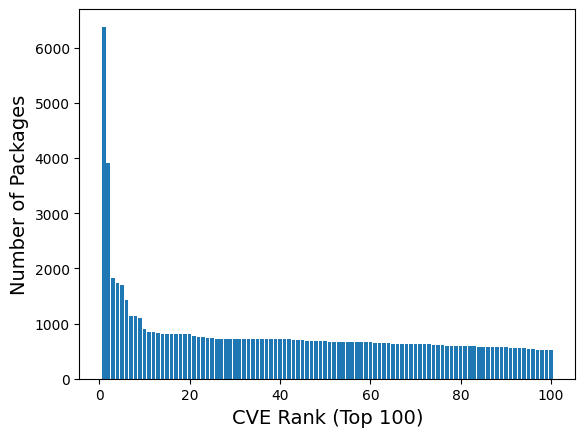
- Distributed of Number of Packages per CVE (Top 100):
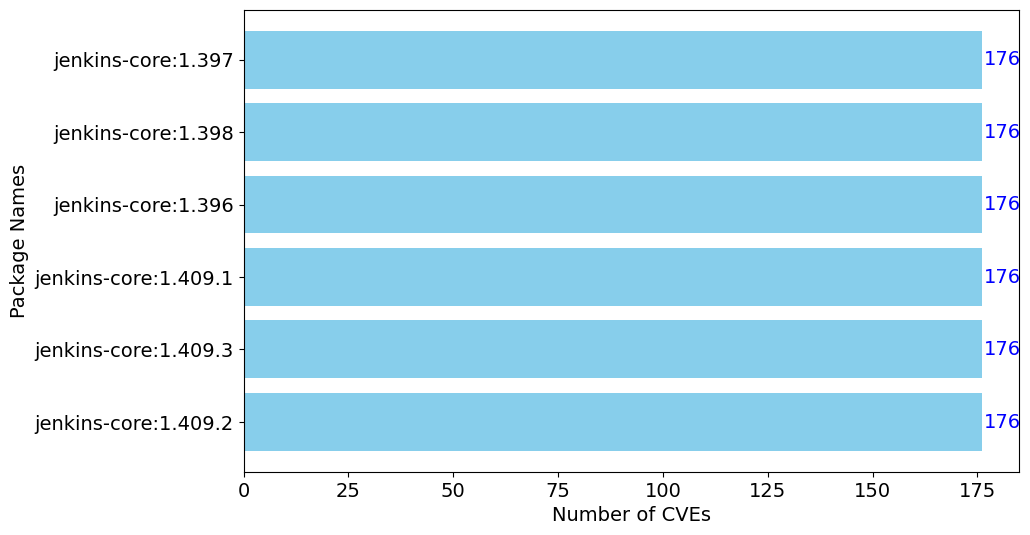
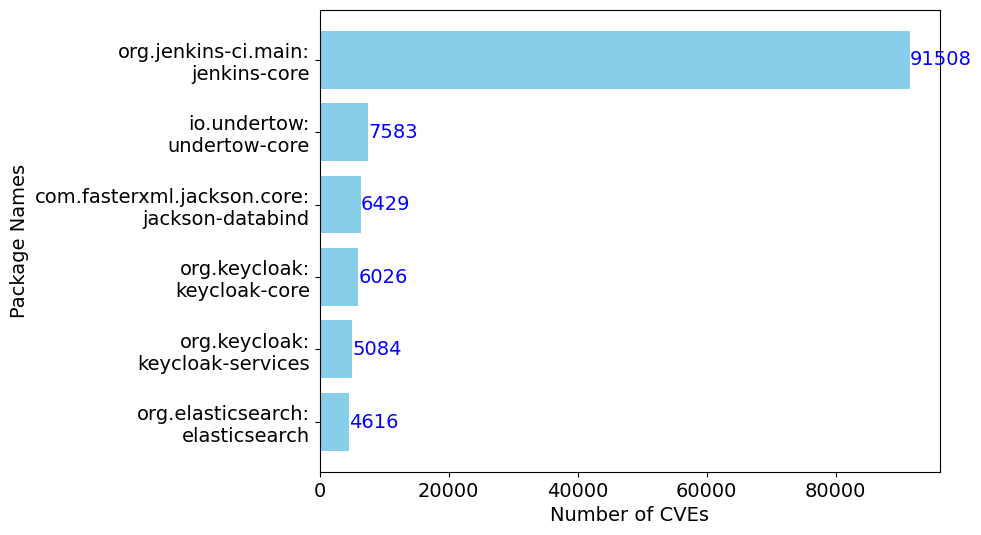
- Releases by number of CVEs (Top 6):
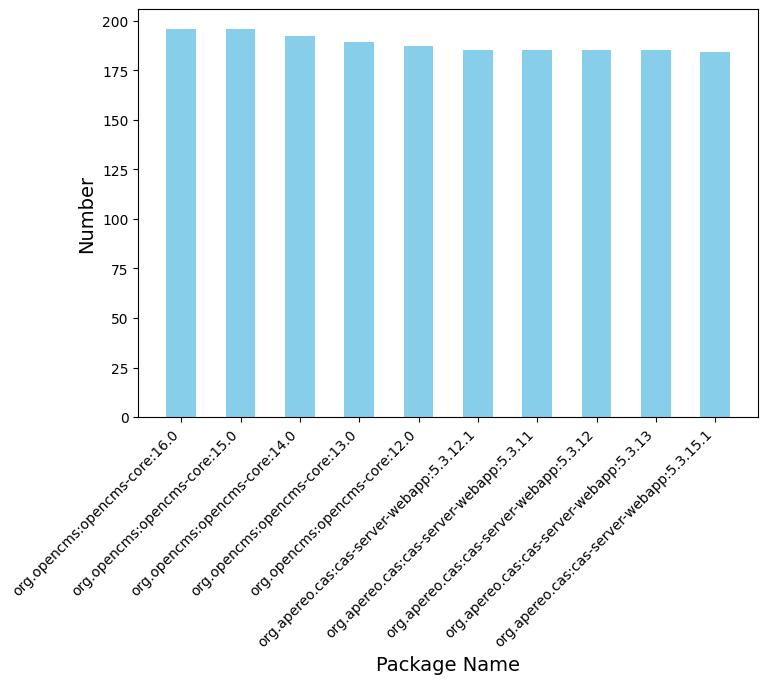
- Top 10 Packages with Vulnerable Releases:
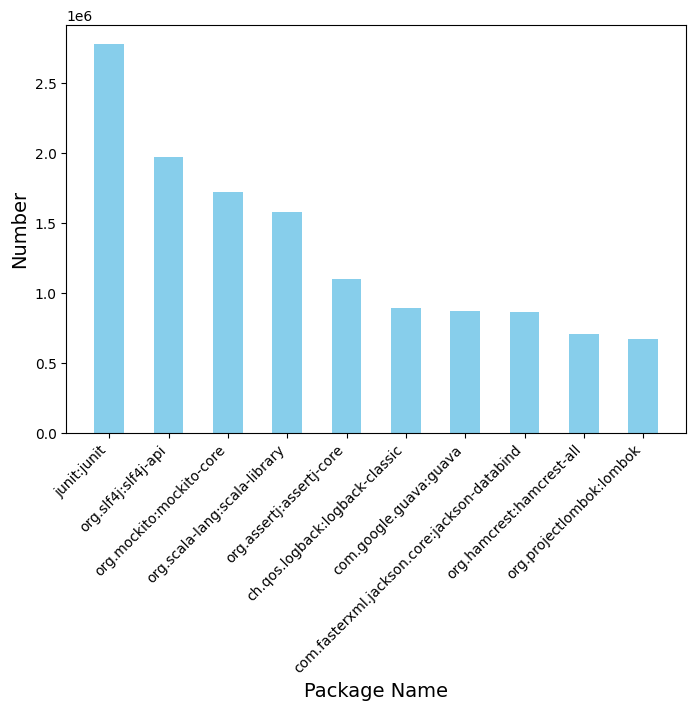
- Top 10 Packages with Highest Degree Centrality:
- Top 10 Vulnerable Releases with Highest Out-degree:

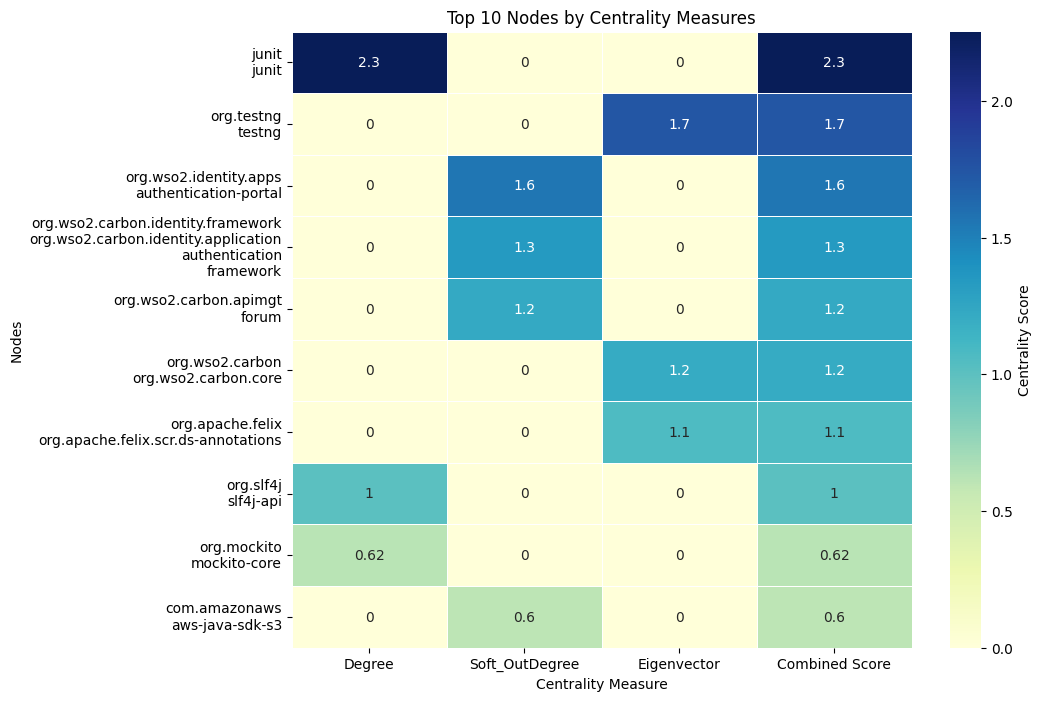
- Top 10 Nodes Heatmap:
- Package by number of CVEs:
```
标签:CVE分析, DAS算法, Goblin Weaver, GraphML, JS文件枚举, Neo4j, Python, 中心性测量, 依赖传播分析, 图论, 图谱可视化, 开源软件供应链, 数据导出, 文档安全, 无后门, 时序依赖, 根本原因分析, 生态安全, 软件开发工具包, 逆向工具