gardener/external-dns-management
GitHub: gardener/external-dns-management
Gardener 推出的 Kubernetes DNS 控制器,通过 CRD 声明式管理多云环境下的 DNS 记录,并支持为 Service、Ingress 和网关自动创建 DNS 解析。
Stars: 95 | Forks: 86
# External DNS Management
[](https://api.reuse.software/info/github.com/gardener/external-dns-management)
[](https://github.com/gardener/external-dns-management/actions/workflows/non-release.yaml)
The main artefact of this project is the **DNS controller manager** for managing DNS records, also
nicknamed as the Gardener "DNS Controller".
It contains provisioning controllers for creating DNS records in one of the DNS cloud services
- [_Amazon Route53_](/docs/aws-route53/README.md),
- [_Google CloudDNS_](/docs/google-cloud-dns/README.md),
- [_AliCloud DNS_](/docs/alicloud-dns/README.md),
- [_Azure DNS_](/docs/azure-dns/README.md) and [_Azure Private_DNS_](/docs/azure-private-dns/README.md),
- [_OpenStack Designate_](/docs/openstack-designate/README.md),
- [_Cloudflare DNS_](/docs/cloudflare/README.md),
- [_Infoblox_](/docs/infoblox/README.md) *(deprecated - is not supported or maintained anymore. It will be removed end of 2025)*,
- [_Netlify DNS_](docs/netlify/README.md),
- [_remote_](docs/remote/README.md),
- [_DNS servers supporting RFC 2136 (DNS Update)_](docs/rfc2136/README.md) *(alpha - not recommended for productive usage)*,
- [_powerdns_](docs/powerdns/README.md),
and source controllers for services and ingresses to create DNS entries by annotations.
The configuration for the external DNS service is specified in a custom resource `DNSProvider`.
Multiple `DNSProvider` can be used simultaneously and changed without restarting the DNS controller.
DNS records are either created directly for a corresponding custom resource `DNSEntry` or by
annotating a service or ingress.
For a detailed explanation of the model, see section [The Model](#the-model).
For extending or adapting this project with your own source or provisioning controllers, see section
[Extensions](#extensions)
## Index
- [External DNS Management](#external-dns-management)
- [Index](#index)
- [Important Note: Support for owner identifiers is discontinued](#important-note-support-for-owner-identifiers-is-discontinued)
- [Quick start](#quick-start)
- [Automatic creation of DNS entries for services and ingresses](#automatic-creation-of-dns-entries-for-services-and-ingresses)
- [`A` DNS records with alias targets for provider type AWS-Route53 and AWS load balancers](#a-dns-records-with-alias-targets-for-provider-type-aws-route53-and-aws-load-balancers)
- [Automatic creation of DNS entries for gateways](#automatic-creation-of-dns-entries-for-gateways)
- [Istio gateways](#istio-gateways)
- [Gateway API gateways](#gateway-api-gateways)
- [The Model](#the-model)
- [DNS Classes](#dns-classes)
- [DNSAnnotation objects](#dnsannotation-objects)
- [Using the DNS controller manager](#using-the-dns-controller-manager)
- [Extensions](#extensions)
- [How to implement Source Controllers](#how-to-implement-source-controllers)
- [How to implement Provisioning Controllers](#how-to-implement-provisioning-controllers)
- [Embedding a Factory into a Controller](#embedding-a-factory-into-a-controller)
- [Embedding a Factory into a Compound Factory](#embedding-a-factory-into-a-compound-factory)
- [Setting Up a Controller Manager](#setting-up-a-controller-manager)
- [Using the standard Compound Provisioning Controller](#using-the-standard-compound-provisioning-controller)
- [Multiple Cluster Support](#multiple-cluster-support)
- [DNS Controller Manager Next Generation](#dns-controller-manager-next-generation)
- [Why not use the community `external-dns` solution?](#why-not-use-the-community-external-dns-solution)
## Important Note: Support for owner identifiers is discontinued
Starting with former release `v0.23`, the support for owner identifiers is discontinued.
See former description of [Owner Identifiers](https://github.com/gardener/external-dns-management/tree/v0.23.0?tab=readme-ov-file#owner-identifiers) for more details.
With release `v0.24`, the support for owner identifiers is removed completely.
The custom resource `DNSOwner` (`dnsowners.dns.gardener.cloud`) is no longer supported.
## Quick start
To install the **DNS controller manager** in your Kubernetes cluster, follow these steps.
1. Prerequisites
- Check out or download the project to get a copy of the Helm charts.
It is recommended to check out the tag of the
[last release](https://github.com/gardener/external-dns-management/releases), so that Helm
values reference the newest released container image for the deployment.
- Make sure, that you have installed Helm client (`helm`) locally. See e.g. [Helm installation](https://helm.sh/docs/install/) for more details.
2. Install the DNS controller manager
Then install the DNS controller manager with
helm install dns-controller charts/external-dns-management --namespace=
This will use the default configuration with all source and provisioning controllers enabled.
The complete set of configuration variables can be found in `charts/external-dns-management/values.yaml`.
Their meaning is explained by their corresponding command line options in section
[Using the DNS controller manager](#using-the-dns-controller-manager)
By default, the DNS controller looks for custom resources in all namespaces. The chosen namespace is
only relevant for the deployment itself.
You may need to install [VerticalPodAutoscaler CRDs](https://raw.githubusercontent.com/kubernetes/autoscaler/master/vertical-pod-autoscaler/deploy/vpa-v1-crd-gen.yaml)
or set `vpa.enabled=false` to disable VPA.
3. Create a `DNSProvider`
To specify a DNS provider, you need to create a custom resource `DNSProvider` and a secret containing the
credentials for your account at the provider. E.g. if you want to use AWS Route53, create a secret and
provider with
cat << EOF | kubectl apply -f -
apiVersion: v1
kind: Secret
metadata:
name: aws-credentials
namespace: default
type: Opaque
data:
# replace '...' with values encoded as base64
# see https://docs.aws.amazon.com/general/latest/gr/managing-aws-access-keys.html
AWS_ACCESS_KEY_ID: ...
AWS_SECRET_ACCESS_KEY: ...
# or if the chain of credential providers should be used:
#AWS_USE_CREDENTIALS_CHAIN: dHJ1ZQ==
EOF
and
cat << EOF | kubectl apply -f -
apiVersion: dns.gardener.cloud/v1alpha1
kind: DNSProvider
metadata:
name: aws
namespace: default
spec:
type: aws-route53
secretRef:
name: aws-credentials
domains:
include:
# this must be replaced with a (sub)domain of the hosted zone
- my.own.domain.com
EOF
Check the successful creation with
kubectl get dnspr
You should see something like
NAME TYPE STATUS AGE
aws aws-route53 Ready 12s
4. Create a `DNSEntry`
Create an DNS entry with
cat << EOF | kubectl apply -f -
apiVersion: dns.gardener.cloud/v1alpha1
kind: DNSEntry
metadata:
name: mydnsentry
namespace: default
spec:
dnsName: "myentry.my-own-domain.com"
ttl: 600
targets:
- 1.2.3.4
EOF
Check the status of the DNS entry with
kubectl get dnsentry
You should see something like
NAME DNS TYPE PROVIDER STATUS AGE
mydnsentry myentry.my-own-domain.com aws-route53 default/aws Ready 24s
As soon as the status of the entry is `Ready`, the provider has accepted the new DNS record.
Depending on the provider and your DNS settings and cache, it may take up to a few minutes before
the domain name can be resolved.
5. Wait for/check DNS record
To check the DNS resolution, use `nslookup` or `dig`.
nslookup myentry.my-own-domain.com
or with dig
# or with dig
dig +short myentry.my-own-domain.com
Depending on your network settings, you may get a successful response faster using a public DNS server
(e.g. 8.8.8.8, 8.8.4.4, or 1.1.1.1)
dig @8.8.8.8 +short myentry.my-own-domain.com
For more examples about the custom resources and the annotations for services and ingresses
see the [examples](examples/) directory and [translation of `DNSEntries` examples](docs/usage/dnsentry_translation.md)
### Automatic creation of DNS entries for services and ingresses
Using the source controllers, it is also possible to create DNS entries for services (of type `LoadBalancer`)
and ingresses automatically. The resources only need to be annotated with some special values.
In this case ensure that the source controllers are enabled on startup of the DNS controller manager, i.e. the
value of the command line option `--controllers` must contain `dnscontrollers` or equal to `all`.
The DNS source controllers watch resources on the default cluster and create DNS entries on
the target cluster. As there can be multiple controllers active on the same cluster, you may
need to set the correct `DNSClass` both for the controller and for the source resource by
setting the annotation `dns.gardener.cloud/class`. The default value for the `DNSClass` is `gardendns`.
**Note**: If you delegate the DNS management for shoot resources to Gardener via the
[shoot-dns-service extension](https://github.com/gardener/gardener-extension-shoot-dns-service),
the correct annotation is `dns.gardener.cloud/class=garden`.
Here is an example for annotating a service (same as `examples/50-service-with-dns.yaml`):
apiVersion: v1
kind: Service
metadata:
annotations:
dns.gardener.cloud/dnsnames: echo.my-dns-domain.com
dns.gardener.cloud/ttl: "500"
# If you are delegating the DNS Management to Gardener, uncomment the following line (see https://gardener.cloud/documentation/guides/administer_shoots/dns_names/)
#dns.gardener.cloud/class: garden
#service.beta.kubernetes.io/aws-load-balancer-ip-address-type: dualstack # AWS-route 53 only: enable both A and AAAA alias targets
#dns.gardener.cloud/ip-stack: dual-stack # AWS-route 53 only: alternative way to enable A and AAAA alias targets
#dns.gardener.cloud/resolve-targets-to-addresses: "true"
# To temporarily skip reconciliation of created entries
#dns.gardener.cloud/ignore: "reconcile" # or "true"
# To skip reconciliation and cleanup of DNS records on deletion
#dns.gardener.cloud/ignore: "full"
name: test-service
namespace: default
spec:
ports:
- name: http
port: 80
protocol: TCP
targetPort: 8080
sessionAffinity: None
type: LoadBalancer
The annotation `dns.gardener.cloud/ignore` has multiple values.
With value `reconcile` or `true` the entry is not reconciled, i.e., the existing DNS records are left untouched on updates of the load balancer addresses.
But on deleting of the `Service` object, the DNS records are cleaned up.
If you want to move the service without intermediate deletion of the DNS records (e.g. to another namespace or cluster), you may use the value `full`.
In this case, the DNS records are left untouched, even if the `Service` object is deleted.
Please note that inproper use may result in orphaned DNS records in this case.
#### `A` DNS records with alias targets for provider type AWS-Route53 and AWS load balancers
For AWS-Route53 and AWS load balancers, `A` DNS records with alias target are created instead of `CNAME`
as an optimisation.
To support dual-stack IP addresses in this case, set one of these annotations:
- `service.beta.kubernetes.io/aws-load-balancer-ip-address-type=dualstack` (services only)
- `dns.gardener.cloud/ip-stack=dual-stack` (ingresses, services or dnsentries)
In this case, both `A` and `AAAA` records with alias target records are created.
With annotation `dns.gardener.cloud/ip-stack=ipv6`, only an `AAAA` record with alias target is created.
### Automatic creation of DNS entries for gateways
There are source controllers for `Gateways` from [Istio](https://github.com/istio/istio) or the new Kubernetes [Gateway API](https://gateway-api.sigs.k8s.io/).
By annotating the `Gateway` resource with the `dns.gardener.cloud/dnsnames` annotation, DNS entries are managed automatically for the hosts.
#### Istio gateways
For Istio, gateways for API versions `networking.istio.io/v1`, `networking.istio.io/v1beta1`, and `networking.istio.io/v1alpha3` are supported.
To enable automatic management of `DNSEntries`, annotate the Istio `Gateway` resource with `dns.gardener.cloud/dnsnames="*"`.
The domain names are extracted from the `spec.servers.hosts` field and from the field `spec.hosts` of related `VirtualService` resources.
The determination of the `DNSEntry` targets, typically the IP addresses or hostnames of the load balancer, follows these steps:
1. If the `dns.gardener.cloud/targets` annotation is provided, its value is used.
This value is expected to be a comma-separated list of the load balancer's IP addresses or hostnames.
2. Alternatively, if the `dns.gardener.cloud/ingress` annotation is set, the IP addresses or hostnames are derived from the status
of the `Ingress` resource. This resource is identified by its name, which can be in the format `/` or simply ``.
In the latter case, the Gateway resource's namespace is assumed.
3. If neither of these annotations is provided, it is assumed that the Gateway `spec.selector` field in Istio matches
a `Service` resource of type `LoadBalancer`. In this case, the targets are obtained from the service load balancer's status.
apiVersion: networking.istio.io/v1
kind: Gateway
metadata:
annotations:
dns.gardener.cloud/dnsnames: '*'
#dns.gardener.cloud/ttl: "500"
# If you are delegating the DNS Management to Gardener, uncomment the following line (see https://gardener.cloud/documentation/guides/administer_shoots/dns_names/)
#dns.gardener.cloud/class: garden
# To temporarily skip reconciliation of created entries
#dns.gardener.cloud/ignore: "reconcile" # or "true"
# To skip reconciliation and cleanup of DNS records on deletion
#dns.gardener.cloud/ignore: "full"
name: my-gateway
namespace: default
spec:
selector:
istio: ingressgateway
servers:
- hosts:
- uk.example.com
- eu.example.com
port:
name: http
number: 80
protocol: HTTP
tls:
httpsRedirect: true
- hosts:
- uk.example.com
- eu.example.com
port:
name: https-443
number: 443
protocol: HTTPS
tls:
mode: SIMPLE
privateKey: /etc/certs/privatekey.pem
serverCertificate: /etc/certs/servercert.pem
- hosts:
- bookinfo-namespace/*.example.com
port:
name: https-9443
number: 9443
protocol: HTTPS
tls:
credentialName: my-secret
mode: SIMPLE
In this case, three `DNSEntries` would be created with domain names `uk.example.com`, `eu.example.com`, and `*.example.com`.
As neither `dns.gardener.cloud/targets` or `dns.gardener.cloud/ingress` annotation is provided, the targets need to
come from the load balancer status of a `Service` resource with the label selector `istio=ingressgateway`.
*Note: Alternatively in this concrete example, you could annotate the `Service` resource with `dns.gardener.cloud/dnsnames="*.example.com"`,
if the domain names are static.*
See the [Istio tutorial](docs/usage/tutorials/istio-gateways.md) for a more detailed example.
#### Gateway API gateways
The Gateway API versions `gateway.networking.k8s.io/v1` and `gateway.networking.k8s.io/v1beta1` are supported.
To enable automatic management of `DNSEntries`, annotate the Gateway API `Gateway` resource with `dns.gardener.cloud/dnsnames="*"`.
The domain names are extracted from the `spec.listeners.hostnames` field and from the field `spec.hostnames` of related `HTTPRoute` resources.
The targets of the `DNSEntry` are extracted from the `status.addresses` field.
apiVersion: gateway.networking.k8s.io/v1
kind: Gateway
metadata:
annotations:
dns.gardener.cloud/dnsnames: '*'
#dns.gardener.cloud/ttl: "500"
# If you are delegating the DNS Management to Gardener, uncomment the following line (see https://gardener.cloud/documentation/guides/administer_shoots/dns_names/)
#dns.gardener.cloud/class: garden
# To temporarily skip reconciliation of created entries
#dns.gardener.cloud/ignore: "reconcile" # or "true"
# To skip reconciliation and cleanup of DNS records on deletion
#dns.gardener.cloud/ignore: "full"
name: my-gateway
namespace: default
spec:
gatewayClassName: my-gateway-class
listeners:
- allowedRoutes:
namespaces:
from: Selector
selector:
matchLabels:
shared-gateway-access: "true"
hostname: foo.example.com
name: https
port: 443
protocol: HTTPS
tls: ...
status:
addresses:
- type: IPAddress
value: 1.2.3.4
In this case, a single `DNSEntry` with domain name `foo.example.com` and target IP `1.2.3.4` would be created.
See the [Gateway API tutorial](docs/usage/tutorials/gateway-api-gateways.md) for a more detailed example.
## The Model
This project provides a flexible model allowing to
add DNS source objects and DNS provisioning environments by adding
new independent controllers.
There is no single DNS controller anymore. The decoupling between the
handling of DNS source objects, like ingresses or services, and the
provisioning of DNS entries in an external DNS provider like
_Route53_ or _CloudDNS_ is achieved by introducing a new custom resource
`DNSEntry`.
These objects can either be explicitly created to request dedicated DNS
entries, or they are managed based on other resources like ingresses or
services. For the latter dedicated _DNS Source Controllers_ are used.
There might be any number of such source controllers. They do not need to know
anything about the various DNS environments. Their task is to figure out which
DNS entries are required in their realm and manage appropriate `DNSEntry`
objects. From these objects they can also read the provisioning status and
report it back to the original source.
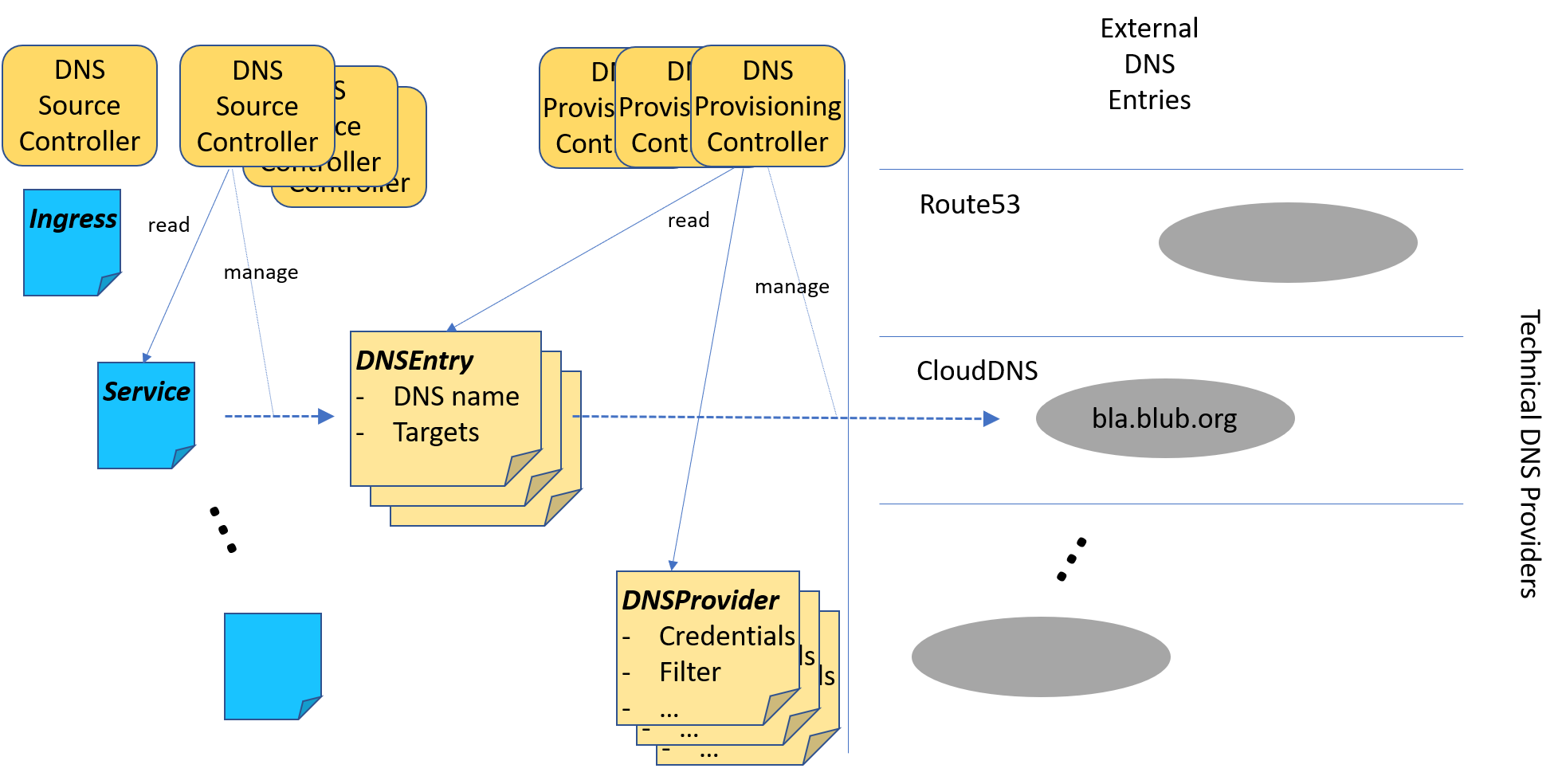
Provisioning of DNS entries in external DNS providers is done by
_DNS Provisioning Controllers_. They don't need to know anything about the
various DNS source objects. They watch `DNSEntry` objects and check whether
they are responsible for such an object. If a provisioning controller feels
responsible for an entry it manages the corresponding settings in the
external DNS environment and reports the provisioning status back to the
corresponding `DNSEntry` object.
To do this a provisioning controller is responsible for a dedicated
environment (for example Route53). For every such environment the controller
uses a dedicated _type_ key. This key is used to look for `DNSProvider` objects.
There might be multiple such objects per environment, specifying the
credentials needed to access different external accounts. These accounts are then
scanned for DNS zones and domain names they support.
This information is then used to dynamically assign `DNSEntry` objects to
dedicated `DNSProvider` objects. If such an assignment can be done by
a provisioning controller then it is _responsible_ for this entry and manages
the corresponding entries in the external environment.
`DNSProvider` objects can specify explicit inclusion and exclusion sets of domain names
and/or DNS zone identifiers to override the scanning results of the account.
### DNS Classes
Multiple sets of controllers of the DNS ecosystem can run in parallel in
a Kubernetes cluster working on different object set. They are separated by
using different _DNS Classes_. Adding a DNS class annotation to an object of the
DNS ecosystems assigns this object to such a dedicated set of DNS controllers.
This way it is possible to maintain clearly separated set of DNS objects in a
single Kubernetes cluster.
### DNSAnnotation objects
DNS source controllers support the creation of DNS entries for potentially
any kind of resource originally not equipped to describe the generation of
DNS entries. This is done by additionally annotations. Nevertheless, it
might be the case, that those objects are again the result of a generation
process, ether by predefined helm starts or by other higher level controllers.
It is not necessarily possible to influence those generation steps to
additionally generate the desired DNS annotations.
The typical mechanism in Kubernetes to handle this is to provide mutating
webhooks that enrich the generated objects accordingly. But this mechanism
is basically not intended to support dedicated settings for dedicated instances.
At least it is very strenuous to provide web hooks for every such use case.
Therefore, the DNS ecosystem provided by this project supports an additional
extension mechanism to annotate any kind of object with additional annotations
by supported a dedicated resource, the `DNSAnnotation`.
The handling of this resource is done by a dedicated controller, the `annotation`
controller. It caches the annotation settings declared by those objects and
makes them accessible for the DNS source controllers.
The DNS source controller responsible for a dedicated kind of resource,
for example Service, reads the object, analyses the annotations, and then decides
what to do with it. Most of the flow is handled by a central library, only
some dedicated resource dependent steps are implemented separately by a
dedicated source controller. The `DNSAnnotation` resource slightly extends this
flow: After reading the object the library additionally checks for the existence
of a `DNSAnnotation` setting for this object by querying the `annotation`
controller's cache. If found, it adds annotations declared there to the original
object prior to the next processing steps.
This way, for example whenever a `Service` without
any DNS related annotation is handled by the controller, and it finds a matching
`DNSAnnotation` setting, the set of actual annotations is enriched accordingly
before the actual processing of the service object is done by the controller.
This `DNSAnnotation` object can be created before or even after the object to
be annotated and will implicitly cause a reprocessing of the original object by
its DNS source controller.
For example, the following object enforces a DNS related annotation for the
processing of the service object `testapp/default` by the service DNS source
controller:
apiVersion: dns.gardener.cloud/v1alpha1
kind: DNSAnnotation
metadata:
name: testapp
spec:
resourceRef:
kind: Service
apiVersion: v1
name: testapp
annotations:
dns.gardener.cloud/dnsnames: testapp.dns.gardener.cloud
dns.gardener.cloud/ttl: "500"
## Using the DNS controller manager
The controllers to run can be selected with the `--controllers` option.
Here the following controller groups can be used:
- `dnssources`: all DNS Source Controllers. It includes the controllers
- `ingress-dns`: handle DNS annotations for the standard Kubernetes ingress resource
- `service-dns`: handle DNS annotations for the standard Kubernetes service resource
- `dnscontrollers`: all DNS Provisioning Controllers. It includes the controllers
- `compound`: common DNS provisioning controller
- `all`: (default) all controllers
It is also possible to list dedicated controllers by their name.
To restrict the compound DNS provisioning controller to specific provider types,
use the `--provider-types` option.
The following provider types can be selected (comma separated):
- `alicloud-dns`: Alicloud DNS provider
- `aws-route53`: AWS Route 53 provider
- `azure-dns`: Azure DNS provider
- `google-clouddns`: Google CloudDNS provider
- `openstack-designate`: Openstack Designate provider
- `cloudflare-dns`: Cloudflare DNS provider
- `infoblox-dns`: Infoblox DNS provider
- `netlify-dns`: Netlify DNS provider
- `remote`: Remote DNS provider (a dns-controller-manager with enabled remote access service)
- `powerdns`: PowerDNS provider
Here is the complete list of options provided:
Usage:
dns-controller-manager [flags]
Flags:
--accepted-maintainers string accepted maintainer key(s) for crds
--advanced.batch-size int batch size for change requests (currently only used for aws-route53)
--advanced.max-retries int maximum number of retries to avoid paging stops on throttling (currently only used for aws-route53)
--alicloud-dns.advanced.batch-size int batch size for change requests (currently only used for aws-route53)
--alicloud-dns.advanced.max-retries int maximum number of retries to avoid paging stops on throttling (currently only used for aws-route53)
--alicloud-dns.blocked-zone zone-id Blocks a zone given in the format zone-id from a provider as if the zone is not existing.
--alicloud-dns.ratelimiter.burst int number of burst requests for rate limiter
--alicloud-dns.ratelimiter.enabled enables rate limiter for DNS provider requests
--alicloud-dns.ratelimiter.qps int maximum requests/queries per second
--annotation.default.pool.size int Worker pool size for pool default of controller annotation
--annotation.pool.size int Worker pool size of controller annotation
--annotation.setup int number of processors for controller setup of controller annotation
--aws-route53.advanced.batch-size int batch size for change requests (currently only used for aws-route53)
--aws-route53.advanced.max-retries int maximum number of retries to avoid paging stops on throttling (currently only used for aws-route53)
--aws-route53.blocked-zone zone-id Blocks a zone given in the format zone-id from a provider as if the zone is not existing.
--aws-route53.ratelimiter.burst int number of burst requests for rate limiter
--aws-route53.ratelimiter.enabled enables rate limiter for DNS provider requests
--aws-route53.ratelimiter.qps int maximum requests/queries per second
--azure-dns.advanced.batch-size int batch size for change requests (currently only used for aws-route53)
--azure-dns.advanced.max-retries int maximum number of retries to avoid paging stops on throttling (currently only used for aws-route53)
--azure-dns.blocked-zone zone-id Blocks a zone given in the format zone-id from a provider as if the zone is not existing.
--azure-dns.ratelimiter.burst int number of burst requests for rate limiter
--azure-dns.ratelimiter.enabled enables rate limiter for DNS provider requests
--azure-dns.ratelimiter.qps int maximum requests/queries per second
--azure-private-dns.advanced.batch-size int batch size for change requests (currently only used for aws-route53)
--azure-private-dns.advanced.max-retries int maximum number of retries to avoid paging stops on throttling (currently only used for aws-route53)
--azure-private-dns.blocked-zone zone-id Blocks a zone given in the format zone-id from a provider as if the zone is not existing.
--azure-private-dns.ratelimiter.burst int number of burst requests for rate limiter
--azure-private-dns.ratelimiter.enabled enables rate limiter for DNS provider requests
--azure-private-dns.ratelimiter.qps int maximum requests/queries per second
--bind-address-http string HTTP server bind address
--blocked-zone zone-id Blocks a zone given in the format zone-id from a provider as if the zone is not existing.
--cache-ttl int Time-to-live for provider hosted zone cache
--cloudflare-dns.advanced.batch-size int batch size for change requests (currently only used for aws-route53)
--cloudflare-dns.advanced.max-retries int maximum number of retries to avoid paging stops on throttling (currently only used for aws-route53)
--cloudflare-dns.blocked-zone zone-id Blocks a zone given in the format zone-id from a provider as if the zone is not existing.
--cloudflare-dns.ratelimiter.burst int number of burst requests for rate limiter
--cloudflare-dns.ratelimiter.enabled enables rate limiter for DNS provider requests
--cloudflare-dns.ratelimiter.qps int maximum requests/queries per second
--compound.advanced.batch-size int batch size for change requests (currently only used for aws-route53) of controller compound
--compound.advanced.max-retries int maximum number of retries to avoid paging stops on throttling (currently only used for aws-route53) of controller compound
--compound.alicloud-dns.advanced.batch-size int batch size for change requests (currently only used for aws-route53) of controller compound
--compound.alicloud-dns.advanced.max-retries int maximum number of retries to avoid paging stops on throttling (currently only used for aws-route53) of controller compound
--compound.alicloud-dns.blocked-zone zone-id Blocks a zone given in the format zone-id from a provider as if the zone is not existing. of controller compound
--compound.alicloud-dns.ratelimiter.burst int number of burst requests for rate limiter of controller compound
--compound.alicloud-dns.ratelimiter.enabled enables rate limiter for DNS provider requests of controller compound
--compound.alicloud-dns.ratelimiter.qps int maximum requests/queries per second of controller compound
--compound.aws-route53.advanced.batch-size int batch size for change requests (currently only used for aws-route53) of controller compound
--compound.aws-route53.advanced.max-retries int maximum number of retries to avoid paging stops on throttling (currently only used for aws-route53) of controller compound
--compound.aws-route53.blocked-zone zone-id Blocks a zone given in the format zone-id from a provider as if the zone is not existing. of controller compound
--compound.aws-route53.ratelimiter.burst int number of burst requests for rate limiter of controller compound
--compound.aws-route53.ratelimiter.enabled enables rate limiter for DNS provider requests of controller compound
--compound.aws-route53.ratelimiter.qps int maximum requests/queries per second of controller compound
--compound.azure-dns.advanced.batch-size int batch size for change requests (currently only used for aws-route53) of controller compound
--compound.azure-dns.advanced.max-retries int maximum number of retries to avoid paging stops on throttling (currently only used for aws-route53) of controller compound
--compound.azure-dns.blocked-zone zone-id Blocks a zone given in the format zone-id from a provider as if the zone is not existing. of controller compound
--compound.azure-dns.ratelimiter.burst int number of burst requests for rate limiter of controller compound
--compound.azure-dns.ratelimiter.enabled enables rate limiter for DNS provider requests of controller compound
--compound.azure-dns.ratelimiter.qps int maximum requests/queries per second of controller compound
--compound.azure-private-dns.advanced.batch-size int batch size for change requests (currently only used for aws-route53) of controller compound
--compound.azure-private-dns.advanced.max-retries int maximum number of retries to avoid paging stops on throttling (currently only used for aws-route53) of controller compound
--compound.azure-private-dns.blocked-zone zone-id Blocks a zone given in the format zone-id from a provider as if the zone is not existing. of controller compound
--compound.azure-private-dns.ratelimiter.burst int number of burst requests for rate limiter of controller compound
--compound.azure-private-dns.ratelimiter.enabled enables rate limiter for DNS provider requests of controller compound
--compound.azure-private-dns.ratelimiter.qps int maximum requests/queries per second of controller compound
--compound.blocked-zone zone-id Blocks a zone given in the format zone-id from a provider as if the zone is not existing. of controller compound
--compound.cache-ttl int Time-to-live for provider hosted zone cache of controller compound
--compound.cloudflare-dns.advanced.batch-size int batch size for change requests (currently only used for aws-route53) of controller compound
--compound.cloudflare-dns.advanced.max-retries int maximum number of retries to avoid paging stops on throttling (currently only used for aws-route53) of controller compound
--compound.cloudflare-dns.blocked-zone zone-id Blocks a zone given in the format zone-id from a provider as if the zone is not existing. of controller compound
--compound.cloudflare-dns.ratelimiter.burst int number of burst requests for rate limiter of controller compound
--compound.cloudflare-dns.ratelimiter.enabled enables rate limiter for DNS provider requests of controller compound
--compound.cloudflare-dns.ratelimiter.qps int maximum requests/queries per second of controller compound
--compound.default.pool.size int Worker pool size for pool default of controller compound
--compound.disable-dnsname-validation disable validation of domain names according to RFC 1123. of controller compound
--compound.disable-zone-state-caching disable use of cached dns zone state on changes of controller compound
--compound.dns-class string identifier used to differentiate responsible controllers for entries of controller compound
--compound.dns-delay duration delay between two dns reconciliations of controller compound
--compound.dns.pool.resync-period duration Period for resynchronization for pool dns of controller compound
--compound.dns.pool.size int Worker pool size for pool dns of controller compound
--compound.dry-run just check, don't modify of controller compound
--compound.google-clouddns.advanced.batch-size int batch size for change requests (currently only used for aws-route53) of controller compound
--compound.google-clouddns.advanced.max-retries int maximum number of retries to avoid paging stops on throttling (currently only used for aws-route53) of controller compound
--compound.google-clouddns.blocked-zone zone-id Blocks a zone given in the format zone-id from a provider as if the zone is not existing. of controller compound
--compound.google-clouddns.ratelimiter.burst int number of burst requests for rate limiter of controller compound
--compound.google-clouddns.ratelimiter.enabled enables rate limiter for DNS provider requests of controller compound
--compound.google-clouddns.ratelimiter.qps int maximum requests/queries per second of controller compound
--compound.infoblox-dns.advanced.batch-size int batch size for change requests (currently only used for aws-route53) of controller compound
--compound.infoblox-dns.advanced.max-retries int maximum number of retries to avoid paging stops on throttling (currently only used for aws-route53) of controller compound
--compound.infoblox-dns.blocked-zone zone-id Blocks a zone given in the format zone-id from a provider as if the zone is not existing. of controller compound
--compound.infoblox-dns.ratelimiter.burst int number of burst requests for rate limiter of controller compound
--compound.infoblox-dns.ratelimiter.enabled enables rate limiter for DNS provider requests of controller compound
--compound.infoblox-dns.ratelimiter.qps int maximum requests/queries per second of controller compound
--compound.lock-status-check-period duration interval for dns lock status checks of controller compound
--compound.netlify-dns.advanced.batch-size int batch size for change requests (currently only used for aws-route53) of controller compound
--compound.netlify-dns.advanced.max-retries int maximum number of retries to avoid paging stops on throttling (currently only used for aws-route53) of controller compound
--compound.netlify-dns.blocked-zone zone-id Blocks a zone given in the format zone-id from a provider as if the zone is not existing. of controller compound
--compound.netlify-dns.ratelimiter.burst int number of burst requests for rate limiter of controller compound
--compound.netlify-dns.ratelimiter.enabled enables rate limiter for DNS provider requests of controller compound
--compound.netlify-dns.ratelimiter.qps int maximum requests/queries per second of controller compound
--compound.openstack-designate.advanced.batch-size int batch size for change requests (currently only used for aws-route53) of controller compound
--compound.openstack-designate.advanced.max-retries int maximum number of retries to avoid paging stops on throttling (currently only used for aws-route53) of controller compound
--compound.openstack-designate.blocked-zone zone-id Blocks a zone given in the format zone-id from a provider as if the zone is not existing. of controller compound
--compound.openstack-designate.ratelimiter.burst int number of burst requests for rate limiter of controller compound
--compound.openstack-designate.ratelimiter.enabled enables rate limiter for DNS provider requests of controller compound
--compound.openstack-designate.ratelimiter.qps int maximum requests/queries per second of controller compound
--compound.pool.resync-period duration Period for resynchronization of controller compound
--compound.pool.size int Worker pool size of controller compound
--compound.powerdns.advanced.batch-size int batch size for change requests (currently only used for aws-route53) of controller compound
--compound.powerdns.advanced.max-retries int maximum number of retries to avoid paging stops on throttling (currently only used for aws-route53) of controller compound
--compound.powerdns.blocked-zone zone-id Blocks a zone given in the format zone-id from a provider as if the zone is not existing. of controller compound
--compound.powerdns.ratelimiter.burst int number of burst requests for rate limiter of controller compound
--compound.powerdns.ratelimiter.enabled enables rate limiter for DNS provider requests of controller compound
--compound.powerdns.ratelimiter.qps int maximum requests/queries per second of controller compound
--compound.provider-types string comma separated list of provider types to enable of controller compound
--compound.providers.pool.resync-period duration Period for resynchronization for pool providers of controller compound
--compound.providers.pool.size int Worker pool size for pool providers of controller compound
--compound.ratelimiter.burst int number of burst requests for rate limiter of controller compound
--compound.ratelimiter.enabled enables rate limiter for DNS provider requests of controller compound
--compound.ratelimiter.qps int maximum requests/queries per second of controller compound
--compound.remote-access-cacert string CA who signed client certs file of controller compound
--compound.remote-access-client-id string identifier used for remote access of controller compound
--compound.remote-access-port int port of remote access server for remote-enabled providers of controller compound
--compound.remote-access-server-secret-name string name of secret containing remote access server's certificate of controller compound
--compound.remote.advanced.batch-size int batch size for change requests (currently only used for aws-route53) of controller compound
--compound.remote.advanced.max-retries int maximum number of retries to avoid paging stops on throttling (currently only used for aws-route53) of controller compound
--compound.remote.blocked-zone zone-id Blocks a zone given in the format zone-id from a provider as if the zone is not existing. of controller compound
--compound.remote.ratelimiter.burst int number of burst requests for rate limiter of controller compound
--compound.remote.ratelimiter.enabled enables rate limiter for DNS provider requests of controller compound
--compound.remote.ratelimiter.qps int maximum requests/queries per second of controller compound
--compound.reschedule-delay duration reschedule delay after losing provider of controller compound
--compound.rfc2136.advanced.batch-size int batch size for change requests (currently only used for aws-route53) of controller compound
--compound.rfc2136.advanced.max-retries int maximum number of retries to avoid paging stops on throttling (currently only used for aws-route53) of controller compound
--compound.rfc2136.blocked-zone zone-id Blocks a zone given in the format zone-id from a provider as if the zone is not existing. of controller compound
--compound.rfc2136.ratelimiter.burst int number of burst requests for rate limiter of controller compound
--compound.rfc2136.ratelimiter.enabled enables rate limiter for DNS provider requests of controller compound
--compound.rfc2136.ratelimiter.qps int maximum requests/queries per second of controller compound
--compound.secrets.pool.size int Worker pool size for pool secrets of controller compound
--compound.setup int number of processors for controller setup of controller compound
--compound.ttl int Default time-to-live for DNS entries. Defines how long the record is kept in cache by DNS servers or resolvers. of controller compound
--compound.zonepolicies.pool.size int Worker pool size for pool zonepolicies of controller compound
--config string config file
-c, --controllers string comma separated list of controllers to start (,,all)
--cpuprofile string set file for cpu profiling
--default.pool.resync-period duration Period for resynchronization for pool default
--default.pool.size int Worker pool size for pool default
--disable-dnsname-validation disable validation of domain names according to RFC 1123.
--disable-namespace-restriction disable access restriction for namespace local access only
--disable-zone-state-caching disable use of cached dns zone state on changes
--dns-class string identifier used to differentiate responsible controllers for entries, identifier used to differentiate responsible controllers for providers
--dns-delay duration delay between two dns reconciliations
--dns-target-class string identifier used to differentiate responsible dns controllers for target entries, identifier used to differentiate responsible dns controllers for target providers
--dns.pool.resync-period duration Period for resynchronization for pool dns
--dns.pool.size int Worker pool size for pool dns
--dnsentry-source.default.pool.resync-period duration Period for resynchronization for pool default of controller dnsentry-source
--dnsentry-source.default.pool.size int Worker pool size for pool default of controller dnsentry-source
--dnsentry-source.dns-class string identifier used to differentiate responsible controllers for entries of controller dnsentry-source
--dnsentry-source.dns-target-class string identifier used to differentiate responsible dns controllers for target entries of controller dnsentry-source
--dnsentry-source.exclude-domains stringArray excluded domains of controller dnsentry-source
--dnsentry-source.key string selecting key for annotation of controller dnsentry-source
--dnsentry-source.pool.resync-period duration Period for resynchronization of controller dnsentry-source
--dnsentry-source.pool.size int Worker pool size of controller dnsentry-source
--dnsentry-source.target-creator-label-name string label name to store the creator for generated DNS entries of controller dnsentry-source
--dnsentry-source.target-creator-label-value string label value for creator label of controller dnsentry-source
--dnsentry-source.target-name-prefix string name prefix in target namespace for cross cluster generation of controller dnsentry-source
--dnsentry-source.target-namespace string target namespace for cross cluster generation of controller dnsentry-source
--dnsentry-source.target-realms string realm(s) to use for generated DNS entries of controller dnsentry-source
--dnsentry-source.targets.pool.size int Worker pool size for pool targets of controller dnsentry-source
--dnsprovider-replication.default.pool.resync-period duration Period for resynchronization for pool default of controller dnsprovider-replication
--dnsprovider-replication.default.pool.size int Worker pool size for pool default of controller dnsprovider-replication
--dnsprovider-replication.dns-class string identifier used to differentiate responsible controllers for providers of controller dnsprovider-replication
--dnsprovider-replication.dns-target-class string identifier used to differentiate responsible dns controllers for target providers of controller dnsprovider-replication
--dnsprovider-replication.pool.resync-period duration Period for resynchronization of controller dnsprovider-replication
--dnsprovider-replication.pool.size int Worker pool size of controller dnsprovider-replication
--dnsprovider-replication.target-creator-label-name string label name to store the creator for replicated DNS providers of controller dnsprovider-replication
--dnsprovider-replication.target-creator-label-value string label value for creator label of controller dnsprovider-replication
--dnsprovider-replication.target-name-prefix string name prefix in target namespace for cross cluster replication of controller dnsprovider-replication
--dnsprovider-replication.target-namespace string target namespace for cross cluster generation of controller dnsprovider-replication
--dnsprovider-replication.target-realms string realm(s) to use for replicated DNS provider of controller dnsprovider-replication
--dnsprovider-replication.targets.pool.size int Worker pool size for pool targets of controller dnsprovider-replication
--dry-run just check, don't modify
--enable-profiling enables profiling server at path /debug/pprof (needs option --server-port-http)
--exclude-domains stringArray excluded domains
--force-crd-update enforce update of crds even they are unmanaged
--google-clouddns.advanced.batch-size int batch size for change requests (currently only used for aws-route53)
--google-clouddns.advanced.max-retries int maximum number of retries to avoid paging stops on throttling (currently only used for aws-route53)
--google-clouddns.blocked-zone zone-id Blocks a zone given in the format zone-id from a provider as if the zone is not existing.
--google-clouddns.ratelimiter.burst int number of burst requests for rate limiter
--google-clouddns.ratelimiter.enabled enables rate limiter for DNS provider requests
--google-clouddns.ratelimiter.qps int maximum requests/queries per second
--grace-period duration inactivity grace period for detecting end of cleanup for shutdown
-h, --help help for dns-controller-manager
--httproutes.pool.size int Worker pool size for pool httproutes
--infoblox-dns.advanced.batch-size int batch size for change requests (currently only used for aws-route53)
--infoblox-dns.advanced.max-retries int maximum number of retries to avoid paging stops on throttling (currently only used for aws-route53)
--infoblox-dns.blocked-zone zone-id Blocks a zone given in the format zone-id from a provider as if the zone is not existing.
--infoblox-dns.ratelimiter.burst int number of burst requests for rate limiter
--infoblox-dns.ratelimiter.enabled enables rate limiter for DNS provider requests
--infoblox-dns.ratelimiter.qps int maximum requests/queries per second
--ingress-dns.default.pool.resync-period duration Period for resynchronization for pool default of controller ingress-dns
--ingress-dns.default.pool.size int Worker pool size for pool default of controller ingress-dns
--ingress-dns.dns-class string identifier used to differentiate responsible controllers for entries of controller ingress-dns
--ingress-dns.dns-target-class string identifier used to differentiate responsible dns controllers for target entries of controller ingress-dns
--ingress-dns.exclude-domains stringArray excluded domains of controller ingress-dns
--ingress-dns.key string selecting key for annotation of controller ingress-dns
--ingress-dns.pool.resync-period duration Period for resynchronization of controller ingress-dns
--ingress-dns.pool.size int Worker pool size of controller ingress-dns
--ingress-dns.target-creator-label-name string label name to store the creator for generated DNS entries of controller ingress-dns
--ingress-dns.target-creator-label-value string label value for creator label of controller ingress-dns
--ingress-dns.target-name-prefix string name prefix in target namespace for cross cluster generation of controller ingress-dns
--ingress-dns.target-namespace string target namespace for cross cluster generation of controller ingress-dns
--ingress-dns.target-realms string realm(s) to use for generated DNS entries of controller ingress-dns
--ingress-dns.targets.pool.size int Worker pool size for pool targets of controller ingress-dns
--istio-gateways-dns.default.pool.resync-period duration Period for resynchronization for pool default of controller istio-gateways-dns
--istio-gateways-dns.default.pool.size int Worker pool size for pool default of controller istio-gateways-dns
--istio-gateways-dns.dns-class string identifier used to differentiate responsible controllers for entries of controller istio-gateways-dns
--istio-gateways-dns.dns-target-class string identifier used to differentiate responsible dns controllers for target entries of controller istio-gateways-dns
--istio-gateways-dns.exclude-domains stringArray excluded domains of controller istio-gateways-dns
--istio-gateways-dns.key string selecting key for annotation of controller istio-gateways-dns
--istio-gateways-dns.pool.resync-period duration Period for resynchronization of controller istio-gateways-dns
--istio-gateways-dns.pool.size int Worker pool size of controller istio-gateways-dns
--istio-gateways-dns.target-creator-label-name string label name to store the creator for generated DNS entries of controller istio-gateways-dns
--istio-gateways-dns.target-creator-label-value string label value for creator label of controller istio-gateways-dns
--istio-gateways-dns.target-name-prefix string name prefix in target namespace for cross cluster generation of controller istio-gateways-dns
--istio-gateways-dns.target-namespace string target namespace for cross cluster generation of controller istio-gateways-dns
--istio-gateways-dns.target-realms string realm(s) to use for generated DNS entries of controller istio-gateways-dns
--istio-gateways-dns.targets.pool.size int Worker pool size for pool targets of controller istio-gateways-dns
--istio-gateways-dns.targetsources.pool.size int Worker pool size for pool targetsources of controller istio-gateways-dns
--istio-gateways-dns.virtualservices.pool.size int Worker pool size for pool virtualservices of controller istio-gateways-dns
--k8s-gateways-dns.default.pool.resync-period duration Period for resynchronization for pool default of controller k8s-gateways-dns
--k8s-gateways-dns.default.pool.size int Worker pool size for pool default of controller k8s-gateways-dns
--k8s-gateways-dns.dns-class string identifier used to differentiate responsible controllers for entries of controller k8s-gateways-dns
--k8s-gateways-dns.dns-target-class string identifier used to differentiate responsible dns controllers for target entries of controller k8s-gateways-dns
--k8s-gateways-dns.exclude-domains stringArray excluded domains of controller k8s-gateways-dns
--k8s-gateways-dns.httproutes.pool.size int Worker pool size for pool httproutes of controller k8s-gateways-dns
--k8s-gateways-dns.key string selecting key for annotation of controller k8s-gateways-dns
--k8s-gateways-dns.pool.resync-period duration Period for resynchronization of controller k8s-gateways-dns
--k8s-gateways-dns.pool.size int Worker pool size of controller k8s-gateways-dns
--k8s-gateways-dns.target-creator-label-name string label name to store the creator for generated DNS entries of controller k8s-gateways-dns
--k8s-gateways-dns.target-creator-label-value string label value for creator label of controller k8s-gateways-dns
--k8s-gateways-dns.target-name-prefix string name prefix in target namespace for cross cluster generation of controller k8s-gateways-dns
--k8s-gateways-dns.target-namespace string target namespace for cross cluster generation of controller k8s-gateways-dns
--k8s-gateways-dns.target-realms string realm(s) to use for generated DNS entries of controller k8s-gateways-dns
--k8s-gateways-dns.targets.pool.size int Worker pool size for pool targets of controller k8s-gateways-dns
--key string selecting key for annotation
--kubeconfig string default cluster access
--kubeconfig.burst int option to set the maximum burst to the apiserver of the cluster default
--kubeconfig.conditional-deploy-crds deployment of required crds for cluster default only if there is no managed resource in garden namespace deploying it
--kubeconfig.crds-shoot-no-cleanup-label add the label 'shoot.gardener.cloud/no-cleanup=true' for CRDS deployed on cluster default
--kubeconfig.disable-deploy-crds disable deployment of required crds for cluster default
--kubeconfig.id string id for cluster default
--kubeconfig.migration-ids string migration id for cluster default
--kubeconfig.qps int option to set the maximum QPS to the apiserver of the cluster default
--lease-duration duration lease duration
--lease-name string name for lease object
--lease-renew-deadline duration lease renew deadline
--lease-resource-lock string determines which resource lock to use for leader election, defaults to 'leases'
--lease-retry-period duration lease retry period
--lock-status-check-period duration interval for dns lock status checks
-D, --log-level string logrus log level
--maintainer string maintainer key for crds (default "dns-controller-manager")
--name string name used for controller manager (default "dns-controller-manager")
--namespace string namespace for lease (default "kube-system")
-n, --namespace-local-access-only enable access restriction for namespace local access only (deprecated)
--netlify-dns.advanced.batch-size int batch size for change requests (currently only used for aws-route53)
--netlify-dns.advanced.max-retries int maximum number of retries to avoid paging stops on throttling (currently only used for aws-route53)
--netlify-dns.blocked-zone zone-id Blocks a zone given in the format zone-id from a provider as if the zone is not existing.
--netlify-dns.ratelimiter.burst int number of burst requests for rate limiter
--netlify-dns.ratelimiter.enabled enables rate limiter for DNS provider requests
--netlify-dns.ratelimiter.qps int maximum requests/queries per second
--omit-lease omit lease for development
--openstack-designate.advanced.batch-size int batch size for change requests (currently only used for aws-route53)
--openstack-designate.advanced.max-retries int maximum number of retries to avoid paging stops on throttling (currently only used for aws-route53)
--openstack-designate.blocked-zone zone-id Blocks a zone given in the format zone-id from a provider as if the zone is not existing.
--openstack-designate.ratelimiter.burst int number of burst requests for rate limiter
--openstack-designate.ratelimiter.enabled enables rate limiter for DNS provider requests
--openstack-designate.ratelimiter.qps int maximum requests/queries per second
--plugin-file string directory containing go plugins
--pool.resync-period duration Period for resynchronization
--pool.size int Worker pool size
--powerdns.advanced.batch-size int batch size for change requests (currently only used for aws-route53)
--powerdns.advanced.max-retries int maximum number of retries to avoid paging stops on throttling (currently only used for aws-route53)
--powerdns.blocked-zone zone-id Blocks a zone given in the format zone-id from a provider as if the zone is not existing.
--powerdns.ratelimiter.burst int number of burst requests for rate limiter
--powerdns.ratelimiter.enabled enables rate limiter for DNS provider requests
--powerdns.ratelimiter.qps int maximum requests/queries per second
--provider-types string comma separated list of provider types to enable
--providers string cluster to look for provider objects
--providers.burst int option to set the maximum burst to the apiserver of the cluster provider
--providers.conditional-deploy-crds deployment of required crds for cluster provider only if there is no managed resource in garden namespace deploying it
--providers.crds-shoot-no-cleanup-label add the label 'shoot.gardener.cloud/no-cleanup=true' for CRDS deployed on cluster provider
--providers.disable-deploy-crds disable deployment of required crds for cluster provider
--providers.id string id for cluster provider
--providers.migration-ids string migration id for cluster provider
--providers.pool.resync-period duration Period for resynchronization for pool providers
--providers.pool.size int Worker pool size for pool providers
--providers.qps int option to set the maximum QPS to the apiserver of the cluster provider
--ratelimiter.burst int number of burst requests for rate limiter
--ratelimiter.enabled enables rate limiter for DNS provider requests
--ratelimiter.qps int maximum requests/queries per second
--remote-access-cacert string CA who signed client certs file
--remote-access-client-id string identifier used for remote access
--remote-access-port int port of remote access server for remote-enabled providers
--remote-access-server-secret-name string name of secret containing remote access server's certificate
--remote.advanced.batch-size int batch size for change requests (currently only used for aws-route53)
--remote.advanced.max-retries int maximum number of retries to avoid paging stops on throttling (currently only used for aws-route53)
--remote.blocked-zone zone-id Blocks a zone given in the format zone-id from a provider as if the zone is not existing.
--remote.ratelimiter.burst int number of burst requests for rate limiter
--remote.ratelimiter.enabled enables rate limiter for DNS provider requests
--remote.ratelimiter.qps int maximum requests/queries per second
--reschedule-delay duration reschedule delay after losing provider
--rfc2136.advanced.batch-size int batch size for change requests (currently only used for aws-route53)
--rfc2136.advanced.max-retries int maximum number of retries to avoid paging stops on throttling (currently only used for aws-route53)
--rfc2136.blocked-zone zone-id Blocks a zone given in the format zone-id from a provider as if the zone is not existing.
--rfc2136.ratelimiter.burst int number of burst requests for rate limiter
--rfc2136.ratelimiter.enabled enables rate limiter for DNS provider requests
--rfc2136.ratelimiter.qps int maximum requests/queries per second
--secrets.pool.size int Worker pool size for pool secrets
--server-port-http int HTTP server port (serving /healthz, /metrics, ...)
--service-dns.default.pool.resync-period duration Period for resynchronization for pool default of controller service-dns
--service-dns.default.pool.size int Worker pool size for pool default of controller service-dns
--service-dns.dns-class string identifier used to differentiate responsible controllers for entries of controller service-dns
--service-dns.dns-target-class string identifier used to differentiate responsible dns controllers for target entries of controller service-dns
--service-dns.exclude-domains stringArray excluded domains of controller service-dns
--service-dns.key string selecting key for annotation of controller service-dns
--service-dns.pool.resync-period duration Period for resynchronization of controller service-dns
--service-dns.pool.size int Worker pool size of controller service-dns
--service-dns.target-creator-label-name string label name to store the creator for generated DNS entries of controller service-dns
--service-dns.target-creator-label-value string label value for creator label of controller service-dns
--service-dns.target-name-prefix string name prefix in target namespace for cross cluster generation of controller service-dns
--service-dns.target-namespace string target namespace for cross cluster generation of controller service-dns
--service-dns.target-realms string realm(s) to use for generated DNS entries of controller service-dns
--service-dns.targets.pool.size int Worker pool size for pool targets of controller service-dns
--setup int number of processors for controller setup
--target string target cluster for dns requests
--target-creator-label-name string label name to store the creator for generated DNS entries, label name to store the creator for replicated DNS providers
--target-creator-label-value string label value for creator label
--target-name-prefix string name prefix in target namespace for cross cluster generation, name prefix in target namespace for cross cluster replication
--target-namespace string target namespace for cross cluster generation
--target-realms string realm(s) to use for generated DNS entries, realm(s) to use for replicated DNS provider
--target.burst int option to set the maximum burst to the apiserver of the cluster target
--target.conditional-deploy-crds deployment of required crds for cluster target only if there is no managed resource in garden namespace deploying it
--target.crds-shoot-no-cleanup-label add the label 'shoot.gardener.cloud/no-cleanup=true' for CRDS deployed on cluster target
--target.disable-deploy-crds disable deployment of required crds for cluster target
--target.id string id for cluster target
--target.migration-ids string migration id for cluster target
--target.qps int option to set the maximum QPS to the apiserver of the cluster target
--targets.pool.size int Worker pool size for pool targets
--targetsources.pool.size int Worker pool size for pool targetsources
--ttl int Default time-to-live for DNS entries. Defines how long the record is kept in cache by DNS servers or resolvers.
-v, --version version for dns-controller-manager
--virtualservices.pool.size int Worker pool size for pool virtualservices
--watch-gateways-crds.default.pool.size int Worker pool size for pool default of controller watch-gateways-crds
--watch-gateways-crds.pool.size int Worker pool size of controller watch-gateways-crds
--zonepolicies.pool.size int Worker pool size for pool zonepolicies
## Extensions
This project can also be used as library to implement own source and provisioning controllers.
### How to implement Source Controllers
Based on the provided source controller library a source controller must
implement the [`source.DNSSource` interface](pkg/dns/source/interface.go) and
provide an appropriate creator function.
A source controller can be implemented following this example:
package service
import (
"github.com/gardener/controller-manager-library/pkg/resources"
"github.com/gardener/external-dns-management/pkg/dns/source"
)
var _MAIN_RESOURCE = resources.NewGroupKind("core", "Service")
func init() {
source.DNSSourceController(source.NewDNSSouceTypeForExtractor("service-dns", _MAIN_RESOURCE, GetTargets),nil).
FinalizerDomain("dns.gardener.cloud").
MustRegister(source.CONTROLLER_GROUP_DNS_SOURCES)
}
Complete examples can be found in the sub packages of `pkg/controller/source`.
### How to implement Provisioning Controllers
Provisioning controllers can be implemented based on the provisioning controller library
in this repository and must implement the
[`provider.DNSHandlerFactory` interface](pkg/dns/provider/interface.go).
This factory returns implementations of the [`provider.DNSHandler` interface](pkg/dns/provider/interface.go)
that does the effective work for a dedicated set of hosted zones.
These factories can be embedded into a final controller manager (the runnable
instance) in several ways:
- The factory can be used to create a dedicated controller.
This controller can then be embedded into a controller manager, either in
its own controller manger or together with other controllers.
- The factory can be added to a compound factory, able to handle multiple
infrastructures. This one can then be used to create a dedicated controller,
again.
#### Embedding a Factory into a Controller
A provisioning controller can be implemented following this
[example](pkg/controller/provider/aws/controller/controller.go):
package controller
import (
"github.com/gardener/external-dns-management/pkg/dns/provider"
)
const CONTROLLER_NAME = "route53-dns-controller"
func init() {
provider.DNSController(CONTROLLER_NAME, &Factory{}).
FinalizerDomain("dns.gardener.cloud").
MustRegister(provider.CONTROLLER_GROUP_DNS_CONTROLLERS)
}
This controller can be embedded into a controller manager just by using
an [anonymous import](./cmd/compound/main.go) of the controller package in the main package
of a dedicated controller manager.
Complete examples are available in the sub packages of `pkg/controller/provider`.
They also show a typical set of implementation structures that help
to structure the implementation of such controllers.
The provider implemented in this project always follow the same structure:
- the provider package contains the provider code
- the factory source file registers the factory at a default compound factory
- it contains a sub package `controller`, which contains the embedding of
the factory into a dedicated controller
#### Embedding a Factory into a Compound Factory
A provisioning controller based on a *Compound Factory* can be extended by
a new provider factory by registering this factory at the compound factory.
This could be done, for example, by using the default compound factory provided
in package [`pkg/controller/provider/compound`](pkg/controller/provider/compound/factory.go) as shown
[here](pkg/controller/provider/aws/factory.go), where `NewHandler` is a function creating
a dedicated handler for a dedicated provider type:
package aws
import (
"github.com/gardener/external-dns-management/pkg/controller/provider/compound"
"github.com/gardener/external-dns-management/pkg/dns/provider"
)
const TYPE_CODE = "aws-route53"
var Factory = provider.NewDNSHandlerFactory(TYPE_CODE, NewHandler)
func init() {
compound.MustRegister(Factory)
}
The compound factory is then again embedded into a provisioning controller as shown
in the previous section (see the [`controller` sub package](pkg/controller/provider/compound/controller/controller.go)).
### Setting Up a Controller Manager
One or multiple controller packages can be bundled into a controller manager,
by implementing a main package like [this](./cmd/compound/main.go):
package main
import (
"github.com/gardener/controller-manager-library/pkg/controllermanager"
_ "github.com/"
...
)
func main() {
controllermanager.Start("my-dns-controller-manager", "dns controller manager", "some description")
}
### Using the standard Compound Provisioning Controller
If the standard *Compound Provisioning Controller* should be used it is required
to additionally add the anonymous imports for the providers intended to be
embedded into the compound factory like [this](./cmd/compound/main.go):
"
...
)
func main() {
controllermanager.Start("dns-controller-manager", "dns controller manager", "nothing")
}
### Multiple Cluster Support
The controller implementations provided in this project are prepared to work
with multiple clusters by using the features of the used controller manager
library.
The *DNS Source Controllers* support two clusters:
- the default cluster is used to scan for source objects
- the logical cluster `target` is used to maintain the `DNSEnry` objects.
The *DNS Provisioning Controllers* also support two clusters:
- the default cluster is used to scan for `DNSEntry` objects. It is mapped
to the logical cluster `target`
- the logical cluster `provider` is used to look to the `DNSProvider` objects
and their related secrets.
If those controller types should be combined in a single controller manager,
it can be configured to support three potential clusters with the
source objects, the one for the entry objects and the one with provider
objects using cluster mappings.
This is shown in a complete [example](./cmd/compound/main.go) using the dns
source controllers, the compound provisioning controller configured to
support all the included DNS provider type factories:
Those clusters can then be separated by registering their names together with
command line option names. These can be used to specify different `kubeconfig`
files for those clusters.
By default, all logical clusters are mapped to the default physical cluster
specified via `--kubeconfig` or default cluster access.
If multiple physical clusters are defined they can be specified by a
corresponding cluster option defining the `kubeconfig` file used to access
this cluster. If no such option is specified the default is used.
Therefore, even if the configuration is prepared for multiple clusters,
such a controller manager can easily work on a single cluster if no special
options are given on the command line.
## DNS Controller Manager Next Generation
The DNS controller manager is being rewritten using [controller-runtime](https://sigs.k8s.io/controller-runtime)
with significant architectural improvements. For details, see the
[DNS Controller Manager Next Generation documentation](docs/dnsman2/README.md).
## Why not use the community `external-dns` solution?
Some of the reasons are context-specific, i.e. relate to Gardener's highly dynamic requirements.
1. Custom resource for DNS entries
DNS entries are explicitly specified as custom resources. As an important side effect, each DNS entry provides an own status. Simply by querying the Kubernetes API, a client can check if a requested DNS entry has been successfully added to the DNS backend, or if an update has already been deployed, or if not to reason about the cause. It also opens for easy extensibility, as DNS entries can be created directly via the Kubernetes API. And it simplifies Day 2 operations, e.g. automatic cleanup of unused entries if a DNS provider is deleted.
2. Management of multiple DNS providers
The Gardener DNS controller uses a custom resource DNSProvider to dynamically manage the backend DNS services. While with external-dns you have to specify the single provider during startup, in the Gardener DNS controller you can add/update/delete providers during runtime with different credentials and/or backends. This is important for a multi-tenant environment as in Gardener, where users can bring their own accounts.
A DNS provider can also restrict its actions on subset of the DNS domains (includes and excludes) for which the credentials are capable to edit.
3. Multi cluster support
The Gardener DNS controller distinguish three different logical Kubernetes clusters: Source cluster, target cluster and runtime cluster. The source cluster is monitored by the DNS source controllers for annotations on ingress and service resources. These controllers then create DNS entries in the target cluster. DNS entries in the target cluster are then reconciled/synchronized with the corresponding DNS backend service by the provider controller. The runtime cluster is the cluster the DNS controller runs on. For example, this enables needed flexibility in the Gardener deployment. The DNS controller runs on the seed cluster. This is also the target cluster. DNS providers and entries resources are created in the corresponding namespace of the shoot control plane, while the source cluster is the shoot cluster itself.
4. Optimizations for handling hundreds of DNS entries
Some DNS backend services are restricted on the API calls per second (e.g. the AWS Route 53 API). To manage hundreds of DNS entries it is important to minimize the number of API calls. The Gardener DNS controller heavily makes usage of caches and batch processing for this reason.
Example Coding
package main import ( "fmt" "os" "github.com/gardener/controller-manager-library/pkg/controllermanager" _ "github.com/gardener/external-dns-management/pkg/controller/provider/compound/controller" _ "github.com/gardener/external-dns-management/pkg/controller/provider/Example Coding
package main import ( "fmt" "os" "github.com/gardener/controller-manager-library/pkg/controllermanager" "github.com/gardener/controller-manager-library/pkg/controllermanager/cluster" "github.com/gardener/controller-manager-library/pkg/controllermanager/controller" "github.com/gardener/controller-manager-library/pkg/controllermanager/controller/mappings" dnsprovider "github.com/gardener/external-dns-management/pkg/dns/provider" dnssource "github.com/gardener/external-dns-management/pkg/dns/source" _ "github.com/gardener/external-dns-management/pkg/controller/provider/compound/controller" _ "github.com/gardener/external-dns-management/pkg/controller/provider/alicloud" _ "github.com/gardener/external-dns-management/pkg/controller/provider/aws" _ "github.com/gardener/external-dns-management/pkg/controller/provider/azure" _ "github.com/gardener/external-dns-management/pkg/controller/provider/google" _ "github.com/gardener/external-dns-management/pkg/controller/provider/openstack" _ "github.com/gardener/external-dns-management/pkg/controller/provider/cloudflare" _ "github.com/gardener/external-dns-management/pkg/controller/provider/netlify" _ "github.com/gardener/external-dns-management/pkg/controller/source/ingress" _ "github.com/gardener/external-dns-management/pkg/controller/source/service" ) func init() { // target cluster already defined in dns source controller package cluster.Configure( dnsprovider.PROVIDER_CLUSTER, "providers", "cluster to look for provider objects", ).Fallback(dnssource.TARGET_CLUSTER) mappings.ForControllerGroup(dnsprovider.CONTROLLER_GROUP_DNS_CONTROLLERS). Map(controller.CLUSTER_MAIN, dnssource.TARGET_CLUSTER).MustRegister() } func main() { controllermanager.Start("dns-controller-manager", "dns controller manager", "nothing") }标签:DNS管理, EVTX分析, 子域名突变, 控制器, 日志审计, 运维工具