thiagofsdata-collab/wyllo-fraud-pipeline

GitHub: thiagofsdata-collab/wyllo-fraud-pipeline

Stars: 0 | Forks: 0

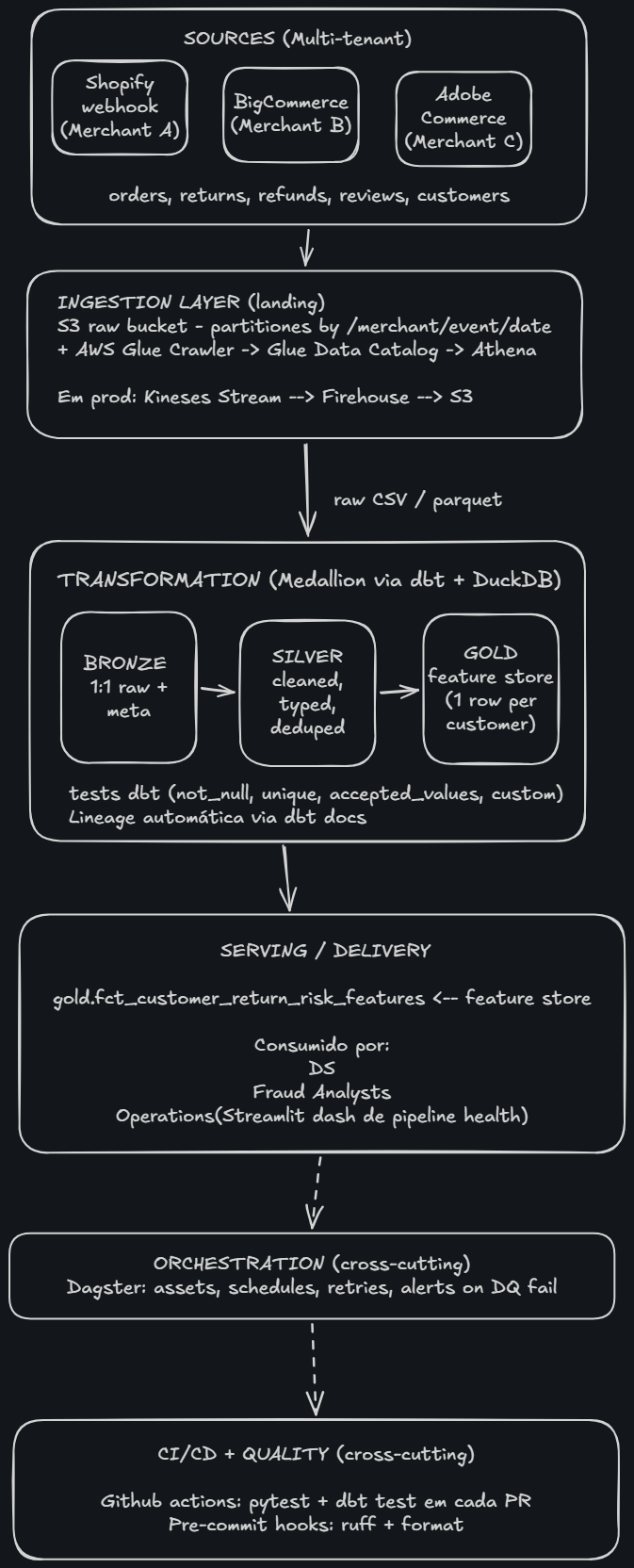
# Wyllo Return Fraud Pipeline ![CI](https://static.pigsec.cn/wp-content/uploads/repos/2026/06/4aa8940c31135133.svg) ![Python](https://img.shields.io/badge/python-3.12-blue) ![dbt](https://img.shields.io/badge/dbt-1.10-orange) ![Dagster](https://img.shields.io/badge/dagster-1.10-purple) ![DuckDB](https://img.shields.io/badge/duckdb-1.5-yellow) ## Intro Return fraud costs e-commerce ~$100B/year. **2% of customers cause 20% of fraudulent returns** (NRF). The hard part isn't blocking, it's **segmenting behaviour** so legitimate occasional-returners stay unblocked. This pipeline produces the feature store that makes that segmentation possible. **As a Data Engineer:** We don't train the model. We deliver the table where the decision becomes obvious. ┌───────────────────────────────────┐ Olist CSVs → S3 → Bronze → Silver → Gold │ fct_customer_return_risk_features │ │ PK: (customer, snapshot_date) │ └─────────┬─────────────────────────┘ │ ┌────────────────────┼────────────────────┐ ▼ ▼ ▼ Data Scientist Fraud Analyst Pipeline Health (trains models) (writes rules) (Streamlit + Plotly) ## Architecture

Architecture

Full breakdown of layer responsibilities and tool-choice rationale in [`docs/ARCHITECTURE.md`](docs/ARCHITECTURE.md). ## Pipeline running end-to-end ### dbt — 17 models, 60 tests, zero warnings The Medallion pipeline materializing Bronze → Silver → Gold, followed by the full test suite passing on real Olist data. ![dbt run and test](https://static.pigsec.cn/wp-content/uploads/repos/2026/06/d55a0cf165135140.gif) ### Dagster — asset graph and orchestration Auto-derived lineage from ingestion through the feature store. Each dbt model becomes a Dagster asset; the graph mirrors the dbt manifest. ![Dagster asset lineage](https://static.pigsec.cn/wp-content/uploads/repos/2026/06/111bbe86d3135151.gif) ### Streamlit — pipeline health dashboard Read-only view over the warehouse: row counts per layer, the feature store contents, and the last dbt test results. ![Streamlit dashboard tour](https://static.pigsec.cn/wp-content/uploads/repos/2026/06/02b7df78dc135207.gif) ## Status — what's built 🟢 Layer 0 — Schema mapping, architecture, repo scaffold 🟢 Layer 1 — Ingestion (CSVs → DuckDB + partitioned Parquet, S3-style layout) 🟢 Layer 2 — dbt Bronze / Silver / Gold (17 models, 60 tests passing) 🟢 Layer 3 — Dagster orchestration (29 assets, jobs, schedule, sensor) 🟢 Layer 4 — Streamlit pipeline-health dashboard 📝 Out of scope by design — documented in this README: - AWS deployment (S3 / Glue / Athena scripts wired but not provisioned) - RAG / AI catalog assistant (designed below) - ML model training (Data Scientist's job — pipeline ends at feature store) ## Design documents (read these first) - [`docs/SCHEMA_FRAUD_MAPPING.md`](docs/SCHEMA_FRAUD_MAPPING.md) — how Olist columns map to fraud-prevention features, with proxy logic and out-of-scope rationale. - [`docs/ARCHITECTURE.md`](docs/ARCHITECTURE.md) — system design, layer responsibilities, tool-choice trade-offs, and the production migration path (Kinesis dashed box explained). ## Quick start — current state # 1. Install Python deps (Python 3.11 or 3.12) make install # 2. Download the Olist dataset from Kaggle into data/raw/ make download-data # 3. (next layer) Build Bronze/Silver/Gold make dbt-run The full one-command Docker setup ships with Layer 6. ## Tech choices in one line each - **AWS S3 + Glue + Athena** — standard data lake; S3 as storage contract - **DuckDB** — analytical engine, portable SQL (same models would run in Snowflake/BigQuery) - **dbt** — SQL-as-code with tests, lineage, docs - **Dagster** — asset-centric orchestrator that maps cleanly to dbt - **Streamlit + Plotly** — pipeline health dashboard, not fraud dashboard - **LangChain + FAISS** — small DataOps utility for catalog NL search - **GitHub Actions** — CI runs dbt tests + pytest on every PR Full rationale: see `docs/ARCHITECTURE.md`. ## Repository layout wyllo-fraud-pipeline/ ├── ingestion/ │ ├── load_raw_to_duckdb.py # The local-first loader (the one that runs) │ ├── s3/ # AWS S3 upload (wired, not deployed) │ ├── glue/ # AWS Glue crawler trigger │ └── athena/ # AWS Athena ad-hoc queries ├── dbt/ │ ├── models/ │ │ ├── bronze/ # 9 views, 1:1 raw + metadata │ │ ├── silver/ # 6 tables, cleaned/typed/deduped │ │ └── gold/ # int_orders_enriched + feature store │ ├── seeds/ # risk thresholds, category priors │ ├── macros/ # haversine, month_spine │ └── tests/generic/ # custom expression_is_true, unique_combination ├── orchestration/ # Dagster — assets, jobs, schedule, sensor ├── streamlit/ # Pipeline health dashboard │ ├── app.py │ ├── pages/ # 4 pages: Layers, Feature Store, Quality, Lineage │ └── utils/ ├── docs/ │ ├── SCHEMA_FRAUD_MAPPING.md │ ├── ARCHITECTURE.md │ └── diagrams/ # Excalidraw + Dagster screenshots └── .github/workflows/ci.yml ## What this pipeline does NOT do (by design) | Out of scope | Why | |-------------------------------------|------------------------------------------------------------------| | ML model training | Data Scientist's job. Pipeline produces the input. | | Rule engine business logic | Fraud Analyst's job. Pipeline exposes features they query. | | Real-time pre-checkout scoring | Sub-second latency need; this is the batch feature store. | | Cross-merchant identity resolution | Wyllo's moat — requires data we don't have. | | Device / IP fingerprint features | Olist has none; simulation would be theater. | These limits are interview discussion points, not failures. ## What I'd build next 1. **AWS deployment** — provision S3 + Glue + Athena via Terraform, flip the dbt target from `local` to `prod`. The code is already wired. 2. **Catalog RAG assistant** — the FAISS + LangChain pipeline sketched below. ~1-2 days of work; the value would be analyst self-service over the dbt docs. 3. **Streaming ingestion path** — Kinesis Stream + Firehose → S3, to replace batch upload. The downstream code (dbt + Dagster) is already abstracted from this — only the entry path changes. 4. **Real-time scoring complement** — the current pipeline is the batch feature store. For pre-checkout (sub-second) decisions, I'd add a feature serving layer (Feast / Tecton / Redis) with selected features replicated from Gold. 5. **Identity resolution** — cluster customer_unique_id by behavioural similarity. Wyllo's competitive moat; would require multi-tenant data.