indicaindependent/dripops

GitHub: indicaindependent/dripops

Stars: 0 | Forks: 0

# DripOps

DripOps

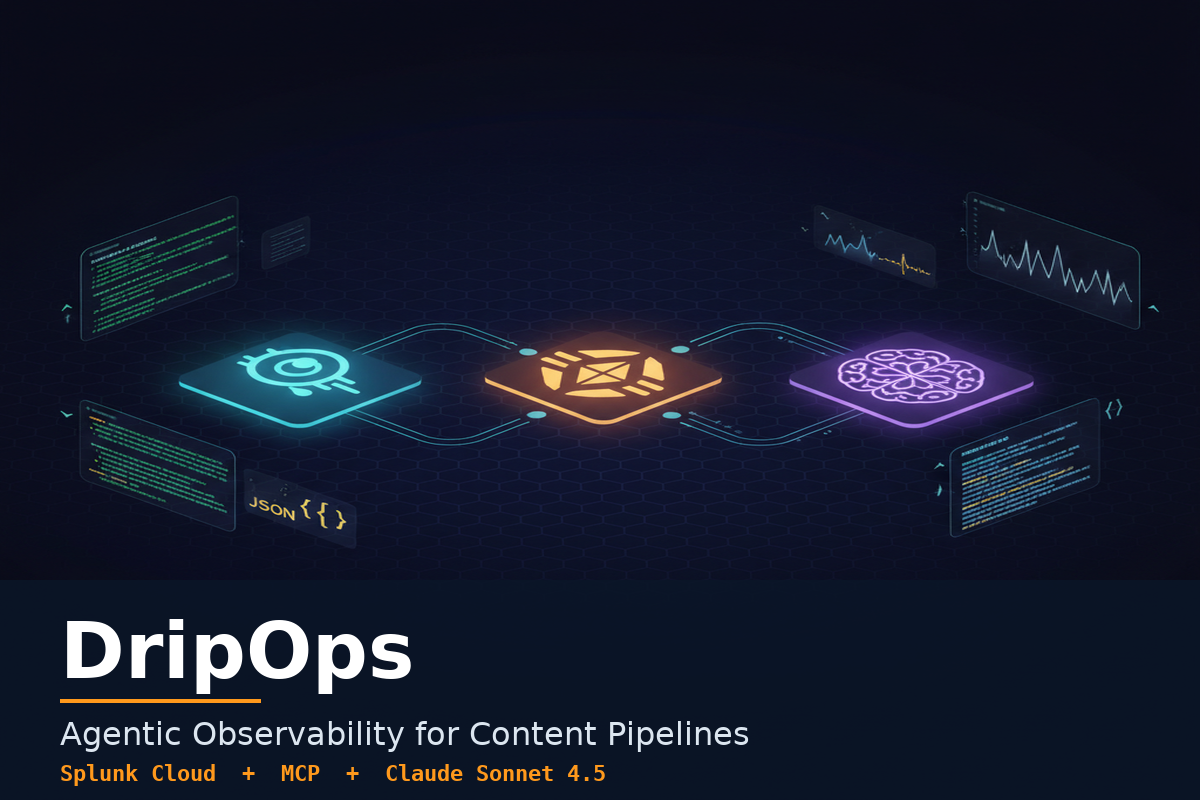
[![License: MIT](https://img.shields.io/badge/License-MIT-yellow.svg)](./LICENSE) [![Bridge Worker](https://img.shields.io/badge/Cloudflare%20Worker-v0.3.0-orange)](./workers/splunk-hec-bridge) [![MCP Server](https://img.shields.io/badge/MCP%20Server-v0.1.0-purple)](./agent/mcp-server) [![Claude](https://img.shields.io/badge/Claude-Sonnet%204.5-blueviolet)](./agent/claude-agent) ## TL;DR DripOps is a three-lane agentic observability stack: 1. **Sources** — Python and Cloudflare Worker services emit typed events. 2. **Ingest** — one Cloudflare Worker (`dripops-splunk-hec-bridge`) validates, buffers, and ships them to Splunk Cloud via HEC, with a SSH-MCP relay fallback. 3. **Intelligence** — a Model Context Protocol server exposes 5 tools to Claude Sonnet 4.5, which reads runbooks, queries Splunk, and acts (Telegram alerts or GitHub PRs) when patterns match known incidents. It's running on the author's production content pipeline right now. Real events. Real Splunk. Real Telegram alerts. ## Architecture

Architecture

### Lane 1 — Sources | Service | Runtime | Emits | |---|---|---| | `drip-watchdog` | Python · systemd | `p0_fired`, `reply_fired`, `fire_failed` | | `campaign-validator-worker` | Cloudflare Worker | `validation_completed` (with stars + violations) | | `tuck-cache-refresh` | Cloudflare Worker | `cache_refreshed`, `refresh_failed`, `freshness_drift` | All sources use the same helper signature: emit_dripops_event(source, event_type, severity="info", **fields) ctx.waitUntil(emitDripops(env, { source, event_type, severity, ...fields })); ### Lane 2 — Ingest `workers/splunk-hec-bridge/` — one Cloudflare Worker that: - Validates every event against a strict JSON schema - Buffers to Cloudflare KV when Splunk is unreachable (cron-drains every 5 min) - Falls back to an OptiPlex SSH-MCP relay when direct HEC is blocked by strict cert validation - Exposes `/event`, `/batch`, `/replay`, `/splunk-search`, and `/splunk-saved-search` ### Lane 3 — Intelligence `agent/mcp-server/` — TypeScript MCP server, stdio transport, 5 tools: | Tool | What it does | |---|---| | `dripops_health` | Reads the bridge `/health` endpoint and last latency | | `splunk_search` | Routes raw SPL via the bridge → relay → Splunk | | `splunk_saved_search` | Dispatches a Splunk saved search by name | | `telegram_alert` | Sends a message to the configured chat | | `github_open_pr` | Opens a draft PR against the configured repo | ## Live proof Real Splunk Cloud, real `dripops:event` sourcetype, real cross-runtime events:

DripOps in Splunk

## Quick start # 1. Clone and install git clone https://github.com/indicaindependent/dripops.git cd dripops cp .env.example .env # fill in your own values # 2. Bridge worker (Cloudflare) cd workers/splunk-hec-bridge npm install # set secrets via `wrangler secret put` — see SECURITY.md wrangler deploy # 3. MCP server (any host that can run Node) cd ../../agent/mcp-server npm install npm run build ./test/smoke-test.sh # 4. Claude agent (any host with Python 3.11+) cd ../claude-agent pip install -r requirements.txt python3 agent.py --once ## Why this design - **One credential surface.** All Splunk secrets live in the bridge worker. The MCP server only needs the bridge URL plus the ingest key. - **Fire-and-forget telemetry.** Sources emit via `ctx.waitUntil()` (CF Workers) or a 3-second timeout (Python). User-facing latency stays under 100ms. - **Saved-search-first.** The agent calls pre-vetted saved searches by name rather than running arbitrary SPL. Real Splunk shops manage SPL through saved reports; this matches that workflow. - **Runbooks as the system prompt.** Adding a new incident pattern is `touch prompts/runbooks/new_pattern.md`. The agent picks it up on the next run. See [SECURITY.md](./SECURITY.md) for credential handling and the rotation runbook. ## Repo layout dripops/ ├── workers/splunk-hec-bridge/ # Lane 2 — Cloudflare Worker ingest │ ├── src/index.ts # v0.3.0 source │ ├── wrangler.toml # deployment config (secrets listed, never set) │ └── package.json │ ├── agent/mcp-server/ # Lane 3 — MCP server (TypeScript) │ ├── src/index.ts # 5 tools, stdio transport │ ├── test/smoke-test.sh # E2E smoke tests │ └── README.md │ ├── agent/claude-agent/ # Lane 3 — Claude orchestrator (Python) │ ├── agent.py # tool-use loop, 8-iteration cap │ ├── prompts/system.md # agent persona + safety rails │ └── prompts/runbooks/ # one .md per incident pattern │ ├── sources/ # Lane 1 — instrumented service snapshots │ ├── campaign-validator-worker.{original,patched}.js │ ├── tuck-cache-refresh.{original,patched}.js │ └── splunk-hec-bridge.{v0.2.0,v0.3.0}.js │ ├── patches/ # Idempotent patcher scripts for sources │ ├── dripops_watchdog_patch.py │ └── patch_campaign_validator.py │ ├── docs/ # Architecture notes, runbook templates ├── assets/ # Diagrams, logos, devpost images ├── .env.example ├── SECURITY.md ├── LICENSE └── README.md ## What's next - Splunk AI Assistant integration for autonomous SPL generation - One-call branch + commit + PR via `github_open_pr` - Multi-tenant runbook directories (bring-your-own runbooks) - Workers AI (Llama 3.3 70B) cheap-tier triage before Claude escalation - A Splunk dashboard for the agent's own activity
标签:自定义脚本