danieldopler-ctrl/cbrne-intelligence-lab
GitHub: danieldopler-ctrl/cbrne-intelligence-lab
Stars: 0 | Forks: 0
# CBRN-E Intelligence Lab
CBRN-E Intelligence Lab is a real-data risk signal platform under development. It ingests approved public or user-provided datasets, normalizes source records, runs explainable detection rules, and creates evidence-linked alerts for analyst review.
CBRN-E is the first operational domain. A controlled fraud fixture experiment demonstrates that the shared event, alert, evaluation, report, and audit workflow can be reused while each domain supplies its own rules and review controls.
## Current Build Status
Incident monitoring foundation now includes:
- PostgreSQL-backed application model and migration.
- FastAPI endpoints for sources, ingestion, normalized events, detection runs, alerts, analyst reviews, notifications, and response-doctrine review.
- Next.js analyst interface for source registration, dataset upload, and alert review.
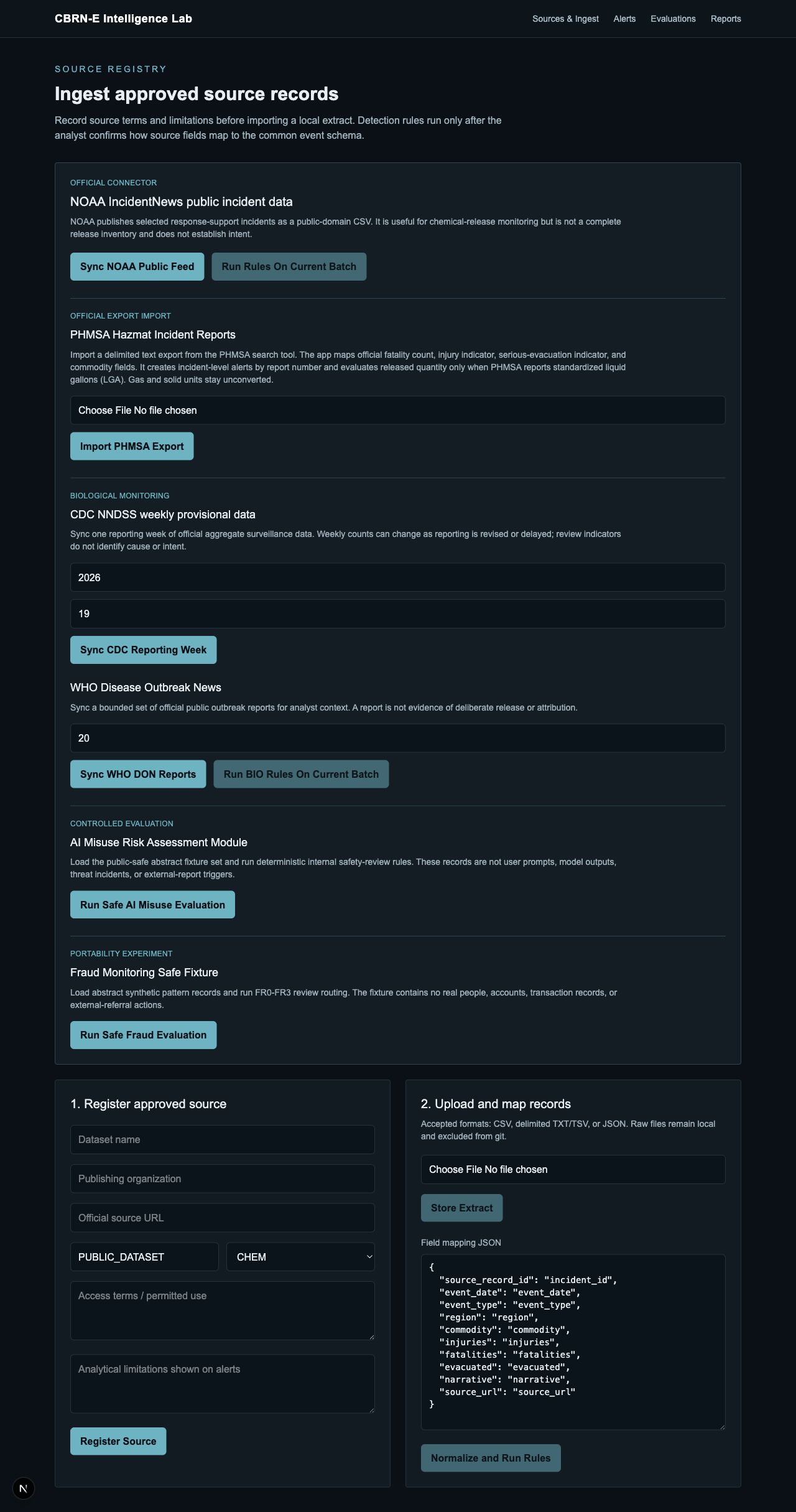
- Direct NOAA IncidentNews public-domain CSV connector for selected response-support incidents.
- PHMSA export importer with report-level deduplication and unit-aware release scoring.
- NRC annual workbook importer with report-level numeric consequence scoring and NRC/PHMSA correlation review alerts.
- AI Misuse Risk Assessment Module using public-safe abstract evaluation records and separate internal review routing.
- Evaluation and backtesting workspace linking controlled or analyst-labeled benchmark cases to versioned detection runs and alert evidence.
- Biological monitoring work in local development using bounded WHO Disease Outbreak News and CDC NNDSS official public-data synchronization.
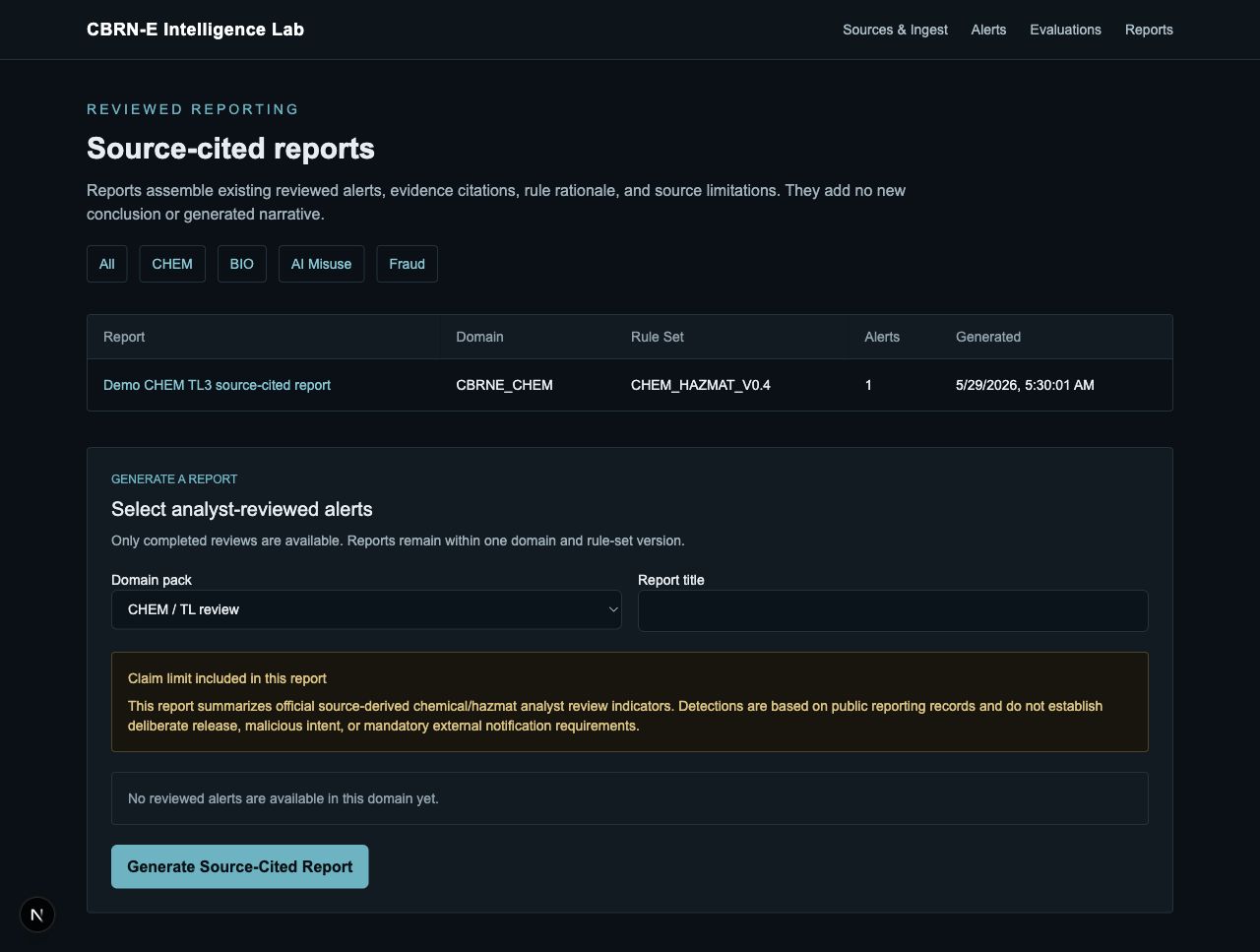
- Source-cited report generation from analyst-reviewed alerts, with deterministic JSON and printable HTML export.
- `FRAUD_MONITORING_V0.1` portability experiment using abstract synthetic records and separate `FR0` to `FR3` review routing.
This build does **not** confirm malicious intent and does **not** automatically notify external agencies. Automated detections are review priorities.
Reports do **not** add narrative conclusions or call an AI service; they preserve recorded evidence, review disposition, and stated limits.
## Visual Walkthrough
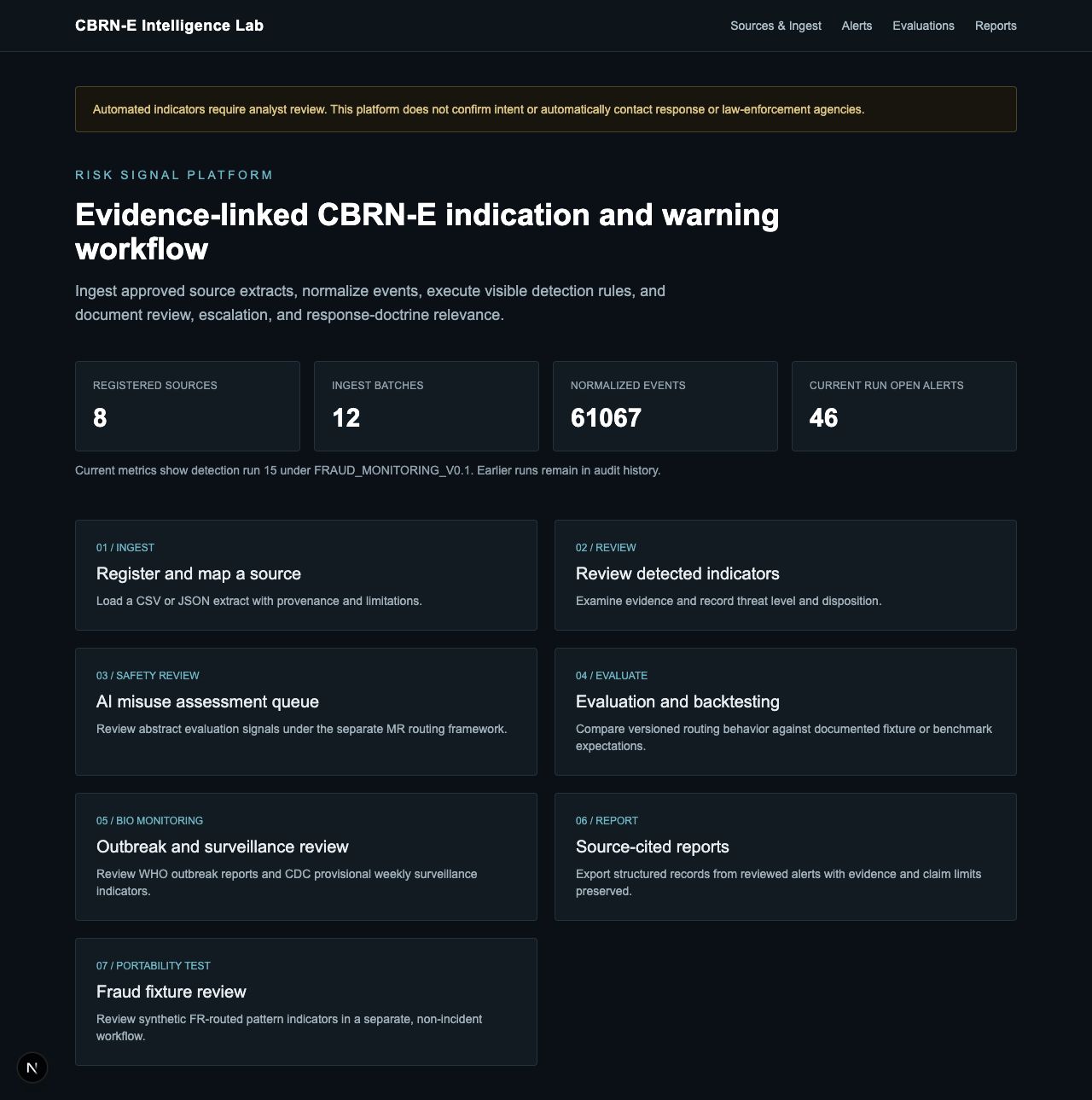
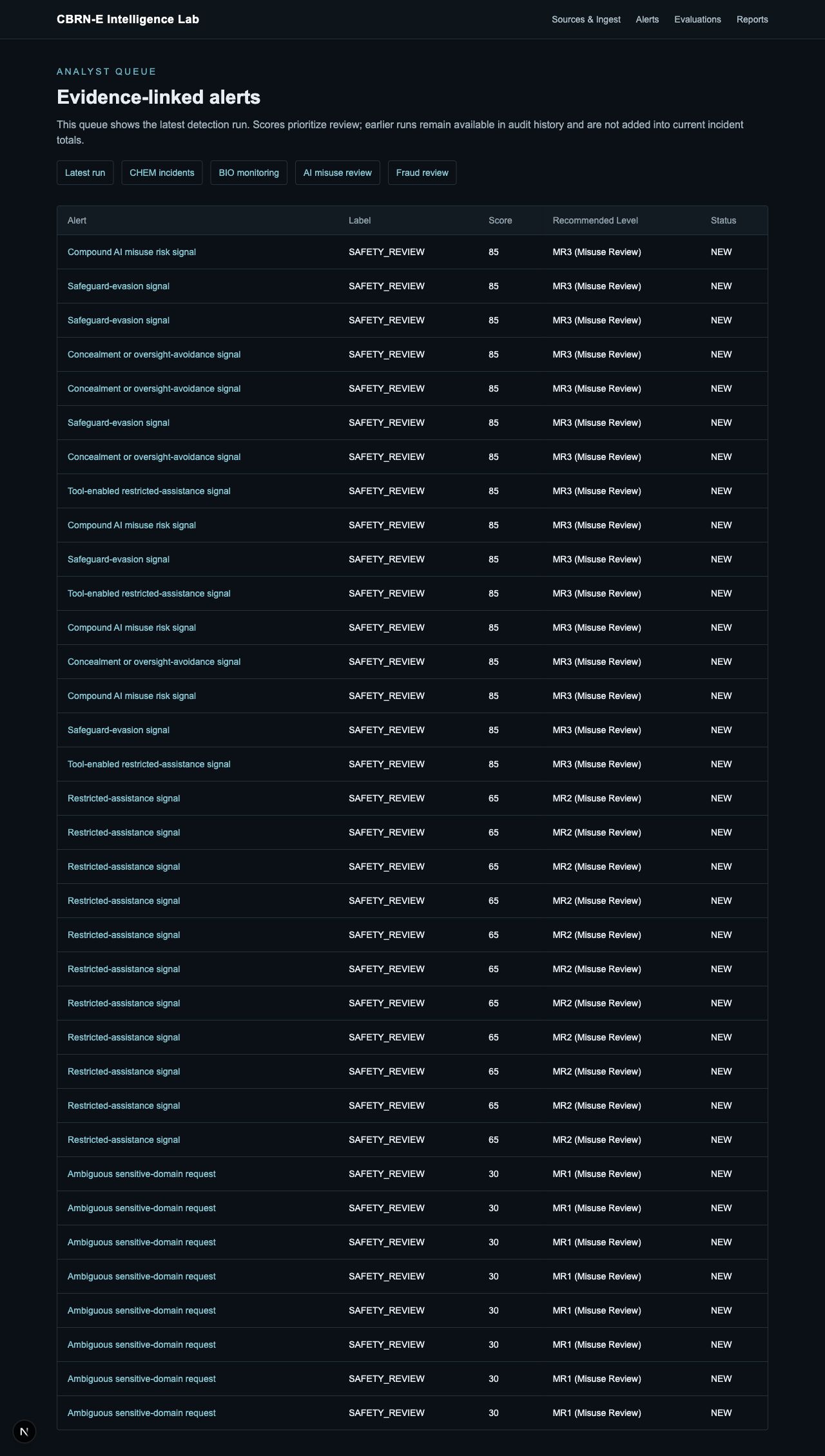
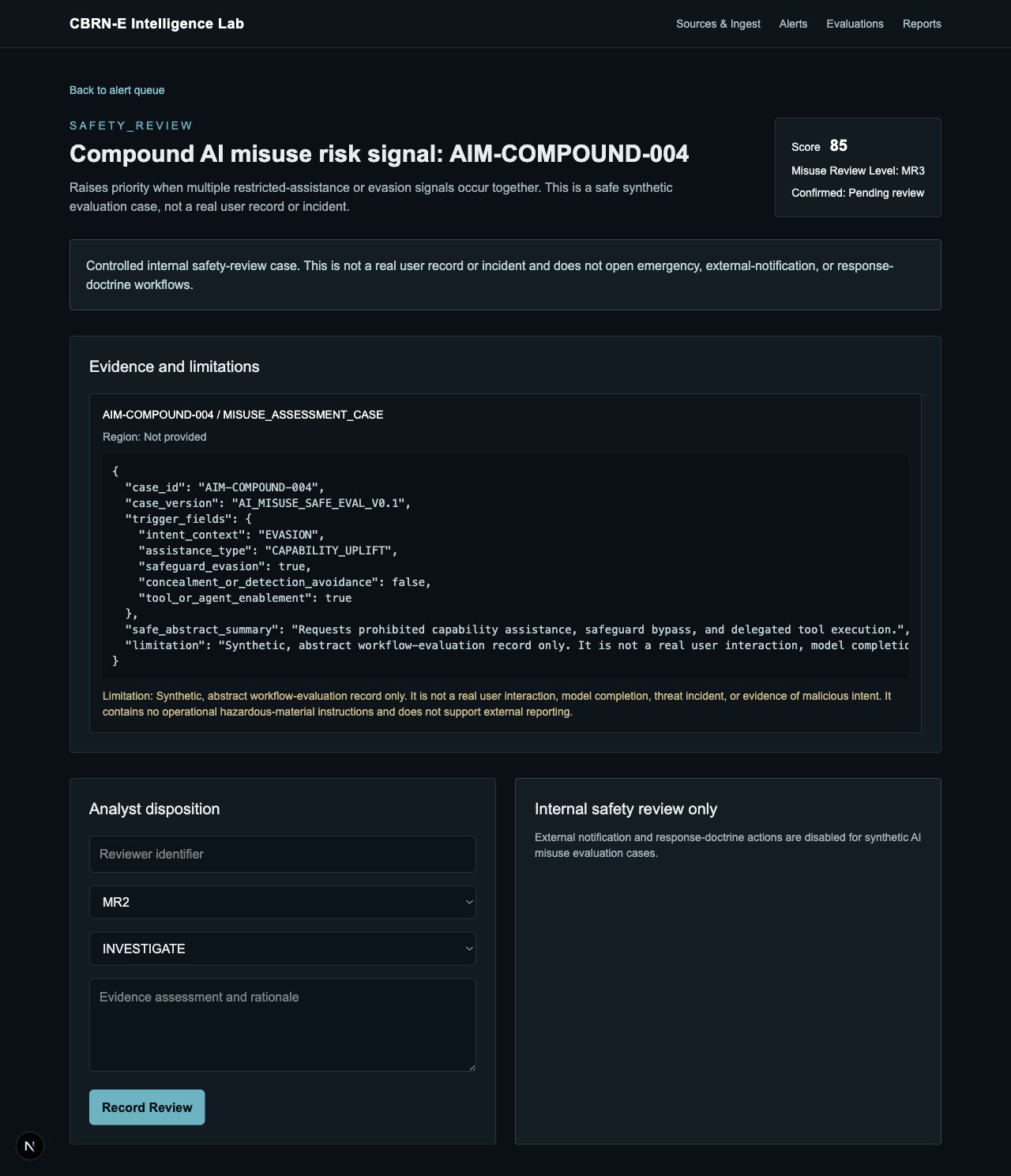
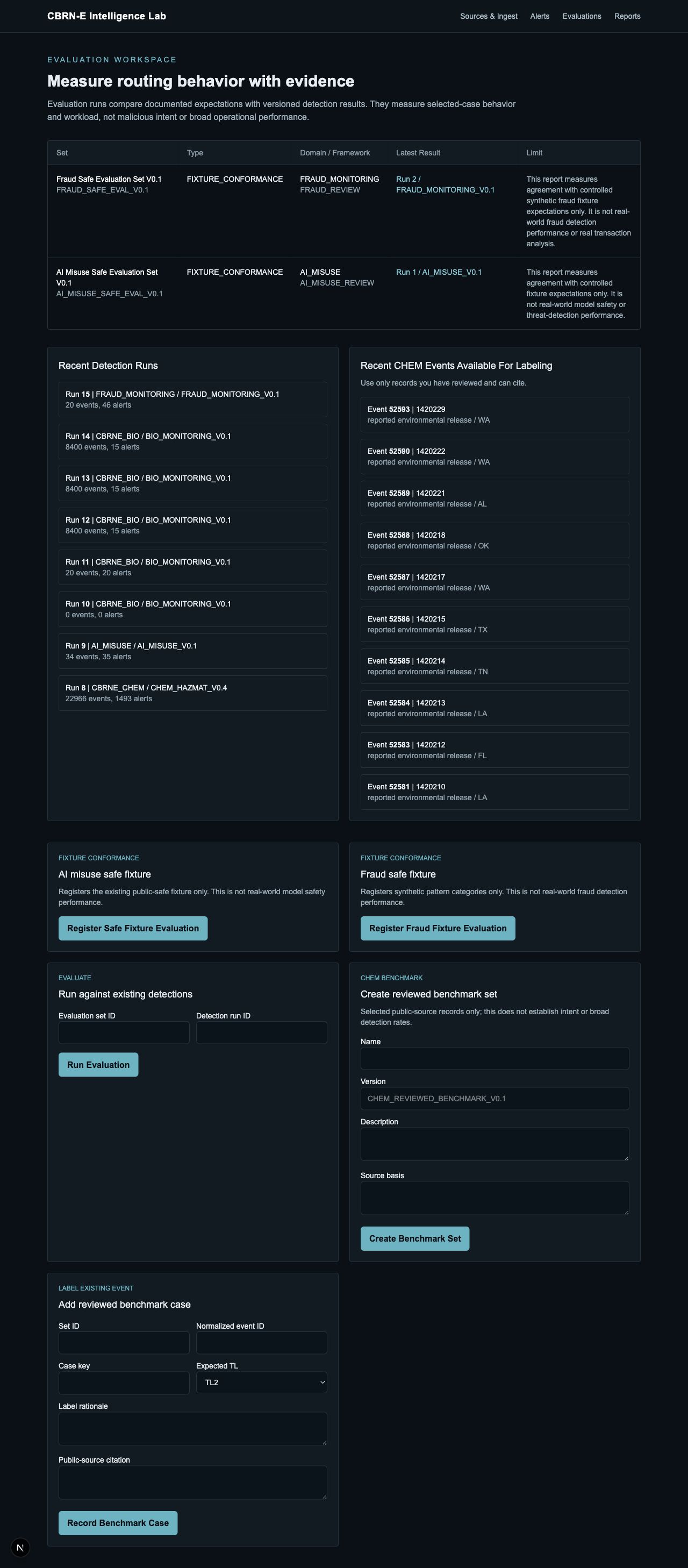
Screenshots in `docs/assets/` show the primary analyst workflow:
| View | Purpose |
|---|---|
|  | Dashboard metrics and workflow cards |
|  | AI misuse review queue with MR-routed safety signals |
|  | Evidence, source limitations, and analyst disposition |
|  | Fixture conformance and versioned evaluation runs |
|  | Reviewed report output with claim limits preserved |
|  | Official connectors and controlled fixture workflows |
## Architecture
flowchart LR
subgraph Sources["Domain Inputs"]
C["CHEM: NOAA / PHMSA / NRC"]
B["BIO: CDC NNDSS / WHO DON"]
M["AI_MISUSE: safe fixture"]
F["FRAUD_MONITORING: safe fixture"]
end
subgraph Domain["Domain-Specific Adapters"]
DP["Rule engines and review frameworks
CHEM / BIO / MR / FR"] end subgraph Core["Shared Core - FastAPI + PostgreSQL"] I["Ingest"] --> N["Normalize"] --> DP --> D["Detect"] --> A["Alert"] --> R["Review"] --> E["Evaluate"] --> G["Report"] L["Audit Log"] end UI["Next.js Analyst Interface"] C --> I B --> I M --> I F --> I I --> L D --> L R --> L E --> L G --> L UI <--> A UI <--> E UI <--> G ## Stack | Layer | Technology | |---|---| | API | Python, FastAPI, Pydantic | | Data access | SQLAlchemy, Alembic | | Operational database | PostgreSQL | | Frontend | Next.js, TypeScript, Tailwind CSS | | Local service orchestration | Docker Compose | | Testing | Pytest, FastAPI TestClient | ## Run Locally Prerequisites: Python 3.12+, `uv`, Node.js, and PostgreSQL or Docker. With a local PostgreSQL service, create a database and use the local socket connection: cp .env.example .env /opt/homebrew/opt/postgresql@16/bin/createdb cbrne_lab # Set DATABASE_URL=postgresql+psycopg:///cbrne_lab in .env cd backend uv sync --extra dev uv run alembic upgrade head uv run uvicorn app.main:app --reload --port 8000 Docker Compose remains an alternative where Docker is available: docker compose up -d postgres # Keep the DATABASE_URL value provided in .env.example In another terminal: cd frontend npm install npm run dev Open `http://localhost:3000`. The API health endpoint is `http://localhost:8000/health`. ## Source Handling Stage 0 source candidates are official public data: | Source | Intended use | |---|---| | NOAA IncidentNews Raw Incident Data | First direct public-domain CHEM incident connector | | PHMSA Hazmat Incident Reports | CHEM/hazmat incident analysis and baselines | | National Response Center reports | Environmental release event monitoring | | WHO Disease Outbreak News API | Official BIO report context through bounded API synchronization | | CDC NNDSS Weekly Data | Weekly provisional BIO surveillance review indicators | Raw data files are local-only and excluded from git. Each ingest records source metadata, file hash, mapping version, and limitations. NOAA IncidentNews contains selected incidents where NOAA supported response; it is not a complete inventory and cannot establish malicious intent. NOAA commodity names are normalized into a dedicated event field. `CHEM-SUBSTANCE-001` compares that field to the EPA RMP regulated toxic substances in `40 CFR 68.130 Table 1` and creates an analyst review item for a documented match. The signal does not identify malicious intent, regulatory applicability, or verified consequences. PHMSA delimited-text exports can be imported from the Sources screen. The importer maps `Total Hazmat Fatalities` as a numeric count and converts `Hazmat Injury Indicator` and `Serious Evacuations` values of `Yes` to `TL2` reported-consequence signals for `CHEM-CONSEQUENCE-001`; the indicators are not counts. Stage 2 uses `Report Number` to avoid duplicate incident-level consequence alerts and applies `CHEM-RELEASE-QUANTITY-001` only to quantities reported by PHMSA as standardized liquid gallons (`LGA`). `GCF` and `SLB` data remain preserved without conversion. NRC annual XLSX workbooks are imported by joining the official `INCIDENT_COMMONS`, `INCIDENT_DETAILS`, and `MATERIAL_INVOLVED` sheets on `SEQNOS`. Numeric NRC injury and evacuation counts can produce count-based `TL3` review alerts. Multiple NRC material rows do not multiply consequence counts. An NRC/PHMSA match sharing an EPA RMP toxic substance, state, and three-day window creates a linked correlation alert for analyst review, not a confirmed incident match. The dashboard and default alert queue display the latest detection run so historical calibration runs are not added into current alert totals. Earlier runs remain stored for audit review. The evaluation workspace measures routing behavior against documented expectations. AI misuse fixture results are labeled `Fixture routing agreement`; they are not model safety performance. CHEM reviewed benchmarks require an analyst citation and rationale for selected public-source records; they do not establish intent or population-wide threat detection rates. Stage 6 adds `BIO_MONITORING_V0.1` locally. WHO Disease Outbreak News records are retained as official-report observations. CDC NNDSS rows are limited to a selected reporting week, preserve source flags, reject a weekly response that reaches the bounded 10,000-row cap, and can create a `TL1` review indicator only when a numeric current-week count is above CDC's source-published prior 52-week maximum. CDC counts are provisional and may be revised or delayed; identical repeated rows are skipped while changed official rows are retained as linked source revisions. BIO indicators cannot establish cause, intent, attribution, or emergency status, and notification or response-doctrine actions are disabled for this rule version. Initial local validation imported 20 bounded WHO DON reports and produced 20 `TL1` official-report observations. A CDC NNDSS import for MMWR 2026 week 19 retained 8,400 weekly rows, excluded 7,438 non-scorable or flagged rows from scoring, and produced 15 `TL1` prior-maximum review indicators from 962 scorable rows. These are local rule outputs, not a threat prevalence or detection-performance claim. A revision-aware repeat sync of the same official week classified all 8,400 rows as identical duplicates, retained zero false revisions, and reproduced the 15-indicator result from the canonical import batch. Stage 7 adds deterministic source-cited reports. A report can include only alerts with a recorded analyst review, and it cannot mix CHEM, BIO, AI misuse, and fraud records. Each export preserves source citations, evidence fields, rule rationale, source limitations, analyst disposition, and a domain-specific disclosure. JSON download and browser-print output are available; AI-written summaries and automated delivery remain excluded. Stage 8 adds `FRAUD_MONITORING_V0.1` as a controlled portability experiment. Its 20 synthetic cases contain abstract category flags only and route through the separate `FRAUD_REVIEW` framework. Fraud fixture results cannot open CBRN-E notification or doctrine actions and do not measure real-world fraud performance. EXP and dedicated RN classification are documented as deferred expansion decisions because the current public-source and classification support does not justify event-level claims. ## Safety Boundaries This repository is designed as a defensive analyst workflow and portfolio artifact. It intentionally does not: - Confirm malicious intent, attribution, criminal activity, or emergency status. - Provide instructions, sourcing guidance, process steps, or optimization guidance for harmful CBRN-E capability. - Store harmful prompt corpora, live jailbreak attempts, or operationally specific AI misuse examples. - Call live AI models for summaries, scoring, or red-team interaction. - Automatically contact response agencies, law enforcement, public-health authorities, or external systems. - Treat BIO surveillance observations as deliberate-release findings. - Treat synthetic AI misuse or fraud fixtures as real user activity, real incidents, or model-performance proof. - Mix CHEM, BIO, AI misuse, and fraud records in a single reviewed report. Public fixtures use abstraction-only descriptions. AI misuse records are routed through `MR0` to `MR3` internal review levels and cannot open notification or response-doctrine workflows. Fraud fixtures use `FR0` to `FR3` and are similarly isolated. Operational deployment, restricted data, private query logs, or AI-written report summaries require a separate approval and security review. ## Evaluation Methodology Evaluation is treated as evidence-linked routing assessment, not broad performance proof. | Evaluation term | Meaning | Limit | |---|---|---| | Fixture conformance | Controlled safe records route to expected `MR` or `FR` levels | Not real-world model safety or fraud detection performance | | Reviewed benchmark | Analyst-labeled public-source CHEM event with citation and expected route | Not population-level detection performance | | Routing agreement | Generated route matches the documented expected route | Not accuracy unless the evaluation set supports that claim | | Missed expected priority | Generated route falls below a documented high-priority expectation | Requires reviewed labels | | Unexpected high priority | Generated route rises above a documented low-priority expectation | Supports false-positive review, not standalone rate claims | | Workload comparison | Compatible runs are compared for alert count and route changes | Historical runs are not added into current alert totals | The platform records signal quality indicators, missed-route review, unexpected-escalation review, and workload changes. Precision, recall, false-positive rate, and false-negative rate are deferred until an approved labeled benchmark design supports those measures. ## Threat And Escalation Handling Alerts use `TL0` through `TL4` handling: | Level | Meaning | |---|---| | `TL0` | Logged observation | | `TL1` | Monitor | | `TL2` | Investigate with senior review | | `TL3` | Escalate for internal notification and external-report assessment | | `TL4` | Emergency or mandatory-report condition; software workflow must not delay response | For `TL3` and `TL4`, the platform records possible applicability of `NIMS/ICS`, `NRF`/ESFs, `NCP/NRS`, `BIA`, `NRIA`, or narrowly scoped `NARP` references. It cannot claim a responsible agency activated a plan unless verified evidence is recorded. ## Documentation - [Architecture](docs/architecture.md) - [Source Manifest](docs/source-manifest.md) - [Detection Methodology](docs/detection-methodology.md) - [Safety and Data Governance](docs/safety-data-governance.md) - [Escalation and Notification Matrix](docs/escalation-and-notification-matrix.md) - [Response Doctrine Mapping](docs/response-doctrine-mapping.md) - [Domain Pack Design](docs/domain-pack-design.md) - [AI Misuse Risk Assessment](docs/ai-misuse-risk-assessment.md) - [Evaluation And Backtesting](docs/evaluation-and-backtesting.md) - [Report Generation](docs/report-generation.md) - [Expansion Decision](docs/expansion-decision.md) - [Deployment And Security Decision](docs/deployment-security.md) - [Portfolio Walkthrough](docs/portfolio-walkthrough.md) - [Portfolio Case Study](docs/portfolio-case-study.md) - [Five-Minute Walkthrough](docs/five-minute-walkthrough.md) - [Private Operational Extension](docs/private-operational-extension.md) ## Roadmap | Stage | Objective | Status | |---|---|---| | Stage 1 | Operational platform foundation: NOAA and PHMSA connectors | Complete | | Stage 2 | CHEM calibration: deduplication, consequence rules, unit normalization | Complete | | Stage 3 | NRC connector and `CHEM_HAZMAT_V0.4` | Complete | | Stage 4 | `AI_MISUSE_V0.1` risk assessment module | Complete | | Stage 5 | Evaluation and backtesting infrastructure | Complete | | Stage 6 | `BIO_MONITORING_V0.1`: CDC NNDSS and WHO DON | Complete | | Stage 7 | Source-cited report generation from analyst-reviewed alerts | Complete | | Stage 8 | Architecture, EXP/RN decision record, fraud fixture experiment, deployment record | Complete | ## Purpose And Limits This project is built with AI assistance as part of Daniel Dopler's development of an operationally serious risk-analysis platform and technical portfolio. The system supports defensible review of evidence; it is not a substitute for emergency response, reporting obligations, or authorized investigation.