
# kuzushi-security-plugin
[](https://github.com/allsmog/kuzushi-security-plugin/actions/workflows/test.yml)
[](LICENSE)


**Security review that proves it or drops it — inside Claude Code.**
Most AI security tools cry wolf. kuzushi makes every finding **earn its place** — it traces the
source→sink path, reconstructs the exploit, proves it with a sandboxed PoC, and validates the patch
against that exploit — then **benchmarks its own recall** against planted CVEs so it can tell you
what it *missed*.
- **🔬 Proof, not hits.** Findings climb a proof ladder — traced → exploit reconstructed → sandboxed PoC → patch validated. Not "the scanner said so."
- **🚫 It won't fool you.** Scored against planted bugs *and* decoys with a hard zero-false-proof gate; it reports its own misses instead of hiding them.
- **🔒 Local & network-denied by default.** Runs on the source you already have checked out; every artifact stays under `.kuzushi/`.
- **🧪 Real techniques, not vibes.** Borrows the AIxCC playbook — obligation discharge, sanitizer execution proof, and scoped-CPG dataflow.
Point it at source you already have checked out and kuzushi turns security review into a
reproducible evidence pipeline: map the code, threat-model it, hunt source-to-sink paths, verify
exploitability, build sandboxed proof, synthesize variant rules, and validate patches before they
touch your working tree.
kuzushi is built for maintainers and product-security teams who need answers they can ship:
- **Is it real?** Findings advance through explicit proof states instead of staying as scanner hits.
- **Can I reproduce it?** Verification, PoC, fuzz, rule-pack, and patch artifacts stay under
`.kuzushi/` with provenance and policy digests.
- **Can I fix it safely?** `/fix` validates exploit regression, functional behavior, and supported
semantic oracles in a sandbox copy before apply.
- **Can I trust the workflow?** The plugin is local-first, policy-gated, network-denied by default
for locked profiles, and designed for auditable CI/SARIF output.
It is self-contained Node (no daemon, no hosted service): plain stdio MCP servers, skills, agents,
schemas, and a SessionStart hook wire up Tree-sitter, Semgrep, CodeQL, Joern, fuzz harnesses, and
language tooling only when the repo needs them.
context ─► x-ray ─► threat-model ─► threat-intel ─► ┌ invariant-test ┐ ─► findings.json ─► verify ─► poc ─► fix ─► report
(langs, (entry (PASTA DFD + (CVEs for └ threat-hunt ┘ (open (exploit- (sandbox- (PoC⁺ (fix-first
deps) points) threats) stack + peers) (adversarial) findings) ability) proven) patch) report)
│
└─► mem-exploitability
(memory-corruption tier
+ mitigation posture)
Each step writes an artifact under `.kuzushi/` that the next step consumes. You stay in
control: heavy or outbound steps **ask first**, and everything runs against your local repo.
## Scope & boundaries
This is a **local source-code** tool with static-first analysis and sandboxed dynamic proof
for harnessable targets. How complete that is depends on what you point it at.
**Always in scope** (any target with source on disk): PASTA threat model, version-checked CVE
intel, source→sink taint analysis, adversarial guard-bypass review, static exploitability
verdicts, memory-corruption exploitability assessment, and a sandboxed PoC harness.
**Web apps / HTTP services** — the plugin covers the *static* half of a grey-box review. Pair
it with a dynamic tool (Burp / DAST) for the rest: browsing the live app, mapping observed
traffic (endpoints, parameters, cookies, roles) to handlers, and triggering against a running
target. None of that lives here.
**Libraries, native / systems code, parsers, CLIs** — there's no HTTP layer to proxy, so most
of that dynamic half simply doesn't apply. Source→sink plus the sandboxed `/poc` harness is
much of the standard workflow. The dynamic complement *here* is fuzzing: `/fuzz` creates a
campaign plan from confirmed/proven findings, executes runnable harnesses in the same offline
sandbox model, triages/minimizes crashes, and only advances findings when empirical crash or
sanitizer evidence exists.
## Measured reality (no false wins)
kuzushi's strongest claim is **honesty backed by reproducible measurement**, not a leaderboard
number. Two instruments keep the project from fooling itself:
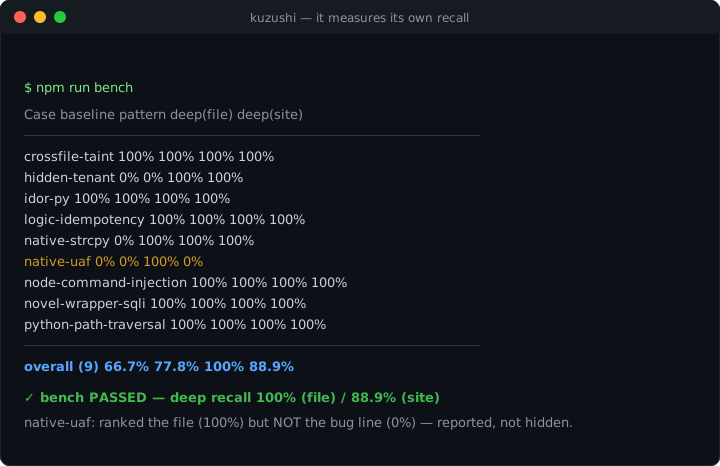
- **`npm test`** is the deterministic gate. It includes a *live producer-firing* recall test
(`test/bench-live-recall.test.mjs`) that runs the real prepare phase on the bundled corpus and
reports recall at both **file** and **site** (±6-line) granularity — so "ranked the file" can
never masquerade as "found the bug". (A separate, frozen-snapshot corpus test is honestly
labelled as testing the *scorer*, not the producers.)
- **`npm run eval[:cve]`** is the LLM-in-the-loop eval: the real agents run blind via `claude -p`
against fix-derived CVEs. It is **billed and never a CI gate** — a low number is a valid result.
**What the eval actually shows** (Sonnet, the 9-CVE Redis+minimist set): a **blind find-rate of
~22%**, with routing ~78%. Routing is largely solved; the wall is *reasoning on subtle lifetime /
integer-overflow bugs* — the agent reads the right file and still mis-judges the bug. The
**scoped-CPG memory lane** (new) closes the *routing* half of that wall: it reaches a real
integer-overflow flow (`lbaselib.c`, ranked #606 by file-routing) and hands it to the agent — but
on the hardest cases the agent can still wrongly accept an insufficient guard, which is why those
findings are driven to **execution proof** (`/sanitize-pov`: a sanitizer abort is ground truth)
rather than confirmed by reading.
**Honest bottom line:** kuzushi is strong at *verified, reproducible, low-false-proof* review
(the defender-value contract) and at *routing-independent* coverage; it is **not** at parity with a
cloud cluster on blind discovery of subtle memory bugs by reading — and the harness lets us say so
with a number instead of a vibe. The full plan and its measurement gates live in
[docs/WORLD-CLASS-DISCOVERY.md](docs/WORLD-CLASS-DISCOVERY.md), the implementation architecture
is in [docs/DISCOVERY_ARCHITECTURE_SPEC.md](docs/DISCOVERY_ARCHITECTURE_SPEC.md), and the
run-by-run log is in [eval/README.md](eval/README.md).
## Install
**Via the plugin marketplace (recommended):**
/plugin marketplace add allsmog/kuzushi-security-plugin
/plugin install kuzushi-security-plugin@kuzushi-security
Then `npm install` once in the plugin directory (bundles the MCP SDK, tree-sitter grammars,
and the TypeScript/Python language servers).
**For local development:**
git clone https://github.com/allsmog/kuzushi-security-plugin
cd kuzushi-security-plugin && npm install
claude --plugin-dir .
## Quickstart
Start Claude Code in any source repo. The SessionStart hook **auto-builds repository
context** (files, languages, components), prints a status report, and suggests one next
step. You don't need to learn 40 commands — kuzushi is **four phases**, and most reviews
are two commands: **`/sweep` then `/report`**.
(→ = typeable in the / menu · + = runs inside the phase or when you ask)
1 MAP understand the code (x-ray runs automatically on session start)
→ /threat-model PASTA threat model + ASCII data-flow diagram
+ deep-context · code-graph · dfd · threat-intel · invariant-test
2 HUNT find vulnerabilities
→ /sweep whole-repo: fans the hunters out by language, then verifies
+ taint · authz · logic-hunt · crypto · sharp-edges · systems · iac
supply-chain · sast · threat-hunt · binary-recon · traffic-map
3 CONFIRM prove it's real
→ /verify reconstruct trigger → verdict; routes each finding to its proof
→ /poc build + sandbox-run one harness (executes; explicit)
+ fuzz · sanitize-pov · path-solve · mem-exploitability (verify picks these by language / finding-type)
4 FIX · SHIP remediate + deliver
→ /fix minimal patch, PoC⁺-validated, applied behind approval
→ /report prioritized "fix first" report (Markdown / HTML)
+ chain · variant-hunt · export-sarif · semgrep-rule · rule-synth
entry: /diff-review (review a PR) setup: /doctor (+ install · build-databases)
**Happy path:** `/sweep` finds and verifies across the whole repo, then `/report` gives
you a prioritized, shareable writeup. Only the `→` commands are in the `/` menu; the `+`
tools aren't separate commands — they run inside their phase (e.g. `/sweep` selects the
hunters by language) or when you ask for them in plain language. The full reference is the
table below.
## Skills
This is the **full reference** — every capability the plugin ships. Only **8 are in the `/`
menu** (the phase drivers + a couple of entry points): `/sweep`, `/verify`, `/poc`, `/fix`,
`/report`, `/threat-model`, `/diff-review`, `/doctor`. The rest are **not separate commands you
type** — they run *inside their phase* (e.g. `/sweep` fans out the hunters by language; `/verify`
routes a finding to `/fuzz` / `/mem-exploitability` / `/path-solve`) or when you **ask in plain
language** ("do an authz review", "draw the data-flow diagram"). They stay fully available —
just demoted from the menu so it reads as the four phases. (Mechanism: `user-invocable: false`
in each skill's frontmatter — hidden from `/`, still model-invocable.)
| Command | What it does | Writes |
|---|---|---|
| `/sweep` | **Whole-repo orchestrator.** Shards the repo by module (budget-sized) and fans every applicable producer (taint, authz, logic-hunt, crypto, sharp-edges, systems-hunt, iac, supply-chain, threat-hunt, binary-recon) out across **every** shard in parallel, then pipelines each new finding through `/verify`. Records a **coverage map** (which shards were reached + the uncovered set — no silent sub-sampling) and writes findings to the shared lock-guarded index. `--input '{"offline":true}'` skips any network producer (zero-exfil); `'{"deep":true}'` adds the whole-file reader and an interprocedural-DB plan. The local, auditable answer to cloud "scan-everything" tools. | `.kuzushi/sweep.json`, `coverage-map.json`, `findings.json` |
| `/deep-scan` | **Whole-file deep reader** — the recall lever that beats pattern-gating. Risk-ranks files (entry points, trust boundaries, blast radius, churn, security-relevant paths, and a **dataflow-reach** signal: files a real source→sink flow already touched), then sends them through the configured Kuzushi LLM bridge. Each file carries a **discharge checklist of obligations** across all classes (memory: buffers/copies/lifetime/overflow; web/logic: command-exec/sql/deser/path/ssrf/xss/authz) the agent must prove or report, and the agent makes **one pass per lens** (memory/lifetime/arithmetic/injection/authz) with a completeness critic. `--input '{"byObligation":true}'` adds an obligation **overlay** for files below the read budget; `'{"cpgMemory":true}'` runs a **discovery-time scoped-CPG pass** that attaches cross-function memory flows (`cpgLeads`) for low-ranked interpreter/parser subsystems — reaching a memory bug regardless of file rank. Token-expensive, budget-bounded, honest about the unread remainder; a malformed draft item is dropped, not fatal to the batch. Leads flow to `/verify` (panel). | `.kuzushi/deep-scan.json`, `findings.json` |
| `cpg-scan` *(internal)* | **Scalable scoped-CPG memory lane** (invoked by the deep agents, not a `/` command). Builds a *light* Joern CPG bounded to a suspect file's subsystem (seconds, not the minutes a whole-repo CPG costs — build scales with the scope, not the repo) and runs the interprocedural use-after-free / double-free / integer-overflow queries, returning `{cwe, filePath, sourceLine, sinkLine}` leads. Reaches cross-function memory flows a single-file read structurally misses, in files that ranked far below the read budget. Heuristic leads → `/verify` + `/sanitize-pov`. | (leads to `findings.json`) |
| `/deep-hunt` | **Interprocedural hypothesis hunt** — the cross-file recall lever. Risk-ranks **trace anchors** (entry points + dangerous sinks), then `deep-hunt-run.mjs` walks source→sink hypotheses through the configured Kuzushi LLM bridge using forward/backward call-graph CLIs: hypothesize → follow the data hop by hop, reading each function → defeat every guard → self-falsify. Promotes only confirmed cross-file flows (≥2 hops, ≥2 files), storing the path as the finding's `evidenceGraph`. Finds the multi-file bugs same-file taint and pattern-gating both miss — **no CPG required**. Token-expensive; run via `/sweep --deep`. Leads flow to `/verify` (panel). | `.kuzushi/deep-hunt.json`, `findings.json` |
| `/deep-context` | **Deep system-understanding pass** (before threat modeling). The context-analyst agent reads the code line-by-line where it matters and builds a grounded model — modules, entry points, actors, trust boundaries, data stores, and **system invariants** — with file:line evidence and anti-hallucination rules. **Context only** (no vuln-finding/fixes/severity); `/threat-model` consumes it. | `.kuzushi/deep-context.json` |
| `/threat-model` | Agent builds a **PASTA** threat model in phases (objectives → scope → decomposition → threats) + an ASCII data-flow diagram. | `.kuzushi/threat-model.json`, `threat-model-dfd.txt` |
| `/threat-intel` | Researches recent **critical/high CVEs** for the detected stack (version-checked) and **similar apps**, distilled into machine-checkable invariants. *(uses web search)* | `.kuzushi/threat-intel.json` |
| `/invariant-test` | Verifies each CVE-derived invariant against the code with tree-sitter taint queries (CodeQL/Joern if built). | `.kuzushi/invariant-results.json` |
| `/threat-hunt` | **Adversarial per-threat review** (the Carlini doctrine): state attacker capabilities → trace source→sink → bypass *every* guard → verdict from a closed set. Promotes verdicts to the findings index. | `.kuzushi/threat-hunt.json`, `findings.json` |
| `/systems-hunt` | **Native / memory-safety review.** Scans for systems patterns (loadLibrary/JNI, `memcpy`/`Unsafe`/`gets`, archive parsers, deserialization, exec), then a subagent confirms reachability + memory-safety impact (OOB, UAF, integer overflow, RCE). Best on C/C++/Rust/native; promotes to findings. | `.kuzushi/systems-hunt.json`, `findings.json` |
| `/taint-analysis` | **IRIS-style source→sink taint hunt.** Ranks a typed CWE catalog for the repo, then runs subagents in sequence — label dangerous **sinks** → label **sources** of user input → trace source→sink with **Joern/CodeQL** queries (or same-file linking) → **triage** each flow `finding`/`candidate`/`rejected` with an evidence level (`path`/`linked`/`candidate`). Deeper with a prebuilt DB/CPG; degrades gracefully without. | `.kuzushi/taint-analysis.json`, `findings.json` |
| `/supply-chain` | **Dependency takeover/abandonment risk.** Parses manifests for direct deps, then the supply-chain-auditor agent rates each by maintainer count, popularity, CVE history, and release cadence (via `gh` + web), promoting high→finding / medium→candidate (`source: supply-chain`). Complements `/threat-intel` (CVEs). *Uses the network — asks first.* | `.kuzushi/supply-chain.json`, `findings.json` |
| `/diff-review` | **Change-focused security review.** Resolves a base ref, risk-scores changed files, then the diff-reviewer agent walks source→sink on the new code, uses `git blame` to catch **regressions**, and estimates **blast radius** by caller count. Threat-hunt verdict set. Needs git. | `.kuzushi/diff-review.json`, `findings.json` |
| `/sharp-edges` | **Misuse-resistance review.** Scans for footgun APIs / dangerous defaults, then the sharp-edges-analyzer agent reasons through three adversaries (scoundrel / lazy / confused dev) across six categories (e.g. JWT `alg:none`, TLS verify off, stringly-typed auth). Distinct from `/sast` (injection). | `.kuzushi/sharp-edges.json`, `findings.json` |
| `/logic-hunt` | **Business-logic & invariant-violation hunt** — the bugs taint/SAST structurally miss (no injection token; the code does the wrong *thing*). Seeds from `/deep-context` system invariants + probes for logic-prone shapes, then the logic-hunter agent adversarially tries to *violate* each property: broken atomicity, skippable state transitions, authorization-by-omission, replay, business-rule abuse (negative amounts, rounding theft). Closed verdict set; `violation` requires the ordered break scenario + evidence. Strongest after `/deep-context`. | `.kuzushi/logic-hunt.json`, `findings.json` |
| `/sast` | **Semgrep SAST pass.** The sast-triager agent runs `semgrep:scan`, then reads the source behind each hit to classify it `finding`/`candidate`/`rejected` (scanner hits are leads, not findings). Promotes the kept ones into findings. Needs semgrep installed. | `.kuzushi/sast.json`, `findings.json` |
| `/crypto-review` | **Crypto-misuse review.** The crypto-reviewer agent confirms each candidate handles a secret, then flags timing side-channels (variable-time compare of a MAC/token, CWE-208), missing/elidable zeroization (CWE-226/14), and non-cryptographic RNG minting secrets (CWE-338). Distinct from `/sast` and `/sharp-edges`. | `.kuzushi/crypto-review.json`, `findings.json` |
| `/authz` | **Authorization-model review.** Scans endpoints + object-access-by-id sites; the authz-reviewer agent finds missing authz (CWE-862), IDOR / broken object-level authz (CWE-639), privilege escalation, and broken ownership. | `.kuzushi/authz.json`, `findings.json` |
| `/logic-hunt` | **Business-logic flaw review** — the class taint/SAST are structurally blind to. Scans for money/state mutations, checkout/redeem entrypoints, price math, and status transitions; the logic-hunter agent reconstructs the multi-step flow and tests it for **idempotency** gaps (replayable actions, CWE-837), **TOCTOU** races (CWE-367), non-atomic **transactions** (CWE-362), **price/quantity** manipulation (CWE-840), and **state-machine** re-entry (CWE-841) — naming the invariant that should protect each action. | `.kuzushi/logic-hunt.json`, `findings.json` |
| `/binary-recon` | **Read-only static binary triage.** Detects ELF/PE/Mach-O by magic bytes and surfaces dangerous imported symbols and writable+executable segments via on-PATH binutils (`nm`/`readelf`/`objdump`); the binary-recon agent judges which signals are real exposures in context and ties them to source. **Assessment only** — no execution, no exploit-oriented disassembly. | `.kuzushi/binary-recon.json`, `findings.json` |
| `/iac` | **Config & container security.** Scans Dockerfiles, Kubernetes/Compose, and Terraform/IaC for misconfigurations (privileged containers, root, unpinned images, hardcoded secrets, public network/storage, disabled TLS); the iac-reviewer agent confirms each in context. | `.kuzushi/iac.json`, `findings.json` |
| `/traffic-map` | **Offline Burp/HAR import.** Parses a HAR or Burp "Save items" XML export into observed endpoints, then the traffic-mapper agent correlates each to its source handler (x-ray + code-graph) and flags the gaps the traffic reveals (shadow surface, unauthenticated mutating endpoints, params reaching sinks). Offline — no proxy. | `.kuzushi/traffic-map.json`, `findings.json` |
| `/report` | **Prioritized security report — the human deliverable.** Deterministic transform of `findings.json` into a ranked, readable report (`.kuzushi/report.md`; `html` also writes `report.html`). Orders findings **fix-first** by severity × proof state × exploitability × blast radius (`scripts/lib/risk.mjs`), and folds in attack chains, `/sweep` coverage (the honest "what wasn't scanned" set), and provenance. Actionable findings by default; `all` includes reviewed/noise. Read-only rendering — makes no security decision; pair with `/export-sarif` for CI. | `.kuzushi/report.md`, `report.html` |
| `/export-sarif` | **SARIF export.** Deterministic transform of `findings.json` into SARIF 2.1.0 (`.kuzushi/findings.sarif`) for CI code-scanning, dashboards, and IDEs — one rule per CWE, severity→level, fingerprints carried. `all` includes reviewed/noise too. | `.kuzushi/findings.sarif` |
| `/variant-hunt` | **Variant analysis.** For each confirmed/proven finding (the *seed*), the variant-hunter agent sweeps the repo for other sites with the same bug class — exact-match → generalize one step at a time (ripgrep → Semgrep → CodeQL/Joern) → triage each. Promotes variants into findings with `refId` `variant-of:
` so they trace back to origin. Requires a confirmed finding first. | `.kuzushi/variant-hunt.json`, `findings.json` |
| `/semgrep-rule` | **Test-driven detection from a confirmed bug.** For each seed finding, the semgrep-rule-author agent writes a positive/negative fixture and a Semgrep rule matching the bug shape under `.kuzushi/rules/`, validates it with `semgrep:scan`, and indexes it. The rules seed `/variant-hunt` and `/sast`. | `.kuzushi/rules/*.yaml`, `semgrep-rules.json` |
| `/rule-synth` | **Validated CodeQL/Joern rules from a confirmed bug** — the heavy semantic engines `/semgrep-rule` doesn't cover. The rule-synthesist agent writes a query per seed; a **native gate** (compile → fire-on-seed → repo-run → precision-cap) accepts only passing rules into a **digest-attested pack** (`.kuzushi/rules/{codeql,joern}/` + `pack.json`). The codeql/joern MCP servers refuse to run a pack query whose bytes don't match the manifest, so generated queries are validated before they execute. New matches promote as `candidate` leads. Needs a built CodeQL DB / Joern CPG. | `.kuzushi/rules/{codeql,joern}/`, `pack.json`, `rule-synth.json`, `findings.json` |
| `/verify` | **Exploitability verification** of the open findings: reconstruct source→sink, build a concrete trigger, defeat every guard → verdict (`confirmed-exploitable` / `not-exploitable` / `inconclusive`) + confidence + PoC sketch. Routes by **proof lane** — a memory-corruption claim is driven to execution proof (`/sanitize-pov`), not confirmed by reading, and memory candidates are auto-enriched with cross-function `cpgLeads` from the scoped-CPG lane. Read-only; attaches a `verification` block onto each finding and tags the PoC-ready ones. | `.kuzushi/verify.json`, `findings.json` |
| `/path-solve` | **Concolic-lite path solving** for findings `/verify` left `inconclusive`. The path-solver agent extracts the guard predicate between source and sink (tree-sitter) and solves it into a concrete reaching input — via the optional concolic MCP backend (**Z3** for numeric/string, **CrossHair** for Python) when installed, else by reasoning (LLM). Attaches a `pathSolution` block that feeds `/verify` + `/fuzz`. Heuristic, not a proof. | `.kuzushi/path-solve.json`, `findings.json` |
| `/poc` | **Empirical proof**: for each verified finding, synthesize a minimal harness and run it in a sandbox (Docker `--network none`, else a gated local run) — a crash/expected exit is the proof. Attaches a `poc` block (`proofLevel`/`proofVerdict`) onto each finding. | `.kuzushi/poc.json`, `findings.json` |
| `/sanitize-pov` | **Sanitizer-driven proof for memory-class findings** — kuzushi's AIxCC-style "find-by-execution" lever. For each memory-safety finding, the sanitize-pov-author agent writes a minimal harness compiled with **AddressSanitizer/UBSan** and runs it in the offline sandbox (`--network none`); a sanitizer abort is ground-truth proof, naming the exact error class + CWE and promoting the finding to `proven` (clean run → `not-reproduced`, build failure → `harness-failed-build` — never a false proof). Executes code — consented, like `/poc` and `/fuzz`. | `.kuzushi/sanitize-pov.json`, `findings.json` |
| `/fuzz` | **Consolidated fuzz proof loop.** Plans a fuzz campaign from confirmed/proven findings, creates harness directories, runs declared harness commands offline, groups crashes, records minimization status, and promotes only `proofVerdict:"exploited"` evidence to `proven`. Lower-level `/fuzz-init`, `/fuzz-run`, `/fuzz-triage`, `/fuzz-minimize`, and `/fuzz-promote` remain replay/debug stages. | `.kuzushi/fuzz/*.json`, `findings.json` |
| `/mem-exploitability` | **Memory-corruption exploitability assessment.** For each memory-safety finding, an agent works the analysis phases — vuln shape, control/offset plausibility, input constraints, and **mitigation posture** (NX/PIE/canary/RELRO/FORTIFY/CFG from build flags + read-only binary inspection via checksec/readelf/otool) — and assigns an exploitability **tier** (`crash-only`/`dos`/`info-leak`/`control-flow-hijack-plausible`/`likely-code-exec`) + remediation. **Assessment only** — no shellcode, ROP chains, or mitigation bypasses; empirical crash proof stays in `/poc`. Attaches an `exploitability` block onto each finding. | `.kuzushi/mem-exploitability.json`, `findings.json` |
| `/fix` | **Patch generation + PoC⁺ validation.** For each confirmed/proven finding, an agent root-causes the bug and writes a minimal **defensive** unified-diff patch + functional and semantic checks. The host applies it to a **sandbox copy**, re-runs the existing PoC harness (must no longer fire), the functional check, and the semantic oracle check for supported CWEs — a patch is **`validated`** only if all required gates pass. The working tree is never modified until you **explicitly approve** the apply step (one finding at a time; native Allow/Deny + a rollback command). Status advances `patched` → `remediated` on apply. | `.kuzushi/fix.json`, `findings.json` |
| `/chain` | **Cross-finding attack chains.** The chain-finder agent reasons over the findings index for compositions (precondition → pivot → impact) — e.g. an auth bypass that turns a read-only SSRF into internal RCE, or a `/mem-exploitability` info-leak that defeats a canary for a control-flow hijack — and records each chain (ordered narrative + member fingerprints), attaching a `chains` ref onto each member (status unchanged). An analysis overlay, not a combined exploit. | `.kuzushi/chains.json`, `findings.json` |
| `/code-graph` | Builds a cached **code-graph** — entry points + per-symbol **caller counts** (blast-radius / attack-surface signal) — via a deterministic ripgrep heuristic (no heavy tooling). `/diff-review` reads it for deterministic blast radius; hunters consult it for reachability. | `.kuzushi/code-graph.json` |
| `/partition` | **Parallel-discovery scoping.** Splits the `/x-ray` attack surface into non-overlapping partitions by subsystem so a hunt coordinator can fan out **one subagent per partition** — parallel hunters explore different components instead of converging on the same shallow bug (the harness's "partition the search space" insight). Deterministic; `/threat-hunt` and `/taint-analysis` consume it. | `.kuzushi/partitions.json` |
| `/benchmark` | **Recall / precision / false-proof measurement.** Scores a run's `findings.json` against a ground-truth manifest (planted bugs + safe decoys that must *not* be flagged) and reports recall, precision, and false-proof rate. Runs the bundled `bench/cases/` corpus for regression, or a live target with `--ground-truth`. Deterministic, no agent. | — (report) |
| `/build-databases` | Builds the **CodeQL database** + **Joern CPG** (async, in the background) that power the deep-query backends. | `.kuzushi/codeql-db/`, `joern/cpg.bin.zip` |
| `/install` | Vendors / installs the tooling relevant to the repo's languages. | `vendor/` |
| `/doctor` | Preflight: Node deps, MCP server health, CLI/LSP install status + install hints. | — |
Skills are backed by provider-neutral command runners or purpose-built analysis prompts (`context-analyst`, `threat-modeler`, `threat-intel-researcher`,
`threat-hunter`, `systems-hunter`, `invariant-tester`, `verifier`, `poc-builder`,
`mem-exploit-analyst`, `variant-hunter`, `sast-triager`, `semgrep-rule-author`, `supply-chain-auditor`,
`diff-reviewer`, `sharp-edges-analyzer`, `crypto-reviewer`, `fuzz-harness-author`, `sanitize-pov-author`,
`path-solver`, `iac-reviewer`, `authz-reviewer`, `logic-hunter`, `binary-recon`, `deep-scanner`,
`deep-hunter`, `traffic-mapper`, `rule-synthesist`, `fixer`, `chain-finder`) that run through the configured model/runtime and
inherit the plugin's MCP tools where available. `/sweep` is a **coordinator** (`sweep-coordinator`) that fans the
producers out across repo shards in parallel and aggregates a coverage map. `/verify` supports a
**panel mode** (`--input '{"panel":3}'`) that runs N independent verifiers per finding and decides
by majority — precision for the un-pattern-gated leads `/deep-scan` produces. `/taint-analysis` is a **coordinator** that sequences four of
them — `taint-sink-labeler` and `taint-source-labeler` (in parallel), then `taint-flow-tracer`,
then `taint-triager` — passing data through staged JSON drafts.
### Companion skills
kuzushi stays focused on white-box source→sink work. For orthogonal angles — config/secrets
defaults, supply-chain risk, crypto side-channels, per-PR diffs — the
[Trail of Bits skills](https://github.com/trailofbits/skills) marketplace installs alongside
kuzushi and complements it. See **[docs/COMPANIONS.md](docs/COMPANIONS.md)** for which to add and
the gap each fills.
## Tooling — conditional & self-installing
The plugin only spins up what your repo needs, and installs what it can.
- **LSP** is gated by file extension automatically — Go tooling never starts in a Java repo.
`typescript-language-server` and `pyright` ship bundled; `gopls`/`jdtls`/`rust-analyzer`/
`clangd` resolve from a vendored copy or your PATH.
- **MCP servers** (always connected, self-reporting): a self-gating **tree-sitter** server
(AST + taint source/sink queries, scoped to detected languages) plus wrappers for
**semgrep, CodeQL, Joern, gtags, codegraph** — each returns a structured "missing" until its
CLI is present.
- **Vendoring**: light tools (rust-analyzer, clangd, jdtls, codegraph) can auto-install in the
background on first session in `developer-fast`; `review-safe` and `ci-locked` disable surprise
downloads. Heavy ones (Joern ~2 GB, CodeQL ~1 GB) are opt-in via `/install joern|codeql`.
Install state records source URLs and digests where available.
- **Deep backend — Joern is primary, CodeQL is the optional accelerator.** **Joern** (Apache-2.0,
language-agnostic, works on private code, no build required) is the default interprocedural engine
the pipeline auto-builds and recommends — `policy.analysis.primaryBackend` is `joern`. **CodeQL**
has higher dataflow precision but is **proprietary and only licensed for public repos / GitHub
Advanced Security**, so it's layered on as an opt-in accelerator when you legitimately have it
(public repo or GHAS); the plugin never requires it. When both are built, queries can use either;
Joern guarantees the floor, CodeQL raises the ceiling.
- **Databases**: `/build-databases` creates the CodeQL DB + Joern CPG **asynchronously** (logs
to `.kuzushi/db-build.log`) so deep semantic queries work without blocking your session.
**Deep-by-default**: when the Joern/CodeQL CLI is already installed (a local build, no network),
the SessionStart hook kicks this off automatically — **Joern first** as the primary backend — so
interprocedural taint is ready in minute one rather than degrading to same-file linking. Governed by
`policy.analysis.autoBuildDatabases` (`when-installed` for developer/review profiles, `off` for
`ci-locked`; CLI absent → it *offers* Joern first, since an install needs approval). The build also
installs a **curated starter query pack**
(`packs/starter/` → `.kuzushi/rules/`, digest-attested) so the first interprocedural CodeQL/Joern
query runs without on-the-fly agent synthesis. It ships 26 queries spanning fifteen CWE classes
(CWE-22/78/79/89/90/94/190/415/416/502/601/611/918/943/1336) — CodeQL standard-library security
flows for JavaScript and Python, plus language-agnostic Joern CPG dataflow queries **including the
memory classes** (use-after-free, double-free, integer-overflow → OOB); `/rule-synth` adds
repo-specific rules alongside it.
Run `/doctor` any time to see exactly what's available — including the effective
**tool-boundary policy**.
**System prerequisites** (only for the tools you use): Java 17+ (jdtls, Joern), Go (gopls),
Python (semgrep). The plugin tells you what's missing and how to get it.
### Trust plane
- `developer-fast`: raw queries allowed, hook errors fail open, light auto-install enabled.
- `review-safe`: raw queries require approval, hook errors block, auto-install disabled.
- `ci-locked`: raw queries denied, git apply denied, network installs denied, hook errors fail closed.
Every artifact carries a `provenance` block (toolchain/repo/scope/policy digests). See
[docs/HARDENING.md](docs/HARDENING.md).
## How it works
Everything persists under `.kuzushi/` in the target repo. Two artifacts are **forward
contracts** that later steps (and your own tooling) build on:
- **Invariants** (`threat-intel.json.invariants[]`) — `{ statement, cwe, severity, sourceCves,
sourceSignals, sinkSignals, sanitizerSignals, taintClass, languages, checkHint }`. CVE
intelligence turned into checkable assertions.
- **Findings** (`findings.json`) — versioned as `findings.v1` / `finding.v1` with
`{ fingerprint, source, refId, title, severity, cwe, verdict, status, proofState,
evidence:[{filePath,startLine}], rationale, nextChecks }`, deduped by fingerprint.
The proof ladder is explicit: `lead/candidate → open → confirmed → proven → patched →
remediated`, with reviewed/noise states kept separate. `/verify`, `/poc`, `/fuzz`,
and `/fix` attach `verification`, `poc`, `fuzz`, and `fix` blocks instead of replacing the
finding, so a finding accretes its full discovery → proof → remediation story in one place.
### Precision built into the determinism layer
The agent prose reasons; the deterministic `*-finalize.mjs` scripts decide what's trustworthy, so
the precision controls can't be reasoned around:
- **Derived severity, not asserted.** A finder supplies `preconditions[]` + `accessLevel`; the
finalize computes severity from the precondition-count × access-level table (`scripts/lib/severity.mjs`),
taking the *lower* of the two columns, with a threat-model match raising it at most one step. The
agent's claimed severity is kept only as an advisory inflation signal — the cure for alert fatigue
is a number nobody can talk upward.
- **A named non-finding taxonomy.** Sixteen numbered false-positive rules (memory-safety in a safe
language, auto-escaped XSS, volumetric DoS, trusted-operator input, …) plus a `refuteReason` enum
let a producer *drop* a candidate and record **why** — so noise is auditable, not silent.
- **Adversarial verification by panel.** `/verify --input '{"panel":3}'` runs N independent
verifier lenses (reachability / guard-bypass / impact), each from a fresh context seeing only its
one finding. A majority confirms — but a `confirmed` consensus still requires at least one lens to
supply a concrete trigger, else it downgrades to `inconclusive`. Split votes break by a
`noiseTolerance` policy (precision drops, recall keeps, ask surfaces). Default-on for un-pattern-gated
`/deep-scan` leads, where false-positive risk is highest.
- **Worked examples in every finder.** Each discovery/verifier agent carries a compact
source→sink→guard→verdict walk-through ending in the exact draft-JSON to emit — the lever that turns
*read the right file* into *found the bug*. A test (`test/agent-compliance.test.mjs`) gates the
required sections and ratchets worked-example coverage.
- **Resumable long runs.** `/sweep` and `/taint-analysis` checkpoint on phase/shard boundaries
(`scripts/lib/checkpoint.mjs`: atomic, path-confined, payload-from-file), so a rate-limit mid-run
resumes instead of restarting.
Schemas live under `schemas/`, and `npm run bench:smoke` verifies the core contracts plus SARIF
metadata and locked policy behavior. See [BENCHMARKS.md](BENCHMARKS.md).
It's a faithful Node port/adaptation of the [kuzushi](#acknowledgements) security toolkit —
no Rust build, no external binary, no daemon.
## Hardening
kuzushi opens **source you may not trust**, which changes the threat model for your own session.
The plugin ships `PreToolUse` guardrail hooks that block `rm -rf`, `git push` to `main`/`master`,
and reads of secret paths (`~/.ssh`, `~/.aws`, keychains, wallets, registry tokens). Hook errors
fail open only in `developer-fast`; `review-safe` and `ci-locked` block on hook errors. For the
user-level settings a plugin can't set itself — notably `enableAllProjectMcpServers: false` so a
target repo's own `.mcp.json` is never auto-loaded — see **[docs/HARDENING.md](docs/HARDENING.md)**.
## Privacy
All analysis runs **locally** against your repo. The only steps that reach the network are
`/threat-intel` (web search for CVEs), `/supply-chain` (registry/`gh` lookups), and optional tool
downloads in `/install` / `/build-databases`, and those are policy-gated. Nothing is uploaded.
`/sweep --input '{"offline":true}'` skips every network-touching producer for an air-gapped run —
the one guarantee a cloud SAST that uploads your source structurally cannot make.
## How well it actually finds bugs (the honest number)
kuzushi does **not** claim a headline find-rate. It ships a blind, LLM-in-the-loop eval
(**[eval/README.md](eval/README.md)**) that runs the *real* agents via `claude -p` against
fix-derived CVE ground truth — and reports low numbers honestly. What the measurement has taught
us, stated plainly:
- **Routing is much improved, but not universal.** The risk ranker (plus `/deep-hunt`'s
file-seeded anchoring) puts the vulnerable file in scope most of the time — **67–78%** across two
independent blind 9-CVE runs. The misses are vulnerable files that don't rank into the top-30
budget. Whether the right file gets *read* is no longer the dominant bottleneck; ranking the long
tail is.
- **Finding subtle bugs is the open problem — and it's a reasoning gap, not a model gap.** Across
those two blind 9-CVE runs (deep-scan lane, single-rep, ~$42 each), **`found` held at 22%** (2/9 —
minimist proto-pollution and the XACKDEL overflow) — reproducible, which is the honest signal.
Several cases **routed but weren't found** — the agent read the *right* file and missed the bug —
and there's a **non-trivial false-positive proxy** (the verifier confirmed an *other* finding in
most cases). Bigger read budgets, a stronger model, and better anchoring each got **refuted** by
the eval as a "win." This is exactly why the eval exists.
- **For the hard memory class, empirical execution is the lever that works.** `/sanitize-pov`
(ASan/UBSan) and `/fuzz` *prove* a memory bug by triggering it — that is what cracked a real Redis
CVE (XACKDEL) which static reading missed. **Reading finds the broad / logic / web / cross-file
classes; execution finds the subtle memory ones.** Use both halves.
The corpus is small (single-digit CVEs, growing), so treat these as *directional, measured* results,
not a leaderboard. The value isn't the number — it's that the number is **honest, reproducible, and
local**, and that the instrument won't let an "improvement" ship unmeasured.
## Where it's headed
The detection levers that improve *routing / coverage / structure* are in — interprocedural taint
without a CPG, the `/deep-hunt` hypothesis loop, the proactive attack-path `/chain`, and
framework-aware entry-point enumeration. The eval's clear message is that the **remaining gap is
reasoning and empirical proof on hard bugs, not plumbing** — so the priority is the empirical lane
(`/sanitize-pov`, `/fuzz`) for the memory class, class-specialized reasoning, and a **larger eval
corpus** to measure generalization honestly rather than overfit to a handful of cases. Tracked in
**[ROADMAP.md](ROADMAP.md)**.
## License
[MIT](LICENSE).
## Acknowledgements
Ports and adapts the **kuzushi** security toolkit (PASTA staging, the Carlini adversarial
threat-hunt doctrine, the analysis-engine conventions). Thanks to the CodeQL, Joern,
Semgrep, tree-sitter, and Eclipse JDT projects whose tools this orchestrates.