Yenn503/AdPack

GitHub: Yenn503/AdPack

Stars: 4 | Forks: 2

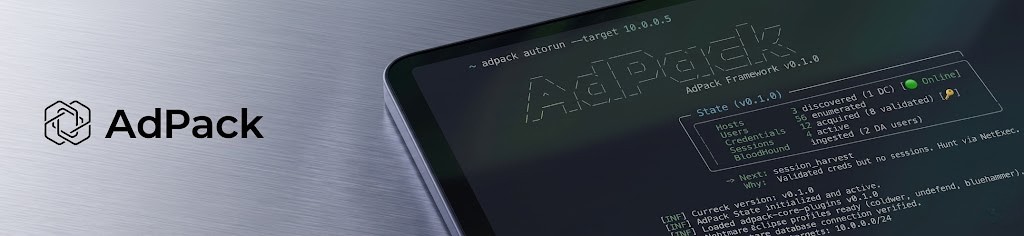
AdPack Banner

Watch it find the network, steal the keys, break the trust, and own everything — automatically

License Go Platform Version

Quick Start Features Evasion Docs Install


## Overview AdPack runs Active Directory and cloud security assessments from a single pipeline. It takes a set of starting credentials and works through each phase, tracking what it finds and figuring out what to do next. Not a checklist — it keeps going until it gets everything it can. The pipeline has three independent tracks: Every step is tracked in an encrypted SQLite database. Run `status` to see what it has found, `next` to see what it can try next, and `autorun` to chain everything together. ### Quick Start git clone https://github.com/Yenn503/AdPack.git cd adpack && ./setup.sh && source ~/.bashrc # Automated attack chain — seed creds, execute privesc paths adpack autorun --target 10.0.0.5 \ --domain corp.local \ --user jsmith --password 'Password1' \ --execute --skip-fail ### Example Output

adpack autorun demo against DREAD-GOAD light VMs (3 VMs, 2 forests)

### Manual Workflow adpack status # View current state and gaps adpack run discovery -t 10.0.0.5 # Find domain controllers adpack run enumeration -t 10.0.0.5 # Enumerate users and computers adpack run credential_acq -t 10.0.0.5 # Extract credentials adpack validate # Test creds across protocols adpack run lateral -t 10.0.0.6 # Lateral movement See [USAGE.md](docs/USAGE.md) for the full command reference. ## Features ### Orchestration - Tracks state across phases so you know what's been done and what's left - `autorun` chains phases together, `--resume` picks up where you left off - `--dry-run` previews actions before running them - Scope enforcement via CIDR whitelist in config - TUI dashboard via `adpack interactive` ### Credential Operations - Credential dump: nanodump+pypykatz, falls back to nxc SAM/LSA - AV kill after SYSTEM: native reg add + sc stop + taskkill (no external binary) - Kerberoasting and AS-REP roasting with automatic hash capture - Hash cracking via hashcat (NTLM, krb5tgs, krb5asrep) - Multi-protocol validation: SMB, LDAP, WinRM, RDP - Flags admin rights and lateral movement options ### Evasion - 3 profiles: `native` (reg-based AV kill), `pplshade` (BYOVD PPL bypass), `phantomkiller` (EDR process kill) - AV kill runs automatically after SYSTEM access - Internal credential acquisition pipeline supports PPLShade, MiniPlasma, PhantomKiller as fallback stages - See the [evasion profiles table](#evasion-profiles) below ### Transport Commands run through nxc/impacket for SMB, WinRM, WMI, and MSSQL. Sliver C2 transport available for executing through implants (`internal/transport/sliver/`). Swap in custom transports for any C2. ### Cracking Extracted hashes queue into background hashcat workers. Cracked creds land in the state database and trigger privesc re-evaluation. ## Attack Phases 16 ordered phases with dependency-grounded execution: flowchart TB subgraph On-Prem["On-Prem AD"] direction TB D["01. Discovery"] --> E["02. Enumeration"] E --> CA["03. Credential Acquisition"] CA --> V["04. Validation"] CA --> SH["05. Session Harvest"] CA --> GA["06. Graph Analysis"] GA --> PR["07. Privesc"] SH --> L["08. Lateral"] PR --> PE["09. Persistence"] L --> I["10. Impact"] PE --> I end subgraph Cloud["Cloud / Entra ID"] direction TB CIA["12. Cloud Initial Access"] --> CEN["13. Cloud Enumeration"] CEN --> CCA["14. Cloud Cred Acq"] CEN --> CPR["15. Cloud Privesc"] CCA --> CPI["16. Cloud Pillage"] CPR --> CPI end CA -.-> HB["11. Hybrid Bridge"] CEN -.-> HB ## Evasion Profiles 3 profiles for credential acquisition: | Profile | What it does | When to use it | |---------|-------------|----------------| | `native` | reg add + sc stop + taskkill, then nanodump | Default — kills Defender, no extra binaries | | `pplshade` | BYOVD PPL bypass via PPLShade + LECOMAx64.sys | LSASS is PPL-protected | | `phantomkiller` | BYOVD process killer via PhantomKiller + PhantomKiller.sys | Need to kill EDR processes | ### Tool Provenance | Tool | Source | |------|--------| | nanodump | Go binary, downloaded during setup | | PPLShade | GitHub release (BYOVD) | | PhantomKiller | GitHub release (BYOVD) | | MiniPlasma | GitHub release — may require manual download | ### Pre-conditions - **native** — Nothing extra needed. Runs reg + sc + taskkill after SYSTEM. - **pplshade** — Needs `PPLShade.exe` + `LECOMAx64.sys` on target. Downloaded during setup. - **phantomkiller** — Needs `PhantomKiller.exe` + `PhantomKiller.sys` on target. Downloaded during setup. ## Environment Built on Windows + WSL2 (Ubuntu). Single Go binary — compile and drop on any Linux attack box. Windows tool binaries live in `exe/` alongside. Tested on DreadGOAD-Light (3 VMware VMs, 2 forests) and VulnAD (Docker). ## Configuration Create `adpack.yaml` in your project directory (or `~/.adpack/config.yaml`): domain: "corp.local" profile: "native" db_path: "" nmap_args: ["-T4", "-sn"] nxc_path: "netexec" bh_python: "bloodhound-python" seeds: - domain: "corp.local" user: "jsmith" password: "ChangeMe" cracking: hashcat_path: "/usr/bin/hashcat" wordlist: "/usr/share/wordlists/rockyou.txt" rules: ["/usr/share/hashcat/rules/best64.rule"] timeout_seconds: 600 # Target scope: CIDR ranges allowed for attacks (optional safety net) # scope: # - "10.0.0.0/8" # - "192.168.1.0/24" Credentials are encrypted with AES-GCM in SQLite. The key file sits next to the database — keep both on an encrypted disk with 600 perms. See [config.example.yaml](config.example.yaml) for the full reference. ## Installation ### Automated Setup git clone https://github.com/Yenn503/AdPack.git cd adpack ./setup.sh source ~/.bashrc Installs Go 1.25+, NetExec, pypykatz, nanodump, PPLShade, PhantomKiller, and the adpack binary. ~5-10 minutes. ### Manual Installation See [docs/SETUP.md](docs/SETUP.md). ## All Commands (v0.6.0) | Command | Description | |---------|-------------| | `adpack autorun` | Full automated attack chain | | `adpack run ` | Execute a single attack phase | | `adpack status` | Current state and gaps | | `adpack next` | Recommended next phase | | `adpack interactive` | TUI dashboard | | `adpack session save/load/list/delete/export/import` | Engagement session management | | `adpack kerb tgt/list/destroy/s4u` | Kerberos ticket management | | `adpack adcs find/esc1-esc13/auth` | ADCS exploitation | | `adpack zerologon check/exploit/dcsync/restore` | CVE-2020-1472 exploit | | `adpack nopac check/exploit/dcsync/scan` | CVE-2021-42278/42287 exploit | | `adpack coerce printerbug/petitpotam/dfscoerce/shadow/all` | NTLM coercion | | `adpack trust list/keys/inter-realm/sidhistory` | Domain trust attacks | | `adpack shadow ntds/ifm/parse` | NTDS.dit extraction | | `adpack gpo create/runkey/task/localadmin/find` | GPO abuse | | `adpack dpapi backupkey/masterkey/blob/vault/chrome/triage/credentials` | DPAPI decryption | | `adpack gmsa list/read` | gMSA account enumeration | | `adpack laps list` | LAPS password enumeration | | `adpack cred list/export/status/verify` | Credential inventory | | `adpack report html/md/json` | Engagement reports | | `adpack validate tools/config/setup` | Validation suite | | `adpack bloodhound collect` | BloodHound collection | | `adpack ingest` | Import tool output | | `adpack query` | Cypher queries | | `adpack initial teams/device-code/consent-phish` | Initial access (Teams/OAuth) | | `adpack cloud enum/cred-acq/privesc/pillage` | Cloud/Entra ID attacks | | `adpack phases/profiles/loot/reset` | Utility commands | | `adpack query [--preset ] [--list-presets]` | Cypher queries with preset library | ## Documentation | Doc | Description | |-----|-------------| | [USAGE.md](docs/USAGE.md) | Complete command reference, workflows, and examples | | [SETUP.md](docs/SETUP.md) | Installation guide and environment setup | | [CONTEXT.md](docs/CONTEXT.md) | Domain language, architecture, and design decisions | | [CONTRIBUTING.md](docs/CONTRIBUTING.md) | Development guidelines and contribution process | | [CHANGELOG.md](docs/CHANGELOG.md) | Release history | ## License MIT License — see [LICENSE](LICENSE)
标签:EVTX分析