
AccessFlow
Open-source database & API access governance platform
A SQL, NoSQL, and API proxy that puts review, approval, and audit between your team and production data and services.




Website ·
Live Docs ·
Quick Start ·
Design Docs
AccessFlow sits as a full query proxy in front of your databases — the relational engines PostgreSQL, MySQL, MariaDB, Oracle, and Microsoft SQL Server are supported out of the box via a declarative **connector catalog** (additional engines such as ClickHouse install with one click), any other JDBC-compatible engine can be added by uploading its driver JAR, the NoSQL document engines **MongoDB** and **Couchbase** (SQL++), the NoSQL key-value engine **Redis**, the NoSQL wide-column engines **Apache Cassandra** (CQL) and **ScyllaDB** (CQL-compatible), the NoSQL search engines **Elasticsearch** and **OpenSearch**, the NoSQL key-value engine **Amazon DynamoDB** (PartiQL), and the NoSQL graph engine **Neo4j** (Cypher over Bolt) install the same way through on-demand native engine plugins. The catalog separates the **SQL** (relational) family from the **NoSQL** umbrella of native engine-managed connectors. Every query a user submits — SQL, a MongoDB shell / JSON command, a Couchbase SQL++ statement, a Redis command, a Cassandra/ScyllaDB CQL statement, an Elasticsearch/OpenSearch query, a DynamoDB PartiQL statement, or a Neo4j Cypher statement — is parsed, classified, optionally analyzed by AI, and routed through a configurable human-approval workflow before it ever reaches live data. The same governance extends beyond databases: outbound **REST, SOAP, GraphQL, and gRPC** calls against registered API connectors run through that identical pipeline — AI risk scoring, attribute-based routing, multi-stage approval — with response masking and immutable, downloadable response snapshots. Every request, decision, and execution is captured in a tamper-evident metadata audit log. Authentication is JWT (RS256) with optional SAML 2.0 SSO and OAuth 2.0 / OIDC sign-in (built-in templates for Google, GitHub, GitHub Enterprise Server, Microsoft, GitLab, and self-managed GitLab). AccessFlow ships as a single open-source product under Apache 2.0 and is designed to run entirely inside your own infrastructure.
## Why AccessFlow
Most teams pick one of two extremes for database access:
- **Shared production credentials** — anyone with the password can run `DELETE`. Fast, but a single mistake is unbounded and there is no record of who did what.
- **Ticket-driven DBA access** — every change goes through a manual DBA queue. Safe, but slow enough that engineers route around it.
AccessFlow provides the missing middle: governed, self-service access where every query is reviewable, every approval is traceable, and AI catches the obvious problems before a human ever sees the request.
## See it in action
A glance at the day-to-day flows engineers and approvers actually use.
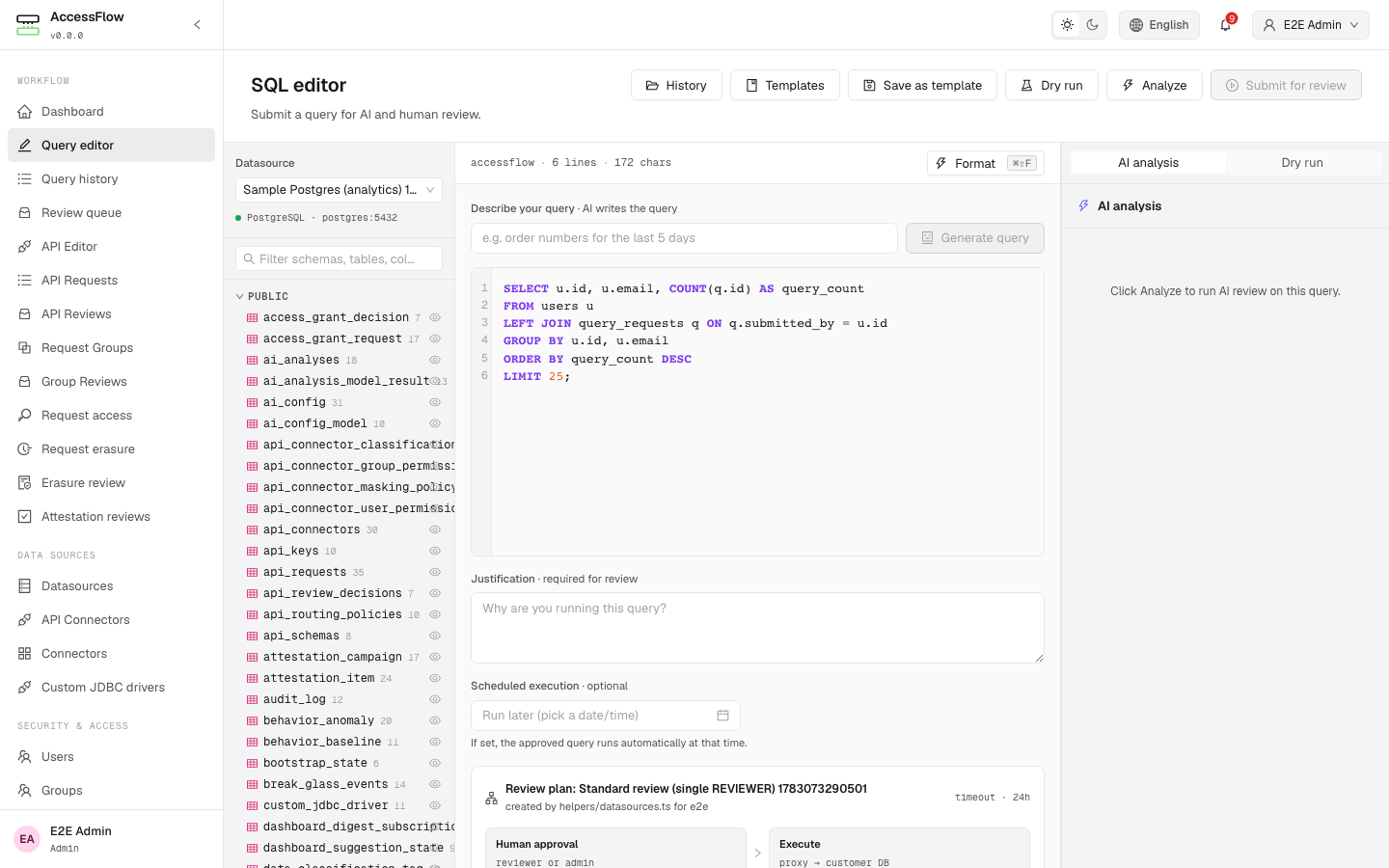
*Submit a query — CodeMirror 6 with dialect-aware highlighting, live schema autocomplete, and an inline review-plan preview that shows exactly which approvals the submission will trigger.*
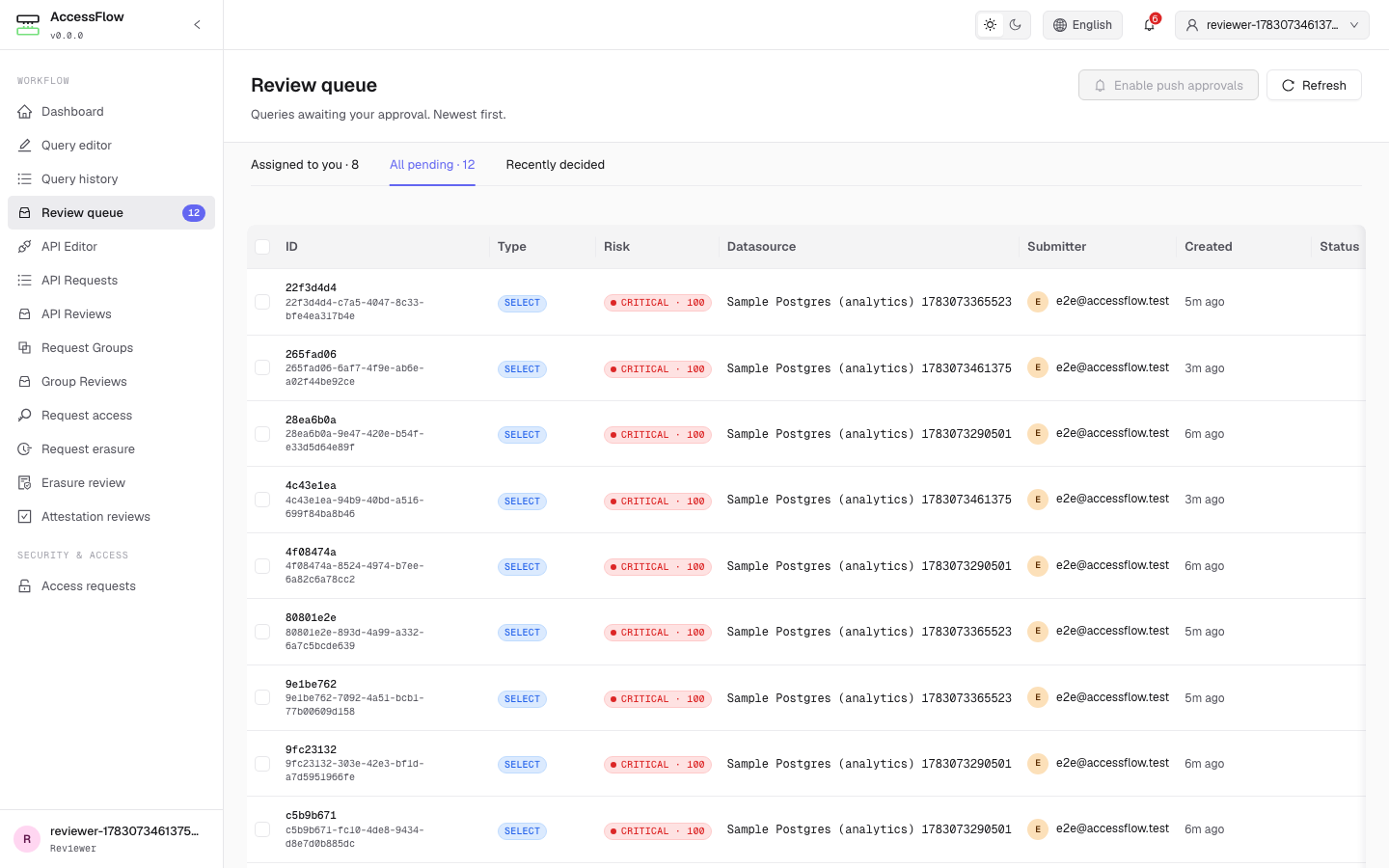
*Approve or reject pending writes from one place — the queue is scoped to queries assigned to you, with risk score, query type, and submitter at a glance. A user can never approve their own query.*
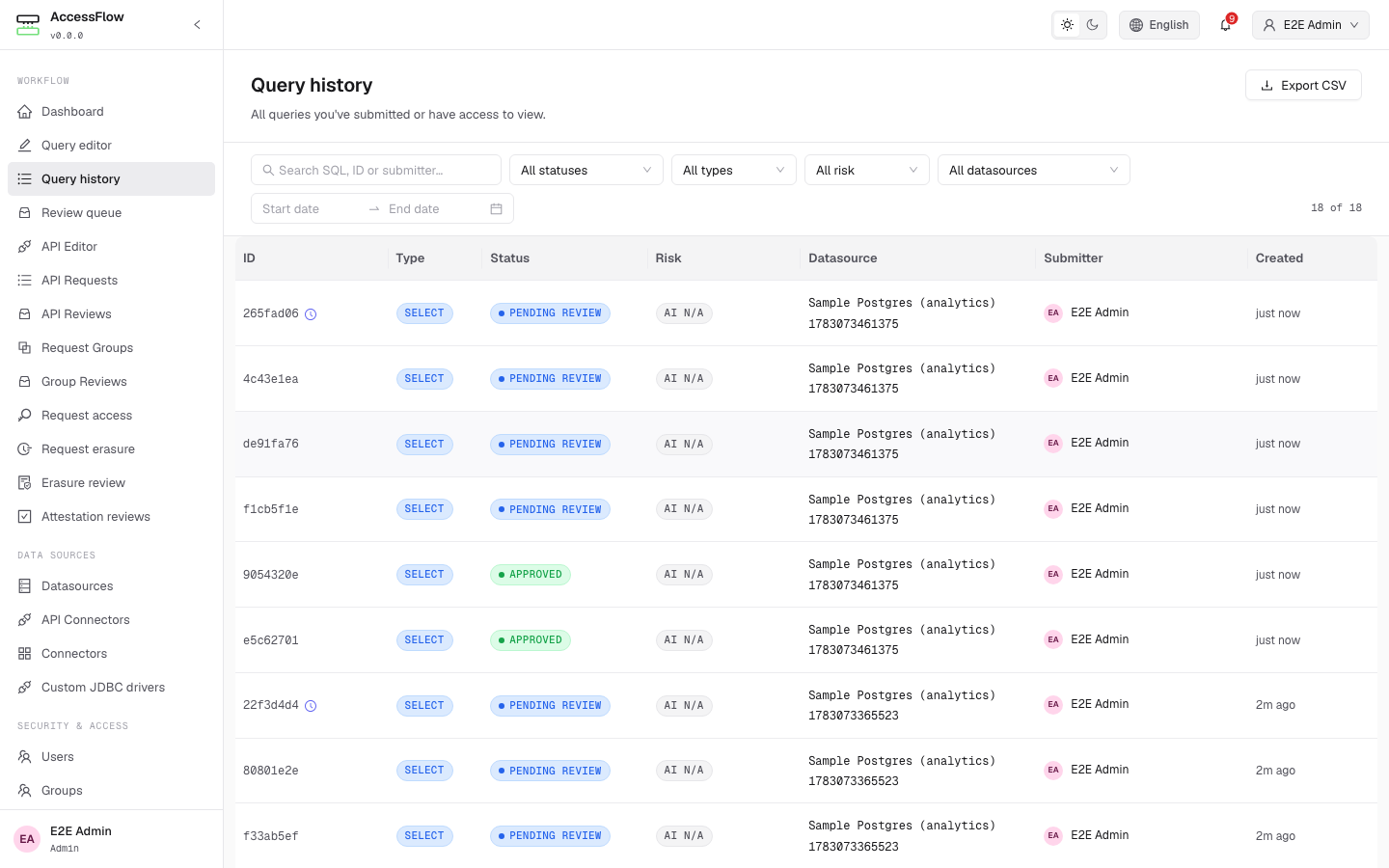
*Searchable, filterable history of every query — by status, type, risk, datasource, submitter, or date range — with CSV export. Each row links to the full request, AI analysis, approval timeline, and result set.*
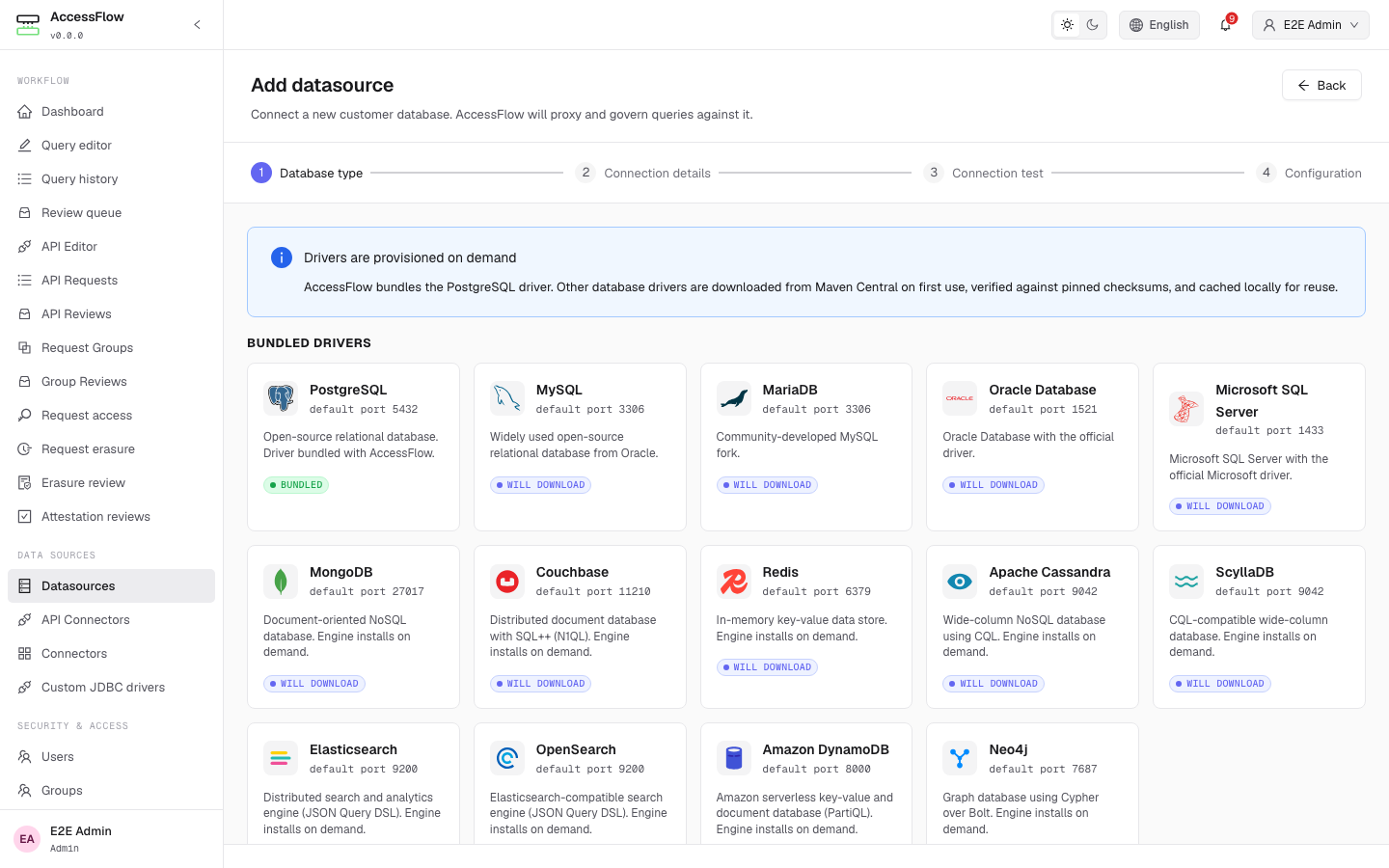
*Connect a database in the admin UI — credentials are AES-256-GCM encrypted at rest, the proxy holds them, and end users never see them.*
## Features
- **Proxy-first execution** — no user ever holds production credentials; the proxy holds them encrypted and opens connections only after approval. Single SQL statements run with autocommit; multi-statement INSERT/UPDATE/DELETE batches wrapped in `BEGIN; … COMMIT;` execute atomically inside one JDBC transaction (mixed SELECT/DML batches are rejected at parse time), with homogeneous INSERT runs collapsed into JDBC `executeBatch()` for bulk-load throughput. Optional **multi-replica read load balancing**: attach any number of replica endpoints to a datasource and SELECT traffic round-robins across the healthy ones — per-node health checks with circuit-breaker failover skip downed replicas, and only full replica-set exhaustion falls back to the primary (with an audit row). Optional **SELECT result caching**: opt a datasource into a Redis-backed result cache (per-datasource TTL) keyed over the security-rewritten query — masking and row-level security still apply — and invalidated on any proxied write to a referenced table.
- **Configurable review workflows** — per-datasource review plans, multi-stage sequential approval chains, optional auto-approve for reads, approval timeouts with auto-reject. Reviewers can be scoped **per-datasource** (directly or via groups) so different teams see only the queues that belong to them.
- **Policy-as-code routing** — ordered, attribute-based routing policies decide a query's path after AI analysis and before reviewers see it: **auto-approve**, **auto-reject**, **require N approvals**, or **escalate**. Conditions match on query type, referenced tables (glob), AI risk level / score, requester role or group, time-of-day / day-of-week, WHERE / LIMIT presence, the transactional flag, and the submission **client context** — source IP / CIDR, user-agent, time-since-last-approval, and CI/CD origin (API key or `X-AccessFlow-CI` header) — combined with AND / OR / NOT. Client-context conditions **fail closed** (missing context never auto-approves), so an off-network or stale-approval query escalates to stricter review instead. First match by priority wins; on no match the query falls through to the datasource's review plan. Every automated decision is recorded in the audit log.
- **Just-in-time (JIT) access requests** — users self-request temporary, scoped access to a datasource (read/write/DDL, optional schema/table scope) or an API connection (read/write, optional operation allow-list) for an ISO-8601 duration. Requests flow through the same approval engine, a time-boxed permission is granted on approval, and a clustered scheduler auto-revokes it on expiry (admins can also revoke early). A grant can opt into **query pre-approval**: while it is active, queries it covers skip human review and are auto-approved with the grant recorded as the approval provenance — routing policies, high-risk AI verdicts, and behavioural anomalies still override.
- **Break-glass / emergency access** — a gated emergency path for when production is on fire and approvers are asleep. A per-user/per-datasource `can_break_glass` permission (required for everyone, including admins; time-boxed) lets a query **execute immediately, bypassing review** — still through every proxy guard (allow-list, masking, row-level security, row caps). Compensating controls: a mandatory justification, instant fanout to all org admins (incl. PagerDuty), a prominently-tagged audit row, and a **mandatory retro-review** an admin (never the submitter) must acknowledge on the `/admin/break-glass` log.
- **Dynamic data masking** — per-column masking policies (full, partial last-N, stable hash, email-preserving, format-preserving) with role / group / user **reveal** conditions evaluated per requester. Masking is applied at result-read time before results are serialized or stored, so unmasked values never persist; applied policy ids are recorded in the audit log. Extends the static `restricted_columns` masking.
- **Row-level security** — per-table row predicates the proxy injects into the parsed SQL so a scoped user only sees (SELECT) or affects (UPDATE/DELETE) the rows they are authorised for. Admins author a structured `column operator value` predicate where the value is a fixed literal or a `:user.*` variable (built-in id / email / role / groups, or an admin-set per-user attribute). Values are bound as JDBC parameters — never concatenated; predicates that can't be safely applied are rejected, never run unfiltered. Composes with column masking and the schema/table allow-list.
- **Data classification tagging** — tag tables and columns as PII, PCI, PHI, GDPR, FINANCIAL, or SENSITIVE right in the schema explorer. Tagging a column auto-applies a masking policy, the AI analyzer raises a query's risk score when it touches a tagged object, and a derivation preview suggests a stricter review posture. Tags are audited and queryable org-wide as the evidence base for compliance reporting.
- **User groups** — bundle reviewers (and other users) into groups; groups can be assigned as datasource reviewers, **granted data/API access** (a whole team inherits a datasource or API-connector grant — read/write/DDL/break-glass — instead of a row per member; effective access is the most-permissive union of a user's direct and group grants), and auto-synced from SAML / OAuth2 IdP claims via per-IdP `group_mappings` (admin-managed memberships are preserved across logins).
- **AI query analysis** — pluggable adapters for OpenAI, Anthropic Claude, self-hosted Ollama, any OpenAI API–compatible backend (vLLM, LM Studio, Together, Groq, OpenRouter, …) via a custom endpoint, and Hugging Face (Inference Providers router or a local / self-hosted TGI server); risk scoring (0–100), missing-index detection, anti-pattern hints. Per-organization configuration via the admin UI, including an **editable analyzer prompt** per configuration (override the built-in template, or leave it blank to use the default); admin **AI analyses dashboard** charts average risk over time, top issue categories, and most active submitters. A per-organization **rate limit** (requests/minute, default 30) and optional **monthly token budget** cap AI usage so a runaway editor or compromised account can't drain the provider API key — enforced before every analysis call; exceedance returns HTTP 429 in the editor or records a sentinel `CRITICAL` analysis row on the async path. A per-organization **fallback pool** marks configurations (typically a local Ollama) to retry in priority order when the primary provider is unreachable — air-gap-friendly resilience without weakening any failure semantics.
- **Multi-model orchestration, voting & guardrails** — an AI configuration can run several models in parallel (the primary plus weighted `{provider, model, weight}` members — e.g. a fast local Ollama pre-score alongside a deep Claude analysis) and combine their verdicts by a configurable voting strategy (**weighted average**, **highest risk**, or **majority**); issues are merged and risk aggregated. **Guardrails** block configured prompt patterns (case-insensitive regex) before any model is called, and the strict output-schema validation rejects malformed responses without failing the query. Per-model **cost (tokens) and latency** are recorded for every analysis and charted on the admin dashboard.
- **Query-optimization suggestions** — alongside the risk verdict, the analyzer returns concrete, dialect-aware optimization suggestions: index recommendations (`CREATE INDEX …`) and query rewrites. Each suggestion has a one-click **"Apply as draft"** that pre-fills the editor with the suggested statement and routes it through the normal review pipeline — nothing auto-executes, and the draft is audited as AI-suggested.
- **Query playground / dry-run sandbox** — preview a query's impact before submitting it for review. A **Dry run** action returns the engine's execution plan (node type, estimated rows, cost, filters) and a best-effort estimated row impact **without executing or mutating data**, shown in the editor next to the AI panel. It runs through the same governance as a real execution (datasource access, table allow-list, row-level security) but creates no review. Dialect-aware across every engine with a plan concept — relational `EXPLAIN` (PostgreSQL / MySQL / MariaDB / Oracle / SQL Server), MongoDB `explain`, Couchbase / Neo4j `EXPLAIN`, Elasticsearch / OpenSearch query validation; engines without one degrade gracefully. SELECT dry-runs prefer the read replica when configured.
- **Text-to-query** — opt-in per datasource. Users describe what they want in plain language ("order numbers for the last 5 days") and the AI drafts a schema-grounded query into the editor — in the datasource engine's **native query language** (SQL for relational engines, plus MongoDB shell/JSON, Cypher, CQL, Elasticsearch Query DSL, redis-cli, SQL++, and PartiQL for the NoSQL engines). Reuses the datasource's AI configuration and is grounded in its introspected schema (restricted columns are never referenced). The generated query is only a draft — it's still submitted through the normal pipeline, so AI risk analysis and human review always apply.
- **RAG knowledge base** — opt-in per AI configuration. Attach knowledge documents (data-governance policies, naming conventions, schema notes); AccessFlow embeds them with a dedicated embedding model and, at analysis / text-to-SQL time, retrieves the most relevant chunks and injects them into the prompt — so analysis reflects your house rules. Pluggable vector store: in-app **pgvector** (self-contained, auto-provisioned where the DB role permits — and optional: AccessFlow still starts if the extension is absent, with the in-app store disabled) or external **Qdrant**. Retrieval is best-effort and never blocks analysis.
- **Langfuse integration** — optional, per-organization. Send a trace of every AI analysis (input SQL, structured output, model, token usage, latency) to [Langfuse](https://langfuse.com) for LLM observability, and/or fetch analyzer prompts from Langfuse by name at runtime (prompt management) so you can iterate on prompts without redeploying. Best-effort and non-blocking — a Langfuse outage never affects query workflow.
- **Datasource health dashboard** — admin-only `/admin/datasource-health` surfaces per-datasource HikariCP pool utilisation plus a trailing 24h summary of query volume, p50/p95 execution latency, and error count, so operators can spot pool exhaustion, slow datasources, or volume spikes. Auto-refreshes every 30s.
- **Built-in SQL editor** — CodeMirror 6 with dialect-aware highlighting, schema autocomplete from live introspection, SQL formatter, and inline AI hint markers.
- **Schema exploration** — a searchable object tree (filter across schemas, tables, and columns), an entity-relationship diagram, and on-demand **sample-row previews** for any table that are row-level-security- and masking-aware, so masked columns never reveal raw values in the preview.
- **Query templates library** — save frequently used queries (private or team-visible) with tags and `:placeholder` substitution, then load them straight into the editor and share them across the team. Every save records an immutable **version**, so you can review how a query evolved with a side-by-side Git-style diff and restore any prior revision.
- **Real-time collaborative editing** — co-author a query that's in review with the submitter and reviewers (VS Code Live Share / Google Docs style): live presence, remote cursors, conflict-free CRDT merge over the existing `/ws`, and inline comment threads anchored to the SQL (persisted and audited). Edits re-enter the workflow through the normal submit path, so approval guarantees are never weakened.
- **Query result diffing** — re-running the same query links the run to its previous execution and surfaces the delta in `rows_affected`, row count, and execution time, so reviewers can spot drift between repeated runs.
- **Immutable query snapshots & replay** — every executed query writes a sanitized, exact-replay-capable snapshot (SQL, schema fingerprint, AI verdict, approval decisions). A **Replay in test environment** action re-runs that exact SQL against a chosen test datasource through the full review workflow — validating engine + referenced-table compatibility, never skipping approval, and distinctly audited (`trigger=replay`).
- **Access recertification campaigns** — schedule recurring attestation campaigns (org- or datasource-scoped) that **snapshot** current standing datasource grants into per-grant items and notify the eligible reviewers. Reviewers certify or revoke each item from a worklist that reuses the review-queue patterns (self-review blocked, bulk-certify); a **revoke** routes through the normal permission-revoke path. Two clustered-safe scheduled jobs open campaigns on their cadence and close them at the due date, applying a configurable `KEEP` / `REVOKE` default to anything still pending, and a completed campaign exports as CSV **evidence** (who reviewed what, decisions, timestamps) for SOC2 / ISO 27001 audits — every transition landing in the tamper-evident audit log.
- **External secrets managers** — keep datasource credentials in **HashiCorp Vault**, **AWS Secrets Manager**, or **Azure Key Vault** instead of the built-in encryption layer: store a secret reference (`vault:
/#`, `aws:[#jsonField]`, `azure:`) in place of the password and AccessFlow resolves it through the store at connection time — enabling central rotation, cloud-native identity (IRSA, workload identity, Vault AppRole/Kubernetes auth with automatic token renewal), and a per-resolve audit trail. Local AES-256-GCM encryption remains the default and fallback.
- **Tamper-evident audit log** — INSERT-only table chained with HMAC-SHA256; INSERT-only DB grants make after-the-fact rewrites detectable.
- **Backup, restore & disaster recovery** — the Helm chart ships an opt-in nightly `pg_dump` CronJob (retention-pruned PVC, optional rclone upload to S3/GCS/anything) and a one-shot restore Job that preserves the audit-role ownership split; a startup flag re-verifies **every organization's audit HMAC chain** after a restore, and a documented DR runbook covers backup, restore, and failover.
- **Compliance reporting** — pre-built reports over a period for audit evidence: a **classified-data-access** report (which executed queries touched PII/PCI/PHI/GDPR/FINANCIAL/SENSITIVE objects) and a **regulatory audit trail** of DDL/DELETE operations with approver names, computed from the immutable query snapshots. Reports export as **digitally signed** PDF/CSV (verifiable offline with the published public key) whose hash is chained into the tamper-evident audit log. A dedicated read-only **Auditor** role exposes the auditor dashboard.
- **Behavioral anomaly detection (UBA)** — a clustered-safe background job builds rolling per-`(user, datasource)` behavioural baselines from the audit log alone (never query result data) and flags out-of-pattern activity — query volume, off-hours access, distinct/new tables, query types, rows returned, and error rate — using z-score detection with a robust IQR fallback. Each anomaly carries an optional AI natural-language explanation, **escalates the flagged user's next query** via a routing condition, fires a notification (incl. PagerDuty), and surfaces on an `/admin/anomalies` dashboard where an admin can acknowledge or dismiss it. Auditors can review anomalies read-only.
- **Personalized dashboard** — the default post-login home (`/dashboard`) gives every user a self-scoped view of what's waiting on them: pending approvals as a reviewer, their recent queries with status/risk trend sparklines, an actionable AI optimization-suggestion backlog (dismissable, one-click "open in editor"), and their own behavioural-anomaly alerts. Widgets are customizable — show/hide, collapse, and drag-and-drop reorder, persisted across sessions. The week's summary is exportable on demand as a **digitally signed** PDF/CSV, and an opt-in **weekly email digest** delivers it on a schedule.
- **Observability** — OpenTelemetry OTLP trace export of the full proxy pipeline (parse → AI analyze → pool acquire → execute) to Tempo / Jaeger / Honeycomb, Prometheus metrics at `/actuator/prometheus`, and two pre-built Grafana dashboards (shipped via the Helm chart) covering query volume, approval SLAs, AI usage/cost, rejection rates, and connection-pool stats. Structured JSON logging (logstash / ECS / GELF) with a `traceId` correlated across logs, error responses, and traces.
- **Real-time updates** — single WebSocket at `/ws` fans review-queue, status, and AI-analysis events to connected clients.
- **Notifications** — Email (SMTP), Slack, Discord, Telegram, Microsoft Teams, PagerDuty, and HMAC-signed outbound webhooks with retry policy. **ServiceNow & Jira ticketing**: auto-create an incident/issue when a query is rejected, escalated, or times out awaiting review, with linked tickets on the query detail page and signed inbound webhooks syncing ticket status back — a ticket resolution can even approve/reject the pending query (bi-directional sync).
- **Slack approve/reject** — a configured Slack app adds **Approve** / **Reject** buttons to review-request messages; the decision runs through the same self-approval and RBAC guards as the REST API (HMAC-verified Interactive Components).
- **Mobile approvals (PWA) with one-tap push** — install AccessFlow as a Progressive Web App with an offline-capable review queue, and get **Web Push** notifications when a query needs your approval. Approve or reject in one tap — the decision only commits after a **step-up re-verification** (password, or TOTP when 2FA is on), and the self-approval guard is enforced server-side on every channel.
- **Identity & SSO** — JWT access tokens (15 min) + HttpOnly refresh cookies, optional SAML 2.0 SSO, OAuth 2.0 / OIDC sign-in with built-in templates for Google, GitHub, GitHub Enterprise Server, Microsoft, GitLab, and self-managed GitLab plus a generic `OIDC` provider for other IdPs (Keycloak, Auth0, Okta, Authentik, Zitadel), password reset and user-invitation flows.
- **Custom roles (RBAC)** — compose org-scoped roles from a fixed catalog of functional permissions (submit SELECT/DML/DDL, review queries / access requests / API calls, manage datasources, view the audit log, …) via a permission-matrix UI, and assign them alongside the five immutable built-in roles — e.g. a reviewer who can approve queries but not manage users. Enforcement is permission-based end to end (JWT permission claims → `PERM_*` authorities → UI gating), and role-targeted policies (masking reveals, row security, routing, approver rules) match custom roles by name.
- **Multi-tenant organization management** — a single deployment hosts one or more fully-isolated organizations (every entity is scoped by org, always derived from the JWT). A super-admin (`platform_admin`) manages tenants across the cluster — create, edit, disable / enable — with **per-org quotas** (`max_datasources`, `max_users`, `max_queries_per_day`; a breach returns `409 QUOTA_EXCEEDED`) and a disabled-org kill-switch that blocks login and requests immediately.
- **MCP server** — built-in Spring AI MCP server exposes a stateless tool surface so external AI agents can submit queries through the same review pipeline, and also discover schemas, validate SQL without executing it, read masking- and row-security-aware sample data, monitor their queries, and review their own audit trail.
- **Connector catalog** — supported databases are described declaratively in a repo-root `connectors/` folder (one manifest + logo per connector), not hardcoded. Each connector carries a `category` (`RELATIONAL` for the SQL family; `DOCUMENT`, `KEY_VALUE`, `WIDE_COLUMN`, `SEARCH`, or `GRAPH` for the NoSQL umbrella) and the marketplace groups them into SQL and NoSQL sections accordingly. Admins browse the **Connectors** marketplace and install a relational database's JDBC driver with one click (downloaded + SHA-256-verified + cached); engines beyond the built-in five (e.g. ClickHouse) install the same way. **MongoDB**, **Couchbase**, **Redis**, **Apache Cassandra**, **ScyllaDB**, **Elasticsearch**, **OpenSearch**, **Amazon DynamoDB**, and **Neo4j** are native (non-JDBC) engine-managed connectors whose engines ship as on-demand **plugin JARs** (`engines/mongodb/`, `engines/couchbase/`, `engines/redis/`, `engines/cassandra/` — the Cassandra plugin serves both Cassandra and ScyllaDB; `engines/elasticsearch/` — the Elasticsearch plugin serves both Elasticsearch and OpenSearch; `engines/dynamodb/`; `engines/neo4j/`), downloaded + verified through the same catalog pipeline. The catalog ships in the image and is also published as a release artifact.
- **MongoDB (NoSQL)** — a first-class document connector. Users write MongoDB queries in either the familiar shell form (`db.users.find({ age: { $gt: 21 } })`) or a JSON command document, selectable in the editor; results render in both a JSON document view and a flattened table view. The same governance applies — AI risk analysis, human approval, row-level security (`$match` injection), and field masking.
- **Couchbase (NoSQL)** — a first-class document connector speaking **SQL++ (N1QL)**, shipped as the second on-demand engine plugin (`engines/couchbase/`). SQL++ statements get SQL-style highlighting and formatting in the editor, classify onto the same approval workflow, and run with row-level security ANDed into the WHERE clause (named parameters, fail-closed on unrewritable shapes) plus field masking; dangerous constructs (`CURL()`, JavaScript UDFs, `system:*` keyspaces) are rejected up front.
- **Redis (NoSQL key-value)** — a first-class key-value connector, shipped as the third on-demand engine plugin (`engines/redis/`, native Jedis driver). Users submit redis-cli commands (`GET user:42`, `HGETALL session:abc`, `SCAN 0 MATCH orders:* COUNT 100`) classified onto the same approval workflow; field masking applies to returned hash fields / values. Row-security policies on a Redis datasource fail closed (row predicates have no key-value meaning), and server-side scripting / blast-radius commands (`EVAL`, `CONFIG`, `FLUSHALL`, `SHUTDOWN`, …) are rejected at submission.
- **Cassandra & ScyllaDB (NoSQL wide-column)** — first-class wide-column connectors speaking **CQL**, shipped as the fourth on-demand engine plugin (`engines/cassandra/`, native DataStax Java driver); the same plugin JAR serves both **Apache Cassandra** and the CQL-compatible **ScyllaDB**. CQL statements classify onto the same approval workflow (SELECT / INSERT / UPDATE / DELETE plus `CREATE`/`ALTER`/`DROP` and `TRUNCATE`); row-level security is key-aware and fails closed — predicates splice into the WHERE clause only on partition/clustering key columns with CQL-filterable operators (`=, IN, <, <=, >, >=`), and a non-key column, `!=`/`NOT IN`, or INSERT into a policied table is rejected rather than injecting `ALLOW FILTERING`, plus field masking on returned columns. Server-side code (`BEGIN … BATCH`, `CREATE`/`DROP FUNCTION`/`AGGREGATE`) is rejected up front. Each datasource sets its load-balancing `local_datacenter`.
- **Elasticsearch & OpenSearch (NoSQL search)** — first-class search connectors, shipped as the fifth on-demand engine plugin (`engines/elasticsearch/`, low-level REST client); the same plugin JAR serves both **Elasticsearch** and the wire-compatible **OpenSearch**. Users write a JSON query envelope (`{"search":"logs-*","query":{…}}`, plus `count`, `get`/`mget`, `index`/`bulk`, `update_by_query`/`delete_by_query`, and index management) classified onto the same approval workflow; row-level security injects `bool.filter` clauses on keyword fields (fail-closed on writes into a policied index), and field masking applies recursively to `_source` fields including nested dot-paths. Server-side scripting (`script`, `runtime_mappings`, Painless) and cluster/system-index APIs are rejected up front. Each datasource authenticates with basic auth or an API key.
- **Amazon DynamoDB (NoSQL key-value)** — a first-class key-value connector speaking **PartiQL**, shipped as the sixth on-demand engine plugin (`engines/dynamodb/`, AWS SDK for Java v2 over the url-connection HTTP client — no Netty). It is the first engine whose connection is **cloud credentials + region** rather than host/port: the region, access key id, secret access key, and an optional custom endpoint (DynamoDB Local / VPC) map onto the existing datasource fields. PartiQL SELECT / INSERT / UPDATE / DELETE classify onto the same approval workflow, and table management (`CreateTable`/`DeleteTable`/`UpdateTable`) arrives as a JSON command document; transaction/batch statements are rejected. Row-level security splices predicates into the PartiQL WHERE clause (positional parameters, any attribute), failing closed on INSERT-into-policied and deny-all, and field masking applies recursively by dot-path including nested maps/lists.
- **Neo4j (NoSQL graph)** — a first-class graph connector speaking **Cypher** over Bolt, shipped as the seventh on-demand engine plugin (`engines/neo4j/`, native Neo4j Java driver). Cypher is clause-based, so the query type is the strongest write clause present (DELETE/REMOVE → DELETE, CREATE/MERGE → INSERT, SET → UPDATE, else a `MATCH … RETURN` / `SHOW` read → SELECT), with index/constraint/database/role schema commands as DDL; `LOAD CSV`, procedure calls outside a read-only allow-list, and multi-statement input are rejected up front. Row-level security ANDs property predicates onto each `MATCH`'s `WHERE` (Cypher named parameters, node-label policies), failing closed on anonymous / write-creates-policied-label shapes; field masking is label-aware and recursive. Connection is host/port + database with the SSL mode encoded in the Bolt scheme, **or** a full `bolt://` / `neo4j+s://` URI (Neo4j Aura / clustered routing).
- **API Access Governance (AF-500)** — govern outbound **API** calls (REST / SOAP / GraphQL / gRPC), not just databases. An admin registers an **API connector** (URL + auth + protocol + admin-defined default headers; secrets AES-256-GCM encrypted) — including **OAuth2 with automatic token fetch, caching & refresh** (client-credentials / refresh-token / resource-owner password), so no bearer token is pasted by hand — uploads its schema (OpenAPI / WSDL / GraphQL SDL / gRPC proto, by paste, file upload, or URL fetch) which is parsed into a normalized operation catalog with read/write classification, and shares governed connectivity with the team via per-user permissions. Users **compose calls like Postman** — query params, custom headers, raw / form-data / x-www-form-urlencoded / binary file bodies. Every call flows through the same machinery as a database query: AI risk scoring, attribute-based routing, multi-stage human approval (no self-approval), **connector-level response masking** (policies targeting a schema field, JSON path, XML/XPath, or regex — with a masking strategy and role / group / user reveal scoping) and **data-classification tags** (PII/PCI/PHI/GDPR/FINANCIAL/SENSITIVE that auto-derive a masking policy and raise the AI risk — AF-518), immutable response snapshots (downloadable in full), W3C trace-context propagation (filterable by trace/span id), break-glass, scheduled execution, and natural-language **text-to-API**. See [`docs/17-api-governance.md`](https://github.com/bablsoft/accessflow/blob/main/docs/17-api-governance.md).
- **Request chaining & grouping (AF-501)** — bundle several steps into one **grouped request** reviewed and approved as a single element, then executed as an **ordered sequence**. Members can mix **queries** across different datasources and **API calls** against governed connectors; a builder lets you add steps, drag-reorder them, and author each one in a **full-parity editing drawer** — query steps get the complete Query Editor surface (schema autocomplete, AI analyze, dry-run, text-to-SQL, templates), API steps the complete API Editor surface (operation picker, request composer, AI analyze, text-to-API) — with an aggregate risk badge, and saved **drafts re-open for editing** without losing the composed request. Bundling never weakens a member's policy: each member is validated against your permission for its target (break-glass groups require `can_break_glass` on **every** target), the required approvers are the **union** across all member plans, and the group is approved only when **every** member plan is satisfied — the submitter can never approve their own group. On execute, members run in order; on the first failure the run stops and the rest are skipped (`continue-on-error` runs them all instead). There is **no distributed rollback** — an approved group is not atomic, already-applied members stay, and this is surfaced clearly. Each member records its own snapshot + audit row alongside group-level audit and live WebSocket progress.
- **Data Lifecycle Manager (AF-499, AF-519)** — govern not just *who reads* data, but *when it is retired*. Admins define **retention/erasure rules** per datasource — target a table / column set / classification tag with a retention window plus **arbitrary conditions** (a structured, parameter-bound predicate builder and a JSqlParser-validated raw-`WHERE` escape hatch) and an action (**hard-delete**, **soft-delete**, or **pseudonymize**) — with an optional **cron schedule**, a clustered scan job, a **dry-run preview**, and **automatic execution** through the proxy. Any user can file a GDPR/CCPA **right-to-erasure** request with the *same* rich configuration; it flows through AI-assisted scope detection and **review-plan-based peer review** (REVIEWER-eligible, multi-stage, no self-approval, auto-reject on timeout) before executing. Enforcement is transparent: soft-deleted rows vanish from reads, `DELETE`s become marker updates, and aged PII resolves to an irreversible **salted hash** at read time — so aggregates survive while the PII does not — all with tamper-evident **proof-of-deletion** audit records and a retention-adherence compliance report.
- **Deploy anywhere** — `docker compose up` for local and small environments; Helm chart for Kubernetes production.
- **Infrastructure as Code** — an official **Terraform / OpenTofu provider** (`bablsoft/accessflow`) and reusable **GitHub Actions** + **GitLab CI template** manage datasources, review plans, routing / row-security / masking policies, AI configs, and notification channels declaratively over the REST API. Pipelines authenticate with a bootstrap-provisioned **service-account API key**. See [`docs/16-iac.md`](https://github.com/bablsoft/accessflow/blob/main/docs/16-iac.md).
## Architecture (at a glance)
AccessFlow is a single Spring Boot 4 application organized as Spring Modulith modules — six logical subsystems share one process, one Postgres, and one Redis but communicate strictly through events and exposed API packages:
- **Proxy** — parses, validates, and executes queries against customer databases: SQL via per-datasource HikariCP pools, MongoDB / Couchbase / Redis / Cassandra / ScyllaDB / Elasticsearch / OpenSearch / DynamoDB / Neo4j via on-demand engine plugins (`engines/mongodb/`, `engines/couchbase/`, `engines/redis/`, `engines/cassandra/`, `engines/elasticsearch/`, `engines/dynamodb/`, `engines/neo4j/` — per-datasource native clients behind the `core.api.QueryEngine` SPI).
- **Workflow** — review-plan state machine, approval chains, scheduled timeout auto-reject.
- **AI Analyzer** — Spring AI–backed adapters resolved per organization from the `ai_config` row.
- **Notifications** — async dispatcher fanning events to Email, Slack, Discord, Telegram, Microsoft Teams, PagerDuty, ServiceNow / Jira ticketing, and outbound webhooks.
- **Audit** — INSERT-only, HMAC-chained record of every domain event.
- **Compliance** — pre-built compliance reports and signed PDF/CSV exports over the immutable query snapshots, gated to the read-only Auditor role.
- **Realtime** — WebSocket fan-out for the React SPA.
For the full request flow, technology stack table, and component-level diagrams, see [`docs/02-architecture.md`](https://github.com/bablsoft/accessflow/blob/main/docs/02-architecture.md).
## Tech Stack
| Layer | Stack |
|-------|-------|
| Backend runtime | Java 25, virtual threads |
| Backend framework | Spring Boot 4, Spring Modulith 2, Spring Security, Spring Data JPA, Spring AI 2.0 |
| Internal database | PostgreSQL 18 |
| Migrations | Flyway |
| Target databases | **SQL:** PostgreSQL, MySQL, MariaDB, Oracle, Microsoft SQL Server, ClickHouse via the declarative connector catalog (one-click driver install) — plus any JDBC-compatible engine via an admin-uploaded custom driver JAR. **NoSQL:** MongoDB, Couchbase, Redis, Apache Cassandra, ScyllaDB, Elasticsearch, OpenSearch, Amazon DynamoDB, and Neo4j (native engine plugins, installed on demand) |
| Frontend | React 19, Vite 8, TypeScript 6, Ant Design 6, CodeMirror 6, Yjs (collaborative editing) |
| Server state | TanStack Query 5 |
| Client state | Zustand 5 |
| Cache & locks | Redis 8 (JWT refresh-token revocation, ShedLock locks for `@Scheduled` jobs) |
| AI backends | OpenAI, Anthropic, Ollama, any OpenAI-compatible endpoint, Hugging Face (Inference Providers router or local TGI) (admin-configurable per organization) |
| Auth | JWT RS256 + optional SAML 2.0 SSO and OAuth 2.0 / OIDC (Google, GitHub, GitHub Enterprise Server, Microsoft, GitLab, self-managed GitLab built in) |
| Observability | Micrometer Tracing + OpenTelemetry (OTLP export), Prometheus metrics (Actuator), pre-built Grafana dashboards, structured JSON logging |
| Deploy | Docker Compose, Helm 3 |
| Infrastructure as Code | Official Terraform / OpenTofu provider (Go, terraform-plugin-framework) + reusable GitHub Actions and a GitLab CI template |
Library versions in `backend/pom.xml` and `frontend/package.json` are pinned to the latest stable at the time of merge; see `CLAUDE.md` for the dependency-bump rule.
## Quick Start
### Try it in Docker (zero-config demo)
The only prerequisite is Docker Desktop. From a fresh clone:
git clone https://github.com/bablsoft/accessflow.git
cd accessflow
docker compose up -d # pulls Postgres + Redis + the released backend & frontend images
open http://localhost:5173 # the SPA detects the empty DB and walks you through /setup
The setup wizard creates the first organization and admin user — no `.env`, no key generation, no Maven, no npm.
### Develop from source
For the hot-reload dev loop you'll also need:
- JDK 25 (e.g. `sdk install java 25-tem`)
- Node.js 20 LTS
The dev compose boots just the infrastructure (Postgres + Redis + a fake SMTP inbox at ) so it can coexist with `./mvnw spring-boot:run` and `npm run dev`:
docker compose -f backend/docker-compose-dev.yml up -d # Postgres + Redis + Mailcrab
Then in two more terminals:
cd backend && ./mvnw spring-boot:run
cd frontend && npm install && npm run dev
The API comes up on `http://localhost:8080` and the SPA on `http://localhost:5173`. Required environment variables (`DB_PASSWORD`, `ENCRYPTION_KEY`, `JWT_PRIVATE_KEY`, …) are documented in [`docs/09-deployment.md`](https://github.com/bablsoft/accessflow/blob/main/docs/09-deployment.md) and the env-var table in [`CLAUDE.md`](https://github.com/bablsoft/accessflow/blob/main/CLAUDE.md).
### Running released images
Tagged releases are published to GitHub Container Registry as multi-arch (`linux/amd64`, `linux/arm64`) images:
docker pull ghcr.io/bablsoft/accessflow-backend:1.2.3
docker pull ghcr.io/bablsoft/accessflow-frontend:1.2.3
# or :latest
The running backend exposes its version at `GET /actuator/info` (`build.version`); the frontend shows it under the brand mark in the sidebar. Maintainers cut a release by running the [`Release` workflow](https://github.com/bablsoft/accessflow/actions/workflows/release.yml) from the Actions tab with a semver `version` input — see [`docs/09-deployment.md → Releases`](https://github.com/bablsoft/accessflow/blob/main/docs/09-deployment.md#releases) for what the pipeline does.
### Install on Kubernetes (Helm)
Each release also publishes a Helm chart to the repo at `https://bablsoft.github.io/accessflow`:
helm repo add accessflow https://bablsoft.github.io/accessflow
helm repo update
# Create the required secrets first — see charts/accessflow/README.md
helm install accessflow accessflow/accessflow \
--namespace accessflow --create-namespace \
--values my-values.yaml
The chart bundles optional `bitnami/postgresql` and `bitnami/redis` subcharts (toggle off
for production with `postgresql.enabled=false` / `redis.enabled=false`) and ships a single
Ingress that dispatches `/api`+`/ws` → backend, `/` → frontend.
For GitOps deployments, the chart can also seed the organization, first admin user, review
plans, AI configs, datasources, SAML, OAuth2 providers, notification channels, and system
SMTP from `values.yaml` (with sensitive fields routed through Kubernetes Secrets) — see
[`docs/09-deployment.md → Bootstrap configuration`](https://github.com/bablsoft/accessflow/blob/main/docs/09-deployment.md#bootstrap-configuration).
Full reference: [`charts/accessflow/README.md`](https://github.com/bablsoft/accessflow/blob/main/charts/accessflow/README.md)
and [`docs/09-deployment.md`](https://github.com/bablsoft/accessflow/blob/main/docs/09-deployment.md).
## Project Structure
accessflow/
├── backend/ # Spring Boot 4 application (single Maven module, Spring Modulith)
│ ├── src/main/java/com/bablsoft/accessflow/
│ │ ├── core/ # Domain entities, repositories, shared service contracts
│ │ ├── proxy/ # SQL proxy engine, JDBC connection management
│ │ ├── workflow/ # Review state machine, approval chains, scheduled jobs
│ │ ├── access/ # JIT time-bound access requests + grant-expiry job
│ │ ├── ai/ # Spring AI adapters (OpenAI / Anthropic / Ollama / Hugging Face)
│ │ ├── security/ # JWT, Spring Security filters, SAML 2.0 SSO
│ │ ├── notifications/ # Email / Slack / Webhook / Discord / Telegram / MS Teams / PagerDuty / ServiceNow / Jira dispatchers
│ │ ├── audit/ # INSERT-only, HMAC-chained audit log
│ │ ├── compliance/ # Compliance reports + signed PDF/CSV exports (AF-459)
│ │ └── mcp/ # Stateless MCP server for AI agents
│ └── pom.xml
├── engines/ # On-demand engine plugins — engines/mongodb/, engines/couchbase/, engines/redis/, engines/cassandra/, engines/elasticsearch/, engines/dynamodb/, engines/neo4j/ (shaded QueryEngine SPI jars)
├── terraform-provider/ # Terraform / OpenTofu provider (Go) — released to a dedicated terraform-provider-accessflow mirror repo
├── ci-templates/ # Reusable GitLab CI template + usage examples (GitHub Actions live in .github/actions/)
├── frontend/ # React 19 + Vite + TypeScript SPA (Ant Design 6, TanStack Query, Zustand)
├── connectors/ # Declarative connector catalog (one connector.json + logo per database)
├── e2e/ # Playwright end-to-end suite + docker-compose.e2e.yml (own npm project)
├── docs/ # Authoritative design documentation
├── website/ # Public marketing site (static HTML/CSS/JS, no build step)
├── docker-compose.yml # Local infrastructure (Postgres + Redis)
├── CLAUDE.md # Agent-facing rulebook (read before changing code)
└── README.md
## Documentation
| File | Description |
|------|-------------|
| [`docs/01-overview.md`](https://github.com/bablsoft/accessflow/blob/main/docs/01-overview.md) | Executive summary, problem statement, goals, non-goals |
| [`docs/02-architecture.md`](https://github.com/bablsoft/accessflow/blob/main/docs/02-architecture.md) | System architecture, service descriptions, technology stack |
| [`docs/03-data-model.md`](https://github.com/bablsoft/accessflow/blob/main/docs/03-data-model.md) | Entity schemas, columns, enums, indexes |
| [`docs/04-api-spec.md`](https://github.com/bablsoft/accessflow/blob/main/docs/04-api-spec.md) | REST endpoints, WebSocket events, payload examples |
| [`docs/05-backend.md`](https://github.com/bablsoft/accessflow/blob/main/docs/05-backend.md) | Modulith layout, proxy engine, workflow state machine, AI analyzer, scheduled jobs |
| [`docs/06-frontend.md`](https://github.com/bablsoft/accessflow/blob/main/docs/06-frontend.md) | Frontend structure, routing, state management, SQL editor |
| [`docs/07-security.md`](https://github.com/bablsoft/accessflow/blob/main/docs/07-security.md) | Auth, RBAC matrix, credential encryption, audit integrity |
| [`docs/08-notifications.md`](https://github.com/bablsoft/accessflow/blob/main/docs/08-notifications.md) | Event types; Email, Slack, Webhook, Discord, Telegram, Microsoft Teams, PagerDuty, ServiceNow, and Jira channel config; ticketing bi-directional sync; signed payload schema |
| [`docs/09-deployment.md`](https://github.com/bablsoft/accessflow/blob/main/docs/09-deployment.md) | Docker Compose, Helm, environment-variable reference |
| [`docs/11-development.md`](https://github.com/bablsoft/accessflow/blob/main/docs/11-development.md) | Local setup, testing strategy, coding standards, Git workflow |
| [`docs/12-roadmap.md`](https://github.com/bablsoft/accessflow/blob/main/docs/12-roadmap.md) | v1.0 → v2.x milestone scope |
| [`docs/13-mcp.md`](https://github.com/bablsoft/accessflow/blob/main/docs/13-mcp.md) | MCP server, user API keys, exposed tools |
| [`docs/14-connectors.md`](https://github.com/bablsoft/accessflow/blob/main/docs/14-connectors.md) | Declarative connector catalog — manifests, install lifecycle, release artifacts |
| [`docs/15-engine-sdk.md`](https://github.com/bablsoft/accessflow/blob/main/docs/15-engine-sdk.md) | Engine-plugin SDK — authoring guide for native (non-JDBC) engines |
| [`docs/16-iac.md`](https://github.com/bablsoft/accessflow/blob/main/docs/16-iac.md) | Infrastructure as Code — Terraform/OpenTofu provider, CI Actions, service-account API keys, registry publishing |
| [`docs/17-api-governance.md`](https://github.com/bablsoft/accessflow/blob/main/docs/17-api-governance.md) | API Access Governance — govern outbound REST/SOAP/GraphQL/gRPC calls (connectors, schema ingestion, permissions; review/AI pipeline planned) |
## Testing & Quality Gates
Both halves of the codebase ship with strict coverage gates enforced by CI.
**Backend:**
cd backend
./mvnw verify -Pcoverage # full build + tests + JaCoCo coverage
./mvnw test -Dtest=ApplicationModulesTest # Spring Modulith boundary check
JaCoCo enforces ≥ 90 % line coverage; the `ApiPackageDependencyTest` ArchUnit check refuses third-party imports inside any `/api/` package; `ApplicationModulesTest` refuses cross-module reaches into `internal/` packages.
**Frontend:**
cd frontend
npm run lint
npm run typecheck
npm run test:coverage # Vitest, ≥ 90 % line / ≥ 80 % branch on included modules
npm run build
**End-to-end:**
cd e2e
npm ci
npx playwright install --with-deps chromium
npm run stack:up # builds backend + frontend, brings up Postgres + Redis, waits on healthchecks
npm test # Playwright auth-flow suite against http://localhost:5173
npm run stack:down
npm run test:setup # first-run setup-wizard spec against a no-admin variant stack (ports 5174 / 8081)
See [`docs/11-development.md`](https://github.com/bablsoft/accessflow/blob/main/docs/11-development.md) for the full testing strategy and `CLAUDE.md` for the per-class coverage-parity rule.
## License
Apache License 2.0.