numdav/forensicnova
GitHub: numdav/forensicnova
ForensicNova是一款基于OpenStack的虚拟机内存取证分析工具。
Stars: 1 | Forks: 0
# ForensicNova
**DevStack plugin for forensically sound RAM acquisition and analysis of OpenStack guest VMs — hypervisor-level memory imaging, append-only chain of custody, Volatility 3 analysis, MISP threat-intelligence enrichment, on-demand operator-signable PDF reporting.**
ForensicNova extends a stock OpenStack deployment with a dedicated digital-forensics service for Incident Response on tenant virtual machines. It acquires guest RAM at the hypervisor layer (zero footprint inside the guest), computes integrity hashes in streaming fashion on the hypervisor, persists the dump in Swift with end-to-end ETag verification, securely wipes the staging copy, and maintains an append-only chain-of-custody journal. The image is then analysed by a companion service that runs Volatility 3 (with `fast`, `full`, and `custom` presets) and correlates the extracted indicators of compromise against a MISP threat-intelligence instance, producing a deterministic threat score per analysis (green / yellow / red), attribution to known actors / tools / ATT&CK techniques, and a feed-aware provenance record. The whole evidence chain — acquisition, analysis, intelligence — is presented through a Horizon panel group (the recommended UI) and through a per-acquisition operator-signable PDF designed for printed countersignature and legal hand-off.
The intelligence extracted from the memory image is the core deliverable: the PDF and the dashboard are the two complementary views of that intelligence and stay aligned field by field.
ForensicNova is the M.Sc. thesis project for the Sicurezza Informatica e Tecnologie Cloud degree programme at the University of Salerno (ISISLab). It originated as coursework for the Piattaforme di Cloud Computing course and was extended into a full DFIR pipeline.
## Table of contents
- [Forensic soundness](#forensic-soundness)
- [Architecture](#architecture)
- [Quick start](#quick-start)
- [Horizon dashboard](#horizon-dashboard)
- [Standalone Flask dashboard (legacy/backup)](#standalone-flask-dashboard-legacybackup)
- [REST API](#rest-api)
- [JSON report schemas](#json-report-schemas)
- [Forensic PDF report](#forensic-pdf-report)
- [Detection capability](#detection-capability)
- [Known limitations](#known-limitations)
- [Roadmap](#roadmap)
- [License](#license)
## Forensic soundness
ForensicNova's evidence-handling pipeline is additionally aligned with
**ISO/IEC 27037:2012** (adopted in Italy as **UNI CEI EN ISO/IEC 27037:2017**),
the reference standard for the identification, collection, acquisition, and
preservation of digital evidence. ForensicNova operates entirely as a
**digital chain of custody**: no physical device is ever seized, so the evidence
exists only as the acquired image and its derived analyses — exactly the case the
standard contemplates when collection of the original device is not possible. The
acquisition workflow maps onto the standard's process model — identification
(operator-driven selection of the target Nova instance), acquisition (out-of-band
libvirt `coreDumpWithFormat()`, a *bitstream copy* produced without ever accessing
the guest filesystem), and preservation (Swift storage with end-to-end ETag
verification, secure deletion of the staging copy, and an append-only chain of
custody) — and satisfies the standard's four handling principles:
- **Auditability** — every pipeline action is recorded in the append-only
chain-of-custody journal with the Keystone operator identity and a microsecond
UTC timestamp, so an independent assessor (a court-appointed expert or an
opposing technical consultant) can reconstruct and evaluate the full sequence of
actions.
- **Repeatability / Reproducibility** — ISO/IEC 27037 explicitly recognises that
some evidence, *volatile memory included*, cannot be re-acquired, and that the
responder must instead make the acquisition reliable and fully documented.
ForensicNova does exactly this: it hashes on the hypervisor before any transfer,
verifies end-to-end against Swift, and re-verifies at analysis time
(triple-witness). The downstream *analysis* of the preserved image is itself
repeatable and reproducible — given the stored dump, the recorded Volatility 3
version, and the documented preset, a third party reaches the same result, while
the triple-witness check guarantees the analysed bytes are identical to the
acquired bytes.
- **Justifiability** — every methodological choice is documented and defensible:
out-of-band acquisition as a natural write-blocker, two independent hash
algorithms (MD5 + SHA-1) for redundancy as recommended by digital-forensics best
practice, an empirically-tuned anti-noise filter, and a deterministic,
human-readable threat score.
This places ForensicNova within the wider ISO digital-evidence framework: the
acquisition and preservation stages follow **ISO/IEC 27037**, while the analysis
and interpretation stage aligns with the goals of **ISO/IEC 27042** (validity,
repeatability, and reproducibility of the analytical process). Where NIST
SP 800-86 frames the full incident-response forensic process (collection,
examination, analysis, reporting), the ISO 27037 / 27042 pair governs evidence
handling and analysis specifically; ForensicNova follows both natively.
Six guarantees are implemented and individually traceable in the chain-of-custody log:
| # | Guarantee | Implementation |
|---|---|---|
| 1 | **Zero bits written inside the guest** | Acquisition via libvirt `coreDumpWithFormat()` reading `/proc//mem` on the hypervisor. No driver, agent, or hypervisor-side write reaches the guest OS. |
| 2 | **Hardened staging directory** | Temporary dump lands in `/var/lib/forensicnova/acquisitions//`, directory mode `0700`, dump file mode `0600`, owned by the service user `stack:stack`. Never in `/tmp`, never on the guest filesystem. |
| 3 | **Hashes computed on the hypervisor, before any transfer** | MD5 + SHA-1 — two independent algorithms for redundancy, following digital-forensics best practice for collision-risk reduction — computed in streaming over 64 KB chunks directly from the staging file. Computing the digest on the hypervisor *before* any transfer satisfies the integrity requirement of the **ISO/IEC 27037** acquisition phase and aligns with the data-integrity guidance of **NIST SP 800-86**'s Collection phase. Neither standard prescribes a specific algorithm; the choice of MD5 + SHA-1 follows established forensic practice. |
| 4 | **End-to-end ETag integrity check with Swift** | On `PUT`, Swift returns a server-side MD5. For single-object uploads the local MD5 is compared byte-for-byte; for Static Large Object uploads (≥ 4 GiB), a composite ETag is computed per segment and verified against the server response. Mismatch → pipeline aborted, the chain-of-custody flags `etag_verified: false` and the staging copy is preserved for debugging. |
| 5 | **Secure delete of the staging copy** | Once the upload is verified, the local dump is destroyed via `shred -u -n 1`. The hypervisor never retains a recoverable residue. |
| 6 | **Append-only chain of custody** | All pipeline events are written to `/var/log/forensicnova/chain-of-custody.jsonl` as JSON lines, with ISO-8601 UTC timestamps to microsecond precision and the Keystone operator identity attached to every event. The journal is the authoritative audit log and is also embedded in the final JSON report. |
## Architecture
The deployment is a monorepo that wires **three DevStack services** plus an **external MISP threat-intelligence lab** that the plugin does not manage. Five systemd units are expected to be active in the demo configuration: `devstack@forensicnova` (acquisition backend on `:5234`), `devstack@forensicnova-analyzer` (analyzer backend on `:5235`), `apache2` (host for the Horizon dashboard, which runs as an Apache-served Django application), `docker` (container runtime for the MISP lab stack), and a standalone `forensicnova-misp.service` (the operator-managed MISP `docker compose` lifecycle). Two Swift containers hold all forensic evidence: `forensics` (acquisition reports, raw dumps, Volatility analyses, MISP analyses) and `forensics_segments` (per-segment SLO storage for dumps ≥ 4 GiB). Two Keystone services advertise the backends in the catalog: `dfir` (type `dfir`, the acquisition API) and `dfir-analyzer` (type `dfir-analyzer`, the analyzer API). A dedicated role `forensic_analyst` gates every authenticated endpoint, and the user `dfir-tester` is granted the `forensic_analyst` role on the `forensics` project plus an `admin` grant on every project so the operator can acquire RAM from any compromised VM without pre-knowing the tenant.
flowchart TD
%% Style Definitions
classDef actor fill:#eceff1,stroke:#37474f,stroke-width:2px;
classDef api fill:#e8f5e9,stroke:#2e7d32,stroke-width:1px;
classDef pipe fill:#e3f2fd,stroke:#1565c0,stroke-width:1px;
classDef storage fill:#fff3e0,stroke:#ef6c00,stroke-width:2px;
classDef external fill:#fce4ec,stroke:#c2185b,stroke-width:1px;
%% Operator Layer
subgraph OPERATOR_LAYER ["OPERATOR / DFIR ANALYST"]
Op["browser / curl / scripts"]
end
class Op actor;
%% Dashboards Layer
subgraph DASHBOARDS_LAYER ["DASHBOARDS"]
DB["Horizon - DFIR panel group (official UI)
&
Flask - :5234 (backup, acq.)"] end Op -->|HTTP / Keystone X-Auth-Token| DB %% API & Auth Layer subgraph API_LAYER ["API LAYER"] AcqAPI["Acquisition API
:5234/api/v1"] AnAPI["Analyzer API
:5235/api/v1"] end class AcqAPI,AnAPI api; DB --> AcqAPI DB --> AnAPI Keystone["Keystone
• role: forensic_analyst
• dfir/dfir-analyzer"] class Keystone external; AnAPI <-->|authN / authZ| Keystone AcqAPI <-->|authN / authZ| Keystone %% Pipelines Layer subgraph PIPELINES ["PIPELINES"] subgraph ACQ_PIPE ["ACQUISITION PIPELINE"] P1["1 libvirt coreDump
(raw, no guest writes)"] P2["2 MD5 + SHA-1
(streaming 64 KB)"] P3["3 Nova/Glance/libvirt metadata"] P4["4 Swift upload
+ ETag/SLO verify"] P5["5 secure delete shred
(only if verified)"] P1 --> P2 P2 --> P3 P3 --> P4 P4 --> P5 end subgraph AN_PIPE ["ANALYSIS PIPELINE"] A1["triple-witness hash
coherence check"] A2["Volatility 3
(fast/full/custom)"] A3["MISP IOC enrichment
(extract/correlate / threat score)"] A1 --> A2 A2 --> A3 end end class P1,P2,P3,P4,P5,A1,A2,A3 pipe; AcqAPI --> P1 AnAPI --> A1 MISP["MISP server
(external, CIRCL OSINT feed)"] class MISP external; A3 <-->|IOC lookup| MISP %% Storage Layer (Evidence Locker) subgraph SWIFT_LAYER ["SWIFT - EVIDENCE LOCKER"] Swift["Containers: forensics + forensics_segments
===
• RAM dump (.raw)
• acquisition report JSON v1.2
• Volatility JSON
• MISP JSON (+ threat score)"] end class Swift storage; P5 -->|dump + report v1.2| Swift A3 -->|Volatility + MISP JSON| Swift %% Footnote 1 Swift -.->|Reads verified dump back
before each analysis| A1 %% Final Output PDF["PDF FORENSIC REPORT
(operator-signable, on-demand)"] Swift -->|report + analyses| PDF %% Chain of Custody Log CoC["[Log] Chain of custody:
Append-only JSONL log"] P1 -.-> CoC P2 -.-> CoC P3 -.-> CoC P4 -.-> CoC P5 -.-> CoC CoC -.->|Embedded in
acquisition report| Swift **Crash isolation between backends.** The acquisition backend (`:5234`) and the analyzer backend (`:5235`) are deployed as separate Flask processes with separate virtualenvs (`.venv` and `.venv-analyzer`). A Volatility 3 crash on a malformed dump cannot interrupt an in-flight acquisition; an analyzer restart does not affect the acquisition pipeline; the two have independent systemd lifecycles and independent Keystone catalog entries. The Horizon dashboard plugin discovers both via Keystone catalog lookup and never hardcodes `host:port`. ## Quick start ### Prerequisites - Ubuntu 24.04 LTS host with hardware virtualization (KVM) - DevStack `master` branch, tested against `2026.2` - Python 3.12 - `stack` user with NOPASSWD sudo, membership in `libvirt` and `kvm` groups - (Optional, for analyses) a reachable MISP instance — the plugin does **not** deploy MISP; see [MISP lab service](#misp-lab-service-external-not-managed-by-the-plugin) below ### `local.conf` snippet The minimal lines needed to enable ForensicNova on top of an existing DevStack `local.conf`. For a fully-commented working example see [`local.conf.example`](local.conf.example) at the root of this repository. [[local|localrc]] ADMIN_PASSWORD=secret DATABASE_PASSWORD=$ADMIN_PASSWORD RABBIT_PASSWORD=$ADMIN_PASSWORD SERVICE_PASSWORD=$ADMIN_PASSWORD HOST_IP=
SERVICE_HOST=$HOST_IP
MYSQL_HOST=$SERVICE_HOST
RABBIT_HOST=$SERVICE_HOST
GLANCE_HOSTPORT=$SERVICE_HOST:9292
# Cinder off, Swift on (forensic artifacts live in object storage)
disable_service cinder c-api c-sch c-vol
enable_service s-proxy s-object s-container s-account
SWIFT_HASH=change_me_to_a_random_string
SWIFT_REPLICAS=1
SWIFT_DATA_DIR=/opt/stack/data/swift
# Size the Swift loopback to accommodate forensic dumps + their SLO segments.
# The DevStack default (~6 GB) is too small for any acquisition above 4 GB
# of RAM. 30 GB gives room for several acquisitions of an 8 GiB guest plus
# their analysis JSONs.
SWIFT_LOOPBACK_DISK_SIZE=30G
LIBVIRT_TYPE=kvm
# ForensicNova plugin
FORENSICNOVA_DFIR_PASSWORD=
enable_plugin forensicnova https://github.com/numdav/forensicnova main
Replace `` with the password you want to assign to the `dfir-tester` user. Replace `` with the IP address of your DevStack host. Set `SWIFT_HASH` to any random string of your choice — it must be stable across reboots of the same deployment.
The single `enable_plugin forensicnova` line enables **three** DevStack services from the same monorepo:
- `forensicnova` — the acquisition Flask REST backend on `:5234` (Keystone service type `dfir`)
- `forensicnova-analyzer` — the analyzer Flask REST backend on `:5235` (Keystone service type `dfir-analyzer`), runs Volatility 3 and the MISP enricher
- `forensicnova-dashboard` — the Horizon panel plugin
To deploy a subset, add `disable_service forensicnova-analyzer` and/or `disable_service forensicnova-dashboard` below the `enable_plugin` line.
### MISP lab service (external, not managed by the plugin)
[misp]
url = https://127.0.0.1:10443
auth_key =
verify_cert = false
timeout_seconds = 30
File permissions: `0600`, owner `stack:stack`. The `auth_key` is the per-user API key generated from the MISP web UI (Administration → List Auth Keys → New). `verify_cert = false` is appropriate for the lab because MISP ships a self-signed certificate; production deployments would set it to `true` with a CA bundle. `timeout_seconds` bounds each MISP query and lets the enricher degrade gracefully (log + skip the IOC) when the network is slow rather than blocking the whole pipeline.
Without this file the acquisition pipeline still works end-to-end and Volatility 3 analyses run; only the MISP enrichment analyzer fails fast on first invocation with a clear `MISP config not found` error.
### Stack and validate
cd /opt/stack/devstack
./stack.sh
Once the stack completes, verify the plugin is running. **Five systemd units** are expected active in the demo configuration:
# Five systemd units active (the last one only if MISP is deployed)
systemctl is-active devstack@forensicnova \
devstack@forensicnova-analyzer \
apache2 docker forensicnova-misp.service
# Health endpoints
curl http://:5234/health
# {"service":"forensicnova","status":"ok","version":"..."}
curl http://:5235/health
# {"service":"forensicnova-analyzer","status":"ok","version":"0.1.0"}
# Keystone service catalog
openstack service show dfir -f value -c type # dfir
openstack service show dfir-analyzer -f value -c type # dfir-analyzer
### Access the dashboards
ForensicNova ships two operator UIs. The recommended one is the Horizon panel group, which covers the whole pipeline (acquisitions + analyses). The standalone Flask UI is a legacy of the project's earliest phase and only covers acquisitions; it is kept deployed as a backup.
**Horizon dashboard** (recommended). Open `http:///dashboard/` in a browser. After logging in as `dfir-tester`, expand the **DFIR** entry in the left sidebar to reach the **Forensics** panel group with three panels: **Acquisitions**, **Analyses**, **New acquisition**. See [Horizon dashboard](#horizon-dashboard) for the full panel-by-panel description.
**Standalone Flask dashboard (legacy)** at `http://:5234/dashboard/`. Covers acquisitions only. Useful as a fallback when the Horizon plugin is disabled. See [Standalone Flask dashboard (legacy/backup)](#standalone-flask-dashboard-legacybackup).
Credentials in both cases:
- **Username**: `dfir-tester`
- **Password**: the one set via `FORENSICNOVA_DFIR_PASSWORD`
- **Project**: `forensics`
## Horizon dashboard
The Horizon plugin registers a top-level **DFIR** dashboard in the OpenStack web console, with a **Forensics** panel group exposing three panels. It is installed in editable mode (`pip install -e`) into Horizon's venv at plugin extra-phase and registers its panels via `_9NNN_*.py` drop-ins under `/opt/stack/horizon/openstack_dashboard/local/enabled/`. The dashboard discovers both backend endpoints via Keystone catalog lookup (service types `dfir` and `dfir-analyzer`); no `host:port` is hardcoded anywhere.
### Acquisitions panel
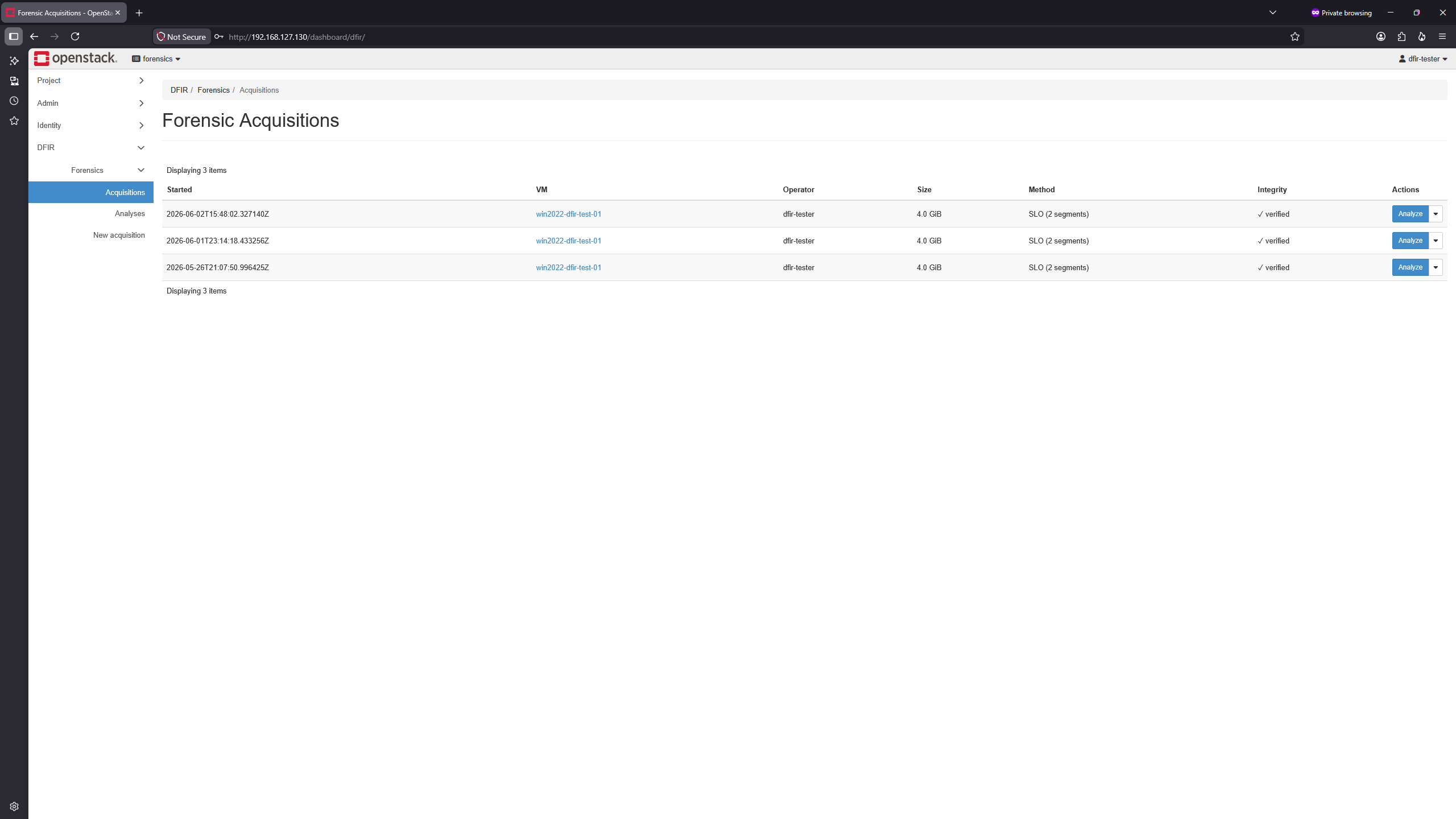
Lists every acquisition stored in the `forensics` Swift container, one row per acquisition. Columns: start time, VM name, operator, dump size (humanized), upload method (`single_put` for dumps < 4 GiB, or `slo` with a segment count for larger dumps verified end-to-end), and integrity status. Per-row actions: **Analyze** (trigger a Volatility 3 job on this acquisition), download PDF, download JSON, download raw dump.
Clicking a row opens the acquisition detail:
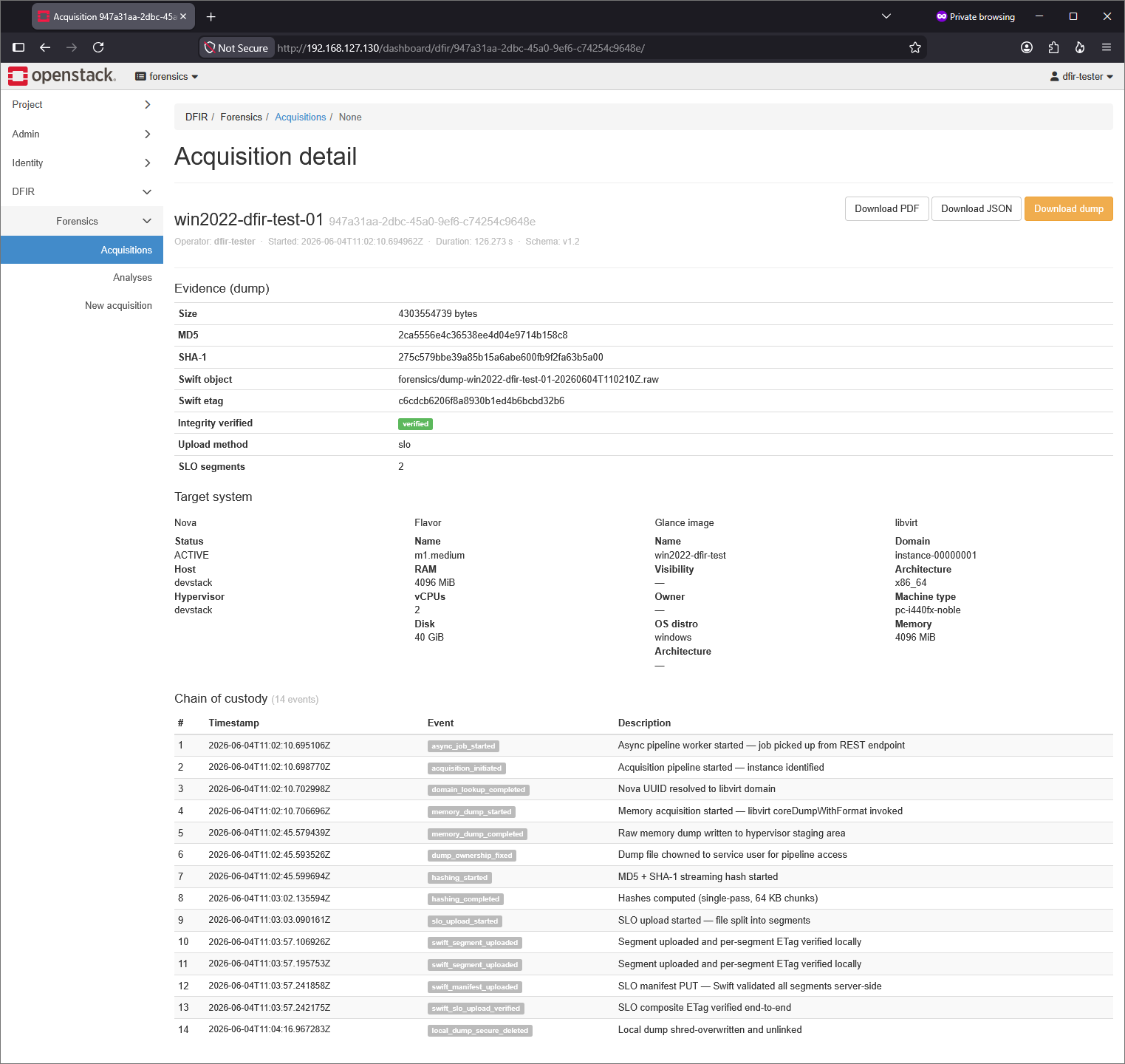
The detail view renders the full JSON report (schema v1.2): timestamps with microsecond precision, full `target_system` block (Nova + Glance + libvirt XML), dump metadata with both hashes and the verified Swift ETag, the complete chain of custody as an ordered event timeline, and the per-segment SLO listing for large dumps.
### New acquisition panel
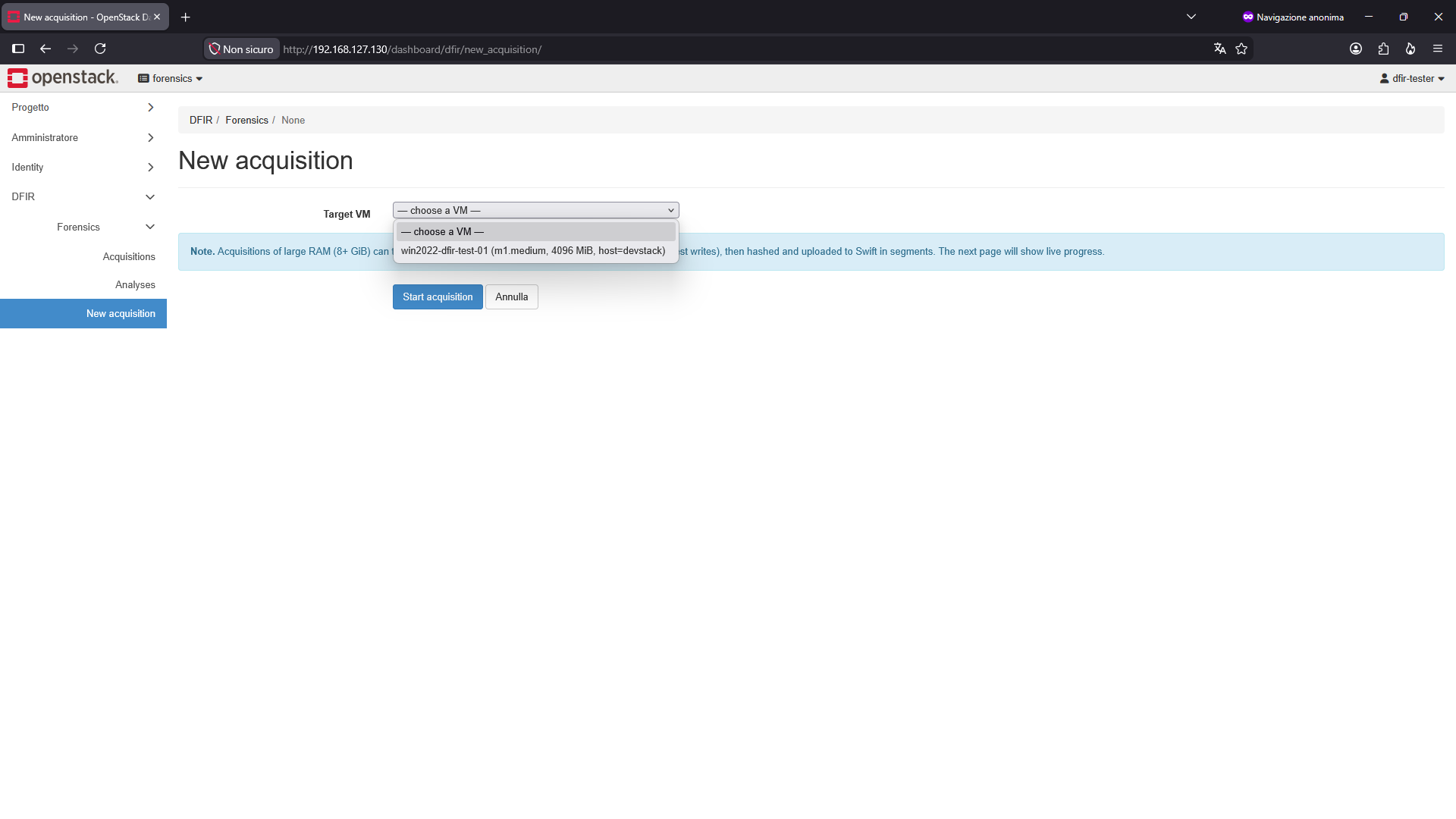
A form with a single dropdown listing all Nova instances visible to the analyst — cross-tenant, because `dfir-tester` carries the `admin` role on every project (see [Known limitations](#known-limitations)). Inactive (non-ACTIVE) instances are listed in the dropdown with a clear non-ACTIVE label but are rejected on submit with a validation error, because libvirt's coreDumpWithFormat() requires a running domain.
Submitting the form triggers the async pipeline and redirects to a watch page that polls `/api/v1/jobs/` every 2 seconds, showing live status, the current human-readable phase label (e.g. `"Uploading dump (segment 2 of 3)"` for SLO acquisitions), and elapsed seconds:
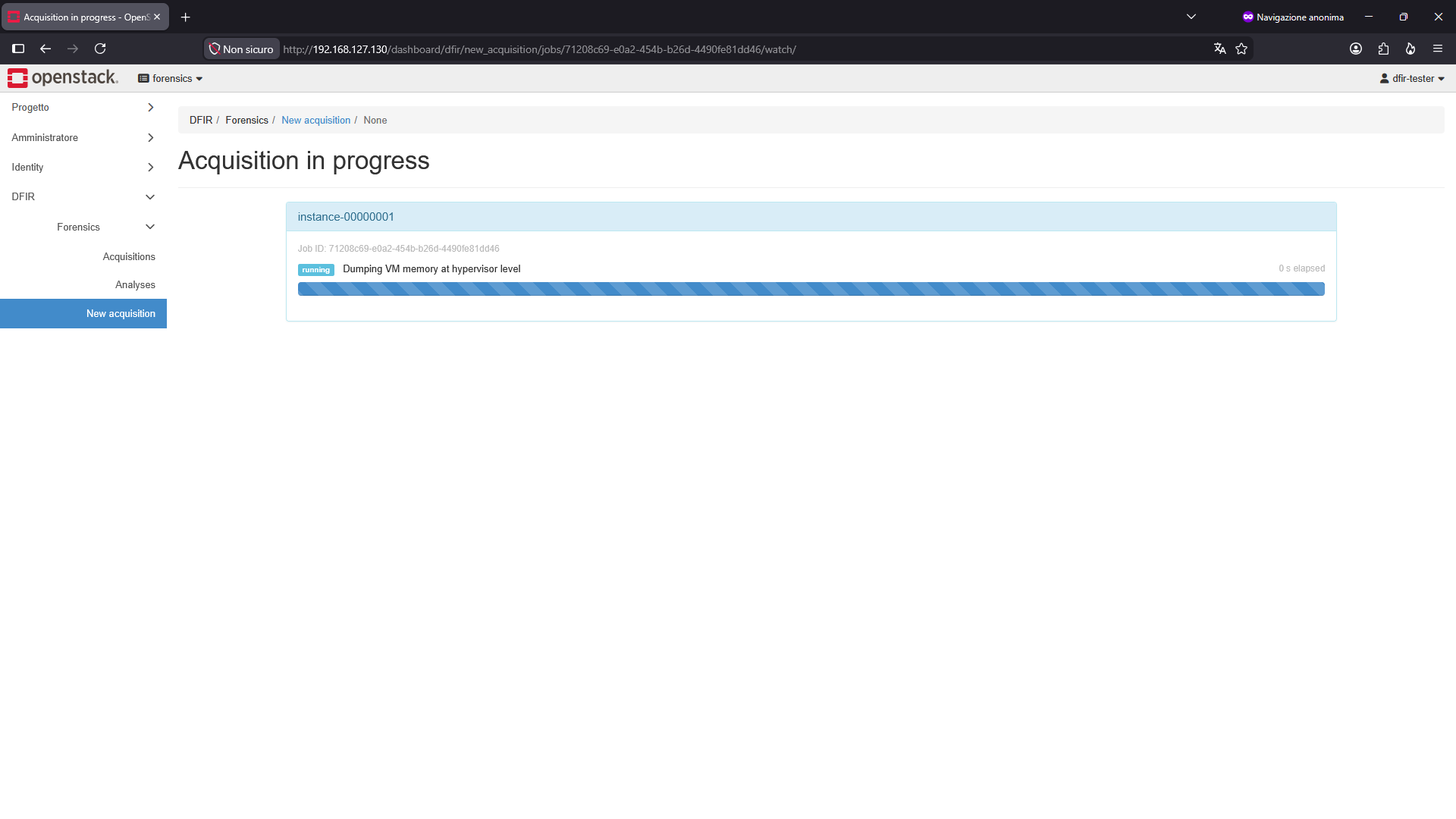
On completion the browser is redirected to the acquisition detail page; on failure, the error message from the backend is displayed inline.
### Analyses panel
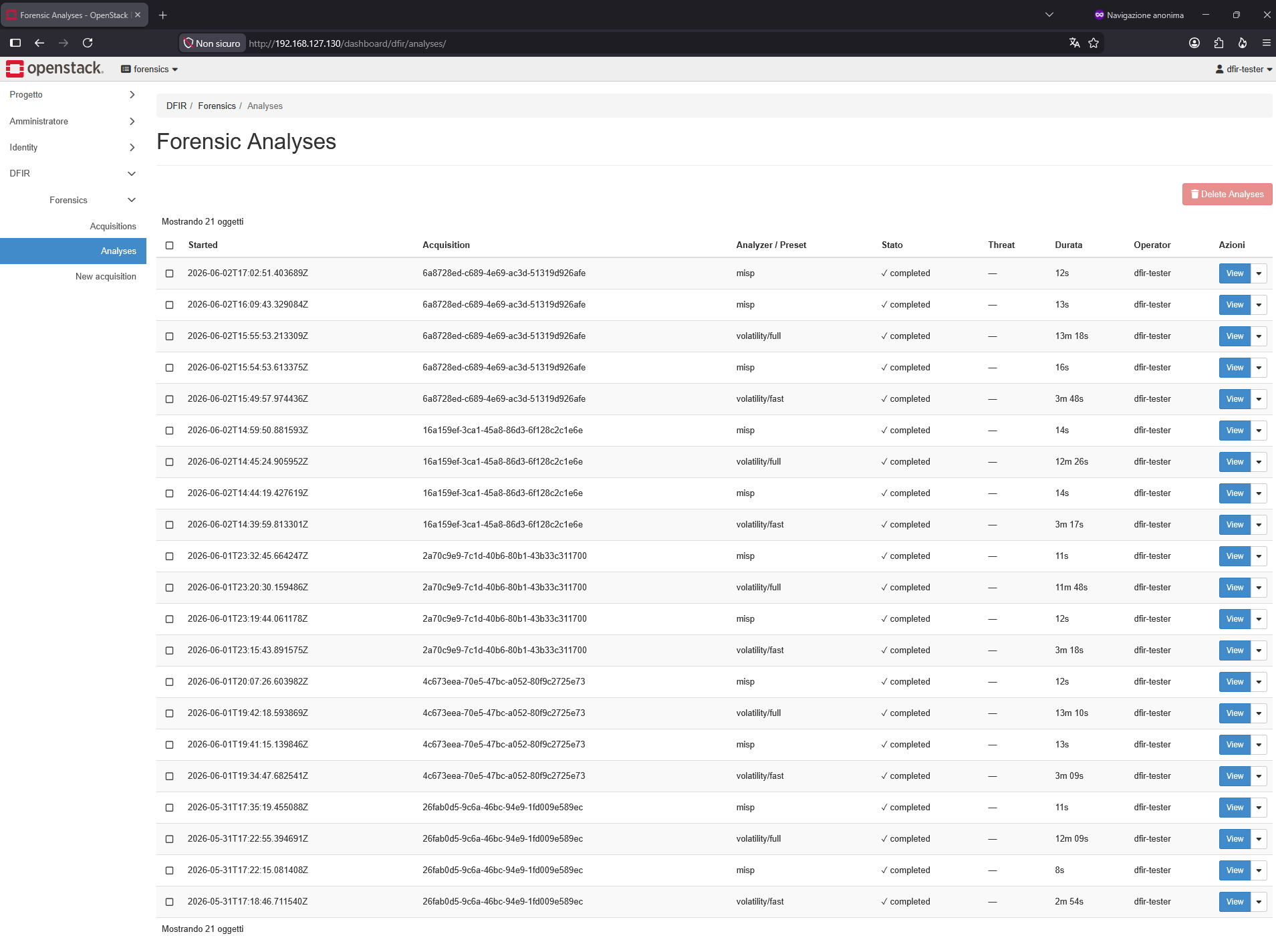
Lists every analysis (Volatility 3 or MISP enrichment) stored in the `forensics` Swift container. Columns: started timestamp, parent acquisition (UUID prefix), analyzer + preset, status, threat score (for MISP enrichments), duration, operator. Per-row action: open the detail page.
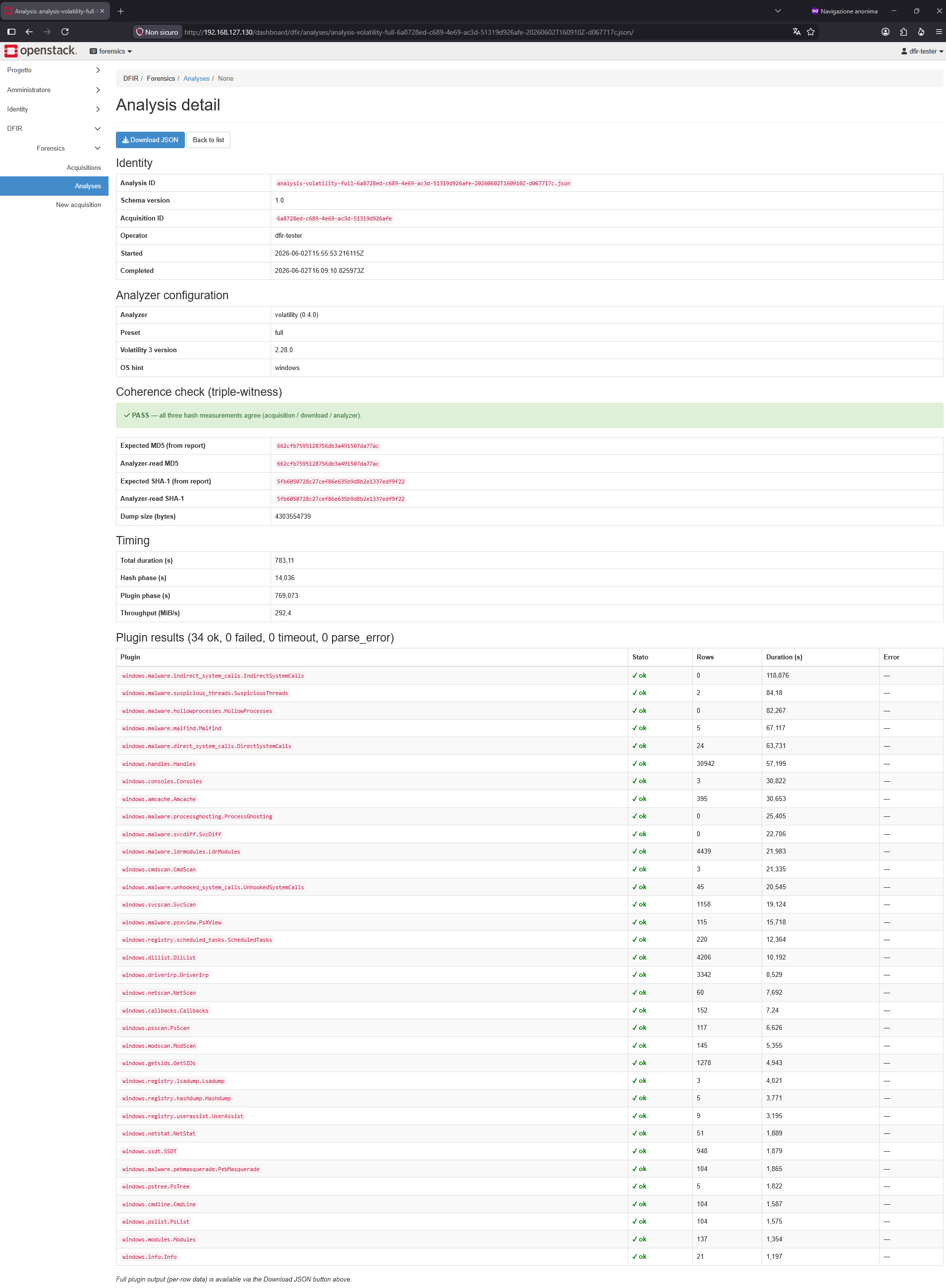
The Volatility detail page shows the per-plugin summary, the triple-witness coherence check, the Volatility 3 version, and OS hint:
The MISP enrichment detail page is where the threat-intelligence story is told. It exposes (in this order): the **Intelligence source** (the MISP feeds that were enabled at the time of the query, e.g. *CIRCL OSINT Feed (CIRCL)*); the **MISP events at query** count (how many events the MISP database held when the IOCs were checked — context for the match probability); the **threat score** with the firing rule shown in plain English (e.g. *RED — high-risk galaxy match: Tool:Meterpreter - S0500*); the **injection signals** breakdown (scoring detectors that drive the score vs informational signals shown for context only); and the **IOC enrichment** table, the analyst-facing summary of every IOC extracted from the dump:
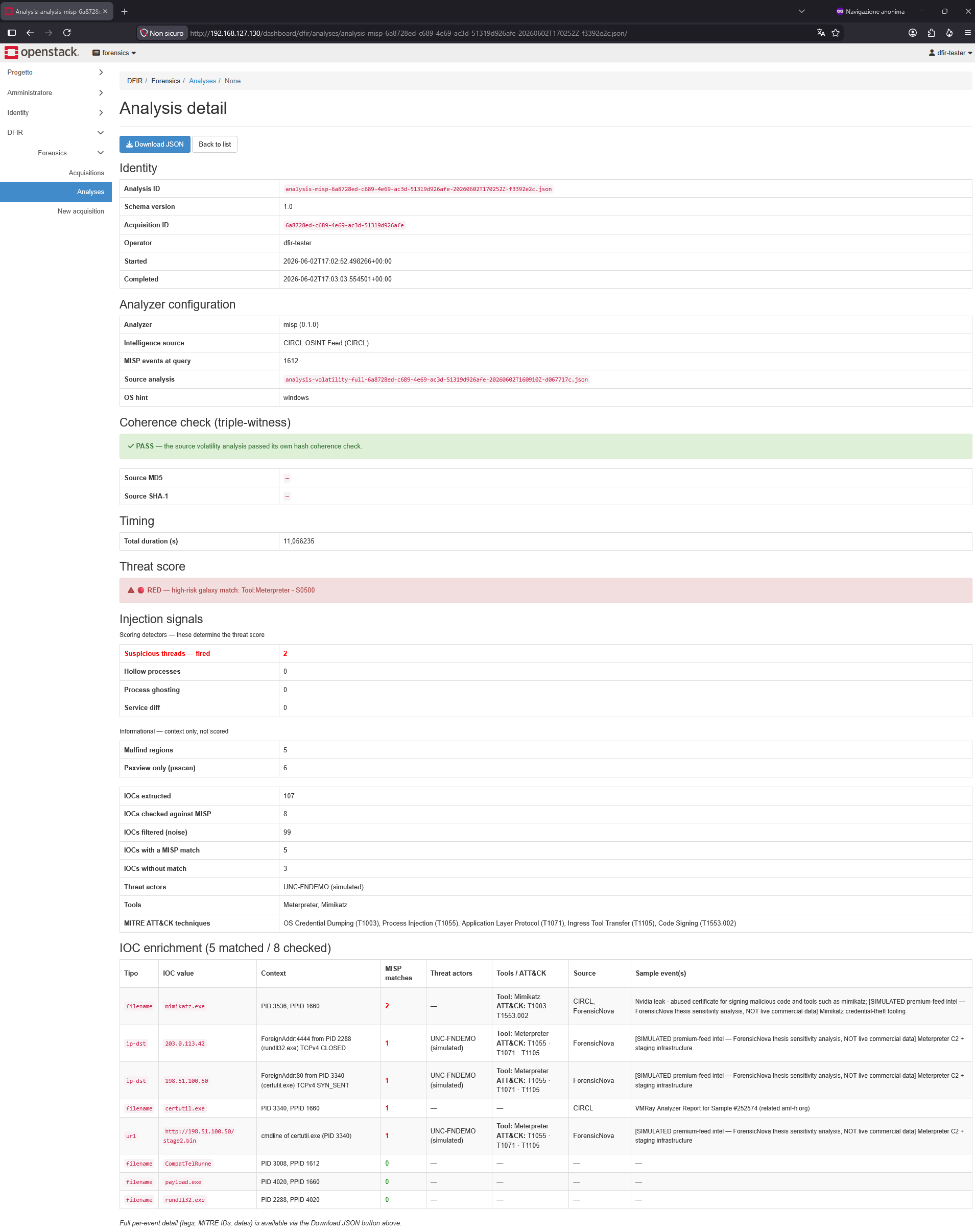
The IOC enrichment table has one row per IOC, with: type (`filename` / `ip-dst` / `url` / `sha256`), value, **context** (where the IOC came from inside the dump — e.g. `ForeignAddr:4444 from PID 2288 (rundll32.exe) TCPv4 CLOSED` for a network IOC, or `PID 3536, PPID 1660` for a process), MISP match count, threat actors (galaxy clusters), tools / ATT&CK techniques, **source** (which feed-provider organisation supplied the matching event, e.g. *CIRCL* or *ForensicNova* for locally curated events), and sample event(s) with their `info` strings. The `Source` column is per-IOC and is read from the matched event's creator organisation (`Orgc`) as a proxy for the feed it came from — see [Known limitations](#known-limitations) for the caveat.
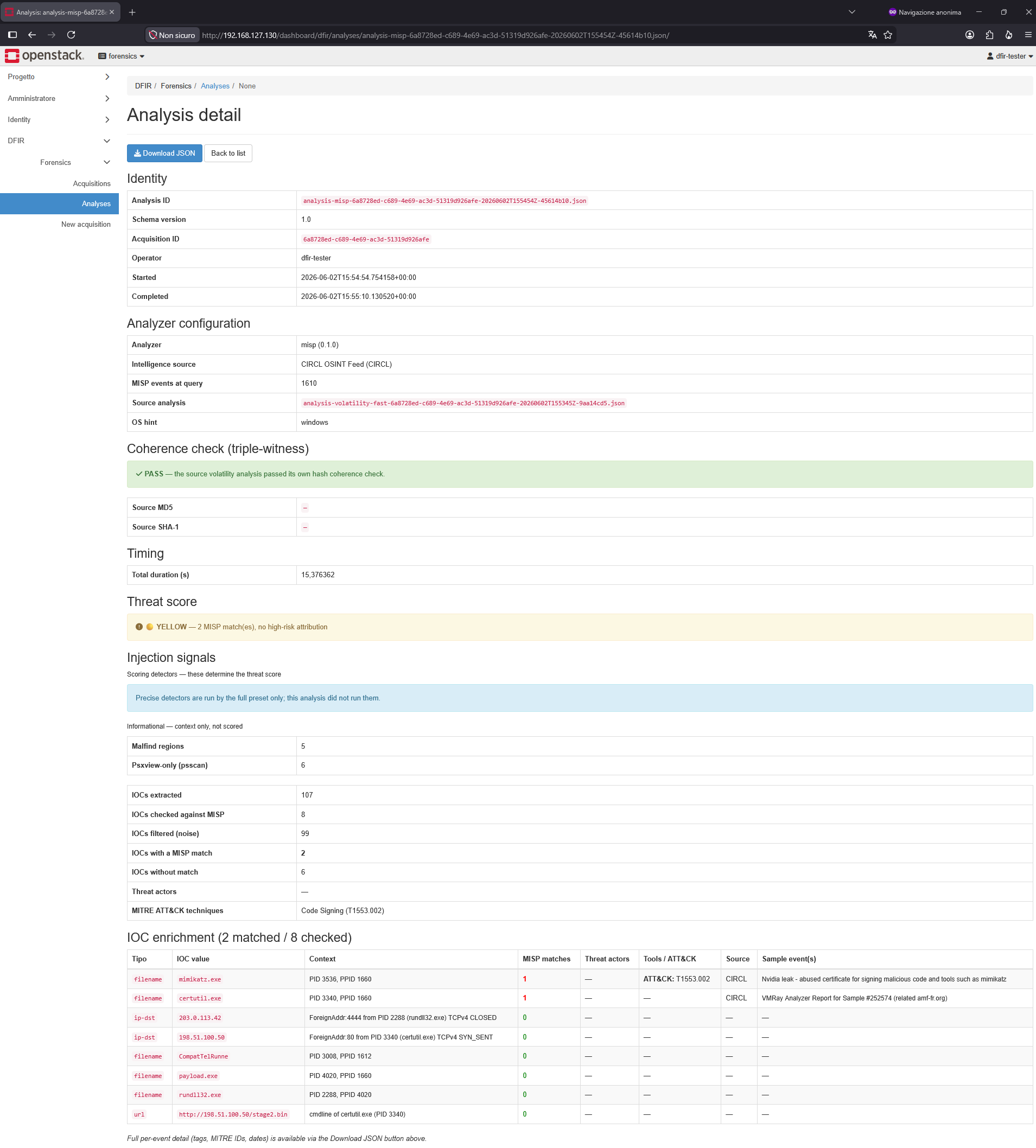
Same panel, different evidence — a *YELLOW* score (1-5 matches, behavioural but not attributed):
And a *RED* score driven by behavioural signals alone (no attribution feed, but the `full` Volatility preset has fired the precise injection detectors):
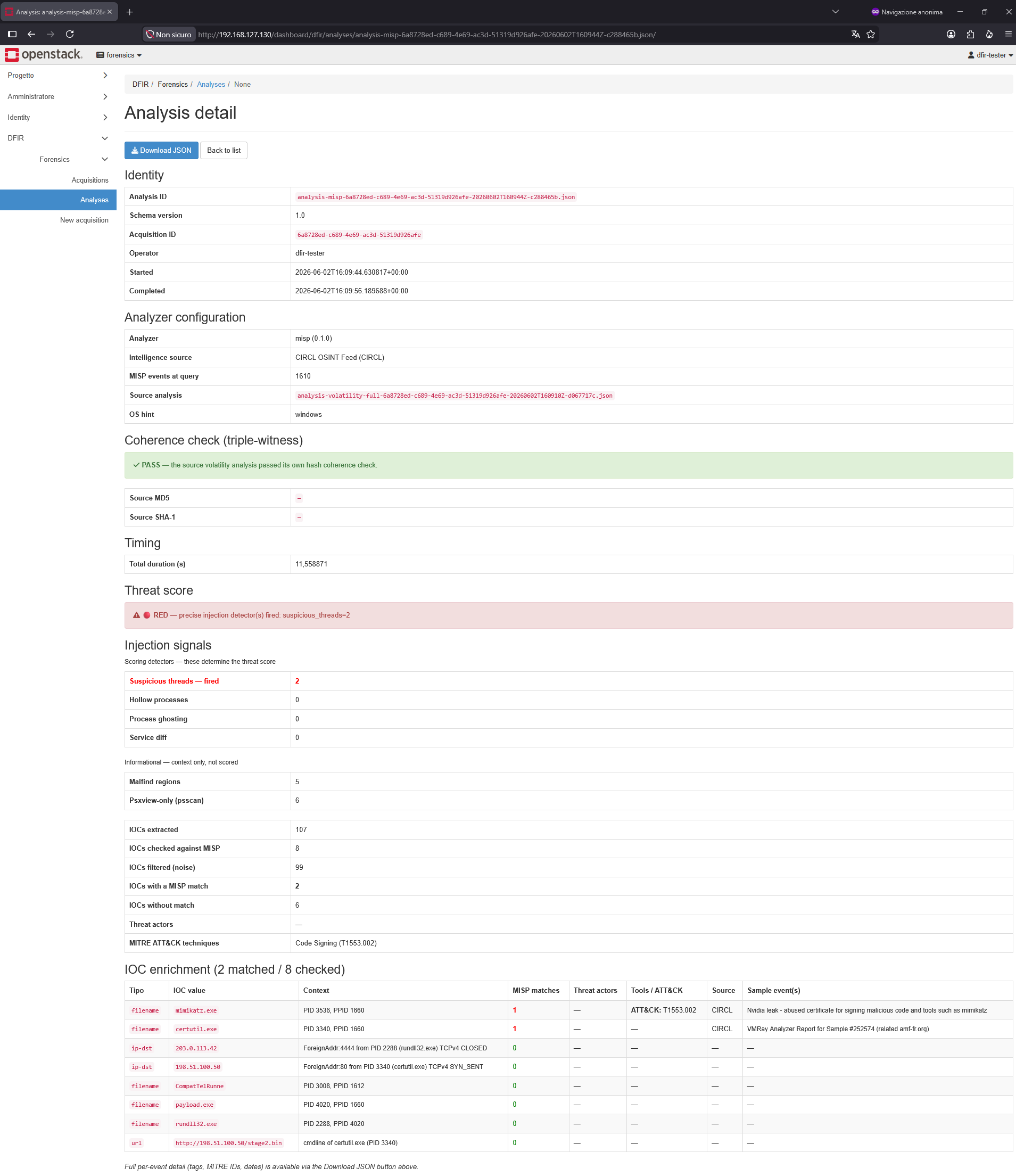
The dashboard is aligned **field by field** with the PDF report (see [Forensic PDF report](#forensic-pdf-report)): every datum visible in the dashboard is also in the PDF, and vice versa. The dashboard adds one extra column (`Sample event(s)`) which the PDF folds into the Attribution column for compactness.
### Authentication flow
The Horizon plugin forwards the operator's Keystone token in `X-Auth-Token` to the ForensicNova REST APIs. Keystone enforces the `forensic_analyst` role, which Horizon's permission middleware also checks at the URL-routing layer (the URLs are unreachable without the role). The polling JavaScript for the watch page goes through a server-side proxy view, so the browser session cookie is sufficient on the JS side — the Keystone token never leaves the server.
## Standalone Flask dashboard (legacy/backup)
The standalone Flask dashboard is the in-service UI that ships with the acquisition backend on `:5234`. It is a session-authenticated Flask blueprint and **only covers the acquisition workflow** — it predates the analyzer and does not expose Volatility / MISP analyses. It remains deployed as a backup for environments where the Horizon plugin is unavailable. The recommended UI is the Horizon panel group above.
Access it at `http://:5234/dashboard/` with the same `dfir-tester` credentials and the `forensics` project. Functionally it covers: login, acquisitions list, new acquisition form (with confirmation modal), watch page during the acquisition, acquisition detail with the JSON report rendered in a human-readable layout, and download links for raw dump, JSON, and PDF.
## REST API
ForensicNova exposes two HTTP backends on the same host. Both are protected by Keystone token authentication (`X-Auth-Token` header) and the `forensic_analyst` role. The acquisition backend on `:5234` drives the dump pipeline and produces the PDF (now extended with all Volatility and MISP analyses associated with the acquisition). The analyzer backend on `:5235` runs Volatility 3 and the MISP enricher. The Horizon dashboard discovers both via Keystone catalog lookup; clients should do the same.
### Acquisition backend — `:5234`
| Method | Path | Auth | Description |
|---|---|---|---|
| `GET` | `/health` | none | Service liveness probe. |
| `POST` | `/api/v1/servers//memory_acquire` | token | Triggers RAM acquisition on Nova instance ``. Returns `202 Accepted` with a `job_id`. |
| `GET` | `/api/v1/servers/` | token | Lists all Nova instances visible to the authenticated user (cross-tenant for `forensic_analyst`). |
| `GET` | `/api/v1/jobs/` | token | Lists acquisition jobs, most recent first. |
| `GET` | `/api/v1/jobs/` | token | Returns the current job record (`status`, `phase`, `label`, `elapsed_seconds`, `result` on completion). Designed for 2-second polling. |
| `GET` | `/api/v1/acquisitions/` | token | Lists all acquisitions in the Swift evidence container with summary metadata. |
| `GET` | `/api/v1/acquisitions/` | token | Returns the full JSON report (schema v1.2) for acquisition ``. |
| `GET` | `/api/v1/acquisitions//dump` | token | Streams the raw dump file (`.raw`). Constant memory on the server side; multi-gigabyte transfers are safe. |
| `GET` | `/api/v1/acquisitions//report` | token | Returns the JSON report as a downloadable attachment. |
| `GET` | `/api/v1/acquisitions//report.pdf` | token | On-demand renders the PDF forensic report. The PDF now bundles **the acquisition + all Volatility 3 analyses + all MISP enrichments** linked to this acquisition by `acquisition_id`. Each invocation produces a new PDF with its own UTC `CreationDate`; the underlying JSON records remain the canonical source of truth. |
### Analyzer backend — `:5235`
| Method | Path | Auth | Description |
|---|---|---|---|
| `GET` | `/health` | none | Service liveness probe. |
| `GET` | `/version` | none | Service version metadata. |
| `POST` | `/api/v1/analyses/` | token | Triggers an analysis (Volatility 3 by default) on an existing acquisition. Body: `{"analyzer": "volatility", "preset": "fast"\|"full"\|"custom", "plugins": [...]}`. The `acquisition_id` is in the URL path, **not** in the body. Returns `202 Accepted` with a `job_id`. |
| `POST` | `/api/v1/misp-enrichments` | token | Triggers a MISP enrichment on an existing Volatility analysis. Body: `{"input_analysis_id": "analysis-volatility-..."}`. Returns `202 Accepted` with a `job_id`. |
| `GET` | `/api/v1/acquisitions` | token | Lists all acquisitions visible in Swift (mirror of the acquisition backend, for analyzer-side use). |
| `GET` | `/api/v1/acquisitions/` | token | Returns the JSON report of one acquisition (mirror of the acquisition backend). |
| `GET` | `/api/v1/analyses/` | token | Lists all analyses (Vol3 + MISP) linked to the given acquisition. |
| `GET` | `/api/v1/analyses/by-id/` | token | Returns the full JSON for one analysis (Vol3 or MISP). |
| `GET` | `/api/v1/plugins` | token | Lists the Volatility plugin whitelist available to `preset=custom`. |
| `GET` | `/api/v1/jobs` | token | Lists analyzer jobs (Vol3 + MISP), most recent first. |
| `GET` | `/api/v1/jobs/` | token | Job status, designed for polling. |
| `DELETE` | `/api/v1/jobs/` | token | Deletes a job record (post-completion cleanup). |
| `DELETE` | `/api/v1/cache/` | token | Clears the analyzer's local cache for the given acquisition. |
### End-to-end example: acquire, analyze, enrich, export PDF
# Obtain a Keystone token scoped to the forensics project
TOKEN=$(openstack token issue -f value -c id)
HOST=
# 1) Async acquisition trigger — returns 202 with a job_id
JOB_ID=$(curl -sX POST \
-H "X-Auth-Token: $TOKEN" \
http://$HOST:5234/api/v1/servers//memory_acquire \
| jq -r .job_id)
# Poll until complete (acquisition backend)
while true; do
JOB=$(curl -s -H "X-Auth-Token: $TOKEN" \
http://$HOST:5234/api/v1/jobs/$JOB_ID)
STATUS=$(echo "$JOB" | jq -r .status)
LABEL=$(echo "$JOB" | jq -r .label)
echo "[acquisition $STATUS] $LABEL"
[[ "$STATUS" == "completed" || "$STATUS" == "failed" ]] && break
sleep 2
done
ACQ_ID=$(echo "$JOB" | jq -r .acquisition_id)
# 2) Trigger a Volatility full analysis on the acquisition
# NB: acquisition_id goes in the URL path; the body carries analyzer + preset.
VOL_JOB=$(curl -sX POST \
-H "X-Auth-Token: $TOKEN" -H "Content-Type: application/json" \
-d '{"analyzer": "volatility", "preset": "full"}' \
http://$HOST:5235/api/v1/analyses/$ACQ_ID \
| jq -r .job_id)
# Poll until complete (analyzer backend)
while true; do
J=$(curl -s -H "X-Auth-Token: $TOKEN" \
http://$HOST:5235/api/v1/jobs/$VOL_JOB)
[[ $(echo "$J" | jq -r .status) =~ ^(completed|failed)$ ]] && break
sleep 5
done
VOL_ANALYSIS_ID=$(echo "$J" | jq -r .analysis_id)
# 3) Trigger a MISP enrichment on the Volatility analysis
MISP_JOB=$(curl -sX POST \
-H "X-Auth-Token: $TOKEN" -H "Content-Type: application/json" \
-d "{\"input_analysis_id\": \"$VOL_ANALYSIS_ID\"}" \
http://$HOST:5235/api/v1/misp-enrichments \
| jq -r .job_id)
# Poll until complete
while true; do
J=$(curl -s -H "X-Auth-Token: $TOKEN" \
http://$HOST:5235/api/v1/jobs/$MISP_JOB)
[[ $(echo "$J" | jq -r .status) =~ ^(completed|failed)$ ]] && break
sleep 5
done
# 4) Download the combined PDF (acquisition + all analyses for this acquisition)
curl -sH "X-Auth-Token: $TOKEN" \
http://$HOST:5234/api/v1/acquisitions/$ACQ_ID/report.pdf \
-o "report-$ACQ_ID.pdf"
## JSON report schemas
ForensicNova produces three JSON schemas. Acquisition reports use schema **v1.2** (a forward-compatible extension of v1.1 that adds `dump.upload_method` and `dump.slo_segments`). Volatility and MISP analyses use schema **1.0**. All three are stored in the same `forensics` Swift container and linked together via `acquisition_id`, which is the only stable cross-schema identifier (the per-record `analysis_id` is not stable: Volatility includes a `.json` suffix in the field while MISP does not — never join on `analysis_id`).
### Acquisition report — `report--.json` (v1.2)
Trimmed to the forensically meaningful fields; the full structure mirrors `app/reports/json_report.py`.
{
"schema_version": "1.2",
"acquisition_id": "",
"operator": "dfir-tester",
"tool": { "name": "ForensicNova", "version": "0.1.0" },
"timestamps": {
"started_at": "2026-05-31T17:18:23.482015Z",
"completed_at": "2026-05-31T17:21:11.094277Z",
"duration_seconds": 167.61
},
"instance": {
"id": "",
"name": "win2022-dfir-target",
"domain": "instance-00000007"
},
"target_system": {
"nova": { "id": "...", "name": "win2022-dfir-target", "status": "ACTIVE", "host": "devstack", "...": "..." },
"flavor": { "id": "...", "name": "ds4G", "vcpus": 2, "ram_mb": 4096, "disk_gb": 25 },
"glance": { "id": "...", "name": "win2022-dfir-test", "os_distro": "windows", "...": "..." },
"libvirt": { "domain_name": "instance-00000007", "architecture": "x86_64", "memory_mb": 4096, "...": "..." }
},
"dump": {
"size_bytes": 4297064448,
"md5": "",
"sha1": "",
"format": "raw",
"acquisition_method": "libvirt-coreDumpWithFormat",
"swift_object": "forensics/dump-win2022-dfir-target-20260531T171823Z.raw",
"swift_etag": "-2",
"etag_verified": true,
"upload_method": "slo",
"slo_segments": [
{ "index": 1, "name": "...seg-0001", "size": 4294967296, "md5": "", "etag": "" },
{ "index": 2, "name": "...seg-0002", "size": 2097152, "md5": "", "etag": "" }
]
},
"report": {
"swift_object": "forensics/report-win2022-dfir-target-20260531T171823Z.json",
"filename": "report-win2022-dfir-target-20260531T171823Z.json"
},
"chain_of_custody": {
"total_events": 14,
"events": [
{
"seq": 1,
"event_type": "async_job_started",
"description": "Async pipeline worker started — job picked up from REST endpoint",
"timestamp": "2026-05-31T17:18:23.482015Z",
"data": { /* event-specific payload */ }
}
// ... 13 more events
]
}
}
### Volatility analysis — `analysis-volatility----.json` (1.0)
{
"schema_version": "1.0",
"analysis_id": "analysis-volatility-fast-...json", // includes .json suffix
"acquisition_id": "", // STABLE link to acquisition
"analyzer": "volatility",
"analyzer_version": "0.4.0",
"preset": "fast", // fast | full | custom
"plugins": null, // null for fast/full; list of FQNs for custom
"operator": "dfir-tester",
"timestamps": {
"started_at": "2026-05-31T17:21:41.000Z",
"completed_at": "2026-05-31T17:23:55.000Z"
},
"input_dump": {
"swift_object": "forensics/dump-...raw",
"size_bytes": 4297064448,
"expected_md5": "", // from acquisition report — witness 1
"expected_sha1": ""
},
"coherence_check": {
"expected_md5": "", // witness 1 (acquisition backend)
"expected_sha1": "",
"analyzer_read_md5": "", // witness 3 (analyzer re-hash) — must match witness 1
"analyzer_read_sha1": "",
"analyzer_size_bytes": 4297064448,
"hashes_match_report": true // triple-witness PASS
},
"result": { // opaque, analyzer-specific
"vol3_version": "2.28.0",
"os_hint": "windows",
"duration_seconds": 134.2,
"throughput_mib_per_s": 30.5,
"summary_counts": { "ok": 11, "failed": 0, "timeout": 0, "parse_error": 0, "skipped_hash_fail": 0 },
"plugins": {
"windows.pslist.PsList": { "status": "ok", "row_count": 102, "duration_seconds": 8.2, "rows": [/* ... */] },
"windows.netscan.NetScan": { "status": "ok", "row_count": 94, "duration_seconds": 7.8, "rows": [/* ... */] },
"windows.malfind.Malfind": { "status": "ok", "row_count": 14, "duration_seconds": 12.4, "rows": [/* ... */] }
// ... one entry per executed plugin
}
}
}
### MISP analysis — `analysis-misp---.json` (1.0)
{
"schema_version": "1.0",
"analysis_id": "analysis-misp-...", // no .json suffix (unlike Volatility)
"acquisition_id": "", // STABLE link to acquisition
"operator": "dfir-tester",
"analyzer": "misp",
"analyzer_version": "0.1.0",
"started_at": "2026-06-03T22:36:38.306175Z", // top-level (NOT under timestamps)
"completed_at": "2026-06-03T22:36:50.200475Z",
"duration_seconds": 11.89,
"source": {
"input_analysis_id": "analysis-volatility-fast-...json", // the Vol3 JSON consumed
"input_hashes": { "md5": "", "sha1": "" }, // dump hashes from source
"hashes_match_report": true, // re-verified coherence
"os_hint": "windows"
},
"misp_server": {
"url": "https://127.0.0.1:10443",
"events_count_at_query": 1613,
"feeds": [ // captured at query time, drives Intelligence source
{ "name": "CIRCL OSINT Feed", "provider": "CIRCL", "url": "https://...",
"enabled": true, "caching_enabled": true }
]
},
"iocs_extracted": { // grouped breakdown of every extracted IOC
"ip_addresses": [ { "value": "203.0.113.42", "source_plugin": "windows.netscan.NetScan", "context": "..." } ],
"domains": [ /* domains + urls go here */ ],
"file_hashes": { "md5": [], "sha1": [], "sha256": [] },
"process_names": [ { "value": "mimikatz.exe", "source_plugin": "windows.pslist.PsList", "context": "PID 3536, PPID 1660" } ],
"registry_paths": [],
"filtered_out": {
"private_ips": 54,
"ms_update_ips": 12,
"localhost_ips": 2,
"native_processes": 31,
"total_filtered": 99,
"reason": "RFC1918 / MS-CDN / Windows-native / system DLLs"
}
},
"enrichment": [
{
"ioc_type": "filename",
"ioc_value": "mimikatz.exe",
"context": "PID 3536, PPID 1660", // where the IOC came from inside the dump
"misp_match": 2, // number of matched MISP events
"events": [
{
"event_id": 17,
"info": "Nvidia leak - abused certificate for signing malicious code and tools such as mimikatz",
"org": "CIRCL", // proxy for the feed source (see Known limitations)
"galaxies": [ { "value": "Tool:Mimikatz" } ],
"attribution": { "actor": null, "actor_hint": null },
"tags": [ "tlp:white", "misp-galaxy:tool=\"Mimikatz\"", "..." ]
}
// ...
]
}
// ... one entry per IOC, including those with zero matches
],
"injection_signals": { // populated by analyzer from Vol3 malware plugins
"malfind_regions": 14, // informational, not scored
"psxview_only_psscan": 8, // informational
"suspicious_threads": 2, // SCORING: drives threat-score rule R2
"hollow_processes": 0,
"process_ghosting": 0,
"service_diff": 0
},
"summary": {
"threat_score": "red", // green | yellow | red
"threat_score_reason": "high-risk galaxy match: Tool:Meterpreter - S0500",
"total_iocs_extracted": 107, // total raw IOCs extracted before filtering
"total_iocs_filtered": 99, // RFC1918 / MS-CDN / native processes / system DLLs
"total_iocs_checked": 8, // 107 - 99, the ones actually queried to MISP
"iocs_with_misp_match": 5,
"iocs_without_match": 3,
"unique_actors": [ "UNC-FNDEMO" ],
"unique_galaxies": [ "Tool:Mimikatz", "Tool:Meterpreter - S0500" ],
"unique_attck": [ "T1003", "T1055", "T1071", "T1105", "T1553.002" ]
}
}
The **MISP enrichment** analysis does not re-hash the dump — its input is the Volatility JSON, not the raw binary. Instead it propagates the source analyzer's verdict in `source.hashes_match_report`, and **refuses to proceed** (fail-fast with `ValueError`) if that flag is `false`. The MISP analysis is therefore bound to a verified-dump source **by inheritance**: the witness chain stays at three independent measurements, while every downstream analysis is gated on the Volatility witness.
## Forensic PDF report
Each acquisition has exactly **one PDF**, generated on demand from the canonical JSON records. The PDF bundles the acquisition report **plus every Volatility 3 analysis and every MISP enrichment** that share the same `acquisition_id`, ordered as Volatility (extraction) then MISP (correlation), chronological within each group. It is rendered by ReportLab from a sequence of `render_*` building blocks (`app/reports/pdf_report.py`), each producing a self-contained Flowable list, and is **not** part of the asynchronous pipeline — generation happens on `GET /api/v1/acquisitions//report.pdf` (or via the corresponding action in the Horizon dashboard).
The title on the cover and in every page header is *Volatile memory forensic report*. The PDF is laid out as:
- **Cover page** — three stacked blocks. *Acquisition identity*: a key-value table covering acquisition UUID, operator (Keystone username), target VM (name, UUID, libvirt domain), timeline (started, completed, duration), MD5, SHA-1, integrity verification outcome, tool name+version, and report schema. *Document generation*: PDF build timestamp (UTC), generator identity, document type. *Operator signature block*: physical signature lines for a printed countersignature — block-capitals full name, with `authenticated as Keystone user: ` underneath as a binding to the immutable Keystone session identity, plus lines for date/place and the ink signature.
- **Evidence** — key-value table with Swift object name, container, size (humanized + bytes), format, acquisition method, MD5, SHA-1, Swift ETag, ETag-verified outcome, and upload method. For SLO uploads, a sub-table lists every segment (index, name, size, MD5/ETag merged into one column when they coincide, separated only when they genuinely differ).
- **Target system** — four sub-blocks (Nova, Flavor, Glance, Hypervisor & libvirt) with the OpenStack-side metadata that an analyst uses to select the right Volatility 3 profile / ISF. No data is ever read from inside the guest.
- **Chain of custody** — numbered timeline table (`seq`, timestamp, event type, description). Failure events (`*_failed`, `integrity_failure`) are rendered in red. The per-event JSON payloads are intentionally **not** dumped (they duplicate information already shown in Evidence and hashes); the full record lives in the downloadable JSON.
- **Analysis** — dispatcher section that iterates over every analysis associated with the acquisition. Volatility 3 sections (one per analysis) are rendered **light**: a meta table (preset, Vol3 version, OS hint, duration, coherence check + analyzer-read MD5/SHA-1), a summary counts line (`Plugins executed: N ok, M failed, ...`), and a per-plugin table (name, status, row count, duration, error). Per-plugin rows are not dumped in the PDF — they live in the downloadable JSON, since dumping hundreds of plugin rows would bury the analyst-meaningful summary. MISP enrichment sections (one per analysis) are rendered **rich**: a key-value table covering *Intelligence source* (feeds enabled at query time, e.g. *CIRCL OSINT Feed (CIRCL)*), *MISP events at query* count, *Coherence* (the inherited Volatility witness flag), *IOCs extracted* / *checked* / *with match* / *filtered* (the four-way breakdown of how raw IOCs flowed through the anti-noise filter and the MISP lookup), the threat-score box (green / yellow / red, with the firing rule in plain English), the injection-signals breakdown (scoring vs informational), an aggregate summary (Tools, ATT&CK techniques by code + name, Threat actors), and the **IOC enrichment table** — one row per IOC with type, value, match count, attribution (actor · galaxy · ATT&CK · `Source: `), and context (where the IOC came from inside the dump). The attribution `Source:` line for each IOC is the per-IOC provenance mapped from the matched event's creator organisation; the section-level *Intelligence source* is the section-wide feeds list.
- **Notice** — five paragraphs of legal disclaimer covering: (1) the role of the PDF relative to the canonical JSON + RAW evidence; (2) the cryptographic integrity guarantees (streaming MD5+SHA-1 at hypervisor, end-to-end ETag, triple-witness in each analysis) and the append-only chain-of-custody journal; (3) the threat-intelligence caveat — every match is only as authoritative as the feed that supplied it, and the *Intelligence source* field records that provenance; (4) the "distinct print event" property — every regeneration is byte-different with its own `CreationDate`, while the underlying evidence is fixed; (5) the academic-prototype status of the project.
**Headers and footers on every page** are rendered through a two-pass `NumberedCanvas` so the footer can show `page X of Y`: top band has the title (*ForensicNova — volatile memory forensic report*) on the left and operator identity on the right; bottom band has the full acquisition UUID on the left and `page X of Y` on the right.
### Example
## Detection capability
This section is the empirical answer to "does the detector see what it is supposed to see?". Four scenarios were validated end-to-end on a Windows Server 2022 Standard Evaluation guest (build 10.0.20348.587), with the dump acquired via the standard ForensicNova acquisition pipeline and analysed via Volatility 3 (presets `fast` and `full`) and the MISP enricher. The scenarios are ordered from a clean baseline to a fully attributed compromise, to show how the detector escalates as more evidence becomes available.
### Stage 1 — GREEN baseline (clean Windows guest)
A freshly-OOBE'd Windows Server 2022 guest with no user-mode activity beyond the standard desktop session (Edge, Notepad). The acquisition pipeline produces a 4 GiB dump in **~80 seconds** end-to-end (libvirt coreDump + MD5+SHA-1 streaming + SLO upload to Swift + secure delete); the `fast` preset of Volatility 3 produces ~100 IOC candidates. After the anti-noise filter (RFC 1918, Microsoft CDN ranges, known Windows-native processes, system DLL paths), 2 IOCs survive (`notepad.exe`, `msedge.exe`, both metadata-only entries); both are queried against MISP and return zero matches; threat score is **GREEN**. This is the negative control — no false positives on a clean image.
### Stage 2 — YELLOW with a vanilla MISP feed (CIRCL only)
The same plugin pipeline but on a dump infected with Mimikatz + Meterpreter reverse_tcp (`LHOST=203.0.113.42`, TEST-NET-3 per RFC 5737) + a `certutil.exe` cradle for a stage-2 payload. The MISP instance is configured with the **CIRCL OSINT Feed** only — no curated demo events. The enricher extracts 8 checkable IOCs (filenames, foreign IPs, command lines); CIRCL's OSINT corpus contains events on `mimikatz.exe` and `certutil.exe`, so 2 matches fire. Threat score is **YELLOW** (rule R4: 1-5 matches).

This is the realistic open-source baseline: behavioural intelligence on broadly-known tools, no specific attribution.
### Stage 3 — RED on behavioural signals alone (full preset)

This is the demonstration that the detector does **not** require a feed to surface a serious incident: the precise injection detectors are sufficient. The feed adds attribution; it does not gate detection.
### Stage 4 — RED with attribution (sensitivity demo)
To illustrate how the detector behaves against a more capable feed — one that has indexed the exact tools and infrastructure of this campaign — a small set of MISP events tagged `simulated` was loaded into the lab MISP, mapped onto the exact IOCs observed in the dump (`mimikatz.exe`, `203.0.113.42`, the stage-2 URL, …) and decorated with realistic actor / galaxy / ATT&CK assignments (`UNC-FNDEMO`, `Tool:Meterpreter - S0500`, `T1003`, `T1055`, `T1071`, `T1105`, `T1553.002`). With this richer intelligence available, the enricher escalates from R2 (behavioural) to R1 (high-risk galaxy match), matches rise from 2 to 5, the attribution column is fully populated, and every event explicitly carries the `[SIMULATED] ... NOT live commercial data` marker so the demo is unambiguously distinguishable from a real intelligence find.

This is a *sensitivity* result: same dump, same Volatility output, same detection rules — only the intelligence quality changes. The detector visibly scales with feed quality, while remaining honest about which datapoints came from a curated demo set and which came from a public feed (the per-IOC *Source* column distinguishes *CIRCL* (public feed) from *ForensicNova* (the lab's curated demo events)).
### Preset comparison
The same dump can be analysed with either the `fast` preset (~11 plugins, ~3 minutes on a 4 GiB dump, behavioural signals only via informational counters) or the `full` preset (~34 plugins, ~13 minutes on the same dump, with the precise injection detectors). The fast preset is appropriate for triage and routine sweeps; the full preset is the deeper dive that lets behavioural rules (R2) trip on their own.
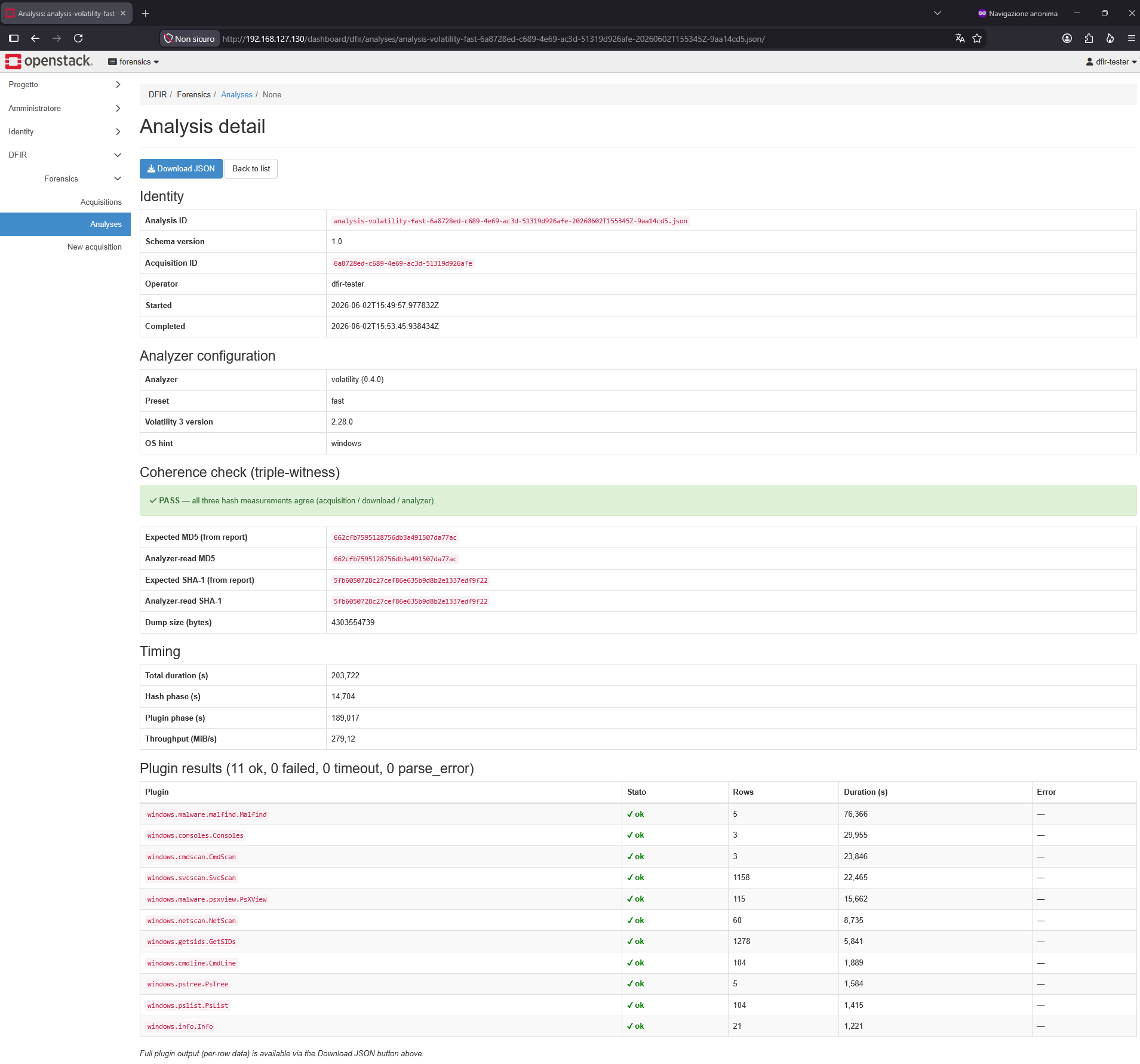

The triple-witness coherence check is identical on both presets (the dump is hashed once in each analyzer run); the analyses differ only in which Volatility plugins are executed.
## Known limitations
The prototype intentionally accepts a small number of documented limitations that do not affect the forensic soundness of individual acquisitions.
### DevStack-only: Swift data lost after `unstack → stack`
Swift uses the Keystone project UUID as its storage namespace (`AUTH_`). In DevStack, `./unstack.sh` followed by `./stack.sh` destroys and recreates Keystone projects with fresh UUIDs, making previously stored Swift objects orphan in namespaces that no longer exist. The underlying `swift.img` filesystem is preserved, but the data is unreachable through the Swift API. **In a production OpenStack deployment, project UUIDs are stable for the lifetime of the cloud and Swift objects persist indefinitely.** Plain reboots of the host do not cause data loss; only the explicit `unstack → stack` sequence does.
### Cross-tenant forensic analyst privileges
### Windows-only analysis
The analyzer's Volatility presets target Windows guests (the demo platform is Windows Server 2022). Both the Volatility analyzer (`os_hint == "linux"` → `LinuxNotSupportedError`) and the MISP enrichment (`os_hint != "windows"` → `ValueError`) fail-fast on non-Windows dumps, so the pipeline never produces a misleading result on an unsupported OS. **Analysis of Linux dumps** is out of scope in this release; **Linux analysis support** is listed in the [Roadmap](#roadmap). The acquisition pipeline itself is fully OS-agnostic — a Linux guest's RAM can be acquired, hashed, uploaded, and reported just like a Windows one (the project has been smoke-tested on CirrOS for exactly this reason); only the post-acquisition analysis side is Windows-only.
### Per-IOC Source: organisation-of-record attribution
The per-IOC *Source* column and the section-level *Intelligence source* expose the matched event's creator organisation (`Orgc`) as the IOC provenance — the field that an analyst uses to weight the credibility of a finding. For events imported from a feed this coincides with the feed provider (e.g. *CIRCL*), which is the canonical case in the demo deployment. A stricter event-to-feed mapping, distinguishing the matched feed object from the event creator in corner cases (e.g. an organisation that both publishes a feed and also creates manual events), is available via MISP's feed-correlation API and is listed in the [Roadmap](#roadmap) as a future extension.
### Large acquisitions and the Swift loopback
Dumps below 4 GiB are uploaded with a single Swift `PUT` and verified end-to-end against the server-returned ETag; dumps at or above 4 GiB are uploaded as a Swift Static Large Object (SLO), split into 4 GiB segments stored in `_segments`, with a composite ETag verified end-to-end. There is no hard cap on guest RAM size. In DevStack the Swift backend is a loopback file whose default size (~6 GB) is too small for any 8 GiB acquisition; the provided `local.conf.example` sets `SWIFT_LOOPBACK_DISK_SIZE=30G`.
### Nova/libvirt state desync after host boot
After a reboot of the hypervisor, Nova reports guests as `SHUTOFF` by default (`resume_guests_state_on_host_boot=False`). This is intended DevStack behaviour, not a bug. Guests must be explicitly started via `openstack server start ` before an acquisition can succeed.
## Roadmap
Natural extensions of the current work, identified as future research directions in the M.Sc. thesis discussion. Each builds on the existing code without breaking changes:
- **YARA-based triage of memory dumps** — signature scanning of in-memory regions against known malware families and custom threat-actor rules, feeding the existing `analysis` section of the report alongside Volatility and MISP findings.
- **Hash-based MISP correlation for in-memory binaries** — extend the IOC extractor with imphash (and other relocation-immune signatures) of PE images recovered from memory, to complement the current behavioural matching.
- **Linux dump analysis support** — extend the Volatility preset catalogue and lift the `os_hint == "windows"` guard on the MISP enricher.
- **Strict feed-to-event mapping** — replace the `Orgc`-as-proxy attribution with MISP's feed-correlation API, so the per-IOC *Source* column distinguishes the matched feed object from the event creator.
- **Cumulative case-level PDF** — bundle multiple acquisitions in a single operator-signable forensic report with a deterministic cover sheet for legal hand-off, reusing the `render_*` building blocks of the per-acquisition PDF.
- **Production WSGI runner** — replace the Flask development server (Werkzeug) with `gunicorn` / `uWSGI` behind a reverse proxy, with proper worker pool, graceful restart, and system-level logging integration.
- **Fine-grained cross-tenant scoping** — tighten the `dfir-tester` admin grant to a service-specific read scope on Nova/Glance via a `policy.yaml` override, on Nova releases where policy overrides remain compatible with the default-policy regime.
## License
To be defined, likely Apache-2.0 for consistency with the OpenStack ecosystem.
**Author**: Davide Numelli — GitHub [@numdav](https://github.com/numdav)
&
Flask - :5234 (backup, acq.)"] end Op -->|HTTP / Keystone X-Auth-Token| DB %% API & Auth Layer subgraph API_LAYER ["API LAYER"] AcqAPI["Acquisition API
:5234/api/v1"] AnAPI["Analyzer API
:5235/api/v1"] end class AcqAPI,AnAPI api; DB --> AcqAPI DB --> AnAPI Keystone["Keystone
• role: forensic_analyst
• dfir/dfir-analyzer"] class Keystone external; AnAPI <-->|authN / authZ| Keystone AcqAPI <-->|authN / authZ| Keystone %% Pipelines Layer subgraph PIPELINES ["PIPELINES"] subgraph ACQ_PIPE ["ACQUISITION PIPELINE"] P1["1 libvirt coreDump
(raw, no guest writes)"] P2["2 MD5 + SHA-1
(streaming 64 KB)"] P3["3 Nova/Glance/libvirt metadata"] P4["4 Swift upload
+ ETag/SLO verify"] P5["5 secure delete shred
(only if verified)"] P1 --> P2 P2 --> P3 P3 --> P4 P4 --> P5 end subgraph AN_PIPE ["ANALYSIS PIPELINE"] A1["triple-witness hash
coherence check"] A2["Volatility 3
(fast/full/custom)"] A3["MISP IOC enrichment
(extract/correlate / threat score)"] A1 --> A2 A2 --> A3 end end class P1,P2,P3,P4,P5,A1,A2,A3 pipe; AcqAPI --> P1 AnAPI --> A1 MISP["MISP server
(external, CIRCL OSINT feed)"] class MISP external; A3 <-->|IOC lookup| MISP %% Storage Layer (Evidence Locker) subgraph SWIFT_LAYER ["SWIFT - EVIDENCE LOCKER"] Swift["Containers: forensics + forensics_segments
===
• RAM dump (.raw)
• acquisition report JSON v1.2
• Volatility JSON
• MISP JSON (+ threat score)"] end class Swift storage; P5 -->|dump + report v1.2| Swift A3 -->|Volatility + MISP JSON| Swift %% Footnote 1 Swift -.->|Reads verified dump back
before each analysis| A1 %% Final Output PDF["PDF FORENSIC REPORT
(operator-signable, on-demand)"] Swift -->|report + analyses| PDF %% Chain of Custody Log CoC["[Log] Chain of custody:
Append-only JSONL log"] P1 -.-> CoC P2 -.-> CoC P3 -.-> CoC P4 -.-> CoC P5 -.-> CoC CoC -.->|Embedded in
acquisition report| Swift **Crash isolation between backends.** The acquisition backend (`:5234`) and the analyzer backend (`:5235`) are deployed as separate Flask processes with separate virtualenvs (`.venv` and `.venv-analyzer`). A Volatility 3 crash on a malformed dump cannot interrupt an in-flight acquisition; an analyzer restart does not affect the acquisition pipeline; the two have independent systemd lifecycles and independent Keystone catalog entries. The Horizon dashboard plugin discovers both via Keystone catalog lookup and never hardcodes `host:port`. ## Quick start ### Prerequisites - Ubuntu 24.04 LTS host with hardware virtualization (KVM) - DevStack `master` branch, tested against `2026.2` - Python 3.12 - `stack` user with NOPASSWD sudo, membership in `libvirt` and `kvm` groups - (Optional, for analyses) a reachable MISP instance — the plugin does **not** deploy MISP; see [MISP lab service](#misp-lab-service-external-not-managed-by-the-plugin) below ### `local.conf` snippet The minimal lines needed to enable ForensicNova on top of an existing DevStack `local.conf`. For a fully-commented working example see [`local.conf.example`](local.conf.example) at the root of this repository. [[local|localrc]] ADMIN_PASSWORD=secret DATABASE_PASSWORD=$ADMIN_PASSWORD RABBIT_PASSWORD=$ADMIN_PASSWORD SERVICE_PASSWORD=$ADMIN_PASSWORD HOST_IP=
标签:JARM, OpenStack, xlsx, 云安全, 内存分析, 威胁情报, 库, 应急响应, 开发者工具, 数字取证, 自动化脚本