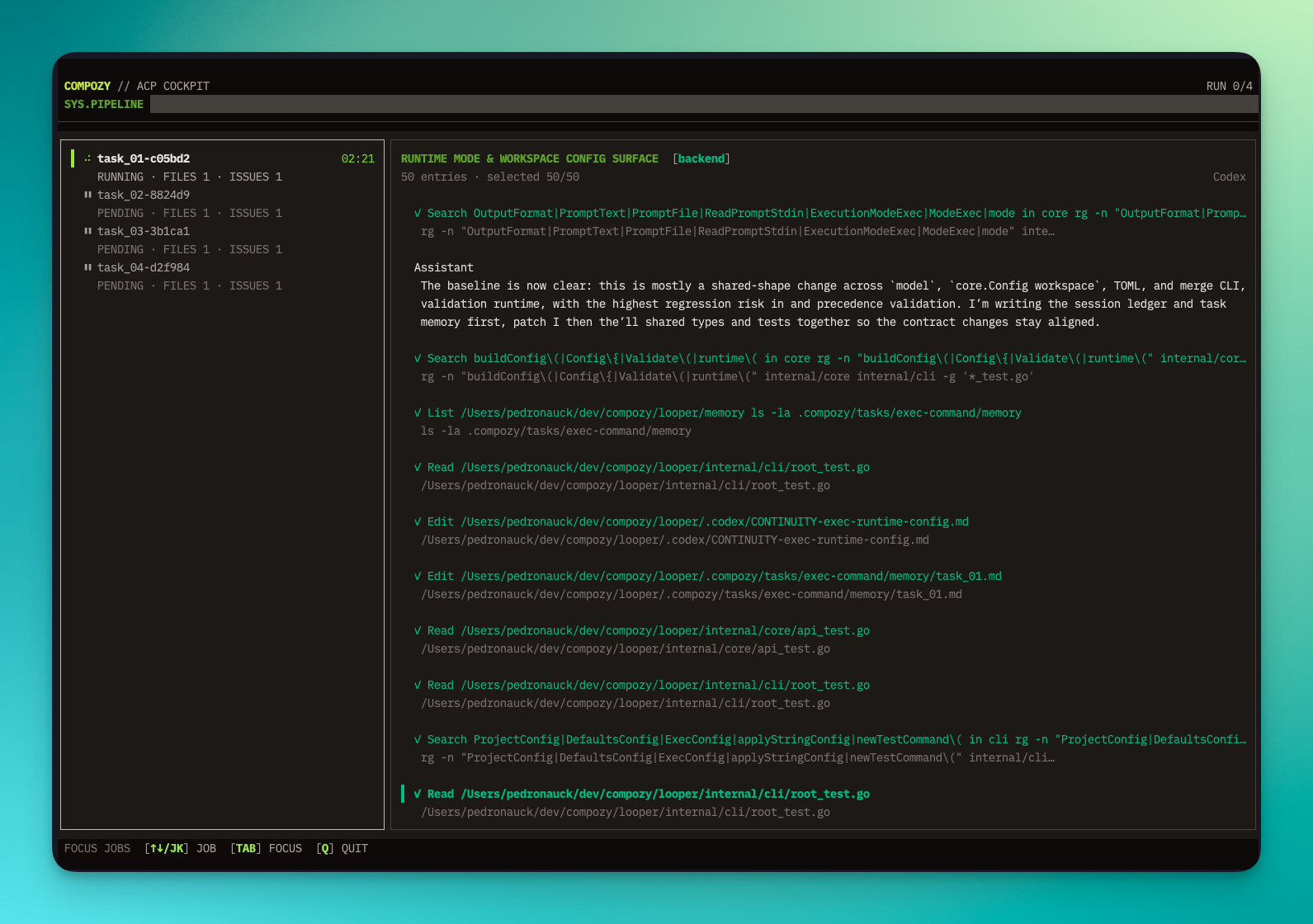
Compozy 是一个 AI 编码代理编排工具,通过结构化流水线将 AI 辅助开发从创意到代码交付的全流程整合到一个 CLI 中。
Stars: 2379 | Forks: 131
Compozy
Orchestrate AI coding agents from idea to shipped code — in a single pipeline.
One CLI to replace scattered prompts, manual task tracking, and copy-paste review cycles. Compozy drives the full lifecycle of AI-assisted development: product ideation, technical specification, task breakdown with codebase-informed enrichment, concurrent execution across agents, and automated PR review remediation.
## ✨ Highlights
- **One command, 40+ agents.** Install core workflow skills into Claude Code, Codex, Cursor, Droid, OpenCode, Pi, Gemini, and 40+ other agents and editors with `compozy setup`, plus any setup assets shipped by enabled extensions.
- **Idea to code in a structured pipeline.** Optional Idea → PRD → TechSpec → Tasks → Execution → Review. Each phase produces plain markdown artifacts that feed into the next. Start from an idea for full research and debate, or jump straight to PRD if you already have a clear scope.
- **Codebase-aware enrichment.** Tasks aren't generic prompts. Compozy spawns parallel agents to explore your codebase, discover patterns, and ground every task in real project context.
- **Multi-agent execution.** Run tasks through ACP-capable runtimes like Claude Code, Codex, Cursor, Droid, OpenCode, Pi, or Gemini — just change `--ide`. Concurrent batch processing with configurable timeouts, retries, and exponential backoff, all with a live terminal UI.
- **Reusable agents.** Package a prompt, runtime defaults, and optional agent-local MCP servers under `.compozy/agents//`, then run it from `compozy exec --agent ` or through nested `run_agent` calls.
- **Workflow memory between runs.** Agents inherit context from every previous task — decisions, learnings, errors, and handoffs. Two-tier markdown memory with automatic compaction keeps context fresh without manual bookkeeping.
- **Provider-agnostic reviews.** Fetch review comments from CodeRabbit, GitHub, or run AI-powered reviews internally. All normalize to the same format. Provider threads resolve automatically after fixes.
- **Markdown everywhere.** PRDs, specs, tasks, reviews, and ADRs are human-readable markdown files. Version-controlled, diffable, editable between steps. No vendor lock-in.
- **Frontmatter for machine-readable metadata.** Tasks and review issues keep parseable metadata in standard YAML frontmatter instead of custom XML tags.
- **Executable extensions.** Intercept and modify any pipeline phase with subprocess hooks. Ship custom prompt decorators, lifecycle observers, review providers, and skill packs using the TypeScript or Go SDKs.
- **Single binary, local-first.** Compiles to one Go binary with zero runtime dependencies. Your code and data stay on your machine.
- **Embeddable.** Use as a standalone CLI or import as a Go package into your own tools.
## 📦 Installation
#### Homebrew
brew install compozy/compozy/compozy
#### NPM
npm install -g @compozy/cli
#### Go
go install github.com/compozy/compozy/cmd/compozy@latest
#### From Source
git clone git@github.com:compozy/compozy.git
cd compozy && make verify && go build ./cmd/compozy
Then install core skills into your AI agents:
compozy setup # interactive — pick agents and skills
compozy setup --all # install everything to every detected agent
`compozy setup` installs Compozy's core workflow skills plus any setup assets shipped by enabled extensions.
If you want the optional ideation workflow and council roster, install the first-party `cy-idea-factory` extension first:
compozy ext install --yes compozy/compozy --remote github --ref --subdir extensions/cy-idea-factory
compozy ext enable cy-idea-factory
compozy setup
Execution runtimes are separate from skill installation. To run `compozy exec`, `compozy tasks run`, or `compozy reviews fix`, install an ACP-capable runtime or adapter on `PATH` for the `--ide` you choose:
| Runtime | `--ide` flag | Expected ACP command |
| ------------------ | -------------- | -------------------------------- |
| Claude Agent | `claude` | `claude-agent-acp` |
| Codex CLI | `codex` | `codex-acp` |
| GitHub Copilot CLI | `copilot` | `copilot --acp` |
| Devin CLI | `devin` | `devin acp` |
| Cursor | `cursor-agent` | `cursor-agent acp` |
| Droid | `droid` | `droid exec --output-format acp` |
| OpenCode | `opencode` | `opencode acp` |
| pi ACP | `pi` | `pi-acp` |
| Gemini CLI | `gemini` | `gemini --acp` |
| Kiro CLI | `kiro` | `kiro-cli acp` |
When the direct ACP command is not installed, Compozy can also fall back to supported launchers such as `npx @zed-industries/codex-acp` when the launcher is available locally. Codex defaults to `gpt-5.5`; using that model with a local `codex-acp` binary requires `@zed-industries/codex-acp >= 0.12.0`. Update with `npm install -g @zed-industries/codex-acp@latest`, or explicitly choose a model supported by your installed adapter.
## 🔄 How It Works
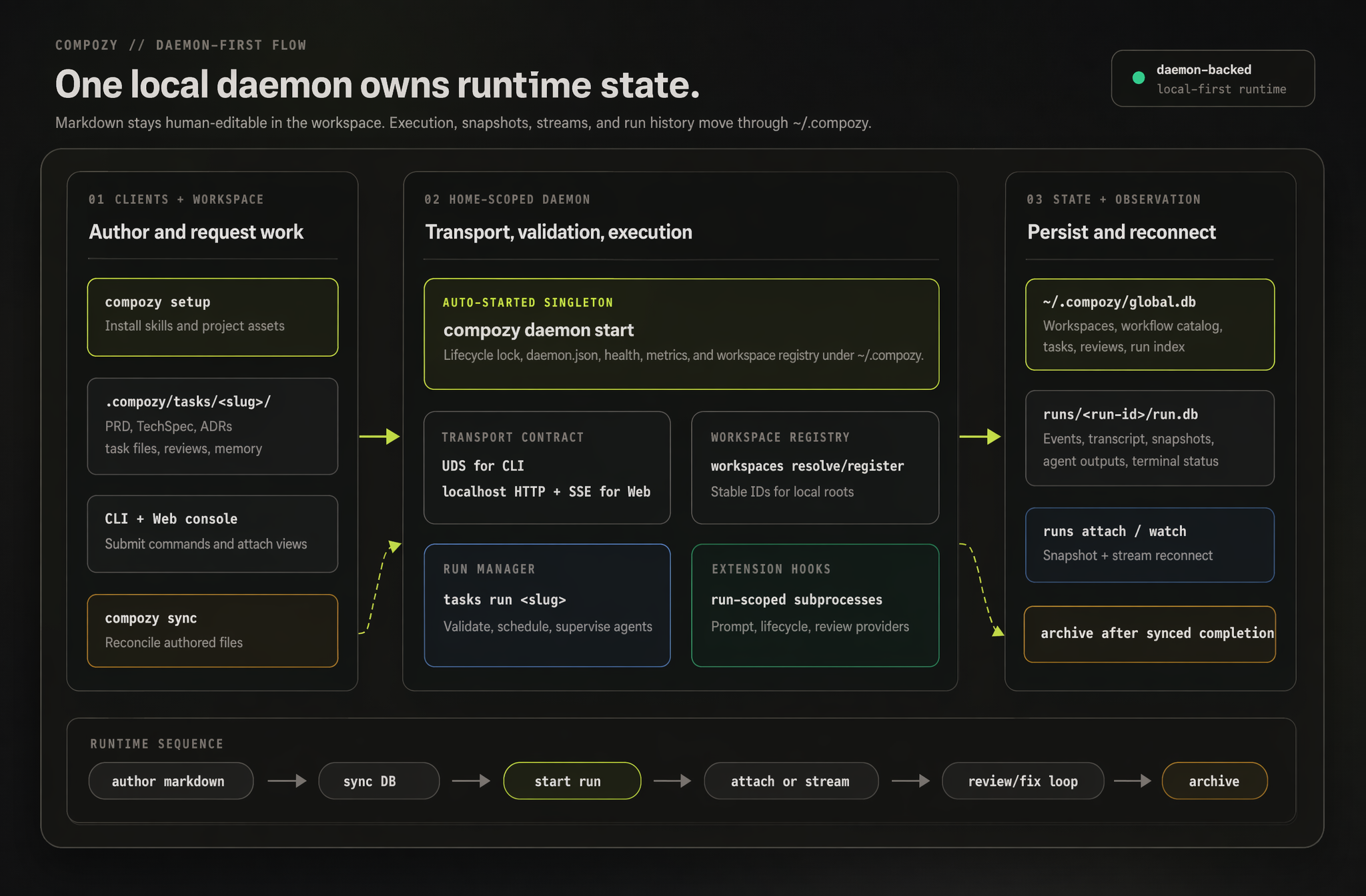
Workflow artifacts stay in `.compozy/tasks//`. These are the PRDs, TechSpecs, ADRs, tasks, reviews, and memory files that you read and edit between steps.
The daemon owns runtime state under `~/.compozy/`. Daemon-managed task runs, review-fix runs, and persisted exec sessions allocate `~/.compozy/runs//`, while attach and watch clients reconnect through daemon snapshots and streams instead of reading workspace-local run files directly.
Task and review issue files use YAML frontmatter for parseable metadata such as `status`, `title`, `type`, `severity`, and `provider_ref`. `compozy sync` now reconciles authored workflow artifacts into the daemon `global.db` catalog and performs one-time cleanup for legacy generated `_meta.md` / `_tasks.md` artifacts when they are encountered. `compozy archive` moves completed workflows only after synced daemon state says they are eligible. If you have an older project with XML-tagged artifacts, run `compozy migrate` once before using daemon-backed workflow commands.
### Daemon Runtime Model
- `compozy daemon start|status|stop` manages the home-scoped daemon lifecycle. `daemon start` is idempotent, and task/review/exec commands auto-start the daemon when needed.
- `compozy workspaces list|show|register|unregister|resolve` exposes the daemon workspace registry. Workspaces are also lazily registered when you run daemon-backed commands inside them.
- `compozy tasks run ` is the canonical single-workflow runner. In interactive terminals it attaches to the TUI by default; in non-interactive environments it falls back to streaming. Use `--ui`, `--stream`, `--detach`, or `--attach` to override that behavior. Add `--parallel-tasks` to opt into dependency-aware parallel execution for task files inside one workflow.
- `compozy tasks run --multiple alpha,beta` starts one daemon-owned queue for several task workflows. Use `tasks run --multiple` when the same flags and runtime defaults should apply to an ordered batch; keep using `tasks run ` for one workflow or scripts that expect one run ID per invocation. Add `--parallel` to run the batch concurrently — each child runs in its own isolated git worktree, bounded by `--parallel-limit` (default `2`).
- Independent `compozy tasks run` invocations from different workspaces run concurrently on the shared home-scoped daemon. When another workspace already has an active run, the CLI prints a warning with the busy workspace and run ID before starting the new run.
- `compozy runs attach ` restores the interactive TUI for an existing daemon-managed run, while `compozy runs watch ` streams textual observation from the same snapshot-plus-stream transport.
- `compozy reviews fetch|list|show|fix` is the canonical review command family.
### Task Schema v2
Task files now use the v2 frontmatter shape: `status`, `title`, `type`, `complexity`, and `dependencies`. Legacy v1 task-only keys are no longer part of the schema. `type` must come from the workspace task type registry: either `[tasks].types` in `.compozy/config.toml` or the built-in defaults `frontend`, `backend`, `docs`, `test`, `infra`, `refactor`, `chore`, `bugfix`.
---
status: pending
title: Add task validation preflight to tasks run
type: backend
complexity: medium
dependencies:
- task_02
---
Validate task files at any time with `compozy tasks validate --name `. `compozy tasks run ` runs the same preflight automatically; use `--skip-validation` only when tasks were validated elsewhere, or `--force` to continue after validation failures in non-interactive runs.
## ⚙️ Config Files
Compozy can load global defaults from `~/.compozy/config.toml` and override them per workspace with `.compozy/config.toml`.
- The CLI discovers the nearest `.compozy/` directory by walking upward from the current working directory.
- If `~/.compozy/config.toml` exists, Compozy loads it once at command startup.
- If `.compozy/config.toml` exists in the resolved workspace, it overrides the global config field by field.
- Explicit CLI flags always win over config values.
Precedence is:
explicit flags > workspace command section > workspace [defaults] > global command section > global [defaults] > built-in defaults
Example:
[defaults]
ide = "codex"
model = "gpt-5.5"
reasoning_effort = "medium"
access_mode = "full"
timeout = "10m"
tail_lines = 0
add_dirs = ["../shared"]
auto_commit = false
max_retries = 2
retry_backoff_multiplier = 1.5
[tasks]
types = ["frontend", "backend", "docs", "test", "infra", "refactor", "chore", "bugfix"]
[tasks.run]
include_completed = false
run_multiple_mode = "enqueued"
run_multiple_parallel_limit = 2
[tasks.run.parallel]
enabled = false
max_concurrency = 4
[tasks.run.parallel.conflict_resolver]
ide = "codex"
model = "gpt-5.5"
reasoning_effort = "medium"
max_attempts = 1
validation_command = []
[exec]
output_format = "text"
[recovery]
enabled = false
ide = "codex"
model = "gpt-5.5"
reasoning_effort = "medium"
max_attempts = 1
[fix_reviews]
concurrent = 2
batch_size = 3
include_resolved = false
[fetch_reviews]
provider = "coderabbit"
nitpicks = false
Supported sections:
- `[defaults]` for shared execution defaults such as `ide`, `model`, `reasoning_effort`, `access_mode`, `timeout`, `tail_lines`, `add_dirs`, `auto_commit`, `max_retries`, and `retry_backoff_multiplier`
- `[exec]` for `output_format` plus exec-specific runtime overrides such as `ide`, `model`, `reasoning_effort`, `access_mode`, `timeout`, `tail_lines`, `add_dirs`, `max_retries`, and `retry_backoff_multiplier`
- `[tasks]` for the allowed task `type` list used by `cy-create-tasks` and `compozy tasks validate`
- `[tasks.run]` for workflow-run defaults used by `compozy tasks run`, such as `include_completed`, `run_multiple_mode`, and `run_multiple_parallel_limit`
- `[tasks.run.parallel]` for dependency-aware parallel execution inside one PRD task workflow, including `enabled`, `max_concurrency`, and the conflict-resolver agent under `[tasks.run.parallel.conflict_resolver]`
- `[fix_reviews]` for `concurrent`, `batch_size`, and `include_resolved`
- `[fetch_reviews]` for `provider` and `nitpicks` (controls CodeRabbit review-body comments; default is enabled when unset)
- `[recovery]` for agentic recovery defaults used by run-producing commands: `enabled`, `ide`, `model`, `reasoning_effort`, and `max_attempts`
- `[sound]` for optional run-completion audio presets or absolute file paths
Notes:
- Both `~/.compozy/config.toml` and `.compozy/config.toml` are optional. If both are absent, Compozy keeps the current built-in defaults.
- `.compozy/tasks` remains the fixed workflow root in this version; the config file does not change the workflow root path.
- Unknown keys and invalid value types are rejected during config loading.
- Relative `add_dirs` are resolved against the owning config scope: the user home directory for `~/.compozy/config.toml` and the workspace root for `.compozy/config.toml`.
- `[tasks.run] run_multiple_mode` controls `tasks run --multiple` scheduling. Valid values are `"enqueued"` and `"parallel"`; when unset, the built-in default is `"enqueued"`.
- `run_multiple_mode = "parallel"` runs the batch concurrently, with each child in its own isolated git worktree. The CLI `--parallel` flag overrides this config value for a single invocation.
- `[tasks.run] run_multiple_parallel_limit` caps how many children run at once in parallel mode. It must be a positive integer and defaults to `2`. The CLI `--parallel-limit ` flag overrides it for a single invocation. The limit has no effect in enqueued mode, which always runs one child at a time.
- `[tasks.run.parallel] enabled = true` runs pending task files in one workflow by dependency waves. The CLI `--parallel-tasks` flag overrides this config value for a single invocation.
- `[tasks.run.parallel] max_concurrency` caps concurrent task worktrees within a wave and defaults to `4`. The conflict resolver uses `ide`, `model`, `reasoning_effort`, and `max_attempts` for bounded merge-conflict resolution.
- `[tasks.run.parallel.conflict_resolver] validation_command` is optional and disabled by default. When set, it is an argv-style command such as `["go", "test", "./..."]`, runs without a shell after conflict markers and unmerged entries are gone, and must not modify the integration worktree. Omit it or set `[]` to rely only on universal git validation.
- `max_retries` applies to execution-stage ACP failures and inactivity timeouts for `compozy exec`, `compozy tasks run`, and `compozy reviews fix`.
- Built-in CLI defaults retry timed-out or transient ACP failures twice; set `max_retries = 0` or pass `--max-retries 0` to opt out.
- `retry_backoff_multiplier` only increases the next attempt timeout; retries restart immediately and do not add a sleep delay.
- Recovery is disabled by default. When enabled, `max_attempts` is the number of remediation plus restart cycles and must be between `1` and `3`.
- Recovery config is resolved fresh for each invocation and is not persisted into run or exec metadata. Use `--recovery`, `--no-recovery`, `--recovery-ide`, `--recovery-model`, `--recovery-reasoning`, and `--recovery-max-attempts` to override `[recovery]` for one command.
## Reusable Agents
Reusable agents are flat filesystem bundles discovered from two scopes:
- workspace: `.compozy/agents//`
- global: `~/.compozy/agents//`
When the same agent name exists in both places, the workspace directory wins as a whole. Compozy does not merge `AGENT.md` from one scope with `mcp.json` from the other.
Each agent directory contains:
- required `AGENT.md` with YAML frontmatter plus a markdown body
- optional `mcp.json` using the standard top-level `mcpServers` shape
Agent directory names are the canonical agent ids. They must match `^[a-z][a-z0-9-]{0,63}$`, and `compozy` is reserved.
Quick start:
compozy agents list
compozy agents inspect reviewer
compozy exec --agent reviewer "Review the staged changes"
Runtime precedence for `compozy exec --agent ...` is:
explicit CLI flags > AGENT.md runtime defaults > workspace/global config > built-in defaults
`mcp.json` is only for agent-local MCP servers. The reserved Compozy MCP server is also named `compozy`, but it is injected by the host and must not appear in `mcp.json`. That reserved server exists only to expose host-owned tools such as `run_agent`. Child agent runs receive the reserved `compozy` server plus the child agent's own `mcp.json`; they do not inherit the parent agent's local MCP servers.
Use these committed example fixtures as starting points:
- [`docs/examples/agents/reviewer/AGENT.md`](docs/examples/agents/reviewer/AGENT.md) for a minimal reusable agent
- [`docs/examples/agents/repo-copilot/AGENT.md`](docs/examples/agents/repo-copilot/AGENT.md) and [`docs/examples/agents/repo-copilot/mcp.json`](docs/examples/agents/repo-copilot/mcp.json) for an agent with external MCP dependencies
The detailed guide lives in [`docs/reusable-agents.md`](docs/reusable-agents.md).
## 🔌 Extensions
Compozy extensions are executable subprocess plugins that intercept and modify pipeline behavior without rebuilding the binary. Extensions communicate with the host over JSON-RPC 2.0 on stdin/stdout and can observe lifecycle events, mutate prompts, inject plan sources, modify agent sessions, gate retries, ship skill packs, and register review providers.
### SDK support
| Language | Package | Install |
| ---------- | ------------------------------------------------- | ------------------------------------------------- |
| TypeScript | [`@compozy/extension-sdk`](sdk/extension-sdk-ts/) | `npm install @compozy/extension-sdk` |
| Go | [`sdk/extension`](sdk/extension/) | `go get github.com/compozy/compozy/sdk/extension` |
Scaffold a new extension project with starter templates:
npx @compozy/create-extension my-ext
npx @compozy/create-extension my-ext --template prompt-decorator
npx @compozy/create-extension my-ext --runtime go
Available templates: `lifecycle-observer`, `prompt-decorator`, `review-provider`, `skill-pack`.
### Extension CLI
compozy ext list # discover extensions across all scopes
compozy ext inspect # show manifest, capabilities, enablement status
compozy ext install # install from a local path or GitHub repo archive
compozy ext uninstall # remove a user-scoped extension
compozy ext enable # enable on this machine
compozy ext disable # disable on this machine
compozy ext doctor # validate manifests and report health warnings
Extensions are discovered from three scopes with workspace > user > bundled precedence. User and workspace extensions start disabled and must be explicitly enabled by the local operator.
### Learn more
- [Extension author guide](.compozy/docs/extensibility/index.md)
- [Architecture overview](.compozy/docs/extensibility/architecture.md)
- [Hook reference](.compozy/docs/extensibility/hook-reference.md) -- 32 hooks across 6 pipeline phases
- [Host API reference](.compozy/docs/extensibility/host-api-reference.md) -- 11 typed host methods
- [Capability reference](.compozy/docs/extensibility/capability-reference.md) -- 19 capability grants
- [Trust and enablement](.compozy/docs/extensibility/trust-and-enablement.md)
- [Testing guide](.compozy/docs/extensibility/testing.md)
## ⚡ Ad Hoc Exec
Use `compozy exec` when you want one prompt through the same ACP-backed execution stack without creating a full workflow first.
compozy exec "Summarize the current repository changes"
compozy exec --prompt-file prompt.md
cat prompt.md | compozy exec --format json
compozy exec --persist "Review the latest changes"
compozy exec --run-id exec-20260405-120000-000000000 "Continue from the previous session"
Prompt source rules are explicit:
- pass one positional prompt for short inline runs
- use `--prompt-file` for longer or reusable prompts
- pipe `stdin` only when neither of the above is provided
- ambiguous combinations are rejected instead of guessed
Output modes:
- `--format text` is headless by default and writes only the final assistant response to stdout
- `--format json` streams the lean JSONL contract to stdout and filters ACP metadata that is mostly useful for debugging
- `--format raw-json` streams the full raw JSONL event trace to stdout
- when `--persist` is enabled, `~/.compozy/runs//events.jsonl` always stores the full raw event stream regardless of the selected stdout format
- operational ACP/runtime logs stay silent by default; use `--verbose` when you want lifecycle logs on stderr
- `--tui` opts back into the Bubble Tea interface for interactive inspection
- `--persist` stores a resumable conversation under `~/.compozy/runs//`
- `--run-id` loads a previously persisted ACP session and appends a new turn
Persisted `exec` runs use this layout:
~/.compozy/runs//run.db
~/.compozy/runs//run.json
~/.compozy/runs//events.jsonl
~/.compozy/runs//turns/0001/prompt.md
~/.compozy/runs//turns/0001/response.txt
~/.compozy/runs//turns/0001/result.json
`compozy exec` uses the same config merge rule as the rest of the CLI: `flags > workspace [exec] > workspace [defaults] > global [exec] > global [defaults] > built-in defaults`.
## 🚀 Quick Start
This walkthrough builds a feature called **user-auth** from idea to shipped code.
### 1. Install skills
compozy setup
Auto-detects installed agents, copies (or symlinks) core skills into their configuration directories, and installs setup assets shipped by enabled extensions.
`compozy tasks run` and `compozy reviews fix` now verify that bundled Compozy skills are installed for the selected agent before running. Missing installs block the run, and outdated installs prompt for refresh in interactive terminals.
### 2. (Optional) Create an Issue
Inside your AI agent (Claude Code, Codex, Cursor, OpenCode, Pi, etc.):
compozy ext install --yes compozy/compozy --remote github --ref --subdir extensions/cy-idea-factory
compozy ext enable cy-idea-factory
compozy setup
Then:
/cy-idea-factory user-auth
Transforms a raw idea into a structured idea spec — asks targeted questions, researches market and codebase in parallel, runs business analysis and council debate, suggests high-leverage alternatives, and produces a research-backed idea. Skip this step if you already have a clear feature scope.
### 3. Create a PRD
/cy-create-prd user-auth
Interactive brainstorming session — reads the idea if one exists, asks clarifying questions, spawns parallel agents to research your codebase and the web, produces a business-focused PRD with ADRs.
### 4. Create a TechSpec
/cy-create-techspec user-auth
Reads your PRD, explores the codebase architecture, asks technical clarification questions. Produces architecture specs, API designs, and data models.
### 5. Break down into tasks
/cy-create-tasks user-auth
Analyzes both documents, explores your codebase for relevant files and patterns, produces individually executable task files with status tracking, context, and acceptance criteria.
Generated task files use task schema v2 (`status`, `title`, `type`, `complexity`, `dependencies`). Validate them any time with `compozy tasks validate --name user-auth`.
### 6. Execute tasks
compozy tasks run user-auth --ide claude
compozy tasks run user-auth --parallel-tasks
compozy tasks run --multiple user-auth,cleanup --ide claude
compozy tasks run --multiple user-auth,cleanup --parallel --parallel-limit 2
Each pending task is processed sequentially through the shared daemon — the agent reads the spec, implements the code, validates it, and updates the task status. Use `--dry-run` to preview prompts without executing.
`compozy tasks run` validates task metadata before execution. Use `--skip-validation` when validation already ran elsewhere, or `--force` to continue after validation failures in non-interactive environments.
Use `compozy tasks run --multiple ,` when you want one command to enqueue several workflows with the same runtime flags. The input is one comma-separated slug list; `compozy tasks run ` remains the single-workflow command. Add `--parallel` to run independent workflows concurrently in isolated git worktrees instead of one at a time.
### 7. Review
**Option A** — AI-powered review inside your agent:
/cy-review-round user-auth
**Option B** — Fetch from an external provider:
compozy reviews fetch user-auth --provider coderabbit --pr 42
Both produce the same output: `.compozy/tasks/user-auth/reviews-001/issue_*.md`
### 8. Fix review issues
compozy reviews fix user-auth --ide claude --concurrent 2 --batch-size 3
Agents triage each issue as valid or invalid, implement fixes for valid issues, and update statuses. Provider threads are resolved automatically.
### 9. Iterate and ship
Repeat steps 7–8. Each cycle creates a new review round (`reviews-002/`, `reviews-003/`), preserving full history. When clean — merge and ship.
## 🧩 Skills
Compozy bundles 9 core skills that its workflows depend on. They run inside your AI agent — no context switching to external tools.
| Skill | Purpose |
| -------------------- | -------------------------------------------------------------------------- |
| `cy-create-prd` | Idea → Product Requirements Document with ADRs |
| `cy-create-techspec` | PRD → Technical Specification with architecture exploration |
| `cy-create-tasks` | PRD + TechSpec → Independently implementable task files |
| `cy-execute-task` | Executes one task end-to-end: implement, validate, track, commit |
| `cy-workflow-memory` | Maintains cross-task context so agents pick up where the last one left off |
| `cy-review-round` | Comprehensive code review → structured issue files |
| `cy-fix-reviews` | Triage, fix, verify, and resolve review issues |
| `cy-final-verify` | Enforces verification evidence before any completion claim |
Optional first-party extension skills:
| Skill | Purpose |
| ----------------- | ------------------------------------------------------------------------------------------- |
| `cy-idea-factory` | Raw idea → structured idea spec with market research, business analysis, and council debate |
Install the optional ideation extension with:
compozy ext install --yes compozy/compozy --remote github --ref --subdir extensions/cy-idea-factory
compozy ext enable cy-idea-factory
compozy setup
### 🧠 Workflow Memory
When agents execute tasks, context gets lost between runs — decisions made, errors hit, patterns discovered. Compozy solves this with a two-tier memory system that gives each agent a running history of the workflow.
Every task execution automatically bootstraps two markdown files inside `.compozy/tasks//memory/`:
| File | Scope | What goes here |
| ------------ | ------------------ | ------------------------------------------------------------------------------- |
| `MEMORY.md` | Cross-task, shared | Architecture decisions, discovered patterns, open risks, handoffs between tasks |
| `task_01.md` | Single task | Objective snapshot, files touched, errors hit, what's ready for the next run |
**How it works:**
1. Before a task runs, Compozy creates the memory directory and scaffolds both files with section templates if they don't exist yet.
2. The agent reads both memory files before writing any code — treating them as mandatory context, not optional notes.
3. During execution, the agent keeps task memory current: decisions, learnings, errors, and corrections.
4. Only durable, cross-task context gets promoted to shared memory. Task-local details stay in the task file.
5. Before completion, the agent updates memory with anything that helps the next run start faster.
**Automatic compaction.** Memory files have soft limits (150 lines / 12 KB for shared, 200 lines / 16 KB per task). When a file exceeds its threshold, Compozy flags it for compaction — the agent trims noise and repetition while preserving active risks, decisions, and handoffs.
**No duplication.** Memory files don't copy what's already in the repo, git history, PRD, or task specs. They capture only what would otherwise be lost between runs: the _why_ behind decisions, surprising findings, and context that makes the next agent immediately productive.
The `cy-workflow-memory` skill handles all of this automatically when referenced in task prompts. No manual setup required — run `compozy tasks run ` and agents inherit context from every previous run.
### 🤖 Supported Agents
**Execution** (`compozy exec`, `compozy tasks run`, `compozy reviews fix`) — ACP-capable runtimes that can run ad hoc prompts and daemon-backed workflow tasks:
| Agent | `--ide` flag |
| -------------- | -------------- |
| Claude Code | `claude` |
| Codex | `codex` |
| GitHub Copilot | `copilot` |
| Devin CLI | `devin` |
| Cursor | `cursor-agent` |
| Droid | `droid` |
| OpenCode | `opencode` |
| Pi | `pi` |
| Gemini | `gemini` |
**Skill installation** (`compozy setup`) — 40+ agents and editors, including Claude Code, Codex, Cursor, Devin CLI, Droid, OpenCode, Pi, Gemini CLI, GitHub Copilot, Windsurf, Amp, Continue, Goose, Roo Code, Augment, Kiro CLI, Cline, and many more. `compozy setup` installs core workflow skills plus any setup assets shipped by enabled extensions. Run `compozy setup` to see all detected agents on your system.
When installing to multiple agents, Compozy offers two modes:
- **Symlink** _(default)_ — One canonical copy with symlinks from each agent directory. All agents stay in sync.
- **Copy** — Independent copies per agent. Use `--copy` when symlinks are not supported.
## 📖 CLI Reference
compozy setup — Install core skills and enabled extension assets
compozy setup [flags]
| Flag | Default | Description |
| ---------------- | ------- | ---------------------------------------------------------------- |
| `--agent`, `-a` | | Target agent name (repeatable) |
| `--skill`, `-s` | | Skill name to install (repeatable) |
| `--global`, `-g` | `false` | Install to user directory instead of project |
| `--copy` | `false` | Copy files instead of symlinking |
| `--list`, `-l` | `false` | List core skills and enabled extension assets without installing |
| `--yes`, `-y` | `false` | Skip confirmation prompts |
| `--all` | `false` | Install all skills to all agents |
compozy migrate — Convert legacy XML-tagged artifacts to frontmatter
compozy migrate [flags]
| Flag | Default | Description |
| --------------- | ---------------- | ------------------------------------------------- |
| `--root-dir` | `.compozy/tasks` | Workflow root to scan recursively |
| `--name` | | Restrict migration to one workflow name |
| `--tasks-dir` | | Restrict migration to one task workflow directory |
| `--reviews-dir` | | Restrict migration to one review round directory |
| `--dry-run` | `false` | Preview migrations without writing files |
compozy sync — Reconcile workflow artifacts into daemon state
compozy sync [flags]
| Flag | Default | Description |
| ------------- | ---------------- | -------------------------------------------- |
| `--root-dir` | `.compozy/tasks` | Workflow root to scan |
| `--name` | | Restrict sync to one workflow name |
| `--tasks-dir` | | Restrict sync to one task workflow directory |
compozy daemon — Manage the shared home-scoped daemon
compozy daemon start
compozy daemon status
compozy daemon stop [--force]
Use `daemon start` for an explicit bootstrap, `daemon status` for health and transport info, and `daemon stop` for graceful shutdown. Most workflow commands auto-start the daemon for you.
compozy workspaces — Manage daemon workspace registrations
compozy workspaces list [--format text|json]
compozy workspaces show [--format text|json]
compozy workspaces register [--name display-name] [--format text|json]
compozy workspaces unregister [--format text|json]
compozy workspaces resolve [--format text|json]
The daemon lazily registers workspaces on first use, but the `workspaces` family gives operators explicit control over the registry.
compozy tasks validate — Validate task metadata before execution
compozy tasks validate [--name my-feature | --tasks-dir .compozy/tasks/my-feature] [--format text|json]
Use `tasks validate` to check every `task_*.md` file in a workflow directory against the v2 task metadata schema before you run `tasks run`.
compozy tasks run — Start one daemon-backed workflow run
compozy tasks run [flags]
The CLI resolves workspace defaults locally, validates the task metadata, auto-starts the daemon when needed, and then starts the workflow through the daemon transport.
| Flag | Default | Description |
| ------------------------- | --------- | ------------------------------------------------------------------------------------------------ |
| `--name` | | Workflow slug (defaults to the positional slug) |
| `--multiple` | | Comma-separated workflow slugs to run through one daemon-owned parent queue |
| `--parallel` | `false` | Run `--multiple` workflows concurrently in isolated git worktrees (valid only with `--multiple`) |
| `--parallel-limit` | `2` | Max children started at once in `--parallel` mode; must be `> 0` (valid only with `--multiple`) |
| `--parallel-tasks` | `false` | Run task files inside one PRD workflow in dependency-aware parallel mode |
| `--include-completed` | `false` | Re-run completed tasks |
| `--recursive`, `-r` | `false` | Discover `task_NNN.md` files in nested subdirectories of the workflow root |
| `--skip-validation` | `false` | Skip task metadata preflight; use only when validation already ran elsewhere |
| `--force` | `false` | Continue after task metadata validation fails in non-interactive mode |
| `--attach` | `auto` | Attach mode: `auto`, `ui`, `stream`, or `detach` |
| `--ui` | `false` | Force interactive TUI attach mode |
| `--stream` | `false` | Force textual stream attach mode |
| `--detach` | `false` | Start the run without attaching a client |
| `--task-runtime` | | Per-task runtime override rule (`type=...`, `id=...`, `ide=...`, `model=...`, etc.) |
| `--recovery` | `false` | Enable agentic recovery for failed runs |
| `--no-recovery` | `false` | Disable agentic recovery for this invocation |
| `--recovery-ide` | `codex` | Runtime used by the recovery agent |
| `--recovery-model` | `gpt-5.5` | Model used by the recovery agent |
| `--recovery-reasoning` | `medium` | Recovery agent reasoning effort: `low`, `medium`, `high`, or `xhigh` |
| `--recovery-max-attempts` | `1` | Recovery remediation plus restart cycles; must be between `1` and `3` |
When `--recursive` is set, tasks are grouped by directory (root tasks first, then each subdirectory in alphabetical order, numerically within), and `_`/`.`-prefixed directories, `reviews-*` rounds, `adrs/`, and `memory/` are skipped. The same setting can be persisted as `[tasks.run] recursive = true` in workspace TOML or chosen from the interactive task-runtime form.
Use `tasks run --multiple` when you want to start several task workflows from one invocation with the same runtime flags. Use `tasks run ` when you only need one workflow run, when a script expects a single workflow slug, or when you want the existing single-run command path.
For one workflow, `--parallel-tasks` executes pending task files in dependency waves using isolated worktrees, bounded by `[tasks.run.parallel] max_concurrency`:
compozy tasks run my-feature --parallel-tasks
The `--multiple` flag takes one comma-separated slug list:
compozy tasks run --multiple alpha,beta --ide codex --model gpt-5.5
compozy tasks run --multiple alpha,beta --stream
compozy tasks run --multiple alpha,beta --detach
Scheduling is controlled by the `--parallel`/`--parallel-limit` flags or by `.compozy/config.toml` / `~/.compozy/config.toml`:
[tasks.run]
run_multiple_mode = "enqueued" # "enqueued" (default) or "parallel"
run_multiple_parallel_limit = 2 # max concurrent children in parallel mode
`"enqueued"` (the default) runs one child workflow at a time in the requested order. `"parallel"` runs independent children concurrently, each in its own isolated git worktree, bounded by the parallel limit:
compozy tasks run --multiple alpha,beta --parallel
compozy tasks run --multiple alpha,beta --parallel --parallel-limit 3
Resolution precedence:
- Mode: `--parallel` flag > `run_multiple_mode` config > `enqueued` default.
- Limit: `--parallel-limit ` flag > `run_multiple_parallel_limit` config > `2` default.
`--parallel` and `--parallel-limit` are valid only with `--multiple`, and the limit must be a positive integer; invalid combinations are rejected before the daemon is contacted.
**Worktree isolation.** In parallel mode the parent workspace must be on a named git branch. Compozy resolves the current branch and `HEAD` once, then creates one detached git worktree per child under `~/.compozy/state/worktrees/`. Each child runs with its workspace root and task directory remapped into that worktree, so concurrent agents get isolated working trees, indexes, and `HEAD`s while sharing the repository object store. Worktrees do **not** isolate shared runtime resources such as ports, credentials, provider rate limits, caches, or external services — treat parallel batches as genuinely independent tasks.
**Preservation and V1 non-goals.** Every child worktree is preserved for manual review while the run settles, regardless of child status. Compozy does not auto-merge, auto-push, or branch those results, and it does not predict semantic conflicts; recombining results is a manual step. Each detached worktree records its base branch and commit so you can branch or merge from it yourself. Preserved worktrees are reclaimed only by explicit retention cleanup through `compozy runs purge`; dirty task worktrees make purge fail before run metadata is deleted.
**Fail-late aggregation.** A child failure does not cancel its siblings. The parent reaches a terminal status only after every started child settles: `completed` when all children complete, or `failed` when any child fails, crashes, or cannot start (the parent error names the failed slugs). Canceling the parent cancels running children and marks not-started children canceled. In non-TUI runs the parent command exits non-zero when the aggregate status is failed, canceled, or crashed.
**Handoff output.** After the queue settles, `--stream` runs (and the UI-settled fallback) print a final handoff that lists each child in requested order so every preserved worktree is locatable:
task multi-run handoff:
alpha completed | run=child-alpha | worktree=~/.compozy/state/worktrees///01-alpha | branch=main
beta failed | run=child-beta | worktree=~/.compozy/state/worktrees///02-beta | boom
Missing run ids or worktree paths render as `-`. Streamed child events also carry `worktree=`, and the TUI shows a worktree status line for the selected child.
Cross-workspace runs are different from `--multiple` scheduling: the home-scoped daemon accepts separate `compozy tasks run` invocations from different workspaces concurrently and does not queue or reject the second run. Before starting a non-dry-run task workflow, the CLI checks daemon status; if active runs belong to another registered workspace, it warns with the busy workspace name/path and run ID, then proceeds. The warning is skipped when the daemon is idle, when the active run belongs to the same workspace, or when `--dry-run` is set.
In the TUI, every requested slug has a tab. Queued tabs appear before their child run exists, the running tab shows the familiar task-run surface, and completed, failed, or canceled tabs remain available for inspection. The quit dialog applies to the parent queue: `Close TUI` detaches and leaves the queue running in the daemon, `Stop Run` cancels the parent queue, cancels the active child, and marks queued workflows canceled, and `Cancel` returns to the TUI without changing execution.
The multi-run path uses the same attach and runtime flags as single-run `tasks run`, except `--multiple` cannot be combined with a positional slug, `--name`, or `--parallel-tasks`.
compozy reviews — Inspect and remediate review workflows
compozy reviews fetch [--provider coderabbit --pr 42 --round N]
compozy reviews list
compozy reviews show [round]
compozy reviews fix [flags]
`reviews fetch` imports provider feedback into `.compozy/tasks//reviews-NNN/`. `reviews fix` uses the same daemon-backed runtime model as `tasks run`, including `--attach`, `--ui`, `--stream`, and `--detach`.
compozy runs — Reattach, observe, and clean daemon-managed runs
compozy runs attach
compozy runs watch
compozy runs purge
Use `runs attach` to restore the interactive TUI for an existing run, `runs watch` for textual streaming observation, and `runs purge` to delete terminal run artifacts according to the configured retention policy. Purge also removes clean Compozy-owned preserved worktrees recorded by terminal run events under `~/.compozy/state/worktrees/`; it ignores paths outside that root and stops before deleting run metadata if a task worktree is dirty.
compozy archive — Move fully completed workflows into the archive root
compozy archive [flags]
| Flag | Default | Description |
| ------------- | ---------------- | ------------------------------------------------- |
| `--root-dir` | `.compozy/tasks` | Workflow root to scan |
| `--name` | | Restrict archiving to one workflow name |
| `--tasks-dir` | | Restrict archiving to one task workflow directory |
compozy exec — Execute one ad hoc prompt
compozy exec [prompt] [flags]
Provide exactly one prompt source: a positional prompt, `--prompt-file`, or `stdin`. When present, `~/.compozy/config.toml` and `.compozy/config.toml` can provide exec defaults through `[exec]` and shared runtime defaults through `[defaults]`.
`compozy exec` is headless and ephemeral by default. Use `--agent ` to execute a reusable agent from `.compozy/agents/` or `~/.compozy/agents/`, `--persist` to create `~/.compozy/runs//` for resumable sessions, `--run-id` to continue a persisted session, `--format json` for lean JSONL, `--format raw-json` for the full raw event stream, and `--tui` to opt back into the interactive UI.
| Flag | Default | Description |
| ---------------------------- | ----------- | ------------------------------------------------------------------------------------------ |
| `--ide` | `codex` | Runtime: `claude`, `codex`, `copilot`, `cursor-agent`, `droid`, `gemini`, `opencode`, `pi` |
| `--model` | _(per IDE)_ | Model override |
| `--agent` | | Reusable agent to execute from `.compozy/agents/` or `~/.compozy/agents/` |
| `--prompt-file` | | Read prompt text from a file |
| `--format` | `text` | Output contract: `text`, `json`, or `raw-json` |
| `--reasoning-effort` | `medium` | `low`, `medium`, `high`, `xhigh` |
| `--access-mode` | `full` | `default` or `full` runtime access policy |
| `--timeout` | `10m` | Activity timeout per job |
| `--recovery` | `false` | Enable agentic recovery for failed exec runs |
| `--no-recovery` | `false` | Disable agentic recovery for this invocation |
| `--recovery-ide` | `codex` | Runtime used by the recovery agent |
| `--recovery-model` | `gpt-5.5` | Model used by the recovery agent |
| `--recovery-reasoning` | `medium` | Recovery agent reasoning effort: `low`, `medium`, `high`, or `xhigh` |
| `--recovery-max-attempts` | `1` | Recovery remediation plus restart cycles; must be between `1` and `3` |
| `--max-retries` | `2` | Retry execution-stage ACP failures or timeouts N times |
| `--retry-backoff-multiplier` | `1.5` | Multiplier applied to the next timeout after each retry |
| `--tail-lines` | `0` | Maximum log lines retained per job in UI (`0` = full history) |
| `--add-dir` | | Additional directories to allow (repeatable; currently `claude` and `codex` only) |
| `--auto-commit` | `false` | Include automatic commit instructions when the prompt asks for code changes |
| `--verbose` | `false` | Emit operational runtime logs to stderr during exec |
| `--tui` | `false` | Open the interactive TUI instead of headless stdout output |
| `--persist` | `false` | Persist exec artifacts under `~/.compozy/runs//` |
| `--run-id` | | Resume a previously persisted exec session by run id |
| `--dry-run` | `false` | Preview prompts without executing |
compozy agents — Discover and inspect reusable agents
compozy agents list
compozy agents inspect
`compozy agents list` prints resolved agents from workspace and global scope, then reports any invalid definitions without hiding the valid ones. `compozy agents inspect ` prints the resolved source, runtime defaults, MCP summary, and validation status for one agent. Invalid inspections print the validation report first and then exit non-zero.
Examples:
compozy agents list
compozy agents inspect reviewer
compozy agents inspect repo-copilot
compozy ext — Manage executable extensions
compozy ext [flags]
| Subcommand | Description |
| ---------------------- | -------------------------------------------------- |
| `ext list` | List discovered extensions across all scopes |
| `ext inspect ` | Show manifest, capabilities, and enablement status |
| `ext install ` | Install an extension into the user scope |
| `ext uninstall ` | Remove a user-scoped extension |
| `ext enable ` | Enable an extension on this machine |
| `ext disable ` | Disable an extension on this machine |
| `ext doctor` | Validate manifests and report health warnings |
Go Package Usage — Use Compozy as a library in your own tools
// Prepare work without executing
prep, err := compozy.Prepare(context.Background(), compozy.Config{
Name: "multi-repo",
TasksDir: ".compozy/tasks/multi-repo",
Mode: compozy.ModePRDTasks,
DryRun: true,
})
// Fetch reviews and run remediation
_, _ = compozy.FetchReviews(context.Background(), compozy.Config{
Name: "my-feature",
Provider: "coderabbit",
PR: "259",
})
// Preview a legacy artifact migration
_, _ = compozy.Migrate(context.Background(), compozy.MigrationConfig{
DryRun: true,
})
_ = compozy.Run(context.Background(), compozy.Config{
Name: "my-feature",
Mode: compozy.ModePRReview,
IDE: compozy.IDECodex,
ReasoningEffort: "medium",
})
// Embed the Cobra command in another CLI
root := compozy.NewCommand()
_ = root.Execute()
Project Layout
cmd/compozy/ CLI entry point
compozy.go Public Go API + reusable Cobra command helpers
internal/cli/ Cobra flags, interactive form, CLI glue
internal/core/ Internal facade for preparation and execution
agent/ IDE command validation and process construction
agents/ Reusable agent discovery, validation, MCP merge, nested execution
extension/ Extension manifest, discovery, hooks, Host API, lifecycle
memory/ Workflow memory bootstrapping, inspection, and compaction detection
model/ Shared runtime data structures
plan/ Input discovery, filtering, grouping, batch prep
prompt/ Prompt builders emitting runtime context + skill names
run/ Execution pipeline, logging, shutdown, Bubble Tea UI
internal/setup/ Bundled skill and council-agent installer (agent detection, symlink/copy)
internal/version/ Build metadata
sdk/extension/ Public Go SDK for extension authors
sdk/extension-sdk-ts/ Public TypeScript SDK for extension authors
sdk/create-extension/ CLI scaffolder for new extension projects
skills/ Bundled installable skills
.compozy/config.toml Optional workspace defaults for CLI execution
.compozy/agents/ Optional reusable agents (`AGENT.md` + optional `mcp.json`)
.compozy/extensions/ Workspace-scoped extensions (starts disabled)
~/.compozy/runs/ Home-scoped runtime artifacts for daemon-managed and persisted exec runs
.compozy/tasks/ Default workflow artifact root (PRDs, TechSpecs, tasks, ADRs, reviews)
## 🛠️ Development
make verify # Full pipeline: fmt → lint → test → build
make fmt # Format code
make lint # Lint (zero tolerance)
make test # Tests with race detector
make build # Compile binary
make deps # Tidy and verify modules
## Star History
## 🤝 Contributing
Contributions are welcome. See [CONTRIBUTING.md](CONTRIBUTING.md) for guidelines.
## 📄 License
[MIT](LICENSE)