gossipcat-ai/gossipcat-ai

GitHub: gossipcat-ai/gossipcat-ai

这是一个通过多代理共识和交叉验证来提升代码审查准确性、减少AI幻觉的MCP服务器。

Stars: 33 | Forks: 4

Gossipcat

weightless in-context RL for code review — agents that learn from grounded signals, no weights touched.

npm version npm weekly downloads MIT License Node 22+ GitHub stars last commit tests Ask DeepWiki

Install · First Run · Daily Use · Dashboard · Troubleshooting · Config · For AI Agents


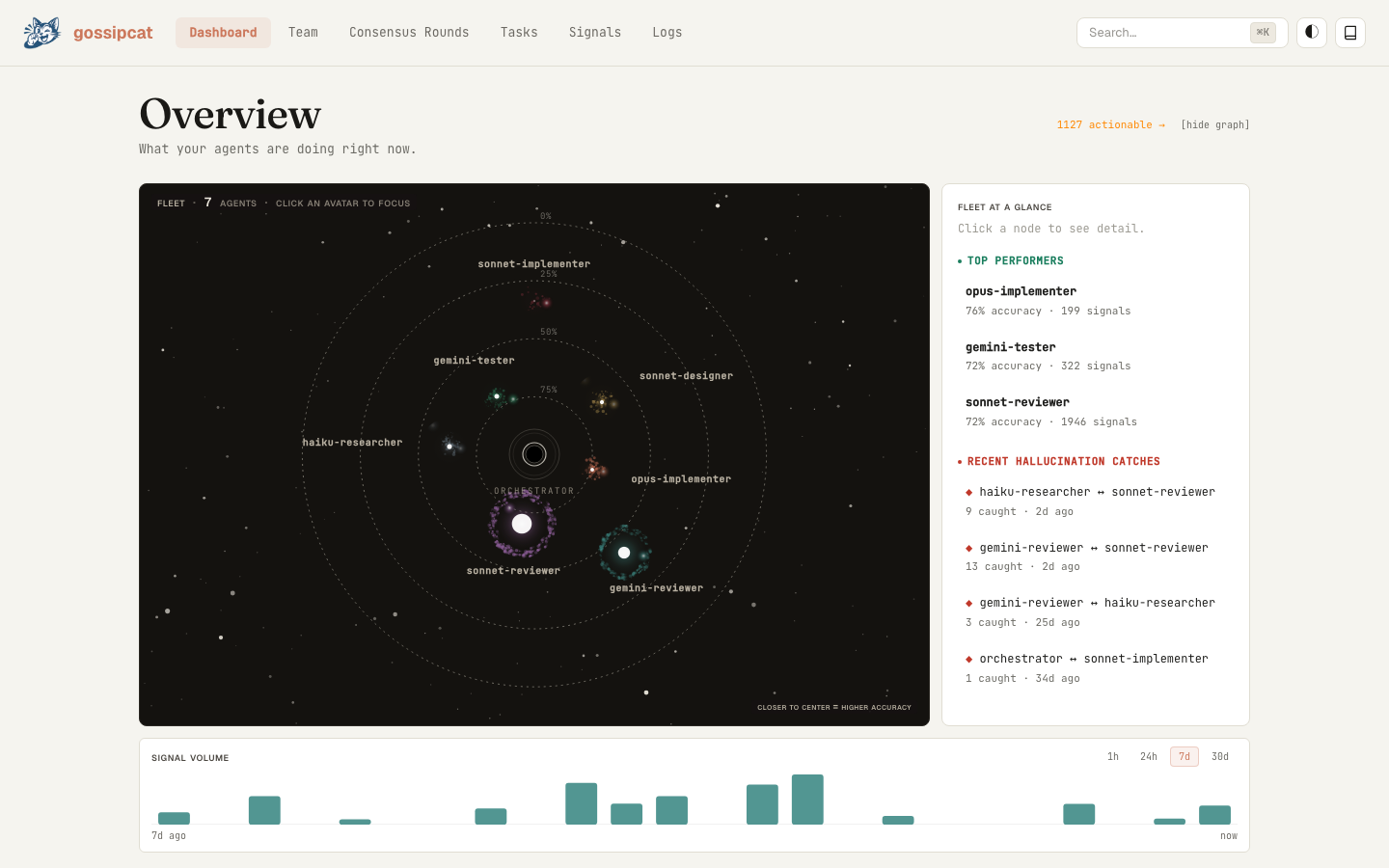
Gossipcat dashboard — live fleet view with per-agent vortexes, accuracy rings, signal volume, and recent hallucination catches

Live dashboard at http://localhost:63007/dashboard — fleet vortex, signal stream, skill graduation grid, and consensus flow, all in real time.

Gossipcat Team page — per-agent accuracy, weight, signals, hallucinations, and last task

Per-agent leaderboard — accuracy, uniqueness, impact, hallucinations caught, and dispatch weight. Updated after every consensus round.


Multi-agent consensus code review that catches hallucinations before you act on them — and gets smarter every session. ## What is Gossipcat? Gossipcat is an MCP server that orchestrates multiple AI agents to review your code in parallel. Agents independently review, then cross-review each other's findings. Agreements are confirmed. Hallucinations are caught and penalized. Over time, each agent builds an accuracy profile — the system learns who to trust for what. ### It's weightless in-context reinforcement learning Every finding an agent produces must cite a real `file:line`. Peers verify those citations against actual source code. Verified findings (and caught hallucinations) become **grounded reward signals** — no judge model, no subjective grade, just mechanical checks against ground truth. Those signals update per-agent competency scores, which steer future dispatch. When an agent keeps failing in a category, a targeted skill file is auto-generated from its own failure history and injected into future prompts. flowchart LR A([agent review]) -->|cites file:line| B([peer cross-review]) B -->|verifies against code| C{verdict} C -->|confirmed| D[reward signal] C -->|hallucination| E[penalty signal] D --> F[competency score] E --> F F -->|steer dispatch| G([next agent pick]) E -->|≥3 in category| H[auto-generate skill] H -->|inject into prompt| A G --> A style A fill:#0ea5e9,stroke:#0369a1,color:#fff style H fill:#f59e0b,stroke:#b45309,color:#fff style D fill:#10b981,stroke:#047857,color:#fff style E fill:#ef4444,stroke:#b91c1c,color:#fff The "policy update" is a markdown file under `.gossip/agents//skills/`. No fine-tuning, no RLHF infrastructure, no labelling pipeline. The reward signal is grounded in source code rather than a judge model, which is the piece that makes the loop trustworthy enough to automate. When agents disagree, we check the code — not another LLM's opinion.
## How Gossipcat compares | | What you get | Hallucination filtering | Agents improve over time | |---|---|---|---| | **Gossipcat** | 3+ agents cross-review each other's findings; confirmed bugs only | Yes — peers catch and penalize hallucinations mechanically | Yes — accuracy signals steer dispatch; skill files fix repeat failures | | **Single-agent review** (Claude Code built-in, Cursor review) | One model reviews your diff | No — hallucinations ship as findings | No — no feedback loop | | **LLM-as-judge cross-review** (most multi-agent frameworks) | One model grades another model's output | Partial — judge can hallucinate too; no ground truth | No — judge scores aren't wired to dispatch | | **Traditional review tools** (CodeRabbit, PR-Agent) | Pattern-match + one LLM pass | No | No | The core difference: gossipcat verifies findings against actual `file:line` citations in your codebase. That ground truth is what makes the reward signal trustworthy enough to automate.
## Real-world session What a typical gossipcat session looks like in practice (2026-05-22, v0.4.30 ship): - **1 feature shipped end-to-end** — consensus auto-verify (PR #448, master commit `4b28a1c`, 1255+ LOC, 50/50 new tests, zero regressions). Full design ↔ ship arc through gossipcat itself: 6 consensus rounds on the spec before any code was written. - **6 consensus rounds on the spec** caught **21+ HIGH-severity defects** across rev-1 → rev-6 — including a double-dispatch bug on the `run()` path (rev-3, opus-implementer), a phantom `AgentTeam` type the implementer would have invented if shipped (rev-5, sonnet-reviewer grep-grounded against live `AgentConfig`), and a `metadata` field that didn't exist on `ConsensusSignal` at all (rev-4, sonnet — `metadata` lives only on `MetaSignal` / `PipelineSignal`). Each round produced a measurable rev: rev-1 had 4 HIGHs, rev-6 had 0. - **1 post-merge bug caught by a pre-existing drift test** — `signal-allowlist-drift.test.ts:108` (which exists precisely to catch this — same failure mode as PR #329's silent-drop of `transport_failure`) flagged that the implementer added the 2 new signals to `KNOWN_SIGNALS` + the type union + `OPERATIONAL_SIGNAL_NAMES` but missed `VALID_CONSENSUS_SIGNALS` in `performance-writer.ts`. 7-line fix landed in the same PR before merge. - **Methodology lesson recorded** — sonnet-reviewer's habit of grepping cited file:line against live code (rather than trusting prose claims) is what ultimately closed the spec. Recorded as a `citation_grounding` agreement signal so the agent's pattern compounds across sessions. Nothing landed without cross-review. Two agents got `+/-` score adjustments based on what they caught vs. what they missed. The spec is now usable as a worked example of what 6 rounds of multi-agent design review looks like — `docs/superpowers/specs/2026-05-21-consensus-auto-verify-design.md`.
## Why multi-agent? | Without gossipcat | With gossipcat | |---|---| | One AI reviews your code — and hallucinates a finding you waste 20 minutes on | Multiple agents cross-check each other — hallucinations get caught before you see them | | Every agent gets the same tasks regardless of track record | Dispatch weights route tasks to the agent with the best accuracy in that category | | An agent keeps making the same class of mistake | Skill files are auto-generated from failure data and injected into future prompts | | You don't know which agent to trust | Accuracy, uniqueness, and reliability scores are tracked per agent, per category |
## Gossipcat is right for you if - You want **multiple AI models** catching different classes of bugs - You don't trust a single agent to catch everything - You want agents to **cross-check each other's findings** before you act on them - You want to know which agents are **actually accurate** vs. hallucinating - You want agents that **get better over time** based on their track record
## Features

Consensus Review

3+ agents review independently, then cross-review each other. Findings tagged as CONFIRMED, DISPUTED, or UNIQUE.

Adaptive Dispatch

Agent accuracy is tracked per-category. Dispatch weights adjust automatically — the best agent for the job gets picked.

Skill Development

When an agent keeps failing in a category, targeted skills are generated from failure data and injected into future prompts. Effectiveness is measured with a z-test on post-bind signals — passed, failed, or inconclusive.

Multi-Provider

Mix Anthropic, Google, OpenAI, and OpenClaw agents in one team. Each brings different strengths. Native agents need no API key. 🦞 Lobster friendly.

Live Dashboard

Real-time view of tasks, consensus reports, agent scores, and activity feed. Terminal Amber theme. WebSocket updates.

Agent Memory

Per-agent cognitive memory persists across sessions. Agents remember past findings, patterns, and project context.

Auto-Verify (v0.4.30)

Opt-in. Every UNVERIFIED finding gets file_read-checked by a verifier agent before the report is returned. tag stays 'unverified' — auto-verify is metadata, not state transition. Flag: GOSSIP_CONSENSUS_AUTO_VERIFY_UNVERIFIED=1.

Works
with
Claude Code
Full support
Cursor
Not yet
Windsurf
Not yet
VS Code
Not yet

Provider
gateways
OpenClaw
HTTP gateway ✅
Ollama
Local models ✅
OpenAI-compatible
Any base_url ✅

## How it works The Mermaid diagram above shows the loop end-to-end. Here's the per-step definition: | Step | What happens | |------|-------------| | **Dispatch** | Tasks routed to agents based on dispatch weights (accuracy history per category) | | **Parallel review** | Agents work independently, each producing findings with confidence scores | | **Cross-review** | Each agent reviews peers' findings: agree, disagree, unverified, or new finding | | **Consensus** | Findings deduplicated and tagged: CONFIRMED, DISPUTED, UNVERIFIED, UNIQUE | | **Signals** | You verify findings against code and record accuracy signals | | **Skill development** | Agents with repeated failures get targeted skill files injected into future prompts |
## Two types of agents | | Native | Relay | |---|---|---| | **Runs as** | Claude Code subagent (`Agent()` tool) | WebSocket worker on relay server | | **Providers** | Anthropic (Claude) | Google (Gemini), OpenAI, any provider | | **API key** | None — uses your Claude Code subscription | Required per provider | | **Defined in** | `.claude/agents/*.md` | `.gossip/config.json` | | **Consensus** | Yes | Yes | | **Memory & Skills** | Yes | Yes | Both types participate equally in consensus, cross-review, and skill development. Native subagents get skill files injected into their system prompts and can call `gossip_remember` for memory recall. Relay workers call the equivalent `memory_query` tool and get `file_read` + `file_grep` during cross-review so their verification parity matches natives.
## Quickstart **Requirements:** Node.js 22+ and [Claude Code](https://claude.com/claude-code). ### One-liner npm install -g gossipcat && claude mcp add gossipcat -s user -- gossipcat Restart Claude Code. Then in any project, ask:
Manual MCP config (if claude mcp add doesn't work for your setup) Add to `~/.claude/mcp_settings.json`: { "mcpServers": { "gossipcat": { "command": "gossipcat" } } } Or project-local in `.mcp.json`: { "mcpServers": { "gossipcat": { "command": "npx", "args": ["gossipcat"] } } }
Claude Code will call `gossip_setup()` to scaffold `.gossip/config.json` and your agent team. First-run bootstrap also writes the dispatch rules and tool catalog so Claude Code knows how to use gossipcat — no manual config needed. Gossipcat is on **[npm](https://www.npmjs.com/package/gossipcat)** and **[GitHub Releases](https://github.com/gossipcat-ai/gossipcat-ai/releases)** — both carry the same bundle. `npm install -g gossipcat` pulls from the registry and is the shortest path; the GitHub release URL is useful when you want to pin to a specific tarball (see [Alternative install paths](#alternative-install-paths) below). Either way, npm drops a `gossipcat` binary on your `PATH`. ### What the install ships | | What you get | |---|---| | **MCP server** | Bundled binary at `dist-mcp/mcp-server.js`, wired as the `gossipcat` command on `PATH` | | **Dashboard** | Prebuilt static assets in `dist-dashboard/` — launches automatically on a dynamic port (ask Claude Code *"what's my gossipcat dashboard URL?"*). Override with `GOSSIPCAT_PORT=24420` if you want a stable port. | | **Default skills + rules + archetypes** | 16 bundled skill templates, operational rules, and project archetypes copied into the install | | **Postinstall wizard** | Writes `.mcp.json` with correct absolute paths for your machine | ### Alternative install paths **Pin to a specific npm version:** npm install -g gossipcat@0.5.2 **Pin to a specific GitHub release tarball** (version-locked, bypasses npm registry): npm install -g https://github.com/gossipcat-ai/gossipcat-ai/releases/download/v0.5.2/gossipcat-0.5.2.tgz **Project-local install** (each project gets its own gossipcat): cd your-project npm install --save-dev gossipcat The postinstall writes `.mcp.json` to your project root. Open Claude Code in that directory and gossipcat connects automatically — no `claude mcp add` needed. git clone https://github.com/gossipcat-ai/gossipcat-ai.git cd gossipcat-ai npm install npm run build:mcp claude mcp add gossipcat -s user -- node "$PWD/dist-mcp/mcp-server.js" ### Upgrading Re-run the install — npm will fetch the latest version and replace the installed binary: npm install -g gossipcat@latest Or in-session, ask Claude Code: *"Check for gossipcat updates"* — the `gossip_update` tool fetches the latest release notes and applies the upgrade with your confirmation. ### 3. API keys Add env vars for the providers you want to use. Pass them with `-e` when registering, or set them in your shell environment. | Provider | Env var | Notes | |----------|---------|-------| | Native (Claude Code) | — | Dispatches through your active Claude Code subscription. No key needed. | | Anthropic API | `ANTHROPIC_API_KEY` | Direct API access if you don't want to go through Claude Code. | | Google Gemini | `GOOGLE_API_KEY` | Gemini Pro / Flash relay agents. | | OpenAI | `OPENAI_API_KEY` (+ optional `OPENAI_BASE_URL`) | GPT-4 / GPT-4o relay agents. `OPENAI_BASE_URL` lets you point at OpenAI-compatible gateways (Azure, Together, Groq, etc.). | | OpenClaw | — (local gateway) | OpenAI-compatible, defaults to `http://127.0.0.1:18789/v1`. No API key — auth handled by your local OpenClaw daemon. | | Ollama (local) | — | Runs locally via `http://localhost:11434`. No key. Pull your model first with `ollama pull llama3.1:8b`. | #### Examples — registering gossipcat with each provider **Native only** (zero API keys — everything runs through Claude Code): claude mcp add gossipcat -s user -- gossipcat Then in session ask for a team built from `sonnet-reviewer` / `haiku-researcher` / `opus-implementer`. Native agents dispatch through `Agent()` and relay back. Good zero-config starting point. **Anthropic API** (direct, bypasses Claude Code): claude mcp add gossipcat -s user \ -e ANTHROPIC_API_KEY=sk-ant-... \ -- gossipcat Use this if you want relay agents running Claude models without going through the Claude Code subscription path — e.g. for parallelism beyond Claude Code's concurrency cap, or for running long background reviews while you keep working. **Google Gemini**: claude mcp add gossipcat -s user \ -e GOOGLE_API_KEY=AIza... \ -- gossipcat Enables `gemini-reviewer`, `gemini-tester`, `gemini-implementer` on the relay. Watch the quota — gossipcat has a built-in 429 watcher that falls back to native agents when Gemini is cooling down. **OpenAI** (and OpenAI-compatible gateways): claude mcp add gossipcat -s user \ -e OPENAI_API_KEY=sk-... \ -- gossipcat For Azure / Together / Groq / OpenRouter, add `OPENAI_BASE_URL`: claude mcp add gossipcat -s user \ -e OPENAI_API_KEY=your-key \ -e OPENAI_BASE_URL=https://api.groq.com/openai/v1 \ -- gossipcat **OpenClaw** (local gateway): # Start the OpenClaw daemon first (see openclaw docs), default port 18789 claude mcp add gossipcat -s user -- gossipcat No env vars. Configure an agent with `provider: "openclaw"` in `.gossip/config.json` and gossipcat talks to the local gateway automatically. Override the port with `base_url` in the agent config if your daemon runs elsewhere. **Ollama** (fully local, no API): # Pull a model once ollama pull llama3.1:8b # Then register gossipcat claude mcp add gossipcat -s user -- gossipcat **Mixed setup** (common production shape — Gemini cheap reviewers + Anthropic heavy implementers): claude mcp add gossipcat -s user \ -e GOOGLE_API_KEY=AIza... \ -e ANTHROPIC_API_KEY=sk-ant-... \ -- gossipcat Then set up a team with `gemini-reviewer` + `haiku-researcher` (native) + `opus-implementer` (native) + `sonnet-reviewer` (native). Gossipcat dispatches by category strength from the signal pipeline. Keys are stored persistently and cross-platform: - **macOS** — OS Keychain - **Linux** — Secret Service (`secret-tool`) - **Windows / other** — AES-256-GCM encrypted file ### 4. Initialize your team Start a Claude Code session in any project and ask Claude to set up your team: "Set up a gossipcat team with a Gemini reviewer and a Sonnet implementer" Claude Code calls `gossip_setup()` to create your `.gossip/config.json` and agent definitions. You choose the providers, models, and roles — gossipcat adapts to your setup. Available presets: `reviewer`, `implementer`, `tester`, `researcher`, `debugger`, `architect`, `security`, `designer`, `planner`, `devops`, `documenter`
## First Run — 5 Minutes The fastest path from "just installed" to "first useful review". If you skip this section you'll probably get stuck on the same things everyone else gets stuck on. ### Step 1 — Open Claude Code in any project cd ~/your-project claude Gossipcat is registered globally now, so it boots automatically. You'll see it in the MCP server list. ### Step 2 — Bootstrap once In Claude Code, just type: You'll see something like: Status: Host: claude-code (native agents supported) Relay: running :49664 Workers: 0 Dashboard: http://localhost:49664/dashboard (key: c3208820f8f70605fd45fa90004a2a4b) Quota: google — OK Open the dashboard URL in your browser, paste the key. You're now connected. ### Step 3 — Create your first team Tell Claude what you're building: Claude calls `gossip_setup()` and proposes a team. Typical proposal: Proposed team: - sonnet-reviewer (anthropic/claude-sonnet-4-6, native) reviewer + security - gemini-reviewer (google/gemini-2.5-pro, relay) reviewer + types - haiku-researcher (anthropic/claude-haiku-4-5, native) researcher - opus-implementer (anthropic/claude-opus-4-6, native) implementer Approve? (y/n) Native agents (`native: true`) run through your existing Claude Code subscription — **no API key needed**. Relay agents need a key for their provider. If you don't have a Google API key, drop `gemini-reviewer` from the team for now and add it later. Once you approve, gossipcat writes `.gossip/config.json` and the agents are live. ### Step 4 — Run your first review In a project where you've made some changes: What happens (typical timing): | Phase | Time | What you see | |---|---|---| | 1. Decompose | 1s | Claude picks agents and dispatches them in parallel | | 2. Independent review | 30s–2min | Each agent reads your diff and reports findings | | 3. Cross-review | 30s–1min | Each agent reviews the others' findings | | 4. Consensus report | <1s | Findings tagged CONFIRMED / DISPUTED / UNVERIFIED / UNIQUE | | 5. Verification | varies | Claude reads UNVERIFIED findings against the code, decides if they're real | | 6. Signal recording | <1s | Accuracy signals saved per agent | You get a report like: Consensus round b81956b2-e0fa4ea4 — 3 agents CONFIRMED (2): [critical] Race condition in tasks Map at server.ts:47 — sonnet + gemini [high] Missing auth on WebSocket upgrade at server.ts:112 — sonnet + gemini UNIQUE (1): [medium] String concat in SQL query at queries.ts:88 — only sonnet caught this DISPUTED (1): [low] "Memory leak in timer" — haiku says yes, sonnet/gemini say no → verified, sonnet was right (not a leak — cleanup is in finally) Final: 3 real bugs to fix, 1 false alarm caught by cross-review. You only act on **CONFIRMED** + verified **UNIQUE** findings. The cross-review is the whole point — single-agent reviews ship hallucinated bugs as critical findings 5–10% of the time. Cross-review with verification drops that to under 1%. ### Step 5 — Watch the dashboard The dashboard shows everything live: agents, scores, active tasks, consensus reports, signals. You can leave it open in a tab while you work — every gossipcat tool call pushes an update via WebSocket. That's the basic loop. The rest of this README covers advanced workflows, troubleshooting, and how to interpret what you're seeing.
## How to use it day-to-day Concrete recipes for the most common workflows. Each one shows what to type, what you'll get back, and what to do with it. ### Recipe 1: Review a diff before committing **Type:** **What you'll get:** A consensus report (1–3 minutes) with findings tagged CONFIRMED / UNIQUE / DISPUTED. Claude verifies UNVERIFIED findings against the code and tells you which are real. **What to do with it:** Fix the CONFIRMED + verified-real findings. Ignore disputed-but-falsified findings. If a finding looks important but you disagree, ask Claude *"verify finding f3 against the code yourself"* — it'll re-check and either back you up or push back. **When NOT to use it:** Tiny diffs (under 20 lines) — overhead exceeds value. Just eyeball them. ### Recipe 2: Catch security issues before shipping a feature **Type:** **What you'll get:** Each security-skilled agent reviews from a different angle (OWASP, input validation, auth, secrets). Findings get cross-validated. Real vulns surface; theoretical ones get caught and dropped. **What to do with it:** Fix critical/high findings before merge. Bookmark medium/low findings for the next pass. **Tip:** Be specific about the file or module. "Security audit the codebase" is too broad and produces noisy results. "Security audit `lib/stripe/webhook.ts`" produces actionable findings. ### Recipe 3: Understand a piece of code before changing it **Type:** **What to do with it:** Use the summary to plan your change. The agent will reference it next time you ask anything related — no re-discovery cost. ### Recipe 4: Verify your own assumption **Type:** **What you'll get:** Two agents independently check the specific claim and either confirm or push back. Author self-review is optimistic — this isn't. **What to do with it:** If both agree with you, fix it. If they push back, read their reasoning before defending your hypothesis. They might be right. ### Recipe 5: See which agents you can actually trust **Type:** **What you'll get:** A table of agents sorted by reliability with per-category accuracy and dispatch weights. Categories include `trust_boundaries`, `injection_vectors`, `concurrency`, `error_handling`, `data_integrity`, `type_safety`, etc. **What to do with it:** If `gemini-reviewer` is sitting at 30% accuracy on `concurrency`, you know not to trust its concurrency findings without cross-review. If `sonnet-reviewer` is at 90% on `trust_boundaries`, you can ship its findings on auth/session bugs with high confidence. ### Recipe 6: Improve an agent that keeps making the same mistake **Type:** **What to do with it:** Nothing — it's automatic. Just keep using the agent. Over time, the failure rate drops. ### Recipe 7: Set up a team for a brand-new project **Type:** **What you'll get:** A proposed team with archetypes matched to your stack. Worker projects need different reviewers than long-running Node services — gossipcat picks accordingly. **What to do with it:** Review the proposal, drop agents you can't run (missing API keys), approve. ### Things to avoid - **Don't ask for "review the whole codebase"** — too broad, agents will pick whatever they find first. Scope to a file, module, or diff. - **Don't approve findings without reading them** — even after cross-review, ~5% of findings are genuinely wrong. The reasoning matters more than the verdict. - **Don't ignore the dashboard** — when something feels weird (slow dispatch, repeated failures, suspicious findings), the dashboard usually shows you why before you have to ask. - **Don't run consensus mode for trivial questions** — `gossip_run` with one agent is fine for "what does this function do?"-tier queries. Save consensus for changes that touch shared state, auth, persistence, or the dispatch pipeline itself.
## Reading the dashboard The dashboard at `http://localhost:/dashboard` is the visual layer over everything gossipcat knows. Open it once with the auth key from `gossip_status`, leave the tab open while you work. Updates push live via WebSocket.

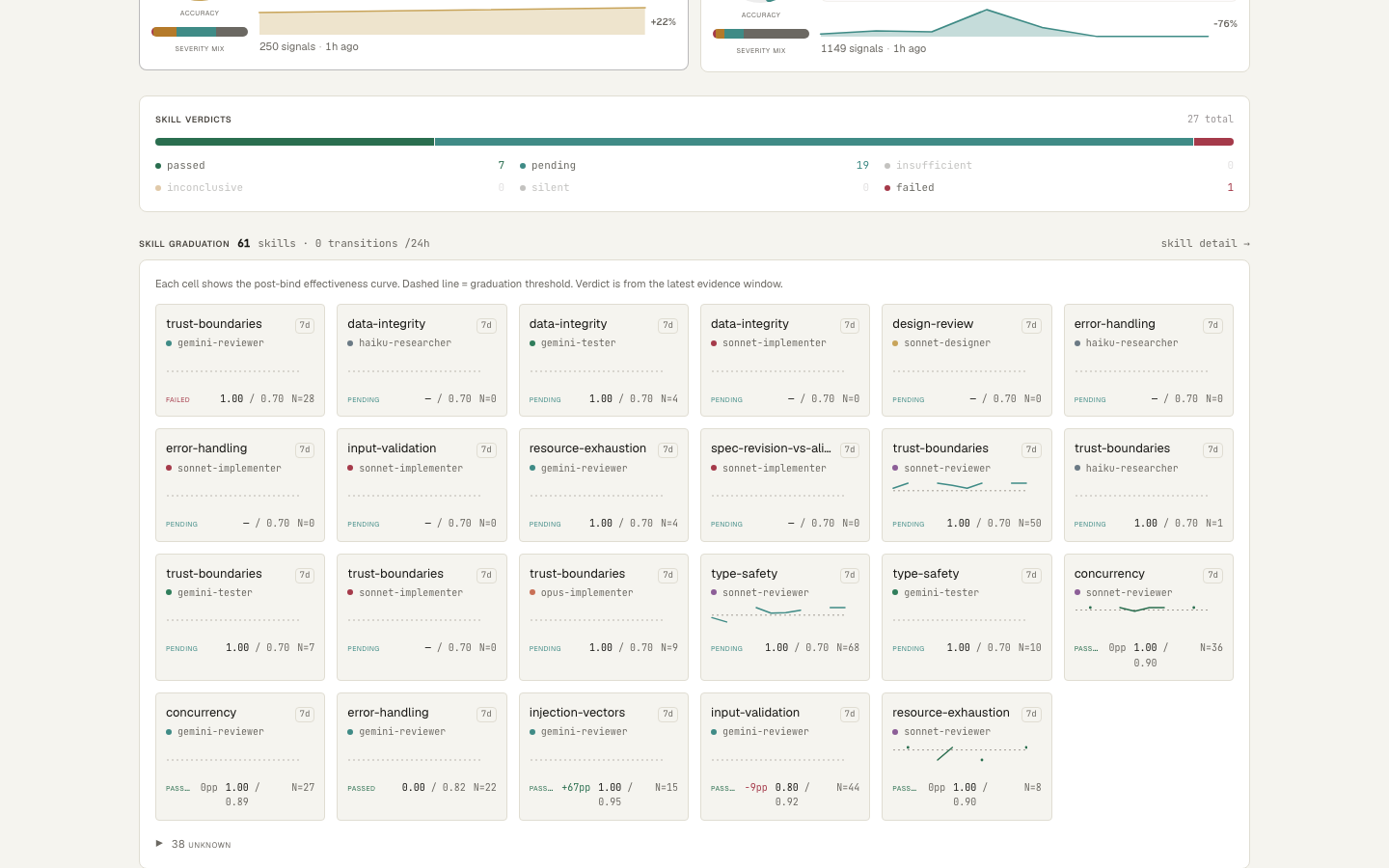
Skill graduation grid — per-skill effectiveness curve, 7d window, current/threshold value, and ±pp delta for graduated skills

Skill graduation grid — each card is one (skill × agent) pair: post-bind effectiveness curve over a 7-day window with current value vs threshold and ±pp drift on graduated skills.

| Panel | What it shows | When to look at it | |---|---|---| | **Overview** | Active agents, dispatch weights, recent finding counts | First thing in the morning — quick sanity check | | **Team** | All agents sorted by reliability score, with category breakdowns | Picking which agent to trust for a tricky finding | | **Tasks** | Live + historical task list with agent, duration, status | When something feels stuck — find it here first | | **Findings** | Consensus reports paginated by round, with CONFIRMED/DISPUTED/UNVERIFIED breakdowns | Reviewing what got caught in a recent review | | **Agent detail** | Per-agent memory entries, skills, score history, task history | Diagnosing why a specific agent keeps failing in a category | | **Signals** | Raw signal feed (agreement / hallucination / unique_confirmed) | Auditing the scoring pipeline if scores look wrong | | **Logs** | mcp.log content (boot, errors, warnings) | When the MCP server is misbehaving and you need raw evidence | **Auth keys rotate every session.** A fresh key is generated each time gossipcat boots. If the dashboard says "unauthorized", run `gossip_status` again to get the new key.
## Troubleshooting ### "Dashboard says unauthorized / 401" The auth key rotates every boot. Run `gossip_status` in Claude Code to get the current key, paste it into the dashboard login. ### "Dashboard URL doesn't load at all" Check `~/.gossip/mcp.log` (or `/.gossip/mcp.log`) for the boot log. Look for the `[gossipcat] 🌐 Dashboard:` line — that's the actual port. If it's missing, the relay didn't start. Common causes: - **Conflicting `.gossip/relay.pid`** from a crashed previous boot — delete it and restart Claude Code - **`GOSSIPCAT_PORT` set to a port already in use** — unset the env var or pick a free port ### "Boot says 'No .gossip/config.json found' and nothing happens" This was a critical bug in v0.1.0 — fixed in v0.1.1. Upgrade with the install one-liner above. v0.1.1+ boots in degraded mode (dashboard + relay only) so you can run `gossip_setup` from inside Claude Code. ### "Agents keep returning empty findings" Usually a model or quota problem. Check `gossip_status` — it shows `Quota: google — OK` (or `cooling down`) per provider. If you're rate-limited, gossipcat will fall back to native agents automatically, but fallback agents may not be in your team. Either wait for the cooldown or add native agents to your team. ### "The same hallucinated finding keeps coming back" Record a `hallucination_caught` signal: ask Claude *"record a hallucination_caught signal for finding f3 in the last consensus round — it claimed X but the code shows Y"*. After 3 such signals, the offending agent's score drops in that category and the orchestrator stops asking it questions in that area. ### "I want to use my own model / provider" Edit `.gossip/config.json` directly. Any OpenAI-compatible endpoint works via `provider: "openai"` + `base_url`. Local models work via Ollama (`provider: "local"`). See the [Configuration](#configuration) section. ### "An agent produced output but the consensus report is empty" The strict `` parser drops tags whose `type` isn't one of `finding | suggestion | insight` (see invariant #8 in `docs/HANDBOOK.md`). When that happens, the `gossip_signals` receipt surfaces the drop count and a `finding_dropped_format` pipeline signal is emitted. Check the consensus round's `droppedFindingsByType` field on the dashboard — it names the offending type. If you see `<agent_finding>` instead of raw ``, a transport layer is entity-encoding the output; pass agent output verbatim to `gossip_relay`. ### "Multiple Claude Code instances all want gossipcat" Already supported as of v0.1.1 — each instance gets its own dynamic port. If you want a stable port for one specific instance (e.g. for browser bookmarks), set `GOSSIPCAT_PORT=24420` for that one project's environment. ### "How do I uninstall?" npm uninstall -g gossipcat claude mcp remove gossipcat -s user rm -rf ~/.gossip # if you want to wipe global memory + signals rm -rf /.gossip # if you want to wipe per-project state ### Still stuck? File an issue at https://github.com/gossipcat-ai/gossipcat-ai/issues. Include the contents of `.gossip/mcp.log` (last 100 lines) and the output of `gossip_status`. Or ask Claude in-session: *"file a gossipcat bug report about <...>"* — the `gossip_bug_feedback` tool packages it up automatically.
## Under the hood Claude Code translates your natural-language requests into gossipcat MCP tool calls automatically — you don't need to type these — but if you want fine-grained control they're documented here: gossip_run(agent_id: "auto", task: "...") → single-agent task gossip_dispatch(mode: "consensus", tasks: [...]) → multi-agent review with cross-review gossip_collect(consensus: true) → wait for results, run consensus gossip_signals(action: "record", signals: [...]) → record accuracy after verification gossip_scores() → view agent performance gossip_skills(action: "develop", ...) → improve a struggling agent gossip_status() → system status + dashboard URL gossip_setup(...) → create or update your team The dispatch rules at `.claude/rules/gossipcat.md` (auto-generated on first boot) teach Claude Code when to pick which mode based on what your change touches. You can edit these rules to bias the dispatch.
## For AI Agents If you are a Claude Code instance reading this to understand how to use gossipcat, here is the complete operational guide. **You are the orchestrator.** Gossipcat gives you tools to dispatch work to a team of specialized agents, collect their results, run cross-review consensus, and record accuracy signals. You do not implement code directly — you coordinate. ### Step 1 — Check what you have gossip_status() This tells you: which agents are available, their providers/models, relay status, dashboard URL, and suggested workflows. Always call this first in a new session. ### Step 2 — Dispatch work **Single agent (auto-selected):** gossip_run(agent_id: "auto", task: "Review the auth module for security issues") **Parallel (fan-out, no consensus):** gossip_dispatch(mode: "parallel", tasks: [ { agent_id: "gemini-reviewer", task: "..." }, { agent_id: "sonnet-reviewer", task: "..." } ]) **Consensus (cross-review):** gossip_dispatch(mode: "consensus", tasks: [ { agent_id: "gemini-reviewer", task: "..." }, { agent_id: "sonnet-reviewer", task: "..." }, { agent_id: "haiku-researcher", task: "..." } ]) ### Step 3 — Collect results gossip_collect(task_ids: ["id1", "id2", "id3"], consensus: true) With `consensus: true`, agents cross-review each other's findings. If native agents are in the round, `gossip_collect` returns `⚠️ EXECUTE NOW` with prompts — dispatch those `Agent()` calls immediately, then relay each result via `gossip_relay_cross_review`. ### Step 4 — Verify and record signals After consensus, **verify every UNVERIFIED finding** against the actual code (grep/read the cited files). Then record signals: gossip_signals(action: "record", signals: [{ signal: "unique_confirmed", // or "hallucination_caught", "agreement" agent_id: "gemini-reviewer", finding: "Race condition in task map at line 47", finding_id: "::f1" // mandatory }]) Signals update dispatch weights. Agents that hallucinate get penalized. Agents that catch real bugs get promoted. ### Key rules - **Never leave UNVERIFIED findings unexamined** — read the code, confirm or deny, record the signal. - **`finding_id` is mandatory on every signal** — format: `::fN`. - **Use `gossip_progress` after reconnect** — if a consensus round was in flight, it re-surfaces the pending EXECUTE NOW prompts. ### When to use consensus Use `gossip_dispatch(mode: "consensus")` when the change touches: shared mutable state, auth/sessions, file persistence, or the core dispatch pipeline. Use `gossip_run` for single-agent research, exploration, or review tasks that don't need cross-validation. ## MCP Tools These tools are called by the internal LLM (the orchestrator — Claude Code with gossipcat MCP). You don't invoke them manually; the orchestrator selects and calls them based on your requests. | Tool | Purpose | |------|---------| | `gossip_status` | System status, dashboard URL, agent list | | `gossip_run` | Single-agent dispatch with auto agent selection | | `gossip_dispatch` | Multi-agent dispatch: `single`, `parallel`, or `consensus` | | `gossip_collect` | Collect results with optional cross-review synthesis | | `gossip_relay` | Feed native agent results back into the pipeline | | `gossip_relay_cross_review` | Feed native cross-review results into consensus | | `gossip_plan` | Decompose task into sub-tasks with agent assignments | | `gossip_signals` | Record or retract accuracy signals | | `gossip_scores` | View agent accuracy, uniqueness, and dispatch weights | | `gossip_skills` | Develop, bind, unbind, or list per-agent skills | | `gossip_setup` | Create or update agent team | | `gossip_session_save` | Save session context for next session | | `gossip_remember` | Search an agent's cognitive memory | | `gossip_progress` | Check in-progress task status | | `gossip_watch` | Stream signals as agents emit them, between dispatch and collect (catches pipeline drops mid-round) | | `gossip_verify_memory` | Verify a memory claim against current code — FRESH / STALE / CONTRADICTED / INCONCLUSIVE — before acting on backlog items | | `gossip_reload` | Self-terminate the MCP process so Claude Code respawns with a fresh bundle (dev loop after code changes) | | `gossip_tools` | List all available tools | | `gossip_update` | Check for or apply gossipcat updates from npm | | `gossip_bug_feedback` | File a GitHub issue on the gossipcat repo from an in-session bug report |
## Dashboard internals Built with React + Vite + shadcn/ui. Source lives at `packages/dashboard-v2/`. The bundled assets ship in `dist-dashboard/` and the relay serves them as static files at `http://localhost:/dashboard/`. Live updates push via WebSocket — every gossipcat tool call emits an event that connected dashboard tabs receive in real time. npm run build:dashboard
## Architecture gossipcat/ apps/ cli/ MCP server, native agent bridge, boot sequence packages/ orchestrator/ Dispatch pipeline, consensus engine, memory, skills, performance scoring, task graph, prompt assembly relay/ WebSocket relay server, dashboard REST/WS API dashboard-v2/ React + Vite frontend (Terminal Amber theme) client/ Lightweight WebSocket client for relay connections tools/ File/shell/git tool implementations for worker agents types/ Shared TypeScript types and message protocol
## OpenClaw Integration

OpenClaw Lobster friendly

Gossipcat supports [OpenClaw](https://github.com/openclaw/openclaw) as a provider gateway. OpenClaw runs locally and exposes an OpenAI-compatible HTTP API — gossipcat talks to it like any other relay agent, with your stored gateway token and a separate quota slot so OpenClaw rate limits never bleed into your OpenAI agents. ### Wiring an OpenClaw agent Store your gateway token once (macOS): security add-generic-password -s gossip-mesh -a openclaw -w On Linux: secret-tool store --label "Gossip Mesh openclaw" service gossip-mesh provider openclaw # (enter token when prompted) Then add it to your team: "Add an OpenClaw reviewer to my team" Or directly via `gossip_setup`: gossip_setup(mode: "merge", agents: [{ id: "openclaw-agent", type: "custom", provider: "openclaw", custom_model: "openclaw/default", role: "reviewer", skills: ["code_review", "typescript"] }]) The gateway runs at `http://127.0.0.1:18789/v1` by default. Override with `base_url` if yours is on a different port. Available models: `openclaw`, `openclaw/default`, `openclaw/main`. Once added, the agent participates in consensus rounds, accumulates accuracy signals, and gets skill files generated from its failure patterns — same as any other agent in the mesh.
## Configuration Config is searched in order: `.gossip/config.json` > `gossip.agents.json` > `gossip.agents.yaml`. { "main_agent": { "provider": "google", "model": "gemini-2.5-pro" }, "utility_model": { "provider": "native", "model": "haiku" }, "consensus_judge": { "provider": "anthropic", "model": "claude-sonnet-4-6", "native": true }, "agents": { "sonnet-reviewer": { "provider": "anthropic", "model": "claude-sonnet-4-6", "preset": "reviewer", "skills": ["code_review", "security_audit", "typescript"], "native": true } } } | Field | Description | |-------|-------------| | `main_agent` | Internal tool LLM for routing, planning, and synthesis | | `utility_model` | Memory compaction, gossip, lens generation | | `consensus_judge` | Model for cross-review synthesis | | `agents..provider` | `anthropic`, `google`, `openai`, `openclaw`, `local` | | `agents..base_url` | Custom endpoint for `openai`/`openclaw` (e.g. `http://127.0.0.1:18789/v1`) | | `agents..native` | `true` = runs via Claude Code Agent(), no API key | | `agents..preset` | `reviewer`, `implementer`, `tester`, `researcher`, `debugger`, `architect`, `security`, `designer`, `planner`, `devops`, `documenter` | | `agents..skills` | Skill labels for dispatch matching |
## Host compatibility Gossipcat auto-detects the host environment: | Host | Native agents | Rules file | |------|---------------|------------| | Claude Code | Yes | `.claude/rules/gossipcat.md` | | Cursor | No | `.cursor/rules/gossipcat.mdc` | | Windsurf | No | `.windsurfrules` | | VS Code | No | — |
## Roadmap | Feature | Status | |---------|--------| | Consensus code review | ✅ Shipped | | Adaptive dispatch weights | ✅ Shipped | | Per-agent skill development | ✅ Shipped | | Agent cognitive memory | ✅ Shipped | | Live dashboard | ✅ Shipped | | Cross-platform key storage | ✅ Shipped | | OpenAI-compatible gateway support (`base_url`) | ✅ Shipped | | OpenClaw provider integration 🦞 | ✅ Shipped | | Local LLM support (Ollama) | ✅ Shipped | | Statistical skill effectiveness (z-test on per-category accuracy, auto pass/fail verdicts) | ✅ Shipped | | Native subagents get skill injection + cognitive memory recall | ✅ Shipped | | Relay cross-reviewers get `file_read` + `file_grep` (closes tool-blindness gap with natives) | ✅ Shipped | | Worktree-aware consensus (`resolutionRoots` + auto-discover for feature-branch reviews) | ✅ Shipped | | Signal pipeline observability (format-drop receipts + `finding_dropped_format` meta-signal + `gossip_watch` stream) | ✅ Shipped | | Consensus round retraction (`gossip_signals action: retract` with tombstones) | ✅ Shipped | | Worktree sandbox hardening (Layer 1+2+3 boundary enforcement + rotated audit log) | ✅ Shipped | | In-session bundle hot-swap (`gossip_reload`) | ✅ Shipped | | npm package — one-liner install with bundled MCP server + dashboard | ✅ Shipped | | Full implementation workflow (agents write code with scoped + worktree isolation) | ✅ Shipped | | Dashboard enrichment (graphs, trends, session history) | ☐ Planned | | Local Postgres migration (embedded Postgres for tasks/signals/consensus/memory — unblocks full task results, real queries, no more JSONL scans) | ☐ Planned | | Full Cursor support | ☐ Planned | | Windsurf / VS Code parity | ☐ Planned | | Standalone CLI (no IDE required) | ☐ Planned | | CLI parity with MCP pipeline (gossip, task graph, agent memory in chat mode) | ☐ Planned |
### Cutting a release (maintainers) Releases go to GitHub Releases via a two-stage script that respects branch protection — no direct commits to master. # Stage 1 — open the version bump PR ./scripts/release.sh 0.1.2 # review + merge the PR via gh or web UI gh pr merge --squash --delete-branch # Stage 2 — build, tag, release (from master, after the PR is merged) git checkout master && git pull ./scripts/release.sh # no args
## License [MIT](LICENSE)
标签:AI代理, Apex, bug检测, IDE插件, MCP服务器, MITM代理, 上下文学习, 人工智能, 代码分析, 代码审查, 凭证管理, 多代理系统, 学习算法, 并行处理, 强化学习, 数据可视化, 数据管道, 机器学习, 用户模式Hook绕过, 自动化攻击, 软件工程, 软件开发