Teycir/ApiHunter
GitHub: Teycir/ApiHunter
一款基于 Rust 的异步 API 安全扫描器,专注于 API 安全基线测试、漏洞发现与 CI/CD 回归检测。
Stars: 19 | Forks: 2
# 🎯 ApiHunter





 Click to watch the full demo on YouTube
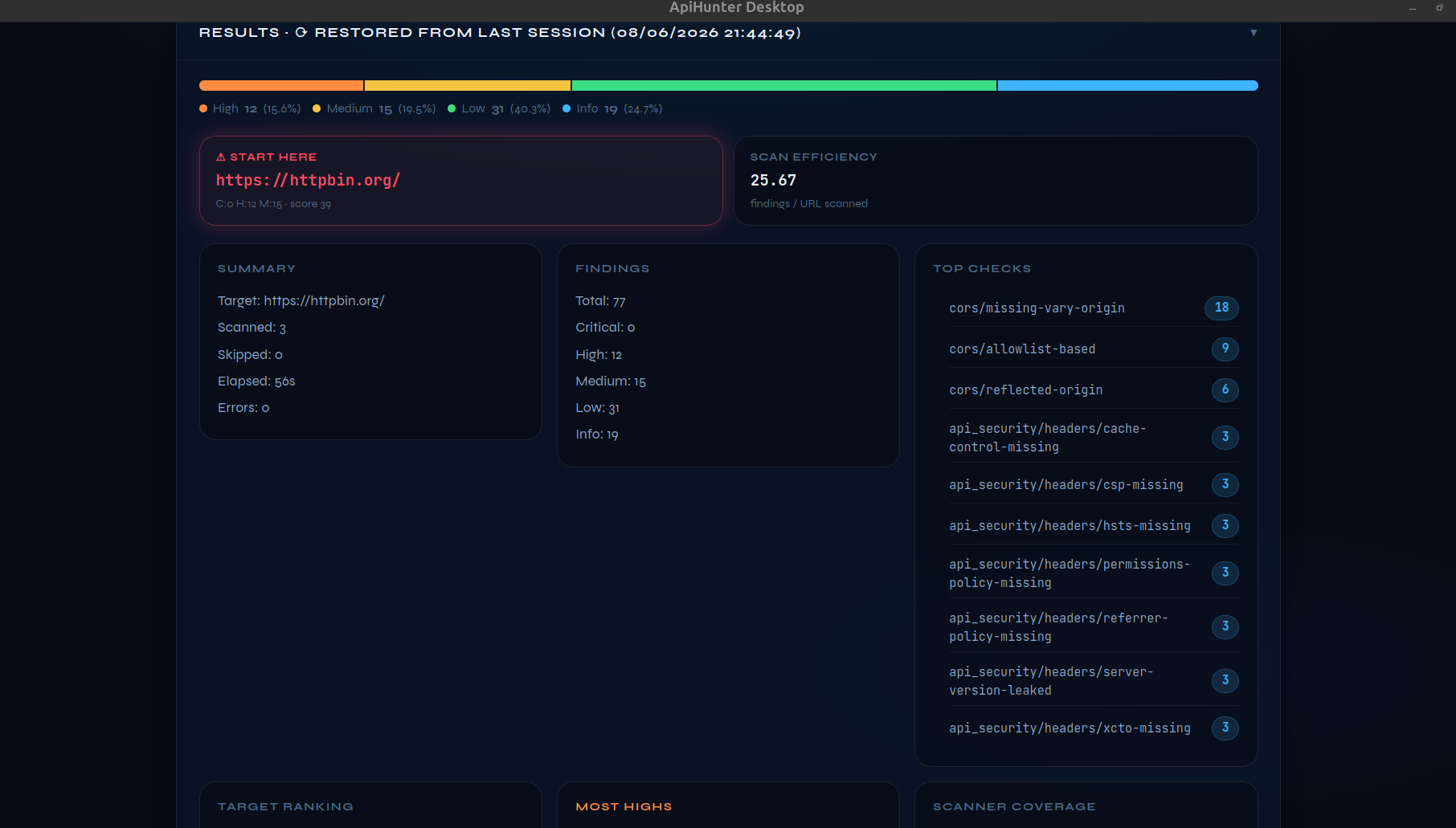
## 🖥️ Desktop App Snapshots
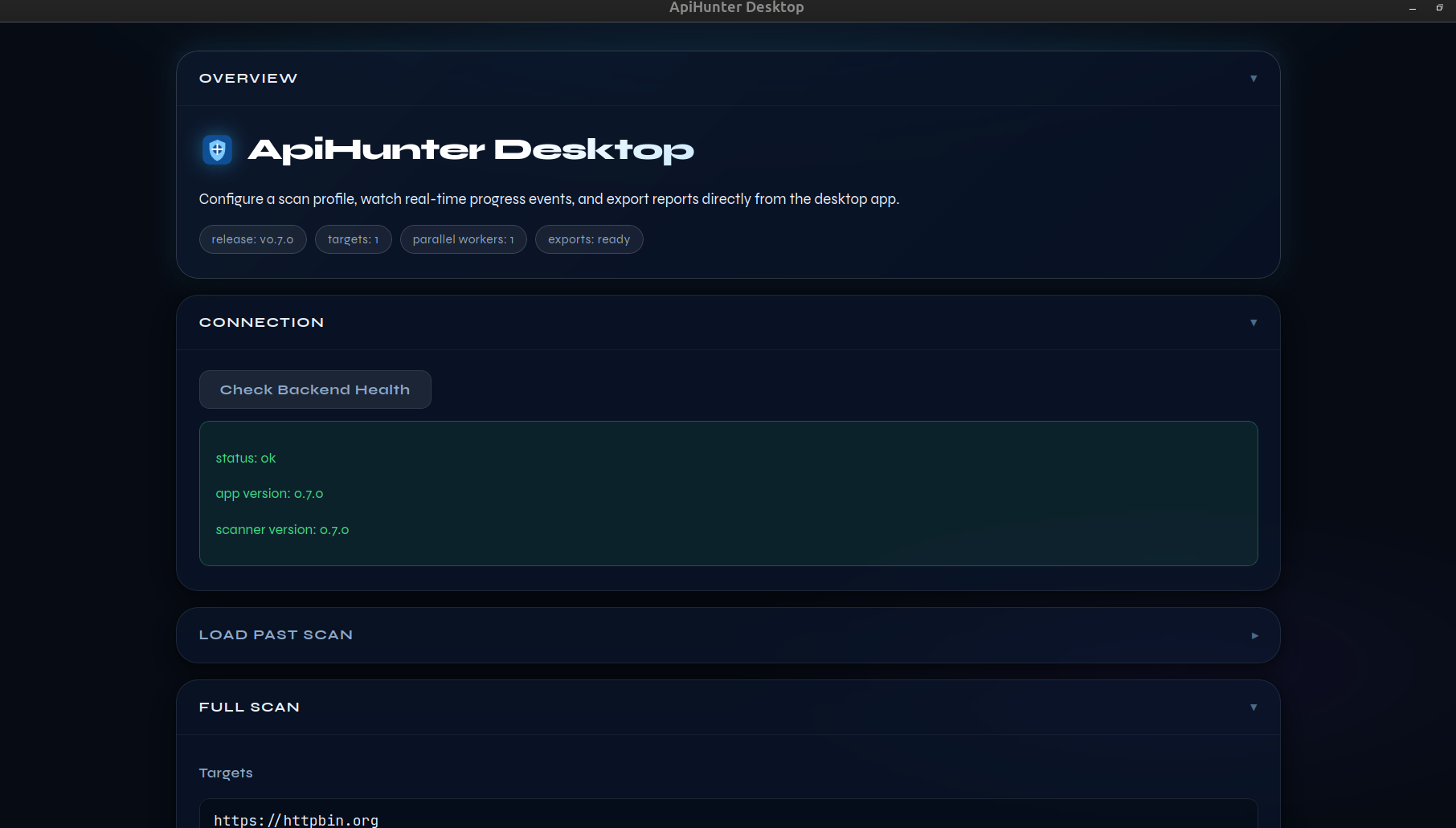
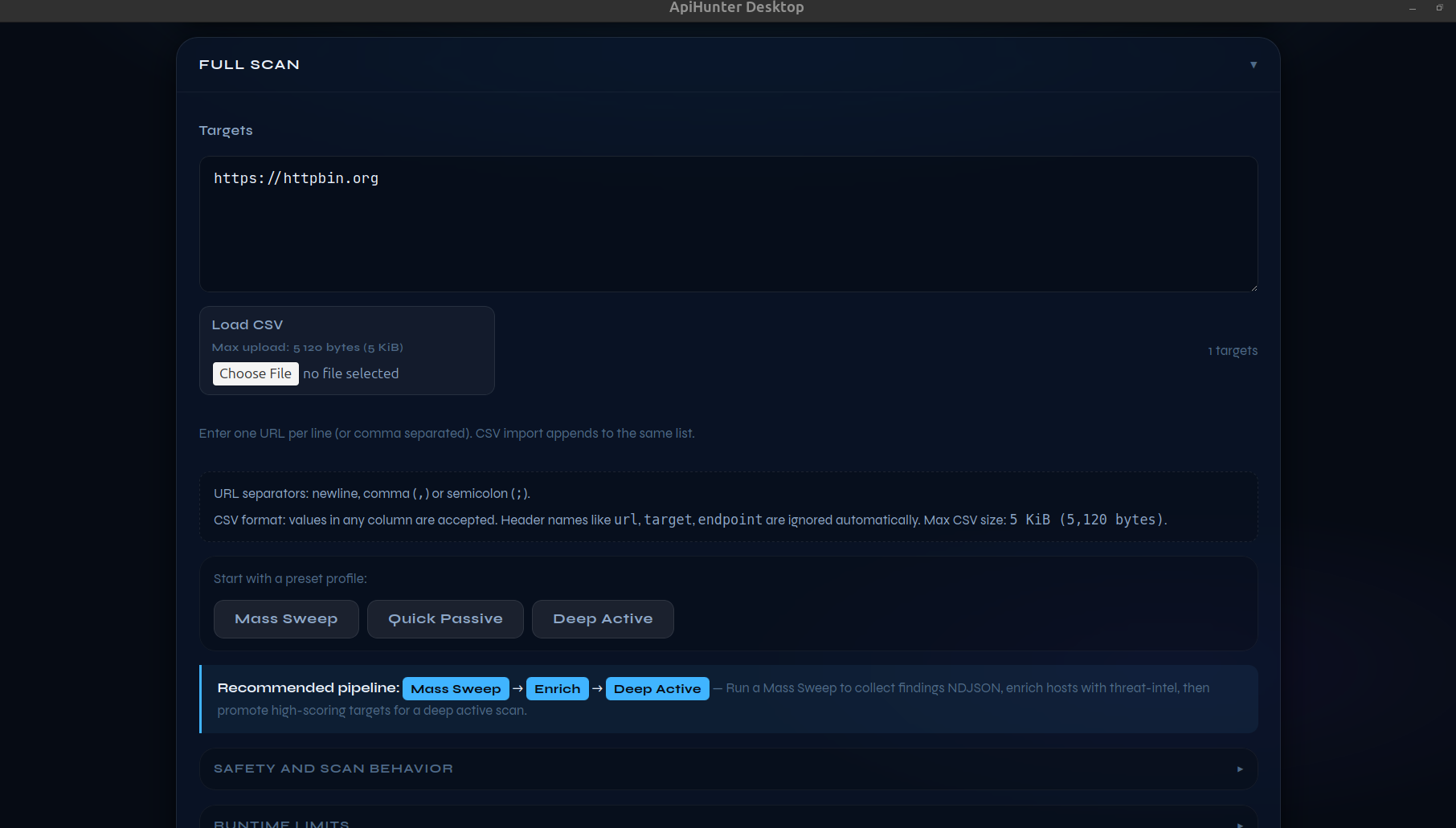
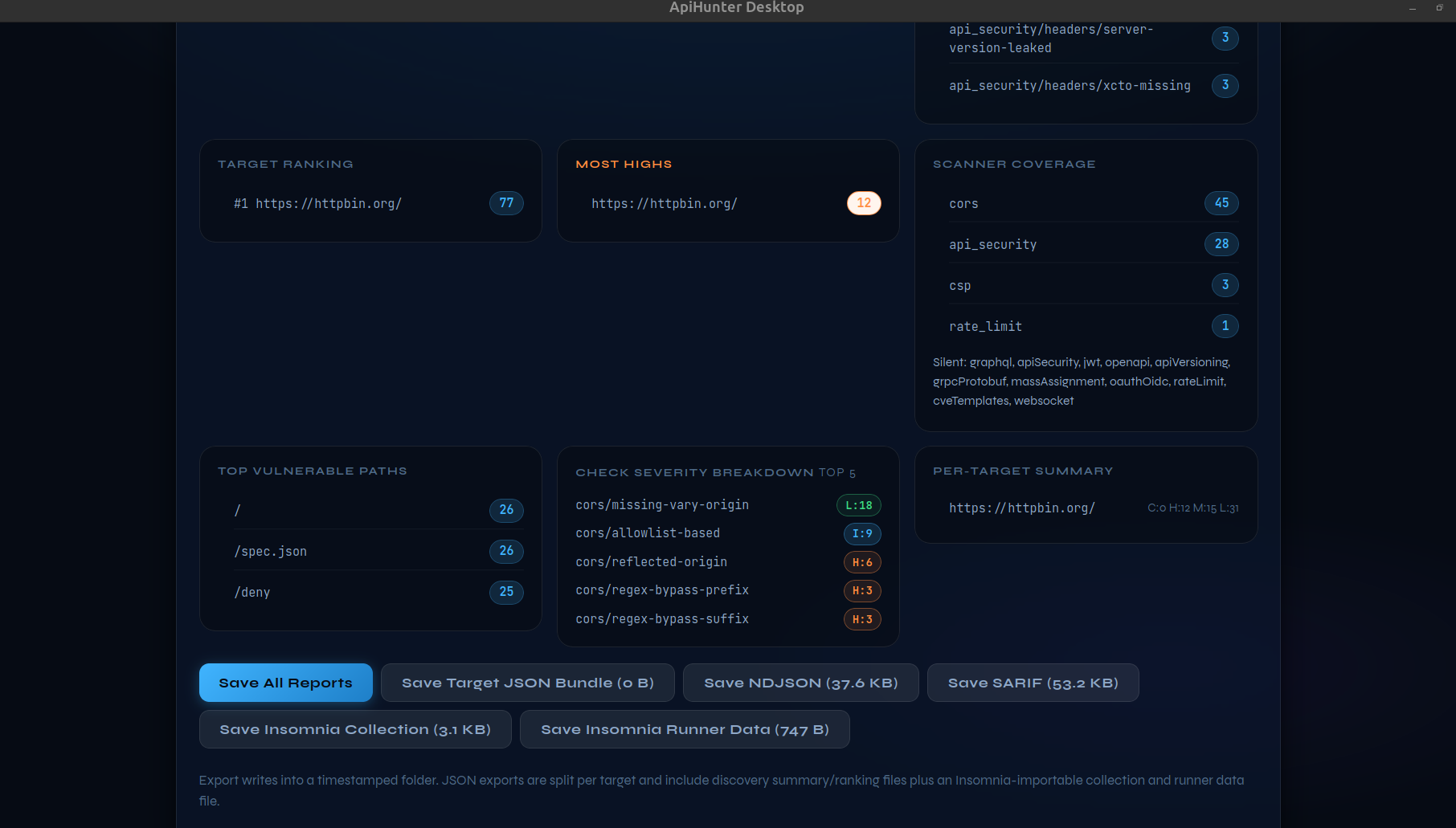
## 📑 Table of Contents
- [Video Demo](#-video-demo)
- [Desktop App Snapshots](#️-desktop-app-snapshots)
- [Why ApiHunter?](#why-apihunter)
- [Scanner Modules](#scanner-modules)
- [Features](#features)
- [Comparison with Other Tools](#comparison-with-other-tools)
- [Quick Start](#quick-start)
- [Architecture](#architecture)
- [Template Tooling](#template-tooling)
- [Scan Scripts](#scan-scripts)
- [Testing Strategy](#testing-strategy)
- [Documentation](#documentation)
- [Roadmap](#roadmap)
- [Installation](#installation)
- [CLI Reference](#cli-reference)
- [Exit Codes](#exit-codes)
- [Security & Legal Guardrails](#security--legal-guardrails)
- [Related Projects](#related-projects)
- [About](#about)
- [FAQ](#faq)
- [License](#license)
Async, modular API security scanner for API baseline testing and regression detection.
Combines discovery with targeted checks (CORS/CSP/GraphQL/OpenAPI/JWT/API Security) using adaptive concurrency and CI-ready outputs (NDJSON/SARIF).
Use cases: offense for red-team/API pentest discovery and exploit validation, and defense for CI/CD regression gating, continuous API hardening, and early misconfiguration detection.
## Naming
- Project/repository: `ApiHunter`
- Cargo package: `apihunter`
- Library crate: `api_scanner`
- CLI binary: `apihunter` (default for `cargo run`)
## GitHub Metadata (Recommended)
Set these in the GitHub repository settings for discoverability:
- **Description**: `Async API security scanner for CORS/CSP/GraphQL/JWT/OpenAPI and active API posture checks.`
- **Website**: `https://github.com/Teycir/ApiHunter`
- **Topics**: `rust`, `security`, `api-security`, `scanner`, `graphql`, `cors`, `csp`, `jwt`, `openapi`, `sarif`, `ndjson`
## Repository Flow
flowchart LR
A[CLI apihunter] --> B[main.rs]
D[Input Sources] --> E[Pre-filter + Discovery]
B --> C[HttpClient + Config]
E --> F[runner.rs]
C --> F
F --> G1[Passive scanners]
F --> G2[Active scanners]
I[template-tool] --> H[CVE templates]
H --> G2
G1 --> J[Findings]
G2 --> J
J --> K[Reporter]
K --> L[Auto Reports]
K --> M[CI/CD Controls]
## Why ApiHunter?
### Core Advantages
- **API-First Architecture**: Purpose-built for REST/GraphQL APIs, not adapted from web app scanners
- **Intelligent False Positive Reduction**:
- SPA catch-all detection with canary probing
- Context-aware secret validation (frontend vs backend)
- Body content validation and referer checking
- Response fingerprinting to skip duplicate findings
- **Production-Safe by Design**:
- Adaptive concurrency (AIMD) that backs off on errors
- Per-host rate limiting with configurable delays
- Politeness controls (retries, timeouts, WAF evasion)
- Dry-run mode for active checks
- **Stealth & Evasion**:
- Runtime User-Agent rotation from curated pool (assets/user_agents.txt)
- Randomized request delays with jitter
- Per-host delay enforcement (avoids burst patterns)
- Retry logic with exponential backoff
- Custom header injection for blending with legitimate traffic
- Adaptive timing based on server responses
- No hardcoded scanner fingerprints in default mode
### Stealth Techniques Deep Dive
ApiHunter uses several stealth techniques to avoid detection by WAF (Web Application Firewall) and bot protection systems:
#### 1. User-Agent Rotation
**What it does:** Randomly cycles through 100+ real browser User-Agent strings from a file (`assets/user_agents.txt`)
**Why it works:** Bots typically use the same User-Agent (like `curl/7.68.0`). By pretending to be Chrome, Firefox, Safari, etc., you blend in with legitimate traffic
**Simple analogy:** Like wearing different disguises instead of always wearing the same uniform
#### 2. Random Timing & Jitter
**What it does:** Adds random delays between requests (controlled by `--delay-ms`) with jitter (small random variations)
**Why it works:** Bots send requests at perfect intervals (exactly 100ms apart). Humans are unpredictable. Random timing makes traffic look organic
**Simple analogy:** Walking with irregular steps instead of marching like a robot
#### 3. Per-Host Delay Enforcement
**What it does:** Tracks delay separately for each domain, not globally
**Why it works:** Prevents burst patterns where you hit one host 50 times instantly. Each host sees polite, spaced-out requests
**Simple analogy:** Taking turns in different conversations instead of shouting at one person repeatedly
#### 4. Adaptive Concurrency (AIMD)
**What it does:** Automatically slows down when getting 429 (rate limit) or 503 (server busy) errors, speeds up when successful
**Why it works:** Backs off when caught, mimics how browsers retry. WAFs see "this client respects our limits"
**Simple analogy:** Slowing down when traffic is congested, speeding up on open roads
#### 5. Retry with Exponential Backoff
**What it does:** When a request fails, waits 1s, then 2s, then 4s before retrying
**Why it works:** Legitimate clients retry gracefully. Bots often hammer immediately or give up
**Simple analogy:** Knocking on a door, waiting longer each time instead of banging continuously
#### 6. No Scanner Fingerprints
**What it does:** Doesn't send headers like `X-Scanner: ApiHunter` or predictable patterns
**Why it works:** Many tools leave signatures (Nuclei templates, sqlmap patterns). ApiHunter avoids obvious markers
**Simple analogy:** Not wearing a name tag that says "Security Tester"
#### 7. Connection Reuse & Pooling
**What it does:** Uses per-host HTTP client pools, keeps connections alive
**Why it works:** Browsers reuse connections. Opening/closing for every request looks suspicious
**Simple analogy:** Keeping the door open instead of slamming it shut and ringing the bell again
#### 8. Custom Header Injection
**What it does:** Can add headers like `Referer`, `X-Forwarded-For`, custom cookies
**Why it works:** Makes requests look like they came from a legitimate application flow (clicked a link, have session cookies)
**Simple analogy:** Showing a ticket stub when entering a venue instead of jumping the fence
#### Detection Comparison
| Technique | Without Evasion | With Evasion |
|-----------|----------------|-------------|
| **User-Agent** | `python-requests/2.28.0` (obvious bot) | `Mozilla/5.0 (Windows NT 10.0; Win64; x64)...` (looks like Chrome) |
| **Timing** | Perfect 100ms intervals → WAF blocks | 120ms, 95ms, 180ms → looks human |
| **Retries** | Instant retry → ban | Wait 1s→2s→4s → "patient client" |
| **Concurrency** | 100 parallel hits → alarm | Adaptive 5→10→3 based on response → "polite browser" |
#### When to use `--waf-evasion`
- Testing production APIs with Cloudflare/Akamai/AWS WAF
- Avoiding IP bans during large scans
- Penetration tests where you need to stay under the radar
- **CI/CD Native**:
- Baseline diffing (only report new findings)
- Streaming NDJSON output for real-time monitoring
- SARIF 2.1.0 for GitHub/GitLab Code Scanning
- Exit code bitmask for pipeline control
- Severity-based filtering and failure thresholds
- **Performance at Scale**:
- Rust async runtime (tokio) with zero-cost abstractions
- Concurrent scanning with semaphore-bounded parallelism
- Per-host HTTP client pools to avoid connection bottlenecks
- Efficient memory usage (no GC pauses)
- **Comprehensive Auth Support**:
- JSON-based auth flows with cookie/header extraction
- Dual-identity IDOR/BOLA testing
- Session file import (Excalibur integration)
- Bearer, Basic, and custom header auth
- Automatic unauth client for privilege escalation checks
## Scanner Modules
ApiHunter includes 13 built-in scanner modules. See [docs/scanners.md](docs/scanners.md) for detailed detection logic.
| Scanner | Type | What It Detects |
|---------|------|----------------|
| **CORS** | Passive | Wildcard origins, reflected origins with credentials, null origin acceptance, regex bypass vulnerabilities (suffix/prefix attacks), missing Vary: Origin, unsafe preflight methods |
| **CSP** | Passive | Missing Content-Security-Policy, unsafe-inline/unsafe-eval directives, wildcard sources, bypassable CDN hosts (JSONP gadgets), missing frame-ancestors |
| **GraphQL** | Passive | Introspection enabled, sensitive schema fields (user/password/token types), field suggestions (schema leakage), query batching, alias amplification (DoS), GraphiQL/Playground exposure |
| **JWT** | Passive | alg=none tokens, weak HS256 secrets (wordlist-based), missing/excessive expiry, sensitive claims in payload, algorithm confusion vulnerabilities |
| **OpenAPI** | Passive | Missing security schemes, operations without auth requirements, file upload endpoints, deprecated operations still present, unsecured sensitive endpoints |
| **API Versioning** | Passive | Version header disclosure, concurrent legacy/new API versions, deprecation headers, and response drift across benign query/version variants (plus deep mode via `--response-diff-deep`) |
| **gRPC/Protobuf** | Passive + Active | gRPC transport/content-type signals, protobuf surface hints, and optional reflection/health probe signals |
| **API Security** | Passive + Active | Missing security headers (X-Content-Type-Options, X-Frame-Options), server version disclosure, unauthenticated access to sensitive paths, HTTP method enumeration, debug endpoints, secret exposure patterns, active IDOR/BOLA checks (body + selected header comparison), blind SSRF callback probes, and gateway/bypass probe signals |
| **Mass Assignment** | Active | Reflected sensitive fields (is_admin, role, permissions), persisted state changes, privilege escalation via field injection |
| **OAuth/OIDC** | Active | Redirect URI validation bypass, missing state parameter, PKCE support issues (missing S256, plain allowed), implicit flow enabled, password grant enabled |
| **Rate Limit** | Active | Missing rate limiting (burst probes), missing Retry-After headers, IP header spoofing bypass (X-Forwarded-For) |
| **WebSocket** | Active | WebSocket upgrade acceptance on common paths, missing origin validation, unauthenticated WebSocket connections |
| **CVE Templates** | Active | Template-driven CVE detection from `assets/cve_templates/*.toml` (168 templates currently), baseline vs bypass differential matching |
**Passive scanners** run by default and analyze responses without sending crafted requests.
**Active scanners/checks** require `--active-checks` and send potentially invasive probes (IDOR/BOLA, mutation, bypass tests).
IDOR/BOLA lives under the `API Security` scanner (there is no dedicated `--no-idor` flag; use `--no-api-security` to disable it).
### Module Output & Signal Notes
These notes summarize how findings are emitted and what typically causes noise:
| Module | Finding Prefix / Shape | Common False Positives | Common False Negatives |
|---------|-------------------------|-------------------------|-------------------------|
| CORS | `cors/*` with origin/evidence fields | Reflection on non-sensitive routes | Origin checks applied only on authenticated routes |
| CSP | `csp/*` with directive evidence | Legacy CSP applied intentionally during migration | CSP delivered only on production CDN edge path |
| GraphQL | `graphql/*` with endpoint + capability signal | Public playground intended for internal/testing tenants | Schema controls enabled only after auth |
| JWT | `jwt/*` with token claim/header evidence | Test/demo tokens in synthetic responses | Token never appears in scanned responses |
| OpenAPI | `openapi/*` with operation/security context | Spec intentionally includes deprecated but blocked endpoints | Spec unavailable or split across private docs |
| API Versioning | `api_versioning/*` + `response_diff/*` | Multiple supported versions during controlled migrations | Versioned paths not discoverable from current seed set |
| gRPC/Protobuf | `grpc_protobuf/*` with transport/reflection evidence | gRPC-like metadata on edge proxies without exposed RPC surface | gRPC endpoints behind separate host/path not reached from seed set |
| API Security | `api_security/*` with header/path/method evidence | Debug/test endpoints intentionally exposed in non-prod | Controls enforced behind auth/session context |
| Mass Assignment | `mass_assignment/*` with reflected/persisted deltas | Echo behavior that does not persist backend state | Mutations rejected by hidden validation rules |
| OAuth/OIDC | `oauth/*` with redirect/metadata evidence | Non-production IdP config with relaxed policies | Dynamic policy enforcement not visible in metadata |
| Rate Limit | `rate_limit/*` with burst/429 behavior | Global traffic shaping masks app-level limiter behavior | Long-window limiters not triggered by short probe window |
| WebSocket | `websocket/*` with upgrade/origin checks | Public WS endpoints intentionally anonymous | Auth required via handshake headers not provided in probe |
| CVE Templates | `cve//` with template evidence | Fingerprint collision on generic endpoints | Vulnerable path/context not reached from seed URLs |
For check-by-check detail and remediation guidance, see [docs/scanners.md](docs/scanners.md) and [docs/findings.md](docs/findings.md).
The scanner docs now include a source-aligned [Module Check Catalog](docs/scanners.md#module-check-catalog) and [False-Positive Expectation Model](docs/scanners.md#false-positive-expectation-model).
## Features
### Passive Security Analysis
- **CORS Misconfiguration Detection**:
- Dynamic origin generation based on target domain
- Regex bypass testing (suffix/prefix attacks)
- Credential-aware severity scoring
- Wildcard and null origin detection
- **CSP Policy Analysis**:
- Missing/weak Content Security Policy detection
- Unsafe inline/eval directives
- Wildcard source detection
- Policy bypass patterns
- **GraphQL Security**:
- Introspection query detection
- Sensitive type/field name analysis
- Query batching support detection
- Alias amplification (DoS) probing
- Active mutation fuzzing (`--active-checks`, supports `--dry-run`)
- GraphiQL/Playground exposure
- **JWT Token Analysis**:
- Algorithm confusion (alg=none, HS256→RS256)
- Weak secret detection (curated wordlist)
- Long-lived token detection (missing/excessive exp)
- Sensitive claim exposure
- Token extraction from headers and cookies
- **OpenAPI/Swagger Analysis**:
- Security scheme validation
- File upload endpoint detection
- Deprecated operation flagging
- Missing security definitions
- Spec caching for performance
- **gRPC/Protobuf Coverage**:
- gRPC response metadata/content-type detection
- Protobuf surface hint detection from endpoint metadata/path shape
- Optional reflection/health active probe signals on known gRPC paths
- **Secret Exposure Detection**:
- AWS keys (AKIA*, secret keys)
- Google API keys (AIza*)
- GitHub tokens (ghp_*, github_pat_*)
- Slack tokens (xox*)
- Stripe keys (sk_live_*, pk_live_*)
- Database URLs, private keys, bearer tokens
- Context-aware validation (reduces false positives)
- **API Security Checks**:
- HTTP method enumeration
- Debug endpoint detection
- Directory listing exposure
- Security.txt presence
- Response header analysis (HSTS, X-Frame-Options, etc.)
- Error message disclosure
### Active Security Testing (--active-checks)
- **API Security IDOR/BOLA Checks** (3-tier approach):
- Unauthenticated access testing
- Response comparison via body fingerprints plus stable header snapshots
- ID enumeration (±2 range walk)
- Cross-user authorization bypass (dual-identity)
- Blind SSRF callback probing via callback-style query params (`APIHUNTER_OAST_BASE`, supports `--dry-run`)
- Gateway fingerprint and bypass probing (`api_security/gateway-*`)
- **Mass Assignment Vulnerabilities**:
- Reflected sensitive field injection
- Persisted state change detection
- Baseline→Mutate→Confirm verification
- Privilege escalation via field injection
- **OAuth/OIDC Security**:
- Redirect URI validation bypass
- State parameter handling
- PKCE support detection
- Metadata configuration hardening
- Implicit flow and password grant detection
- **Rate Limiting**:
- Burst request probing
- Missing rate limit detection
- Retry-After header validation
- IP header spoofing bypass tests
- **WebSocket Security**:
- Upgrade acceptance on common paths
- Origin validation testing
- Missing authentication checks
- **CVE Template Engine**:
- TOML-based template catalog
- Nuclei YAML import support
- Baseline vs bypass differential matching
- Host+template deduplication
- Loader quality gates skip invalid/unsafe request templates (for example unresolved request placeholders)
- Segment-aware context matching reduces broad path-substring over-triggering
- Current local catalog: 168 templates (includes curated hardened checks such as CVE-2022-22947, CVE-2021-29442, CVE-2021-29441, CVE-2020-13945, CVE-2021-45232, CVE-2022-24288)
### Discovery & Enumeration
- **Endpoint Discovery**:
- robots.txt parsing
- sitemap.xml parsing
- OpenAPI/Swagger spec import
- HAR file import (Excalibur integration)
- Postman/Insomnia collection import (`--collection`)
- JavaScript endpoint extraction
- Same-host filtering
- **URL Accessibility Pre-filtering**:
- Fast pre-check to skip dead endpoints
- Configurable timeout
- Optional bypass with --no-filter
### Performance & Reliability
- **Adaptive Concurrency (AIMD)**:
- Automatic rate adjustment based on errors
- Additive increase (every 5s)
- Multiplicative decrease on 429/503/timeouts
- **Stealth & WAF Evasion**:
- User-Agent rotation from runtime pool (assets/user_agents.txt with 100+ real UAs)
- Embedded fallback UAs if file unavailable
- Random delay jitter to avoid detection patterns
- Per-host timing enforcement (not global)
- Retry logic with exponential backoff
- Custom header injection (X-Forwarded-For, Referer, etc.)
- Adaptive timing based on 429/503 responses
- Politeness mode for cooperative testing
- No scanner fingerprints in User-Agent or headers by default
- **Resource Management**:
- Semaphore-bounded parallelism
- Per-host HTTP client pools
- Connection reuse and pooling
- Configurable timeouts and retries
- **Error Handling**:
- Panic recovery via JoinSet
- Captured errors reported separately
- Graceful degradation on scanner failures
### Output & Reporting
- **Multiple Output Formats**:
- Pretty JSON (human-readable)
- NDJSON (streaming, parseable)
- SARIF 2.1.0 (GitHub/GitLab Code Scanning)
- **Baseline Diffing**:
- Generate baseline snapshots
- Compare scans to report only new findings
- Perfect for regression testing
- **Auto-Save Reports** (enabled by default, disable with `--no-auto-report`):
- Saved to ~/Documents/ApiHunterReports//
- findings.json (structured findings)
- summary.md (markdown report)
- scan.log (execution log)
- **Real-Time Streaming**:
- Stream findings as they're discovered
- NDJSON format for live parsing
- Progress tracking
- **Severity Filtering**:
- Filter by minimum severity (info/low/medium/high/critical)
- Fail-on threshold for CI/CD
- Exit code bitmask (0x01 findings, 0x02 errors)
### Integration & Extensibility
- **Pluggable Scanner Architecture**:
- Implement Scanner trait to add modules
- Async-first design
- Independent scanner execution
- Panic isolation per scanner
- **TOML-Based Extensibility**:
- CVE template catalog in assets/cve_templates/*.toml
- No code changes needed to add new checks
- Template-driven vulnerability detection
- Community-shareable template format
- **Nuclei Template Import**:
- template-tool binary for YAML → TOML conversion
- Automatic matcher translation (status, word, regex, dsl)
- Safe preflight request-chain extraction
- Preserves detection logic from upstream templates
- **Dual Extension Model**:
- **Code-based**: Write Rust scanners implementing Scanner trait for complex logic
- **Template-based**: Write TOML templates for signature-based checks (CVEs, misconfigs)
- Best of both worlds: performance + flexibility
- **Complementary Tools**:
- Excalibur browser extension (HAR capture)
- BurpAPIsecuritysuite (manual testing)
- Workflow: Capture → Automate → Deep test
### Configuration & Control
- **Flexible Input**:
- File-based URL lists
- stdin (pipe from other tools)
- HAR file import
- Postman/Insomnia collection import
- OpenAPI spec import
- **Granular Scanner Control**:
- Enable/disable individual scanners
- Active vs passive mode
- Dry-run for active checks
- Per-scanner configuration
- **Network Configuration**:
- HTTP/HTTPS proxy support
- TLS certificate validation control
- Custom headers and cookies
- Configurable timeouts and retries
- **Scan Profiles**:
- quickscan.sh (fast, low-impact)
- deepscan.sh (comprehensive, active checks)
- inaccessiblescan.sh (re-check previously inaccessible targets with slower settings)
- baselinescan.sh (generate baseline)
- diffscan.sh (compare against baseline)
- authscan.sh (authenticated scanning)
- sarifscan.sh (CI/CD integration)
- scan-and-report.sh (run scan + print latest report path)
- split-by-host.sh (split targets by host and optionally fan out scans)
## Comparison with Other Tools
| Feature | ApiHunter | Nuclei | ZAP | Burp Suite | ffuf |
|---------|-----------|--------|-----|------------|------|
| **Language** | Rust | Go | Java | Java | Go |
| **Performance** | ⚡⚡⚡ Async, adaptive concurrency | ⚡⚡ Fast parallel | ⚡ Moderate | ⚡ Moderate | ⚡⚡⚡ Very fast |
| **API-First Design** | ✅ Built for APIs | ❌ General web | ⚠️ Hybrid | ⚠️ Hybrid | ❌ Fuzzing focus |
| **False Positive Filtering** | ✅ SPA detection, body validation, referer checks | ⚠️ Template-dependent | ⚠️ Many FPs | ✅ Good | N/A |
| **CORS/CSP Analysis** | ✅ Deep policy parsing | ⚠️ Basic templates | ✅ Good | ✅ Good | ❌ |
| **GraphQL Introspection** | ✅ Schema exposure + sensitive field checks | ⚠️ Basic detection | ⚠️ Limited | ✅ Via extensions | ❌ |
| **OpenAPI/Swagger** | ✅ Security scheme analysis | ❌ | ✅ Import only | ✅ Import + scan | ❌ |
| **JWT Analysis** | ✅ alg=none, weak secrets, expiry | ⚠️ Via templates | ⚠️ Limited | ✅ Via extensions | ❌ |
| **IDOR/BOLA Detection** | ✅ 3-tier (unauth/range/cross-user) | ⚠️ Manual templates | ⚠️ Limited | ✅ Manual testing | ❌ |
| **Secret Detection** | ✅ Context-aware (frontend vs backend) | ⚠️ Regex-based | ⚠️ Basic | ⚠️ Basic | ❌ |
| **Active Checks** | ✅ Opt-in (IDOR, mass-assignment, OAuth/OIDC, websocket, rate-limit, CVE templates) | ✅ Template-based | ✅ Active scan | ✅ Active scan | ✅ Fuzzing |
| **WAF Evasion** | ✅ UA rotation, delays, retries, adaptive timing | ⚠️ Basic | ⚠️ Limited | ✅ Good | ⚠️ Basic |
| **CI/CD Integration** | ✅ NDJSON, SARIF, exit codes | ✅ JSON, SARIF | ⚠️ XML reports | ⚠️ XML/JSON | ✅ JSON |
| **Baseline Diffing** | ✅ Built-in | ❌ External tools | ❌ | ❌ | ❌ |
| **Auth Flows** | ✅ JSON-based pre-scan login | ⚠️ Header injection | ✅ Session mgmt | ✅ Session mgmt | ⚠️ Header injection |
| **Streaming Output** | ✅ Real-time NDJSON | ❌ Batch only | ❌ | ❌ | ✅ |
| **Resource Usage** | 🟢 Low (Rust) | 🟢 Low (Go) | 🟡 High (Java) | 🟡 High (Java) | 🟢 Low (Go) |
| **Learning Curve** | 🟢 Simple CLI | 🟢 Template syntax | 🟡 GUI complexity | 🔴 Steep | 🟢 Simple |
| **Extensibility** | ✅ Rust trait system | ✅ YAML templates | ✅ Add-ons | ✅ Extensions | ⚠️ Limited |
| **License** | MIT (Free) | MIT (Free) | Apache 2.0 (Free) | Commercial | MIT (Free) |
| **Best For** | API security in CI/CD, regression testing, CORS/GraphQL/JWT analysis | General vuln scanning, CVE detection | Full web app pentesting | Manual pentesting, complex workflows | Directory/parameter fuzzing |
### Key Differentiators
**ApiHunter:** API-first design, SPA detection, baseline diffing, 3-tier IDOR/BOLA, context-aware secrets, AIMD concurrency, **stealth/WAF evasion (UA rotation, jitter, adaptive timing)**, **dual extensibility (TOML templates + Rust modules)**
**Nuclei:** Broader CVE coverage, YAML templates only, basic evasion
**ZAP/Burp:** Manual testing, proxy workflows, GUI-based extensions, limited stealth
**ffuf:** Pure fuzzing, content discovery, limited extensibility, basic evasion
## Quick Start
cargo build --release
# Scan URLs from a file (newline-delimited)
./target/release/apihunter --urls ./targets/cve-regression-real-public.txt --format ndjson --output ./results.ndjson
# Or scan URLs from stdin
cat ./targets/cve-regression-real-public.txt | ./target/release/apihunter --stdin --min-severity medium
### Desktop Quick Start (Tauri + React)
ApiHunter also ships a desktop app in `apps/desktop`.
cd apps/desktop
npm install
npm run tauri dev
Desktop scan input supports:
- Manual multi-target entry (one URL per line or comma-separated)
- CSV import via `Load CSV` (max 5,120 bytes / 5 KiB)
- Guided scan presets: `Mass Sweep`, `Quick Passive`, and `Deep Active`
- Hard limit: up to 100 targets per run (deduped + validated as absolute `http/https` URLs)
- Scope controls: discovery on/off, accessibility filtering + timeout, max endpoints per site
- API versioning controls: optional deep response-diff probing toggle
- Advanced controls: proxy, headers, cookies, bearer/basic auth, TLS invalid-cert toggle
- Blind SSRF callback correlation input (`OAST callback base`) for active checks
- Performance controls: per-host clients, adaptive concurrency, WAF evasion with custom user-agent pool
- Full scanner toggle coverage including `API Versioning` and `gRPC/Protobuf`
- Collapsible scan sections with right-aligned carets; `Safety and Scan Behavior`, `Runtime Limits`, and `Scanner toggles` are collapsed by default
- Parallel-run progress cards with per-target completion/findings snapshots
- Results analytics dashboard: severity heatmap, worst-target card, scan efficiency, scanner coverage, top vulnerable paths, check severity breakdown
- Session persistence: last scan results auto-restore on next launch
- Enrich Mode panel: load findings NDJSON, run threat-intel enrichment, promote high-scoring hosts directly to Full Scan with Deep Active preset
- Export UX: size labels + `Save All Reports` + per-run timestamped filenames; exports include per-target JSON bundles, NDJSON, SARIF, Insomnia collection, and Insomnia Runner data
See [HOWTO.md](HOWTO.md) for detailed usage, [docs/lab-setup.md](docs/lab-setup.md) for Vulhub-based CVE validation labs, and [docs/](docs/) for internals.
If you want a release desktop binary:
cd apps/desktop
npm run tauri build
./src-tauri/target/release/apihunter-desktop
Install a clickable Linux app icon/launcher:
cd apps/desktop
npm run desktop:install-icon
Note: desktop dev startup now uses built frontend assets directly and does not require a separate `localhost:1420` server.
See [HOWTO.md](HOWTO.md) for detailed usage, [docs/lab-setup.md](docs/lab-setup.md) for Vulhub-based CVE validation labs, and [docs/](docs/) for internals.
### Example NDJSON Finding
{
"url": "https://api.example.com/graphql",
"check": "graphql/introspection-enabled",
"title": "GraphQL introspection is enabled",
"severity": "MEDIUM",
"detail": "Introspection query returned schema metadata from a public endpoint.",
"evidence": "POST /graphql -> HTTP 200 with __schema fields in response body",
"scanner": "graphql",
"timestamp": "2026-03-19T14:02:11.824Z"
}
## Architecture
main.rs ──► cli.rs (args) ──► config.rs (Config)
│
runner.rs (orchestration)
┌──────┴────────────────────────────┐
discovery/ scanner/
├─ robots.rs ├─ cors.rs
├─ sitemap.rs ├─ csp.rs
├─ swagger.rs ├─ jwt.rs
├─ js.rs ├─ graphql.rs
├─ headers.rs ├─ openapi.rs
└─ common_paths.rs ├─ api_security.rs
├─ api_versioning.rs
├─ grpc_protobuf.rs
├─ mass_assignment.rs
├─ oauth_oidc.rs
http_client.rs ├─ rate_limit.rs
auth.rs ├─ cve_templates.rs
waf.rs └─ websocket.rs
reports.rs
error.rs
**Flow:** CLI args → Config → Runner orchestrates Discovery + Scanners → HTTP Client (with Auth/WAF) → Reports
## Template Tooling
ApiHunter supports **dual extensibility**: add checks via **TOML templates** (no code) or **Rust modules** (full control).
### TOML Template Format
Create custom checks in `assets/cve_templates/*.toml`:
id = "custom-api-check"
name = "Custom API Vulnerability"
severity = "high"
[[requests]]
method = "GET"
path = "/api/vulnerable"
[[requests.matchers]]
type = "status"
values = [200]
[[requests.matchers]]
type = "word"
part = "body"
words = ["sensitive_data", "exposed"]
### Import Nuclei Templates
Convert existing Nuclei YAML templates:
cargo run --bin template-tool -- import-nuclei \
--input tests/fixtures/upstream_nuclei/CVE-2022-24288.yaml \
--output assets/cve_templates/cve-2022-24288.toml
### Add Custom Rust Scanners
Implement the `Scanner` trait for complex logic:
#[async_trait]
impl Scanner for MyCustomScanner {
async fn scan(
&self,
url: &str,
client: &HttpClient,
config: &Config,
) -> (Vec, Vec) {
// Your custom scanning logic
}
}
See [HOWTO.md](HOWTO.md#import-a-nuclei-cve-template-into-apihunter-toml) and [docs/scanners.md](docs/scanners.md) for details.
## Scan Scripts
`ScanScripts/` contains convenience wrappers for common scan profiles:
- **quickscan.sh** - Fast, low-impact scan (concurrency: 10, max-endpoints: 20, timeout: 5s, retries: 0, delay: 50ms)
- **deepscan.sh** - Comprehensive scan with active checks (adaptive concurrency, per-host clients, unlimited endpoints, retries: 3, timeout: 20s, delay: 200ms)
- **defaultscan.sh** - Run with CLI defaults (no preset flags)
- **baselinescan.sh** - Generate baseline NDJSON for diffing
- **diffscan.sh** - Compare against baseline and report only new findings
- **authscan.sh** - Authenticated scan with auth flows (requires `--auth-flow`, enables active checks, WAF evasion, retries: 2, timeout: 15s, delay: 150ms)
- **sarifscan.sh** - Output SARIF format for CI/CD integration
- **inaccessiblescan.sh** - Re-scan previously inaccessible URLs with conservative retry/timeouts
- **scan-and-report.sh** - Run scan and print latest auto-saved report location
- **split-by-host.sh** - Split URL list into per-host files and optionally scan them in parallel
### Usage Examples
# Quick scan from file
./ScanScripts/quickscan.sh targets/cve-regression-real-public.txt
# Deep scan from stdin
cat targets/cve-regression-real-public.txt | ./ScanScripts/deepscan.sh --stdin
# Generate baseline
./ScanScripts/baselinescan.sh targets/cve-regression-real-public.txt
# Compare against baseline
./ScanScripts/diffscan.sh targets/cve-regression-real-public.txt baseline.ndjson
# Authenticated scan
./ScanScripts/authscan.sh targets/cve-regression-real-public.txt --auth-flow auth.json
# SARIF output for GitHub Code Scanning
./ScanScripts/sarifscan.sh targets/cve-regression-real-public.txt
# Split by host and scan in parallel
./ScanScripts/split-by-host.sh targets/cve-regression-real-public.txt --scan-cmd ./ScanScripts/quickscan.sh --jobs 4
All wrapper scripts except `split-by-host.sh` support `--stdin` and trailing ApiHunter flags.
## Testing Strategy
ApiHunter testing is split by intent:
- **Unit tests** (`tests/*_scanner.rs`, parser/config tests): scanner logic and edge cases.
- **Integration tests** (`tests/integration_runner.rs`, startup/CLI behavior): orchestration and runtime wiring.
- **Fixture regression tests** (`tests/cve_templates_real_data.rs`, `tests/cve_templates_upstream_parity.rs`): replay real payloads and compare against pinned upstream templates.
- **Mock-server tests** (multiple scanner suites): deterministic behavior checks without relying on internet targets.
- **Live-target checks**: optional/manual only (not part of default `cargo test`).
See the dedicated [Testing Guide](docs/testing.md) for the full test matrix and coverage map.
Run focused suites:
cargo test --test cors_scanner
cargo test --test graphql_scanner
cargo test --test cve_templates_runtime_ext
cargo test --test integration_runner
Run full validation:
cargo test
Run real-data integration gate (fixtures + live ignored suites):
# Fixture-backed real payload regression suites
cargo test --test cve_templates_real_data --test cve_templates_upstream_parity --test cve_templates_runtime_ext
# Manual live internet integration suites (ignored by default)
cargo test --test live_vulnerable_apis --test live_real_world_targets -- --ignored
Live suites use default target inventories:
- `targets/vuln-api-regression-real-public.txt`
- `targets/real-world-integration-public.txt`
You can override with:
- `APIHUNTER_LIVE_VULN_TARGET_FILE` or `APIHUNTER_LIVE_VULN_TARGETS`
- `APIHUNTER_LIVE_REAL_TARGET_FILE` or `APIHUNTER_LIVE_REAL_TARGETS`
## Documentation
Complete documentation is available in `docs/`. Start with:
- [Documentation Index](docs/INDEX.md)
- [Desktop App Guide](docs/desktop.md)
- [Architecture](docs/architecture.md)
- [Configuration](docs/configuration.md)
- [Auth Flow](docs/auth-flow.md)
- [Testing Guide](docs/testing.md)
- [Operations Runbook](docs/operations.md)
- [Scanners](docs/scanners.md)
- [Findings & Remediation](docs/findings.md)
- [Security Policy](SECURITY.md)
- [HOWTO](HOWTO.md)
- [Triage Mode](docs/triage.md)
- [Enrich Mode](docs/enrich.md)
## Roadmap
**Completed (v0.7.0):** Glass UI redesign, scan persistence (last-scan store), results analytics dashboard (severity heatmap, worst-target card, scan efficiency, scanner coverage, check severity breakdown), Enrich → Deep-Scan promote flow, Triage/threat-intel mode, Discovery configuration, WebSocket/Mass-Assignment/OAuth/Rate-Limit/CVE scanners, expanded Nuclei importer, Docker image
**Next:** App.tsx component split, scan history ring-buffer, finding detail drawer, HTML/PDF report export, GitHub Actions native action, per-target timing in live progress
## Installation
### CLI Installation
Requires Rust stable (tested on 1.76+).
git clone https://github.com/Teycir/ApiHunter
cd ApiHunter
cargo build --release
### Prebuilt Release Artifacts
Tagged releases (`v*`) publish prebuilt `apihunter` binaries for:
- Linux (`x86_64-unknown-linux-gnu`, `aarch64-unknown-linux-gnu`)
- macOS (`x86_64-apple-darwin`)
- Windows (`x86_64-pc-windows-msvc`)
Each release also publishes supply-chain artifacts:
- SHA256 checksum files (`*.sha256`)
- Sigstore keyless signature materials (`*.sig`, `*.pem`, `*.sigstore.json`)
- SPDX JSON SBOM (`apihunter-release-assets-sbom.spdx.json`)
- GitHub artifact attestations (provenance and SBOM attestation metadata)
Download from [GitHub Releases](https://github.com/Teycir/ApiHunter/releases).
### Desktop Installation (Tauri + React)
Desktop app source lives in `apps/desktop`.
Build and run a production desktop binary:
cd apps/desktop
npm install
npm run tauri build
./src-tauri/target/release/apihunter-desktop
For development mode:
cd apps/desktop
npm run tauri dev
Install a clickable Linux launcher icon:
cd apps/desktop
npm run desktop:install-icon
Desktop features (brief):
- Multi-target scans (up to 100 targets) with manual input + CSV import (5 KiB limit)
- Guided setup presets: `Mass Sweep`, `Quick Passive`, and `Deep Active`
- Live progress UI with per-target status cards
- Full scan profile controls (discovery/filtering, retries/timeouts, scanner toggles)
- Collapsible scan sections with right-aligned carets; heavy subsections collapsed by default
- API versioning deep response-diff toggle and OAST callback base control
- Advanced runtime controls (proxy/auth headers/cookies, TLS toggle, WAF/adaptive/per-host options)
- Results analytics dashboard: severity heatmap, worst-target, scan efficiency, scanner coverage, check severity breakdown, top vulnerable paths, per-target summary
- Session persistence: last scan auto-restores on next launch with timestamp badge
- Enrich Mode panel: threat-intel enrichment with per-host promote-to-deep-scan flow
- One-click export for per-target JSON bundles, NDJSON, SARIF, Insomnia collection, and Insomnia Runner data
### Docker
docker build -t apihunter:local .
docker run --rm apihunter:local --help
Run a scan from files in your current directory:
docker run --rm -v "$PWD:/work" apihunter:local \
--urls /work/targets/cve-regression-real-public.txt \
--format ndjson \
--output /work/results.ndjson
## CLI Reference
| Flag | Default | Description |
|---|---|---|
| `--urls` | required* | Path to newline-delimited URL file |
| `--stdin` | off | Read newline-delimited URLs from stdin |
| `--har` | off | Import likely API request URLs from HAR (`log.entries[].request.url`) |
| `--collection` | off | Import likely API request URLs from Postman/Insomnia collection export JSON |
| `--output` | stdout | Write results to a file instead of stdout |
| `--format` | `pretty` | Output format: `pretty`, `ndjson`, or `sarif` |
| `--stream` | off | Stream NDJSON findings as they arrive |
| `--baseline` | none | Baseline NDJSON for diff-only findings |
| `--quiet` | off | Suppress non-error stdout output |
| `--summary` | off | Print summary even in quiet mode |
| `--no-auto-report` | off | Skip writing local auto reports under `~/Documents/ApiHunterReports` |
| `--min-severity` | `info` | Filter findings below this level |
| `--fail-on` | `medium` | Exit non-zero at or above this severity |
| `--concurrency` | `20` | Max in-flight requests |
| `--max-endpoints` | `50` | Limit scanned endpoints per site (0 = unlimited) |
| `--delay-ms` | `150` | Minimum delay between requests per host |
| `--retries` | `1` | Retry attempts on transient failure |
| `--timeout-secs` | `8` | Per-request timeout in seconds |
| `--no-filter` | off | Skip pre-filtering of inaccessible URLs |
| `--filter-timeout` | `3` | Timeout for accessibility pre-check (seconds) |
| `--no-discovery` | off | Skip endpoint discovery and scan only provided seed URLs |
| `--waf-evasion` | off | Enable WAF evasion heuristics |
| `--user-agents` | none | Comma-separated UA list (implies WAF evasion) |
| `--headers` | none | Extra request headers (e.g. `Authorization: Bearer ...`) |
| `--cookies` | none | Comma-separated cookies (e.g. `session=abc,theme=dark`) |
| `--auth-bearer` | none | Add `Authorization: Bearer ` |
| `--auth-basic` | none | Add HTTP Basic auth (`user:pass`) |
| `--auth-flow` | none | JSON auth flow file (pre-scan login) |
| `--auth-flow-b` | none | Second auth flow for cross-user IDOR checks |
| `--unauth-strip-headers` | none | Extra header names to strip for unauth probes |
| `--session-file` | none | Load/save cookies from Excalibur session JSON (`{"hosts": {...}}`) |
| `--proxy` | none | HTTP/HTTPS proxy URL |
| `--danger-accept-invalid-certs` | off | Skip TLS certificate validation |
| `--active-checks` | off | Enable active (potentially invasive) probes |
| `--dry-run` | off | Dry-run active checks (report intended probes without sending mutation requests) |
| `--response-diff-deep` | off | Enable deeper response-diff variant probes in API versioning checks |
| `--per-host-clients` | off | Use per-host HTTP client pools |
| `--adaptive-concurrency` | off | Adaptive concurrency (AIMD) |
| `--no-cors` | off | Disable the CORS scanner |
| `--no-csp` | off | Disable the CSP scanner |
| `--no-graphql` | off | Disable the GraphQL scanner |
| `--no-api-security` | off | Disable the API security scanner |
| `--no-jwt` | off | Disable the JWT scanner |
| `--no-openapi` | off | Disable the OpenAPI scanner |
| `--no-api-versioning` | off | Disable the API versioning scanner |
| `--no-grpc-protobuf` | off | Disable the gRPC/Protobuf scanner |
| `--no-mass-assignment` | off | Disable the Mass Assignment scanner (active checks) |
| `--no-oauth-oidc` | off | Disable the OAuth/OIDC scanner (active checks) |
| `--no-rate-limit` | off | Disable the Rate Limit scanner (active checks) |
| `--no-cve-templates` | off | Disable the CVE template scanner (active checks) |
| `--no-websocket` | off | Disable the WebSocket scanner (active checks) |
*You must provide exactly one of `--urls`, `--stdin`, `--har`, or `--collection`.
## Exit Codes
| Code | Meaning |
|---|---|
| `0` | No findings at/above `--fail-on` threshold and no errors |
| `1` | One or more findings at/above `--fail-on` threshold |
| `2` | One or more scanners captured errors |
| `3` | Both findings and errors |
## Security & Legal Guardrails
- `--proxy` does **not** disable TLS verification on its own. Certificate checks remain enabled unless `--danger-accept-invalid-certs` is explicitly set.
- `--danger-accept-invalid-certs` is intended for controlled lab/debug use only. ApiHunter emits an explicit runtime warning when this flag is enabled.
- `--waf-evasion` and active probes may trigger IDS/WAF alerts. Run only with explicit written authorization and within agreed test windows.
- For CI or production-adjacent checks, prefer passive mode first, then scope active checks to approved targets.
## Related Projects
ApiHunter is part of a complementary security testing toolkit:
- **[Excalibur](https://github.com/Teycir/Excalibur)** - Browser extension for capturing API traffic and exporting HAR files with session cookies. Use with ApiHunter via `--har` and `--session-file` flags.
- **[BurpAPIsecuritysuite](https://github.com/Teycir/BurpAPIsecuritysuite)** - Burp Suite extension for interactive API security testing. Complements ApiHunter's automated scanning with manual testing workflows.
**Workflow:** Capture traffic with Excalibur → Automated baseline with ApiHunter → Deep manual testing with BurpAPIsecuritysuite
## About
**Author:** Teycir Ben Soltane
**Email:** teycir@pxdmail.net
**Website:** [teycirbensoltane.tn](https://teycirbensoltane.tn)
## FAQ
**Q: Why ApiHunter vs Nuclei/ZAP/Burp?**
A: API-first design, SPA detection, baseline diffing, 3-tier IDOR, context-aware secrets. Complementary to Nuclei (CVE coverage) and ZAP/Burp (manual testing).
**Q: Production-safe?**
A: Yes. Use `--delay-ms` and lower `--concurrency`. Try `quickscan.sh`.
**Q: Authenticated scans?**
A: `--auth-bearer`, `--auth-basic`, or `--auth-flow`. For IDOR: `--auth-flow-b`.
**Q: Speed comparison (1000 endpoints)?**
Depends on endpoint latency, retries, target behavior, and enabled checks. Use `--concurrency`, `--delay-ms`, and `--active-checks` to tune throughput vs impact.
**Q: Slow scan?**
Increase `--concurrency` (default: 20), reduce `--delay-ms` (default: 150ms), enable `--adaptive-concurrency`.
**Q: Output formats?**
`pretty` (default), `ndjson` (streaming), `sarif` (CI integration).
**Q: CI/CD integration?**
./target/release/apihunter --urls targets/cve-regression-real-public.txt --fail-on medium --format sarif --output results.sarif
**Q: Baseline diffing?**
./target/release/apihunter --urls targets/cve-regression-real-public.txt --format ndjson --output baseline.ndjson
./target/release/apihunter --urls targets/cve-regression-real-public.txt --baseline baseline.ndjson --format ndjson
**Q: Passive vs active checks?**
Passive (default): analyze responses. Active (`--active-checks`): send crafted requests (IDOR, mass-assignment, OAuth, rate-limit, CVE probes).
**Q: CORS testing?**
Dynamic origin generation: `null`, `https://evil.com`, `https://.evil.com`, `https://evil`. Tests regex bypasses when reflected.
**Q: IDOR detection?**
3-tier: (1) unauthenticated fetch, (2) ID enumeration (±2), (3) cross-user (`--auth-flow-b`).
**Q: Secret detection?**
AWS/Google/GitHub/Slack/Stripe keys, bearer tokens, DB URLs, private keys. Context-aware validation.
**Q: Cookies?**
`--cookies "session=abc"`, `--session-file excalibur.json`, or `--auth-flow login.json`.
**Q: Proxy?**
`--proxy http://proxy.corp.com:8080`
**Q: Debug logging?**
`RUST_LOG=debug ./target/release/apihunter --urls targets/cve-regression-real-public.txt`
**Q: Adaptive concurrency?**
AIMD: increases by 1 every 5s, halves on errors (429/503/timeouts). Enable with `--adaptive-concurrency`.
**Q: Disable scanners?**
`--no-cors`, `--no-csp`, `--no-graphql`, `--no-api-security`, `--no-jwt`, `--no-openapi`, `--no-api-versioning`, `--no-mass-assignment`, `--no-oauth-oidc`, `--no-rate-limit`, `--no-cve-templates`, `--no-websocket`.
**Q: Is ApiHunter stealthy?**
A: Yes. Features: UA rotation from 100+ real browsers (assets/user_agents.txt), randomized delays with jitter, per-host rate limiting, adaptive backoff on 429/503, no scanner fingerprints in headers, exponential retry logic, custom header injection. Enable with `--waf-evasion`.
**Q: How does WAF evasion work?**
A: Automatically rotates User-Agents from curated pool, adds random jitter to delays, enforces per-host timing (not global bursts), backs off exponentially on rate limits, and allows custom header injection to blend with legitimate traffic. No "scanner" strings in default headers.
See [CONTRIBUTING.md](CONTRIBUTING.md) for development guidelines.
## License
[MIT](LICENSE)标签:API安全扫描器, Rust, 主机安全, 安全测试, 密码管理, 异步编程, 攻击性安全, 漏洞检测, 网络流量审计, 通知系统