
Access Context Fuzzer
A comprehensive Burp Suite extension for testing access control, path traversal, and Web Cache Deception vulnerabilities — all in one tool.
Developed with 🛡️ by Tagoletta
Installation •
Features •
Usage •
Web Cache Deception •
Build •
Contributing





## 📥 Installation
### Option 1: Download Pre-built JAR (Recommended)
1. Go to **[Releases](https://github.com/Tagoletta/AccessContextFuzzer/releases/latest)**
2. Download the latest `access-context-fuzzer-*-jar-with-dependencies.jar`
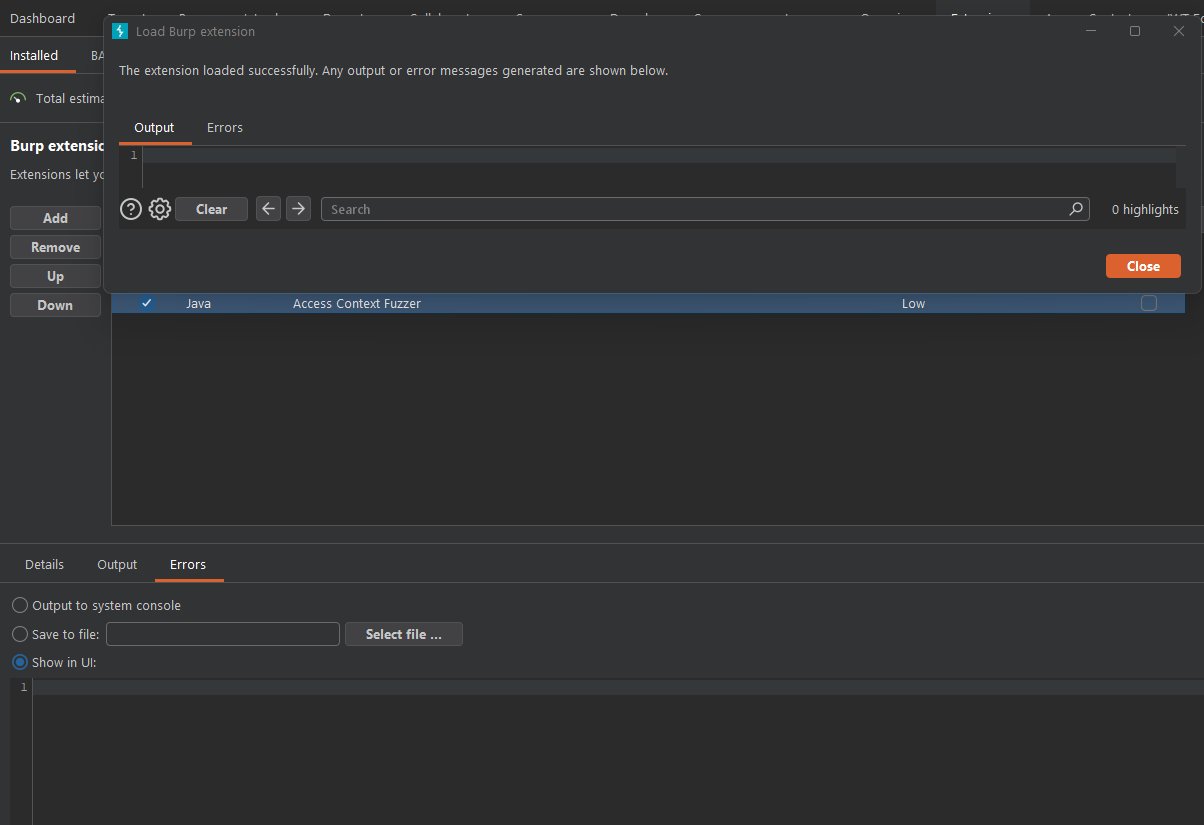
3. Open **Burp Suite** → **Extensions** → **Add**
4. Select the downloaded JAR file
5. The **"Access Context"** tab will appear in Burp Suite
### Option 2: Build from Source
See [Building from Source](#-building-from-source) below.
## 🎯 What is Access Context Fuzzer?
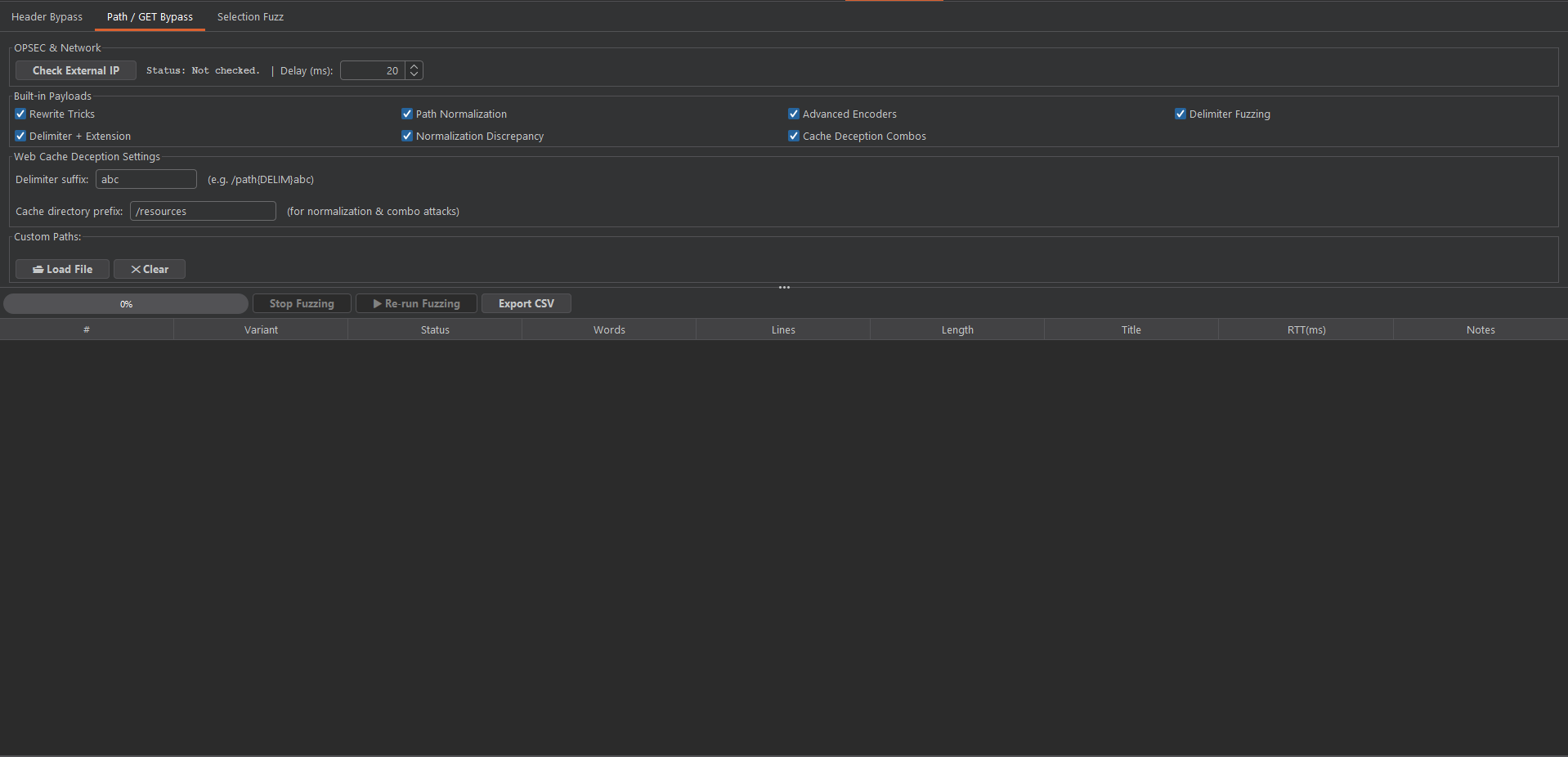
**Access Context Fuzzer** is a Burp Suite extension designed for security researchers and penetration testers who need to systematically test for **access control bypass** and **Web Cache Deception (WCD)** vulnerabilities.
Instead of manually crafting dozens of header and path variations, this extension **automatically generates and tests hundreds of bypass variants** in seconds — then highlights exactly which ones behave differently from the baseline.
## 🌟 What's New in v2.4.0
**Web Cache Deception — detection that actually confirms**
- 🐛 **Critical: Turkish-locale `toUpperCase()`/`toLowerCase()` broke all cache detection.** On a Turkish-locale JVM, `"hit".toUpperCase()` yields `"HİT"` (dotted capital İ, U+0130) — so `xCache.toUpperCase().contains("HIT")` was always `false`, and the same trap silently broke `private` → `prıvate` and `no-store` matching. Every `X-Cache` / `Cache-Control` / `Vary` comparison in `ScanEngine` and `HttpUtils` now uses `Locale.ROOT`. This is why cacheable responses were reported as `MISS` even though every resend was really a `HIT`.
- 🎯 **`/` delimiter for path-mapping WCD:** The Delimiter + Extension phase now also tests `/path/abc.js` (the exact vector behind PortSwigger's *"Exploiting path mapping"* lab), not just query/encoded delimiters.
- 🔁 **Automatic MISS→HIT confirmation:** When a variant returns a cacheable `200` `X-Cache: MISS` with `max-age`/`s-maxage`, the scanner resends the *same* request a few times inside the cache window. If `X-Cache` flips to `HIT`, the row is flagged **`🎯 WCD CONFIRMED (MISS→HIT)`** and shown as `HIT ✅` — the cache-warming step is now automatic instead of a manual Repeater round-trip.
**Verify WCD — warm + no-auth replay**
- 🔓 **Rewritten `Verify WCD` (right-click):** The old one-shot no-auth replay produced false negatives (a cold cache returns `302 / MISS` even on a cacheable URL). It now (1) **warms** the cache with your current auth until the entry is `HIT`, then (2) **replays without cookies/auth** and compares bodies. A confirmed leak requires a no-auth `HIT` whose body matches the authenticated response (or contains sensitive data) — cleanly separating `✅ CONFIRMED WCD` from `⚠️ HIT but content differs` and `❌ not cached without auth`. Works on whichever message (request **or** response) is open.
**New: 🎯 WCD Findings tab**
- 🗂️ A dedicated tab collects every WCD result — both the scanner's automatic MISS→HIT confirmations and manual verifications — with URL, auth/no-auth status, `X-Cache`, verdict, and timestamp. **Double-click a row to open the request/response that proves it.** No more transient popups with no history.
**UI & reporting**
- 🏷️ **Status moved to a proper label:** The cramped, text-truncated progress bar now shows just the bar; the run summary lives in a clean label — `✅ Done — N sent | M findings | B 🎯 bypass | W 🎯 WCD cacheable | Re-run available`.
- 🎯 **Cache HITs count as findings:** Confirmed MISS→HIT results are now included in the bypass tally and surfaced via a dedicated *WCD cacheable* counter (previously always reported `0 bypasses`).
- 🔎 **Tightened "interesting":** Only real findings (bypass, WCD confirmed, cache-hit, sensitive data, custom-rule hits) count as *interesting* and pass the *Show Only Interesting* filter — baseline noise (`STATUS_CHANGE` / `WORD_DELTA` / `LEN_DELTA` / `X-Cache:miss`) no longer inflates the count.
- 🌐 **English dialogs:** The WCD verification and scan-summary dialogs are now fully English.
**Settings**
- ⚙️ **OPSEC & Network moved to Settings:** The *Check External IP* / *Delay* panel was removed from the Header, Path, and Selection tabs and consolidated into a single section at the top of **Settings & History**, separated from per-engine payload options.
- 💾 **Single, persisted delay:** The three per-engine delays are unified into one `Delay (ms)` that all engines share and that is saved across restarts (key `acf.delay`; a legacy `acf.path.delay` is migrated automatically).
## 🌟 What's New in v2.3.2
**Bug Fixes**
- 🐛 **Swing EDT violations in scan startup:** `startFuzzing()` ran on a background thread but read `JTextArea`, `JSpinner`, and `JCheckBox` values directly — a race condition with the EDT. All UI values are now snapshotted via `ScanConfig` on the EDT before the task is submitted.
- 🐛 **Swing EDT violations in context-menu handlers:** Payload builders (`HeaderPayloadBuilder`, `PathPayloadBuilder`, `SelectionPayloadBuilder`) were being constructed inside the executor lambda, reading multiple `JCheckBox` components off the EDT. Builders are now called on the EDT before task submission.
- 🐛 **`flashTab` Timer created off EDT:** The `javax.swing.Timer` inside `flashTab()` was being constructed and started from the background fuzzing thread. Wrapped in `SwingUtilities.invokeLater()`. Additionally, the `JTabbedPane.indexOfComponent()` and `getTitleAt()` reads that fed `flashTab()` were themselves still on the background thread — moved inside the `invokeLater` lambda so all Swing reads happen on the EDT.
- 🐛 **DiffDialog false diff on CRLF responses:** `split("\n")` left trailing `\r` on each element when responses used Windows line endings, causing identical lines to appear as "changed". Changed to `split("\r?\n")`.
- 🐛 **Invalid custom rule regex silently discarded:** A bad pattern in the Custom Detection Rules panel was swallowed by `catch (Exception ignored)` with no feedback. Now logged to Burp's output panel.
- 🐛 **`btnPreview` useless executor roundtrip:** The Preview Payloads button submitted to the background thread pool only to immediately dispatch back to the EDT via `invokeLater`. Removed the intermediate hop.
- 🐛 **Duplicate `buildOpsecPanel` / `createTextAreaPanel` in every tab:** `HeaderEngineTab`, `PathEngineTab`, and `SelectionEngineTab` each declared private copies of methods already defined as `public static` in `ResultsPanel`. All three now delegate to the canonical implementations.
- 🐛 **`historyModel.getRowCount()` off EDT in scan history:** `appendScanHistory()` read `DefaultTableModel.getRowCount()` from the background fuzzing thread to compute the next row number, then wrapped only `addRow()` in `invokeLater`. Both the read and the write are now inside the `invokeLater` lambda.
- 🐛 **Parallel-mode timeout leaves HTTP request running:** On a `TimeoutException`, the timed-out `Future` was left running — the underlying HTTP connection stayed open until the remote server closed it. `future.cancel(true)` is now called before creating the fallback `FuzzResult`.
- 🐛 **`Desktop.getDesktop().browse()` blocking on EDT:** The About tab's hyperlink listener called `Desktop.browse()` directly on the Event Dispatch Thread. This is a blocking OS call that can freeze the entire Burp UI. Moved to a dedicated daemon thread.
- 🐛 **Custom path/payload/header `split("\\n")` broken on Windows:** Newlines typed in the Custom Paths (Path engine), Custom Payloads (Selection engine), Custom IPs, and Custom Headers (Header engine) text areas use `\r\n` on Windows. Splitting on `\n` left a trailing `\r` on each entry, producing payloads or header values with literal carriage-return characters. Changed to `split("\\r?\\n")` in all four locations.
- 🐛 **Hardcoded `User-Agent: AccessContext/3.0` in OPSEC check:** The IP-verification request to api.ipify.org sent a stale hardcoded version string. Now reads `ExtensionContext.VERSION` so the UA always matches the installed release.
**Performance**
- ⚡ **Single `bodyToString()` call per response:** `wordCount`, `lineCount`, `getTitle`, `detectSensitiveData`, and `bodyHash` each called `rr.response().bodyToString()` independently — up to 5 redundant body conversions per variant. A `bodyStr()` helper now fetches the body once per response; all analysis methods accept the pre-fetched string via overloaded signatures.
- ⚡ **ThreadLocal `MessageDigest` for MD5 hashing:** `MessageDigest.getInstance("MD5")` triggered a security-provider lookup on every call. Replaced with a `ThreadLocal
` that is reused (`md.reset()`) across calls on the same thread — zero lookups after warm-up.
- ⚡ **`ThemeColors.isDark()` result cached:** Every table cell repaint called `UIManager.getColor("Panel.background")` through `isDark()`. The result is now cached in a `volatile boolean` and refreshed only when the Look & Feel changes via a `UIManager` property listener.
## 🌟 What's New in v2.3.1
**Bug Fixes**
- 🐛 **Session drift dialog (EDT fix):** The mid-scan confirmation dialog was being called via `JOptionPane.showConfirmDialog()` directly from the background fuzzing thread. Replaced with `SwingUtilities.invokeAndWait()` — potential deadlock on certain JVM/OS combinations.
- 🐛 **Null body crash in `bodyHash()`:** `.body()` returns null on 204/HEAD responses. Was silently swallowed by the catch block but still caused unnecessary exception overhead. Added an explicit null check.
- 🐛 **CSV newline escaping:** Multi-flag Notes entries contain embedded `\n` characters. These weren't being escaped before writing, breaking row boundaries in Excel and most CSV parsers.
**Performance**
- ⚡ **Regex pre-compilation:** Custom detection rules (Settings tab) were calling `Pattern.compile()` on every response — O(variants × rules) compilations per scan. Rules are now compiled once at scan start into a cached `List`.
- ⚡ **Allocation-free word/line counting:** `wordCount()` was doing `body.split("\\s+").length` — allocates a full `String[]` just to discard it. Replaced with `StringTokenizer.countTokens()`. `lineCount()` similarly replaced with a single-pass `char` loop.
- ⚡ **`getTitle()` static pattern:** `Pattern.compile()` was called on every invocation. Moved to a `private static final` field.
## 🌟 What's New in v2.3.0
- 📊 **Cache Status Column:** Results table now has a dedicated **Cache** column showing `HIT ✅`, `MISS`, `PRIVATE 🚫`, `NO-STORE 🚫`, `HIT/Vary:Cookie`, or the raw `X-Cache` value. WCD triage without reading the Notes column.
- 🌐 **CDN Profile Selector:** Pick your target's CDN (Cloudflare, Akamai, Fastly, CloudFront, Nginx, Varnish) in the Path engine. Delimiter payloads are filtered to that CDN's known delimiter set — less noise, more signal.
- 🏋️ **Fat GET:** New checkbox in Path engine. Sends the request as a GET with a body. CDNs key the cache on path and ignore the body; some origins behave differently. Surfaces WCD vectors that path-only testing misses.
- 🗂️ **Extended Static Extensions:** Delimiter + Extension phase now covers 19 file types (was 6): `.js .css .png .jpg .gif .ico .woff .woff2 .svg .ttf .eot .mp4 .webp .avif .pdf .xml .json .txt .html`.
- 🔬 **Normalization Discrepancy Extras:** Four additional Norm Discrepancy payloads: `%252F` (double-encoded slash), BOM + extension, `%00.css` (null byte), `%c0%af` (overlong UTF-8).
- 🔑 **Sensitive Data Detection:** Every response body is automatically scanned for JWT tokens, CSRF tokens, email fields, Bearer tokens, and API keys. Matches are flagged as `SENSITIVE_DATA:JWT` (etc.) in Notes and highlighted pink. Confirms WCD exploitation when an unauthenticated cache replay returns sensitive content.
- 📋 **WCD Scan Summary:** After a Path engine scan, a popup summarises cache findings — HIT count, private/no-store count, Vary:Cookie count, and which specific variants look exploitable.
- 🔓 **Verify WCD (No-Auth):** New right-click context menu item. Replays the URL without cookies or auth headers in a fresh connection. If the cached response still returns authenticated content, it's a confirmed WCD finding — shown in a before/after comparison dialog.
- 🏗️ **Internal Refactor (1 file → 17 files):** The monolithic `AccessContextFuzzer.java` (was ~2000 lines) is now a proper multi-package structure: `burp.core`, `burp.util`, `burp.payload`, `burp.ui`. No behaviour changes — the entry point is now 123 lines. Makes contributing significantly more approachable.
## 🌟 What's New in v2.2.0
- 💾 **Settings Persistence (A):** All checkboxes, spinners, delays, and custom rules now auto-save using Burp's native Preferences API and are restored on next load.
- ⚡ **Parallel Fuzzing Mode (B):** Toggle `Parallel Mode` in the new **⚙ Settings & History** tab to send multiple requests simultaneously. Configurable thread count (2–20). Ordered collection preserves row numbering. Disables delay and session drift check.
- 📊 **Scan Summary (D):** Progress bar updates to a rich summary at end of scan — `Done! ✅ 147 sent | 12 interesting | 3 🎯 bypasses | Re-run available`.
- 🔍 **Response Diff Viewer (E):** Right-click any row → **Compare with Baseline** for a side-by-side HTML diff showing which lines changed between the baseline and the variant response.
- 📝 **Custom Detection Rules (G):** Define regex patterns in the Settings tab using `regex=LABEL` format. Matches in any response body are highlighted as `CUSTOM:LABEL` in the Notes column.
- 🔀 **Expanded Bypass Detection (H):** Now detects redirect-based bypasses (`🔀 REDIRECT BYPASS?` for 403→30x) and same-status body changes on 2xx (`⚠️ BODY_BYPASS?`).
- 🛡️ **Configurable WAF Threshold (I):** The WAF block threshold (consecutive connection resets before auto-stop) is now a spinner in Settings — default 5, range 1–50.
- 📋 **Scan History Tab (J):** A new **⚙ Settings & History** tab logs every completed scan with engine type, target URL, timestamp, payload count, interesting count, bypass count, and baseline status.
- 👁️ **Payload Preview (K):** Click **👁 Preview Payloads** on any engine tab to see a full categorized list of all variants that would be sent — without actually running the scan.
## 🌟 What's New in v2.1.0
- 🔧 **Thread Safety:** Fixed thread leak on extension unload via `taskExecutor.shutdownNow()`.
- 🖥️ **Swing EDT Fix:** `flashTab()` converted from raw `Thread.sleep()` to a proper `javax.swing.Timer`.
- ♻️ **DRY Refactor:** Eliminated 3× duplicate OPSEC panel code with `buildOpsecPanel()` helper.
- 📣 **Error Visibility:** All silently swallowed exceptions now log to `api.logging().logToError()`.
- 📂 **CSV Export Fix:** Export failure now shows an error dialog instead of failing silently.
## 🌟 What's New in v2.0 (The "Smart Fuzz" Update)
Access Context Fuzzer has been significantly upgraded to tackle modern web applications, aggressive WAFs, and complex API gateways:
- 🧠 **MD5 Body Hash Engine & "Interesting" Filter:** Detects hidden state changes (`BODY_DIFF`) even when the status code remains the same. Click **"🔍 Show Only Interesting"** to instantly filter out noise.
- 🛡️ **Adaptive Rate Limiting Anti-WAF:** Automatically doubles the delay upon `429 Too Many Requests` or `503`, and halts the scan if the WAF starts dropping connections (`status -1`).
- ⏱️ **Real-Time Fuzz Estimation:** The progress bar now dynamically estimates `(~1:45 remaining)` based on rolling RTT averages.
- 🔄 **Session Drift Detection:** Re-verifies your baseline every 50 requests. If your session expires (`SESSION_DRIFT`), it pauses the scan and warns you.
- 🗂️ **Bulk "Send to Repeater":** Multi-select support! Send all "Interesting" variants to the Repeater with a single click.
- 🎯 **Scan Profiles:** 1-click preset buttons (`⚡ Quick Scan`, `🔥 Full Scan`, `🎯 WCD Only`) instantly configure the payloads.
- 🧬 **Deep Protocol Injection:** Added WebDAV verbs, case-tampering (`gEt`), HTTP/2 pseudo-header injection (`:authority`), and obscure unicode traversals.
### Why This Tool?
| Problem | Without This Tool | With Access Context Fuzzer |
|---------|-------------------|---------------------------|
| Header bypass testing | Manually add `X-Forwarded-For`, `X-Real-IP`, etc. one by one | **40+ header variants** tested simultaneously |
| Path normalization bugs | Guess which encoding tricks work | **Systematic fuzzing** of URL encoding, double encoding, IIS Unicode, dot-segments |
| Web Cache Deception | Complex multi-step manual testing | **Automated 4-phase WCD pipeline** with cache header detection |
| Result analysis | Compare responses manually | **Smart color-coded diff** — status changes, word deltas, length anomalies highlighted automatically |
## ✨ Features
### 🔹 Three Fuzzing Engines
Access Context Fuzzer provides three independent fuzzing engines, each accessible via its own tab:

### 1️⃣ Header Bypass
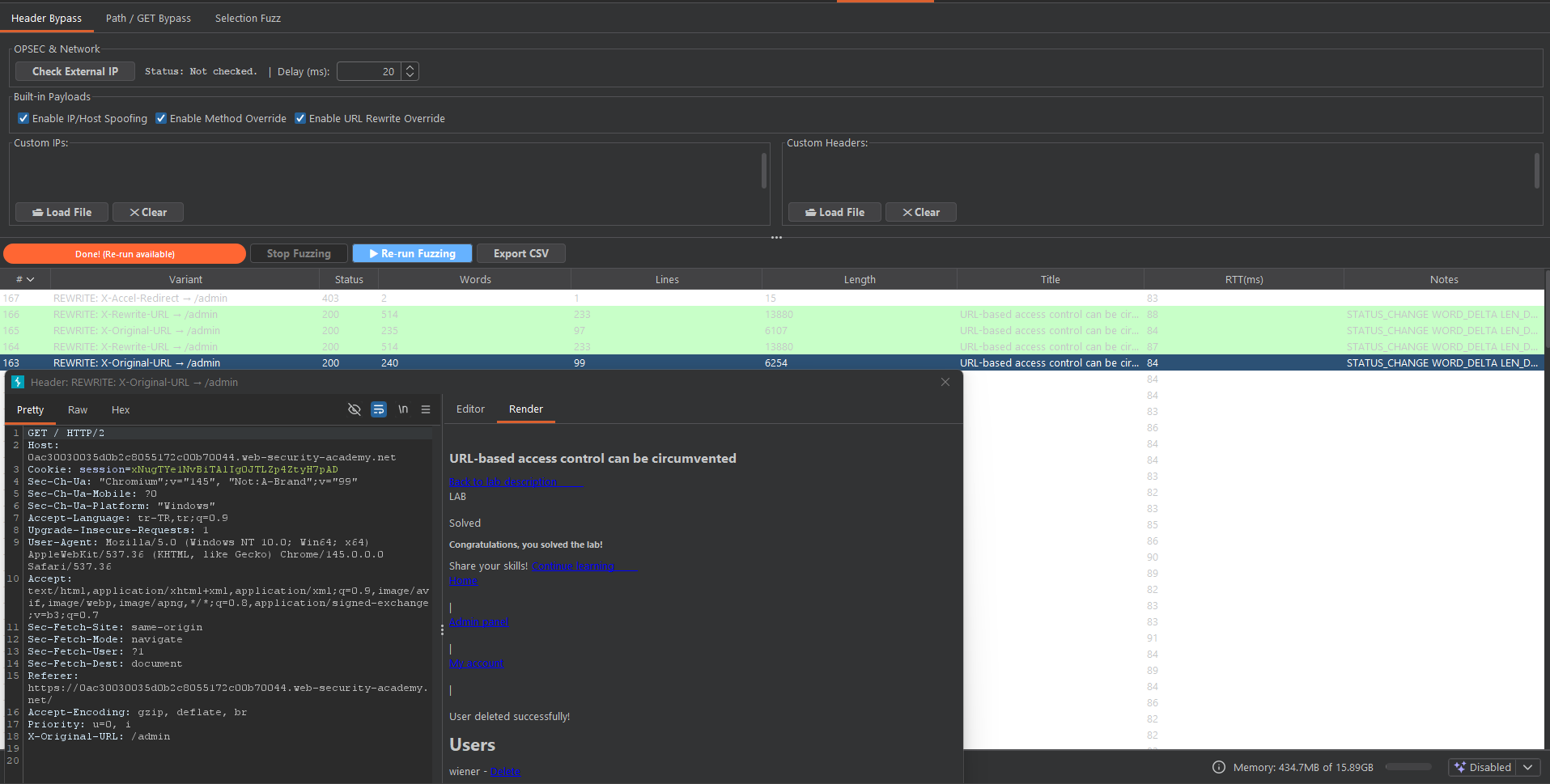
Tests access control enforcement by injecting **IP spoofing and host manipulation headers**.
**What it tests:**
| Category | Headers | Example |
|----------|---------|---------|
| **IP Spoofing** | `X-Forwarded-For`, `X-Real-IP`, `X-Client-IP`, `True-Client-IP`, `CF-Connecting-IP`, and 30+ more | `X-Forwarded-For: 127.0.0.1` |
| **Host Override** | `X-Forwarded-Host`, `X-Host`, `X-Original-Host` | `X-Host: allowed-origin.com` |
| **Custom IPs** | User-defined list | Any IP you specify |
| **Custom Headers** | User-defined `Header: Value` pairs | Load from wordlist file |
**Use case:** Testing if the application relies on easily spoofable headers for access control decisions (e.g., admin panels restricted by IP).
### 2️⃣ Path / GET Bypass
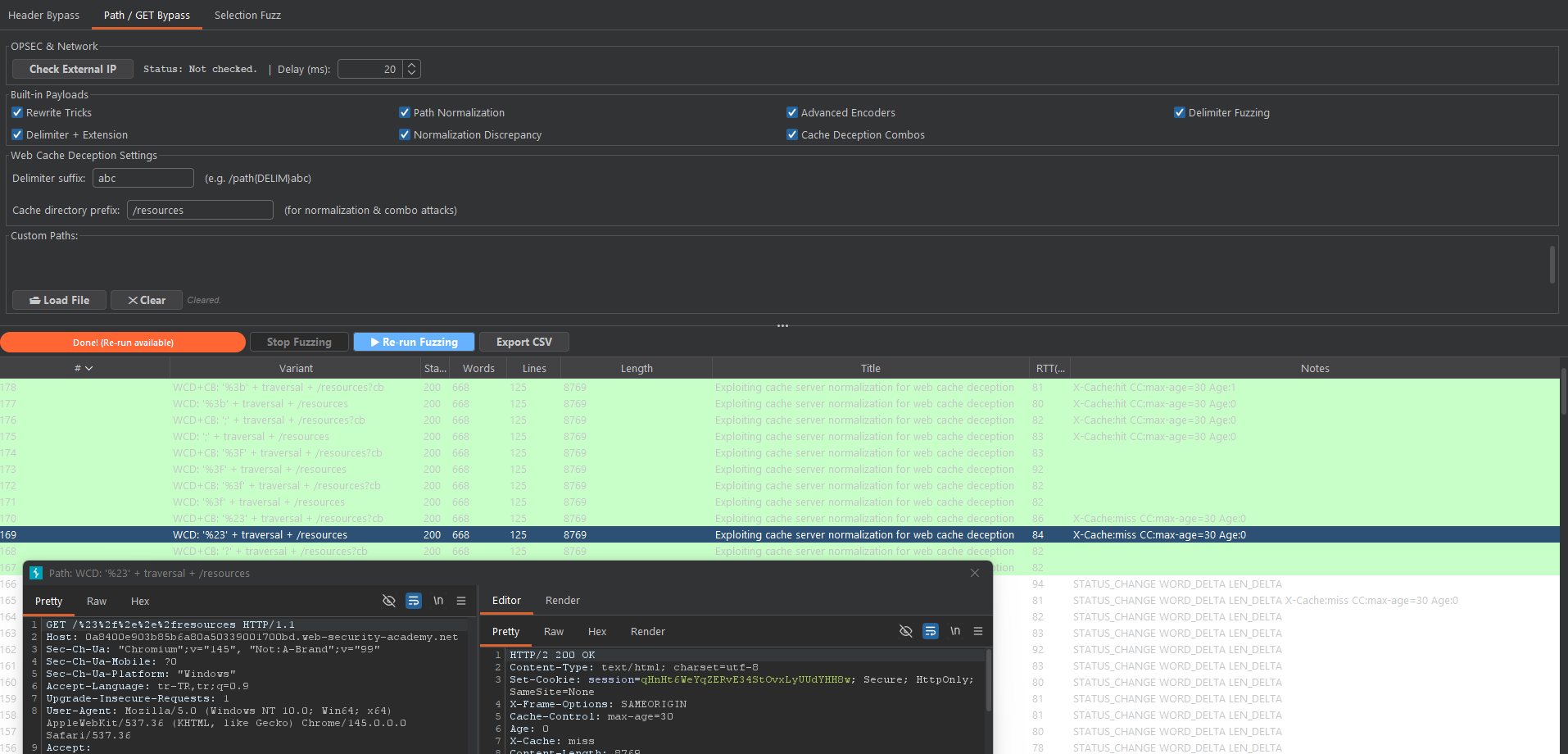
Tests path-level access control by manipulating the **URL path** using various encoding and normalization techniques.
**What it tests:**
| Technique | Checkbox | Example | Purpose |
|-----------|----------|---------|--------|
| **URL Encoding** | `Path Normalization` | `/%61%64%6d%69%6e` | Bypass path-matching rules |
| **Double URL Encoding** | `Path Normalization` | `/%2561%2564%256d%2569%256e` | Exploit double-decode vulnerabilities |
| **IIS Unicode Encoding** | `Path Normalization` | IIS short/wide Unicode variants | Target IIS-specific normalization |
| **Case Flipping** | `Advanced Encoders` | `/Admin`, `/ADMIN` | Case-sensitive path matching |
| **Trailing Slash** | `Advanced Encoders` | `/admin/` | Path normalization differences |
| **Dot-Segment Injection** | `Advanced Encoders` | `/path/..;/admin` | Tomcat/Spring path traversal |
| **Double Slash Prefix** | `Advanced Encoders` | `//admin` | Proxy path confusion |
| **JSON Suffix** | `Advanced Encoders` | `/admin.json` | Content negotiation bypass |
| **Semicolon Suffix** | `Advanced Encoders` | `/admin;` | Parameter delimiter abuse |
| **X-Rewrite-URL** | `Rewrite Tricks` | Header: `/admin` | Frontend/backend path discrepancy |
| **X-Original-URL** | `Rewrite Tricks` | Header: `/admin` | URL override |
| **X-Accel-Redirect** | `Rewrite Tricks` | Header: `/admin` | **Nginx / OpenResty** internal redirect bypass |
| **Custom Paths** | — | User-defined paths | Load from wordlist file |
### 3️⃣ Selection Fuzz
Allows you to **select specific text** within a request and fuzz just that portion with various encodings.
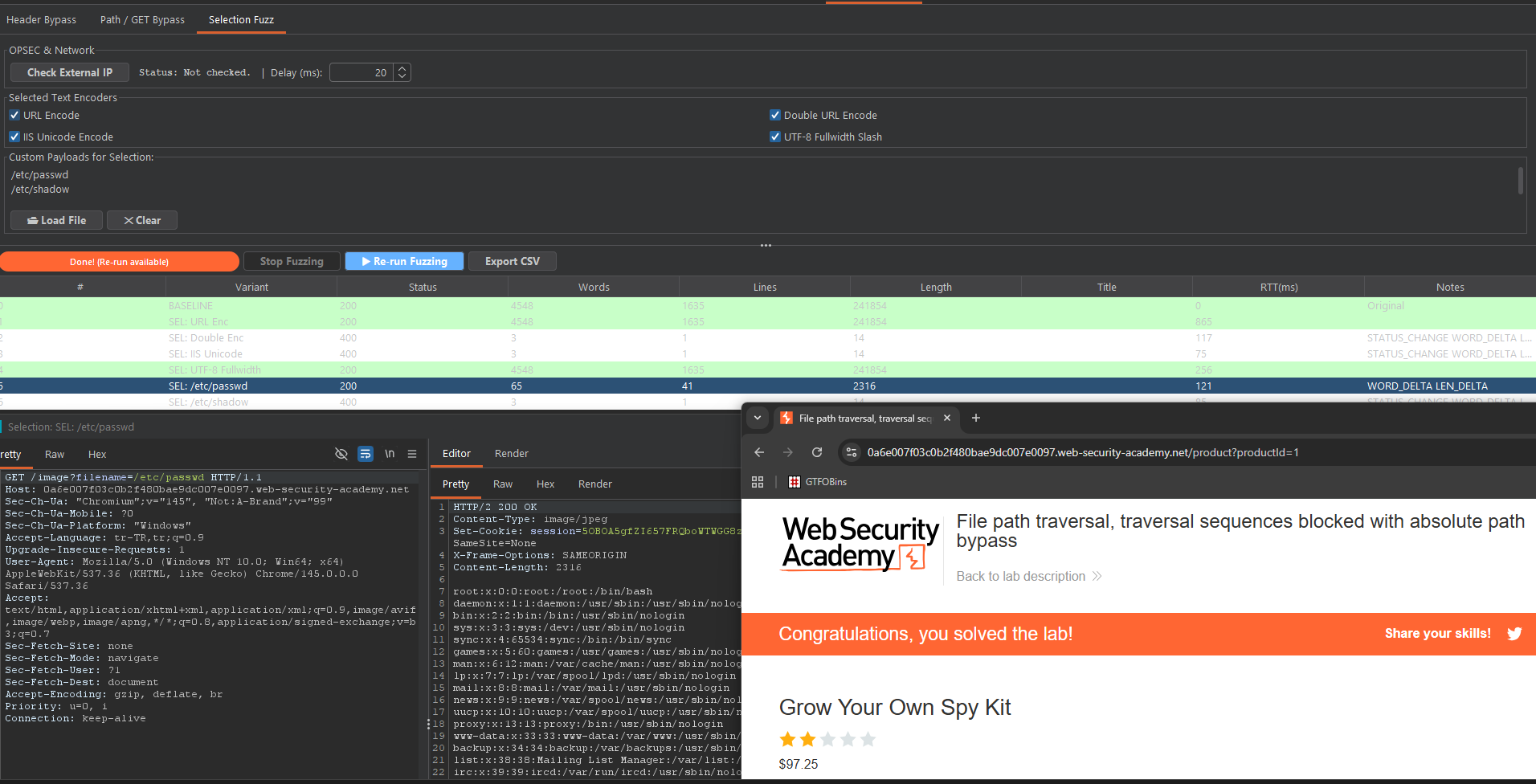
**What it tests:**
| Encoder | Description |
|---------|-------------|
| **URL Encode** | Standard percent-encoding of selected text |
| **Double URL Encode** | Double-layer encoding |
| **IIS Unicode Encode** | IIS-specific Unicode mapping |
| **UTF-8 Fullwidth Slash** | Fullwidth character substitution |
| **Custom Payloads** | User-defined replacements from file or manual input |
**Use case:** When you've identified a specific parameter or path segment that might be vulnerable, select it and test encoding-specific bypasses.
### 🔹 Web Cache Deception (WCD) Testing
A dedicated 4-phase pipeline for discovering and exploiting Web Cache Deception vulnerabilities. Each phase maps directly to a checkbox in the **"Built-in Payloads"** panel:

#### Phase 1: Delimiter Discovery
Identifies which characters the **origin server** treats as path delimiters.
/my-account?abc → 200 = '?' is a delimiter
/my-account#abc → 200 = '#' is a delimiter
/my-account%23abc → 200 = '%23' (encoded #) is a delimiter
/my-account%3fabc → 200 = '%3f' (encoded ?) is a delimiter
#### Phase 2: Delimiter + Extension
Tests if the **cache** treats responses differently when combined with static file extensions.
/my-account?abc.js → Check X-Cache header
/my-account%23abc.css → Check X-Cache header
#### Phase 3: Normalization Discrepancy
Tests whether the origin server and cache **handle encoded dot-segments differently**.
/aaa/..%2fmy-account → 404 = origin doesn't normalize
/aaa/..%2fresources/test → X-Cache:hit = cache DOES normalize!
/resources/..%2ftest → No cache = confirms /resources prefix rule
#### Phase 4: Cache Deception Exploits
Generates **combined exploit payloads** using discovered delimiters + cache normalization.
/my-account%23%2f%2e%2e%2fresources → 200 + X-Cache:hit = EXPLOIT! 🎯

### 🔹 Smart Results Table
Every fuzzing result is displayed in an intelligent, color-coded table:
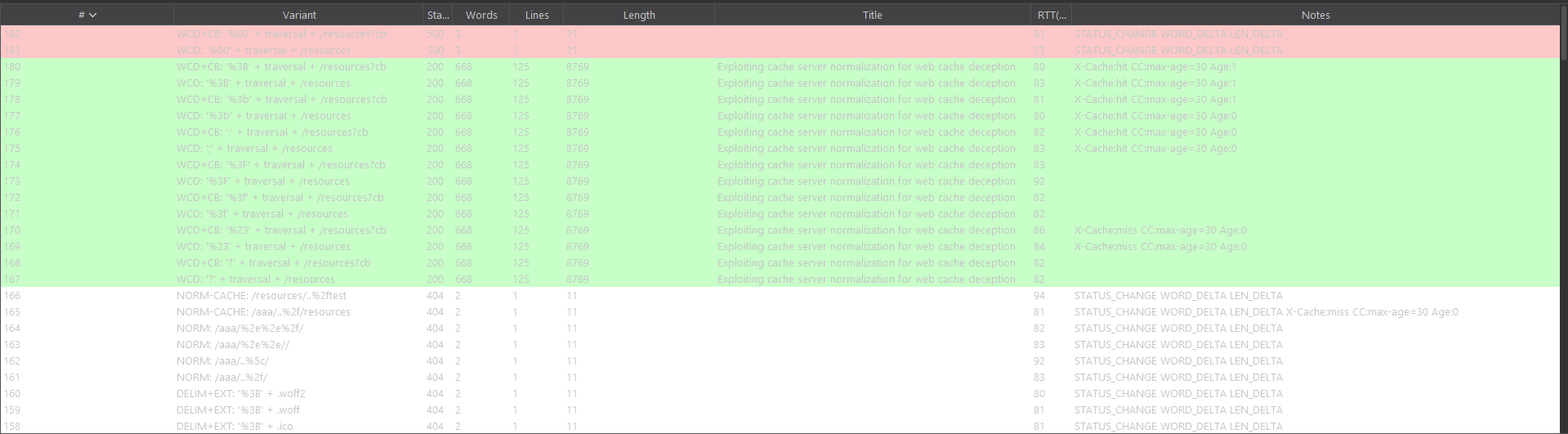
| Column | Description |
|--------|-------------|
| **#** | Row index |
| **Variant** | Name of the test (e.g., `DELIM: '?'`, `WCD: '%23' + traversal`) |
| **Status** | HTTP status code |
| **Cache** | Cache status: `HIT ✅`, `MISS`, `PRIVATE 🚫`, `NO-STORE 🚫`, `HIT/Vary:Cookie`, or raw `X-Cache` value |
| **Words** | Word count of the response body |
| **Lines** | Line count of the response body |
| **Length** | Response body length in bytes |
| **Title** | Extracted HTML `` tag |
| **RTT(ms)** | Round-trip time in milliseconds |
| **Notes** | Auto-detected anomalies and sensitive data matches |
**Automatic anomaly detection in Notes:**
| Tag | Meaning |
|-----|---------|
| `SENSITIVE_DATA:JWT` | Response body contains a JWT token (also: `CSRF`, `EMAIL`, `BEARER`, `SECRET`) |
| `🎯 POTENTIAL BYPASS` | Baseline was a 40x error, but payload returned 2xx — strong bypass signal |
| `🔀 REDIRECT BYPASS?` | 401/403 baseline changed to a 30x redirect — possible auth bypass via redirect |
| `⚠️ BODY_BYPASS?` | Same 2xx status but body content changed — possible auth bypass with same code |
| `🔍 PATH_CONFUSION` | 404 baseline returned a non-404 response — path traversal or confusion |
| `CUSTOM:LABEL` | Response body matched a user-defined regex rule from the Settings tab |
| `STATUS_CHANGE` | Response status differs from baseline |
| `WORD_DELTA` | Word count differs from baseline |
| `LEN_DELTA` | Body length differs by >50 bytes |
| `BODY_DIFF` | MD5 hash of the response body differs from baseline despite same status |
| `RATE_LIMITED(429)` | Target is rate limiting. Delay automatically increased. |
| `⚠️ SESSION_DRIFT` | Original session is invalidated mid-scan |
| `X-Cache:hit` | Response served from cache |
| `X-Cache:miss` | Response not in cache (first request) |
| `CC:public,max-age=30` | Cache-Control header value |
| `Age:15` | Cache age in seconds |
**Color coding:**
- 🩷 **Pink rows** — Sensitive data in response body (`SENSITIVE_DATA:*`)
- 🟡 **Gold rows** — Potential bypass detected (`🎯 POTENTIAL BYPASS`)
- 🔵 **Sky-blue rows** — Redirect bypass hint (`🔀 REDIRECT BYPASS?`)
- 🟠 **Orange rows** — Body-based bypass hint (`⚠️ BODY_BYPASS?`)
- 🟣 **Lavender rows** — Custom rule match (`CUSTOM:LABEL`)
- 🟢 **Green rows** — 2xx Success response
- 💙 **Light Blue rows** — 3xx Redirects
- 🟡 **Light Yellow rows** — 429 Rate Limited
- 🔴 **Red rows** — 5xx Server errors
- ⚪ **Grey rows** — -1 Connection Resets (WAF dropping packets)
**Dynamic Sorting & Filtering:**
Use the **"🔍 Show Only Interesting"** button to hide completely normal baseline-matching responses. Click any column header to instantly sort results by **Status Code**, **Word Count**, **Length**, or **RTT**. No need to scroll through hundreds of rows; **one click reveals your bypass**.
### 🔹 Request / Response Viewer
**Double-click** any row to open a dedicated inspection window powered by **Burp Suite's native HTTP editors** (`HttpRequestEditor` / `HttpResponseEditor` from the Montoya API). This is not a plain text viewer — it is the same editor component used in Burp's own Repeater and Proxy tabs.
<p align="center">
<img src="https://static.pigsec.cn/wp-content/uploads/repos/cas/08/082d4c6724beae6a3f0de7a321eae09a7b5bc03bd4e07516e283252558675e15.png" alt="Request/Response Viewer" width="900"/>
</p>
The viewer opens as a **non-modal split pane** (request on the left, response on the right) with full tab support:
| Tab | Description |
|-----|-------------|
| **Raw** | Full HTTP message exactly as sent/received, including headers and body |
| **Pretty** | Syntax-highlighted, auto-formatted view (JSON, HTML, XML) |
| **Hex** | Byte-level hexadecimal view for binary analysis |
| **Render** | **Live HTML preview** of the response — instantly see if the page contains API keys, tokens, or sensitive data without reading raw HTML |
### 🔹 Re-run Fuzzing
Changed your settings? No need to go back to HTTP history — click **▶ Re-run Fuzzing** to re-execute with updated configuration.
<p align="center">
<img src="https://static.pigsec.cn/wp-content/uploads/repos/cas/92/9232fcdf149befa9dc0ebb3e9a6d40211a30f1191fcf90be9a1a1eb1b38030f4.png" alt="Re-run Fuzzing Button" width="600"/>
</p>
- ✅ Modify checkboxes, add custom payloads, change delay
- ✅ Click **▶ Re-run** — uses the same base request with new settings
- ✅ Previous results are cleared automatically
### 🔹 Load Wordlists from File
Every custom text area includes **📂 Load File** and **✕ Clear** buttons.
<p align="center">
<img src="https://static.pigsec.cn/wp-content/uploads/repos/cas/31/31adacfa6a6b4e3b81cd8817e0df09f10356907ac164ca2922a92faf513c7ce1.png" alt="Load File Feature" width="700"/>
</p>
- Supports `.txt`, `.lst`, `.csv`, `.list` files
- **Appends** to existing content (combine manual + file payloads)
- Shows line count feedback after loading
- Works with all custom fields: IPs, Headers, Paths, Payloads
### 🔹 OPSEC & Network Safety
Each tab includes an **IP verification check** to ensure your traffic is properly anonymized.
<p align="center">
<img src="https://static.pigsec.cn/wp-content/uploads/repos/cas/78/786496ee5c7459dc288a156ef9ada8189363fd23e1b8b1ac82832710625b60aa.png" alt="OPSEC Check" width="600"/>
</p>
- Click **Check External IP** to verify your public IP
- **OPSEC Warning Dialog** — if you haven't verified your IP, the extension **blocks fuzzing** and shows a confirmation dialog to prevent accidental exposure of your real IP
- Configurable **delay (ms)** between requests to avoid rate limiting and WAF detection
### 🔹 Export & Integration
| Feature | How |
|---------|-----|
| **Send to Repeater** | Extensively supports Multi-select (`Ctrl`+Click, `Shift`+Click). Right-click to find **"Send All Selected"** or **"Send All Interesting"**. |
| **Export CSV** | Click *Export CSV* to save all tabular results |
| **Site Map** | All fuzzing requests are natively integrated and added to Burp's Site Map |
## 🏆 Proven: PortSwigger Lab Success
Access Context Fuzzer has been tested and **proven effective** against official PortSwigger Web Security Academy labs:
<p align="center">
<img src="https://static.pigsec.cn/wp-content/uploads/repos/cas/5c/5c65183b16cae1a5f4ca5b6e32ed943c9937ed982dd57cc7c0a92a339b591874.png" alt="Lab Success Showcase" width="800"/>
</p>
| Status | Lab | Technique Used | Extension Feature |
|--------|-----|---------------|-------------------|
| ✅ Solved | **URL-based access control can be circumvented** | Root-level URL rewrite via `X-Original-URL` header | `Header Bypass` tab — `URL Rewrite Override` checkbox |
| ✅ Solved | **Host header authentication bypass** | Host manipulation via `X-Forwarded-Host` | `Header Bypass` tab — IP/Host spoofing |
| ✅ Solved | **Authentication bypass via information disclosure** | Custom header `X-Custom-IP-Authorization: 127.0.0.1` | `Header Bypass` tab — Custom Headers |
| ✅ Solved | **Exploiting cache server normalization for WCD** | Delimiter + encoded dot-segment + cache prefix | `Cache Deception Combos` checkbox |
## 📦 Installation
### From JAR (Recommended)
1. Download the latest `access-context-fuzzer-*-jar-with-dependencies.jar` from [Releases](../../releases)
2. In Burp Suite, go to **Extensions** → **Installed** → **Add**
3. Set **Extension type** to **Java**
4. Select the downloaded JAR file
5. Click **Next** — the **Access Context** tab appears
<p align="center">
<img src="https://static.pigsec.cn/wp-content/uploads/repos/cas/f3/f3a1b1597c3cfb8aebc8d848e3357d9dcee6bf61499b97fec0e8942cd3bea18e.png" alt="Installation Steps" width="700"/>
</p>
### Requirements
- Burp Suite Professional or Community Edition **2023.1+**
- Java **17** or higher
<a id="usage"></a>
## 🚀 Usage
### Quick Start
1. Browse to your target in Burp's built-in browser
2. Find a request in **Proxy → HTTP History**
3. Right-click the request and choose:
| Menu Item | When to Use |
|-----------|-------------|
| **Access Context: Header Fuzz** | Testing header-based access control (IP restrictions, host checks) |
| **Access Context: Path Fuzz** | Testing path-based access control (URL normalization, encoding bypass) |
| **Access Context: Fuzz Selection** | Testing a specific selected portion of the request |
<p align="center">
<img src="https://static.pigsec.cn/wp-content/uploads/repos/cas/a1/a1ceb696a454495c97956361c14cd5276f92b738b331204d311472477d055c7a.png" alt="Context Menu" width="500"/>
</p>
4. The extension switches to the appropriate tab and begins fuzzing
5. Watch the progress bar and results table populate in real-time
6. Look for **green highlighted rows** with `STATUS_CHANGE` or `WORD_DELTA` in Notes
### Workflow: Web Cache Deception Lab
A step-by-step guide for testing WCD vulnerabilities:
Step 1: Enable "Delimiter Fuzzing" checkbox
→ Find delimiters that return 200 (e.g., ?, #, %23)
Step 2: Enable "Delimiter + Extension" checkbox
→ Check Notes column for X-Cache headers
Step 3: Enable "Norm Discrepancy" checkbox
→ Set Cache Prefix to "/resources"
→ Find normalization differences between origin and cache
Step 4: Enable "Cache Deception Combos" checkbox
→ Look for rows with Status=200 AND X-Cache:hit
→ That row's path is your exploit payload!
Step 5: Double-click the exploit row
→ Verify API key / sensitive data in the Render tab
→ Copy the path for your exploit server
<a id="building-from-source"></a>
## 🏗 Building from Source
### Prerequisites
- **JDK 17+** (OpenJDK or Oracle JDK)
- **Maven 3.6+**
### Maven
# Clone the repository
git clone https://github.com/Tagoletta/AccessContextFuzzer.git
cd AccessContextFuzzer
# Compile
mvn compile
# Build JAR with dependencies
mvn package
# Output: target/access-context-fuzzer-2.4.0-jar-with-dependencies.jar
### Project Structure
AccessContextFuzzer/
├── src/
│ └── main/
│ └── java/
│ └── burp/
│ ├── AccessContextFuzzer.java # Entry point (123 lines)
│ ├── core/
│ │ ├── ExtensionContext.java # Shared state / DI container
│ │ ├── ScanEngine.java # Scan orchestration, WCD logic
│ │ ├── FuzzerEngine.java # Per-engine UI state
│ │ ├── FuzzResult.java # Data class: response + RTT
│ │ └── Variant.java # Data class: name + request
│ ├── payload/
│ │ ├── HeaderPayloadBuilder.java # Header bypass variants
│ │ ├── PathPayloadBuilder.java # Path + WCD variants
│ │ └── SelectionPayloadBuilder.java # Selection encoding variants
│ ├── ui/
│ │ ├── HeaderEngineTab.java
│ │ ├── PathEngineTab.java
│ │ ├── SelectionEngineTab.java
│ │ ├── ResultsPanel.java
│ │ ├── SettingsTab.java
│ │ └── DiffDialog.java
│ └── util/
│ ├── HttpUtils.java # Static helpers: status, cache, diff
│ └── EncoderUtils.java # URL/Unicode encoding helpers
├── img/ # README screenshots
├── .github/
│ └── workflows/
│ └── release.yml # Auto-build & release on tag push
├── pom.xml # Maven build config
├── .gitignore
└── README.md
## 🧪 Test Coverage Matrix
The following table summarizes all test variants generated by the extension:
### Header Bypass Variants
| # | Variant | Header | Value |
|---|---------|--------|-------|
| 1-8 | IP Spoofing (127.0.0.1) | `X-Forwarded-For`, `X-Real-IP`, `X-Client-IP`, `True-Client-IP`, `CF-Connecting-IP`, `X-Cluster-Client-IP`, `Fastly-Client-IP`, `X-Azure-ClientIP` | `127.0.0.1` |
| 9-16 | IP Spoofing (Custom IPs) | Same headers as above | User-defined IPs |
| 17-19 | Host Override | `X-Forwarded-Host`, `X-Host`, `X-Original-Host` | User-defined hosts |
| 20-30 | WebDAV & Method Swap | `METHOD` | `MKCOL`, `COPY`, `PROPPATCH`, `GET`, `gEt`, `post` |
| 31-38 | Content-Type Override | `Content-Type`, `Accept` | `application/xml`, `text/html` |
| 39-45 | HTTP/2 & Scheme Injection | `:authority`, `:path`, `X-Forwarded-Scheme`, `Front-End-Https` | `localhost`, `https`, `on` |
| 46+ | Custom Headers | User-defined | User-defined |
### Path Bypass Variants
| # | Variant | Checkbox | Example | Technique |
|---|---------|----------|---------|----------|
| 1 | URL Encode | `Path Normalization` | `/%61%64%6d%69%6e` | Single URL encoding |
| 2 | Double URL Encode | `Path Normalization` | `/%2561%2564%256d%2569%256e` | Double encoding |
| 3 | IIS Unicode | `Path Normalization` | IIS-mapped characters | IIS short filename |
| 4 | Case Flip | `Advanced Encoders` | `/Admin`, `/ADMIN` | Case sensitivity |
| 5 | Trailing Slash | `Advanced Encoders` | `/admin/` | Path normalization |
| 6 | Dot-Segment | `Advanced Encoders` | `/..;/admin` | Tomcat/Spring bypass |
| 7 | Overlong UTF-8 & Unicode | `Advanced Encoders` | `..%c0%af`, `%ef%bc%8f`, `..%5c` | Apache/IIS deep bypass |
| 8 | Double Slash | `Advanced Encoders` | `//admin` | **Nginx/OpenResty** proxy path confusion — targets misconfigurations in `location` block matching |
| 9 | JSON Suffix | `Advanced Encoders` | `/admin.json` | Content negotiation bypass |
| 9 | Semicolon | `Advanced Encoders` | `/admin;` | Delimiter abuse |
| 10 | X-Rewrite-URL | `Rewrite Tricks` | Header: `/admin` | URL rewrite (IIS/ASP.NET) |
| 11 | X-Original-URL | `Rewrite Tricks` | Header: `/admin` | URL override (IIS/ASP.NET) |
| 12 | X-Accel-Redirect | `Rewrite Tricks` | Header: `/admin` | **Nginx / OpenResty** internal redirect bypass — targets `X-Accel-Redirect` header handling in Nginx reverse proxy setups |
| 13+ | Delimiter Fuzzing | `Delimiter Fuzzing` | `/admin?abc`, `/admin%23abc` | WCD Phase 1 |
| 20+ | Delimiter + Extension | `Delimiter + Extension` | `/admin?abc.js` | WCD Phase 2 |
| 30+ | Norm Discrepancy | `Normalization Discrepancy` | `/aaa/..%2fadmin` | WCD Phase 3 |
| 40+ | Cache Deception Combo | `Cache Deception Combos` | `/admin%23%2f%2e%2e%2fresources` | WCD Phase 4 |
## 📸 Screenshot Guide
Place the following screenshots in the `img/` directory:
| Filename | What to Capture |
|----------|-----------------|
| `banner.png` | A branded banner image (1200×300 recommended) |
| `overview.png` | Full extension window showing all three tabs |
| `three_tabs.png` | Close-up of the tab bar (Header Bypass, Path/GET Bypass, Selection Fuzz) |
| `header_bypass_tab.png` | Header Bypass tab with settings and results populated |
| `path_bypass_tab.png` | Path/GET Bypass tab showing WCD checkboxes |
| `selection_fuzz_tab.png` | Selection Fuzz tab with custom payloads |
| `wcd_settings.png` | Close-up of the WCD settings panel (delimiter, extension, norm, combo checkboxes) |
| `wcd_results.png` | Results table showing X-Cache headers in Notes column |
| `results_table.png` | Color-coded results table with anomalies highlighted |
| `request_response_viewer.png` | Double-click dialog showing Burp's native Request/Response editors |
| `rerun_button.png` | Control panel showing the ▶ Re-run Fuzzing button |
| `load_file.png` | Custom textarea with Load File button and "X lines loaded" feedback |
| `opsec_check.png` | OPSEC panel showing verified IP address |
| `installation.png` | Burp Extensions tab showing the loaded extension |
| `context_menu.png` | Right-click context menu showing the three Access Context options |
| `lab_success.png` | Screenshot showing solved PortSwigger labs (green "Solved" banners) |
## 🔒 Responsible Use
This tool is designed for **authorized security testing only**. Always ensure you have proper authorization before testing any target. The OPSEC features (IP verification, configurable delays) are provided to help testers operate safely and responsibly.
<a id="contributing"></a>
## 🤝 Contributing
Contributions are welcome! Here's how to get started:
1. **Fork** the repository
2. Create a **feature branch** (`git checkout -b feature/awesome-feature`)
3. **Commit** your changes (`git commit -m 'Add awesome feature'`)
4. **Push** to the branch (`git push origin feature/awesome-feature`)
5. Open a **Pull Request**
### Ideas for Contribution
- [ ] Additional encoding schemes (e.g., Base64, Punycode)
- [ ] GraphQL-specific bypass techniques
- [ ] Collaborative notes / tagging for results
- [ ] Auto-detect interesting responses using ML heuristics
- [ ] WCD two-phase verification (automated attacker re-request to confirm cached content)
- [ ] Persistent scan history across Burp restarts (serialize to file)
## 📄 License
This project is licensed under the **MIT License** — see the [LICENSE](LICENSE) file for details.
## 🙏 Acknowledgments
- **PortSwigger** — for Burp Suite and the [Montoya API](https://portswigger.net/burp/documentation/desktop/extensions/creating)
- **PortSwigger Web Security Academy** — for the [Web Cache Deception labs](https://portswigger.net/web-security/web-cache-deception) that inspired the WCD module
- The security research community for documenting access control bypass techniques
### 📖 Further Reading
- [Web Cache Deception & Poisoning](https://tagmachan.com/web-cache-deception-and-poisoning.tagox) — a deep dive into the attack classes this extension automates
## 👤 Author
<p align="center">
<strong>Developed with 🛡️ by <a href="https://tagmachan.com">Tagoletta</a></strong>
</p>
<p align="center">
For detailed write-ups, development stories, and more security tools, visit <a href="https://tagmachan.com"><strong>tagmachan.com</strong></a>
</p>
<p align="center">
<a href="https://github.com/Tagoletta/AccessContextFuzzer/issues">Report Bug</a> •
<a href="https://github.com/Tagoletta/AccessContextFuzzer/issues">Request Feature</a> •
<a href="https://tagmachan.com">Blog & Write-ups</a>
</p></div><div><strong>标签:</strong>Burp Suite插件, CISA项目, JS文件枚举, Ubuntu, Web安全, 域名枚举, 网络管理, 蓝队分析, 路径遍历</div></article></div>
<!-- 人机验证 -->
<script>
(function () {
var base = (document.querySelector('base') && document.querySelector('base').getAttribute('href')) || '';
var path = base.replace(/\/?$/, '') + '/cap-wasm/cap_wasm.min.js';
window.CAP_CUSTOM_WASM_URL = new URL(path, window.location.href).href;
})();
</script>
</body>
</html>