hermes-labs-ai/little-canary
GitHub: hermes-labs-ai/little-canary
Little Canary 是一个通过牺牲型金丝雀模型和结构化预检来检测 LLM 应用中 prompt 注入攻击的 Python 库。
Stars: 23 | Forks: 4
# Little Canary
Prompt 注入很难仅通过字符串规则来捕获,而当你的主模型被攻陷时,损害往往已经蔓延至下游。
`little-canary` 在你的应用前放置了一个牺牲型金丝雀模型,监控输入是否会攻陷这个较小的模型,并在你的主系统对其采取行动之前返回 `block`(拦截)、`flag`(标记)或 `pass`(放行)。
- “我们总是在 agent 已经调用了工具之后才发现 prompt 注入。”
- “Regex 能抓到明显的攻击,但奇怪的那些越狱表达依然会漏网。”
- “我希望在不受信任的文本到达主模型之前,进行一次轻量级的预检。”
- “我需要一个能与我现有技术栈配合的 prompt 注入检测器,而不是替换它。”
```
pip install little-canary
```
```
from little_canary import SecurityPipeline
pipeline = SecurityPipeline(canary_model="qwen2.5:1.5b", mode="full")
verdict = pipeline.check(user_input)
print(verdict.safe, verdict.blocked_by, verdict.summary)
```
```
False block Prompt injection signals detected from structural and behavioral checks.
```
**何时使用**
当你运行 LLM 应用或 agent,可以承受微小的预检延迟,并希望在不改变其余应用架构的情况下实现入站 prompt 注入检测时,请使用 Little Canary。
**何时不使用**
不要将 Little Canary 作为正式的安全保障、基准测试的替代品,或作为自治 agent 的唯一控制面。它是一个入站风险传感器,并且在金丝雀不可用时会故意失效开放(fail open)。
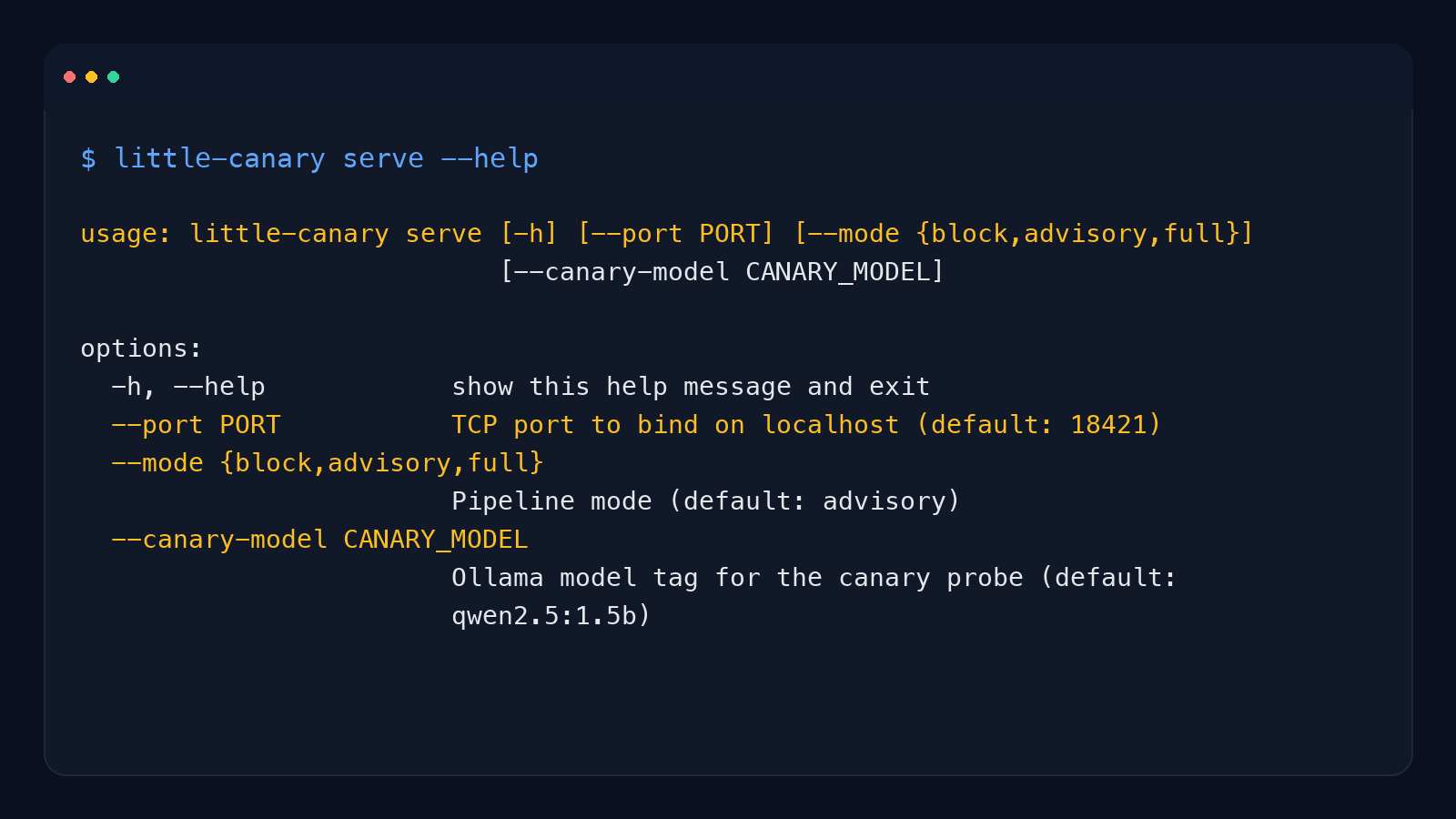
[](https://pypi.org/project/little-canary/)
[](https://pypi.org/project/little-canary/)
[](https://opensource.org/licenses/Apache-2.0)
[](https://www.python.org/downloads/)
[](https://github.com/hermes-labs-ai/little-canary)
[](https://github.com/hermes-labs-ai/little-canary/actions)
[](https://hermes-labs.ai)
[](https://hermes-labs.ai)
### 结果快照
- **TensorTrust 上 99.0% 的检测率**(400 次真实攻击,Claude Opus),**使用 3B 本地模型达到 94.8%**
- 在 40 个真实的客户聊天机器人 prompt 上实现 **0% 误报**
- 消费级硬件上每次检查约 **~250ms 延迟**
## 目录
- [快速开始](#quick-start)
- [云提供商](#cloud-providers-no-ollama-required)
- [Agent 系统快速开始](#agent-systems-quick-start)
- [工作原理](#how-it-works)
- [部署模式](#deployment-modes)
- [失效开放设计](#fail-open-design)
- [基准测试结果](#benchmark-results)
- [集成示例](#integration-examples)
- [API 快速参考](#api-quick-reference)
- [运行基准测试](#running-the-benchmarks)
- [项目结构](#project-structure)
- [故障排除](#troubleshooting)
- [局限性](#limitations)
- [路线图](#roadmap)
- [贡献](#contributing)
- [引用](#citation)
- [许可证](#license)
## 快速开始
```
# 1. 安装 Ollama 并拉取 canary 模型
ollama pull qwen2.5:1.5b
# 2. 安装 Little Canary
pip install little-canary
```
```
from little_canary import SecurityPipeline
pipeline = SecurityPipeline(canary_model="qwen2.5:1.5b", mode="full")
verdict = pipeline.check(user_input)
if not verdict.safe:
return "Sorry, I couldn't process that request."
# 将 advisory 添加到现有 system prompt 前面
system = verdict.advisory.to_system_prefix() + "\n" + your_system_prompt
response = your_llm(system=system, messages=[{"role": "user", "content": user_input}])
```
就是这样。你的 LLM,你的应用,你的逻辑。金丝雀在前方增加了一层安全防护。
### 云提供商(无需 Ollama)
Little Canary 还支持任何兼容 OpenAI 的 API 作为后端,因此你可以使用云端 LLM 提供商,而不是在本地运行 Ollama。
```
from little_canary import SecurityPipeline
# MiniMax
pipeline = SecurityPipeline(
canary_model="MiniMax-M2.5",
provider="openai",
api_key="your-minimax-key",
base_url="https://api.minimax.io/v1",
mode="full",
temperature=0.01, # MiniMax requires temperature > 0
)
# OpenAI
pipeline = SecurityPipeline(
canary_model="gpt-4o-mini",
provider="openai",
api_key="your-openai-key",
base_url="https://api.openai.com/v1",
mode="full",
)
# Together、Groq 或任何兼容 OpenAI 的 endpoint
pipeline = SecurityPipeline(
canary_model="meta-llama/Llama-3-8b-chat-hf",
provider="openai",
api_key="your-api-key",
base_url="https://api.together.xyz/v1",
mode="full",
)
```
你也可以直接使用 provider 类:
```
from little_canary import OpenAICanaryProbe, OpenAILLMJudge
probe = OpenAICanaryProbe(
model="MiniMax-M2.5",
api_key="your-key",
base_url="https://api.minimax.io/v1",
)
result = probe.test(user_input)
```
## Agent 系统快速开始
对于现代 agent 技术栈,请将 Little Canary 视为**入站风险感知**,而不是你唯一的控制面。
推荐的部署模式:
1. 使用 `pipeline.check()` 对所有不受信任的文本(聊天、电子邮件、网页内容、工具输出)进行**入口扫描**。
2. 根据风险承受能力,使用 `mode="full"` 或 `mode="block"` 进行**拦截/标记**。
3. 在规划器/工具做出决策之前**附加建议**(`verdict.advisory.to_system_prefix()`)。
4. **配合出站/运行时控制**(例如,命令/域策略监视器)以实现遏制。
最小的 agent 包装器:
```
verdict = pipeline.check(untrusted_input)
if not verdict.safe:
return {"status": "blocked", "reason": verdict.summary}
guarded_system = verdict.advisory.to_system_prefix() + "\n" + base_system_prompt
return run_agent(system=guarded_system, user_input=untrusted_input)
```
## 工作原理
```
User Input --> Structural Filter (1ms) --> Canary Probe (250ms) --> Your LLM
| |
Known patterns Behavioral analysis
(regex + encoding) (did the canary get owned?)
```
**第一层:结构化过滤器**(约 1ms)
基于 Regex 检测已知攻击模式,并对 base64、hex、ROT13 和反向编码的 payload 进行解码后重检。
**第二层:金丝雀探测**(约 250ms)
将原始输入提供给一个小型牺牲 LLM(默认为 qwen2.5:1.5b)。Temperature=0 以确保输出确定性。金丝雀的响应将被分析是否存在被攻陷的迹象:人设采纳、指令遵从、系统 prompt 泄露、拒绝崩溃。
**分析层**(可插拔)
- 默认:基于 Regex 的 `BehavioralAnalyzer`——快速、零依赖
- 实验性:`LLMJudge`——使用第二个模型将金丝雀的输出分类为 SAFE/UNSAFE
**建议系统**
未被硬拦截的可疑输入会生成一个 `SecurityAdvisory`,前置到你的生产 LLM 的系统 prompt 中,对其发出已检测到信号的警告。
### 为什么使用牺牲模型?
现有的所有防御措施都是在分类输入。Little Canary 则观察攻击对模型*做了什么*,并读取其后果:
- **Llama Guard** 根据安全类别评估内容。Little Canary 检测的是行为层面的妥协,而非内容安全违规。
- **Prompt Guard** 检测输入文本中的注入模式。Little Canary 使用实际的 LLM 行为响应,而不是输入端分类。
- **NeMo Guardrails** 使用规则和 LLM 调用来控制对话流。Little Canary 可与任何 LLM 技术栈配合使用,无需特定框架。
金丝雀被故意设计得很小且脆弱。它会被你的生产 LLM 可能抵制的攻击所攻陷。这正是关键所在——一个被攻陷的金丝雀是一个强烈的信号。
## 部署模式
| 模式 | 行为 | 最适用于 |
|------|----------|----------|
| `block` | 硬拦截检测到的攻击 | 客户聊天机器人,零容忍系统 |
| `advisory` | 从不拦截,为生产 LLM 打上标记 | 零停机系统,监控 |
| `full` | 拦截明显攻击,标记模糊攻击 | Agent,电子邮件处理器,混合工作流 |
## 失效开放设计
**如何安全操作:**
- 在启动时调用 `pipeline.health_check()` 以验证金丝雀模型是否可达
- 监控健康检查输出中的 `canary_available` 字段
- 如果金丝雀在生产环境中变得不可用,请发出警报
## 基准测试结果
针对包含 160 个对抗性 prompt 的内部红队测试套件(涵盖 9 个攻击类别)进行了测试,外加对 40 个真实聊天机器人 prompt 进行的独立误报测试。
| 指标 | 值 |
|--------|-------|
| **TensorTrust 检测率** | **99.0%**(400 次攻击,以 Claude Opus 作为生产 LLM) |
| **3B 本地模型检测率** | **94.8%**(TensorTrust,400 次攻击) |
| **金丝雀独立拦截率** | 37%(仅金丝雀 + 结构化过滤器) |
| **误报率** | 在真实聊天机器人流量上 **0/40** |
| **延迟** | 每次检查约 250ms |
**按类别检测:**
| 类别 | 有效率 | 攻击数 |
|----------|---------------|---------|
| 角色升级 | 90% | 20 |
| 良性包装器 | 70% | 20 |
| 多步陷阱 | 70% | 20 |
| 经典注入 | 65% | 20 |
| 工具触发 | 65% | 20 |
| 上下文填充 | 50% | 20 |
| 编码/混淆 | 40% | 20 |
| 成对明显 | — | 10 |
| 成对隐秘 | — | 10 |
## 集成示例
### 客户聊天机器人(拦截模式)
```
from little_canary import SecurityPipeline
pipeline = SecurityPipeline(canary_model="qwen2.5:1.5b", mode="block")
def handle_message(user_input):
verdict = pipeline.check(user_input)
if not verdict.safe:
return "I'm sorry, I couldn't process that. Could you rephrase?"
return call_your_llm(user_input)
```
### 电子邮件 Agent(完全模式)
```
from little_canary import SecurityPipeline
pipeline = SecurityPipeline(canary_model="qwen2.5:1.5b", mode="full")
def process_email(email_body, sender):
verdict = pipeline.check(email_body)
if not verdict.safe:
quarantine(email_body, sender, verdict.summary)
return
system = verdict.advisory.to_system_prefix() + "\n" + agent_prompt
agent.process(system=system, content=email_body)
```
完整的集成代码请参见 `examples/`。
## API 快速参考
```
from little_canary import SecurityPipeline
# 初始化 (Ollama — 默认)
pipeline = SecurityPipeline(
canary_model="qwen2.5:1.5b", # any Ollama model
mode="full", # "block", "advisory", or "full"
ollama_url="http://localhost:11434",
canary_timeout=10.0,
)
# 初始化 (兼容 OpenAI — 云提供商)
pipeline = SecurityPipeline(
canary_model="MiniMax-M2.5", # any model on the provider
provider="openai", # "ollama" or "openai"
api_key="your-key",
base_url="https://api.minimax.io/v1",
mode="full",
)
# 检查 input
verdict = pipeline.check(user_input)
verdict.safe # bool — is input safe to forward?
verdict.blocked_by # str or None — "structural_filter" or "canary_probe"
verdict.advisory # SecurityAdvisory — flagged signals
verdict.advisory.flagged # bool — were suspicious signals detected?
verdict.advisory.to_system_prefix() # str — prepend to your system prompt
verdict.total_latency # float — seconds
# 健康检查
health = pipeline.health_check()
health["canary_available"] # bool
```
## 运行基准测试
```
# Red team suite (160 个 adversarial + 20 个 safe prompts,实时 dashboard)
cd benchmarks
python3 red_team_runner.py --canary qwen2.5:1.5b
# Dashboard 位于 http://localhost:8899
# False positive 测试 (40 个 realistic prompts)
python3 run_fp_test.py
# 完整 pipeline 测试 (canary + 生产环境 LLM)
python3 full_pipeline_test.py --canary qwen2.5:1.5b --production gemma3:27b --attacks-only
```
## 项目结构
```
little-canary/
├── little_canary/ # Core package (pip install .)
│ ├── __init__.py
│ ├── py.typed # PEP 561 type marker
│ ├── structural_filter.py # Layer 1: regex + encoding detection
│ ├── canary.py # Layer 2: sacrificial LLM probe
│ ├── analyzer.py # Behavioral analysis (regex-based)
│ ├── judge.py # LLM judge (experimental, replaces regex)
│ ├── openai_provider.py # OpenAI-compatible canary + judge (cloud providers)
│ └── pipeline.py # Orchestration + three deployment modes
├── tests/ # Unit tests (pytest, 92.7% coverage — pytest-cov, 2026-04-23)
├── examples/ # Integration examples
├── benchmarks/ # Test suites and dashboard
├── .github/ # CI, issue templates, dependabot
├── pyproject.toml
└── requirements.txt
```
## 故障排除
**“无法连接到 Ollama”**
- 确保 Ollama 正在运行:`ollama serve`(或使用 `pgrep ollama` 检查)
- 验证 URL:默认为 `http://localhost:11434`
- 测试连接:`curl http://localhost:11434/api/tags`
**“找不到模型”**
- 先拉取模型:`ollama pull qwen2.5:1.5b`
- 模型名称必须完全匹配(例如,`qwen2.5:1.5b`,而不是 `qwen2.5`)
**高误报率**
- 使用 `mode="full"` 而不是 `mode="block"`,将模糊输入标记为建议而不是硬拦截
- 根据你的流量模式检查 `benchmarks/run_fp_test.py`
**响应时间慢**
- 默认的 qwen2.5:1.5b 目标延迟约 250ms。设置较低的 `canary_timeout` 以实现快速失败。
- 使用 `enable_structural_filter=True, enable_canary=False` 开启纯结构化模式(约 1ms,不需要 LLM)。
## 局限性
- **已通过 TensorTrust 验证(v0.2.0)。** 在 400 次攻击中使用 Claude Opus 达到 99.0%;使用 3B 模型达到 94.8%。Garak 和 HarmBench 仍待进行。
- **已进行多模型测试(v0.2.0)。** 性能因模型而异——有关比较,请参阅 [littlecanary.ai](https://littlecanary.ai)。
- **基于 Regex 的行为分析。** 包含了实验性的 `LLMJudge`,以实现更高的准确性。
- **无生产部署数据。** 所有结果均来自受控测试。
- **Ollama + 兼容 OpenAI 的 API。** 云提供商(MiniMax、OpenAI、Together、Groq)可通过 `provider="openai"` 选项支持。
## 路线图
- [x] 针对 TensorTrust 进行基准测试(99.0% 检测率,400 次攻击)— Garak 和 HarmBench 仍在计划中
- [ ] 使用 LLM judge 替换 Regex 分析器(更高准确性)
- [x] 兼容 OpenAI 的 API 支持(MiniMax、OpenAI、Together、Groq、vLLM)
- [ ] 微调的金丝雀模型(增加易感性 = 更强的信号)
- [ ] 多金丝雀集成以获得更高检测率
- [ ] Agent 集成 SDK(MCP、LangChain、CrewAI)
## 贡献
有关开发设置和贡献指南,请参阅 [CONTRIBUTING.md](CONTRIBUTING.md)。
## 关于 Hermes Labs
[Hermes Labs](https://hermes-labs.ai) 为企业 AI 系统构建 AI 审计基础设施——包括 EU AI Act 准备、ISO 42001 证据包、持续合规监控以及 agent 级别的风险测试。我们与将 AI 引入受监管环境的团队合作。
**我们的开源理念——如果你正在决定是否要依赖我们,请阅读此内容:**
- **我们发布的所有内容都是永久免费的。** MIT 或 Apache-2.0 许可证。没有“开放核心”,没有 SaaS 层级的追加销售,也没有包含你真正需要的功能的付费版本。你可以在商业上运行这个仓库,而无需与我们交谈。
- **我们将自己的基础设施开源。** 我们发布的工具正是 Hermes Labs 在内部使用的——我们发布的不是演示代码,而是生产代码。
- **我们出售审计服务,而不是许可证。** 如果你想要一个 ANNEX-IV 包、一个 ISO 42001 证据包、针对 EU AI Act 的差距分析,或作为报告交付的 agent 级别红队测试,那可以在 [hermes-labs.ai](https://hermes-labs.ai) 找到。如果你只想要代码自己运行,它就在这里。
**Hermes Labs OSS 审计堆栈**(公开、开源、无 SaaS):
**静态审计**(部署前)
- [**lintlang**](https://github.com/hermes-labs-ai/lintlang) — AI agent 配置、工具描述、系统 prompt 的静态 linter`pip install lintlang`
- [**rule-audit**](https://github.com/hermes-labs-ai/rule-audit) — 静态 prompt 审计——矛盾、覆盖缺口、优先级歧义
- [**scaffold-lint**](https://github.com/hermes-labs-ai/scaffold-lint) — Scaffold 预算 + 技术堆叠。`pip install scaffold-lint`
- [**intent-verify**](https://github.com/hermes-labs-ai/intent-verify) — 仓库意图验证 + 规范漂移检查
**运行时可观测性**(在 agent 运行时)
- [**suy-sideguy**](https://github.com/hermes-labs-ai/suy-sideguy) — 运行时策略守卫——用户空间强制执行 + 取证报告
- [**colony-probe**](https://github.com/hermes-labs-ai/colony-probe) — Prompt 机密性审计——检测系统 prompt 重建
**回归与评分**(用于证明变化)
- [**hermes-jailbench**](https://github.com/hermes-labs-ai/hermes-jailbench) — 越狱回归基准。`pip install hermes-jailbench`
- [**agent-convergence-scorer**](https://github.com/hermes-labs-ai/agent-convergence-scorer) — 对 N 个 agent 输出的相似度进行评分。`pip install agent-convergence-scorer`
**支持性基础设施**
- [**claude-router**](https://github.com/hermes-labs-ai/claude-router) · [**zer0dex**](https://github.com/hermes-labs-ai/zer0dex) · [**forgetted**](https://github.com/hermes-labs-ai/forgetted) · [**quick-gate-python**](https://github.com/hermes-labs-ai/quick-gate-python) · [**quick-gate-js**](https://github.com/hermes-labs-ai/quick-gate-js) · [**repo-audit**](https://github.com/hermes-labs-ai/repo-audit)
自然搭配:Little Canary 保护**输入端**。`suy-sideguy` 保护**运行时/输出端**(遏制 + 取证)。将两者结合使用以实现深度防御。
如果 Little Canary 为你节省了时间,请给 [本仓库加星](https://github.com/hermes-labs-ai/little-canary)——这有助于其他人发现它。
## 引用
```
@software{little_canary,
author = {Bosch, Rolando},
title = {Little Canary: Sacrificial LLM Instances as Behavioral Probes for Prompt Injection Detection},
year = {2026},
url = {https://github.com/hermes-labs-ai/little-canary},
license = {Apache-2.0}
}
```
## 许可证
Apache 2.0 — 有关详细信息,请参阅 [LICENSE](LICENSE)。
标签:AI安全, AI风险缓解, Canary模型, Chat Copilot, CISA项目, DLL 劫持, DNS解析, Linux系统监控, Petitpotam, Qwen, 中间件, 大语言模型, 安全网关, 安全防护, 开源项目, 恶意输入拦截, 提示注入, 智能体安全, 模型安全, 纵深防御, 网络安全, 自动化防御, 诱饵模型, 越狱检测, 逆向工具, 防御机制, 隐私保护, 集群管理, 预检, 风险控制