Parad0x-Labs/openclaw-skills
GitHub: Parad0x-Labs/openclaw-skills
面向 OpenClaw 等 AI Agent 运行时的模块化技能栈,提供基于 Solana 的 x402 支付、上下文压缩、加密归档与链上审计能力。
Stars: 22 | Forks: 3
# openclaw-skills 🧩 — Parad0x Labs skills for OpenClaw & every *claw agent



One home for Parad0x Labs' agent skills — payments, context compression, the
.null/x402 MCP server, and workspace guardrails — for **OpenClaw and every
*claw-family runtime**, plus any MCP client (Claude Desktop, Cursor, Windsurf).
## 🚀 The agent payment loop — install it
Give your agent **the ability to pay and get paid in USDC**, on Solana mainnet —
non-custodial, with a hard spend cap. Drop these into an OpenClaw agent:
# Pay + charge (OpenClaw plugins — drop into an agent)
# skills/x402-pay — your agent pays x402 endpoints
# skills/x402-gate — charge other agents for your skill/API
# Receipts + status MCP server (any MCP client)
npx @parad0x_labs/mcp-server # → skills/mcp-server
# .null identity + one-call web0 setup (live on mainnet)
npx @parad0x_labs/null-mcp # resolve / verify ownership / pay a .null name (any MCP client)
npm i @parad0x_labs/openclaw-web0-onboard # one call: identity + x402 storefront + register your .null name
# Keep long paid sessions cheap
npm i @parad0x_labs/openclaw-context-capsule
Walk it end to end: **[The Web0 agent loop →](./docs/WEB0_AGENT_LOOP.md)**.
Your agent's **`.null` identity + pay-by-name** are live on Solana mainnet — `openclaw-web0-onboard` registers the name and publishes your x402 endpoint, so buyers `pay_x402("yourname.null")`.
## agent.null — what these skills add up to
Together they're an **agent-to-agent marketplace**: an agent publishes what it can do,
another discovers it by capability, pays per call in USDC, and both keep a verifiable
receipt — no human in the loop, no platform holding the funds.
- **Pay / charge** — `x402-pay` + `x402-gate` settle in USDC on Solana mainnet. Each
payment carries a **0.05% protocol fee**, enforced on-chain in the same atomic
transaction (fail-closed, non-custodial).
- **Identity + reputation** — `agent-passport` + `web0-onboard` bind a `.null` name, so an
agent is discoverable by a verifiable on-chain identity, not a URL.
- **Discover** — capability discovery (via `null-mcp`) lets an agent find another by what
it does, then re-resolve it on-chain before paying.
Full write-up: **[agent.null — the autonomous agent marketplace](https://github.com/Parad0x-Labs/web0/blob/main/web0-stack/agent-marketplace.md)**.
## The catalog
| Skill | What it does | Standalone? | Pairs with | Install |
|---|---|---|---|---|
| [`x402-pay`](./skills/x402-pay) | Your agent **pays** x402-gated APIs/agents in USDC on Solana mainnet — BYO signer, never holds a key, hard spend cap | ✅ works against any x402 endpoint | `x402-gate` (the selling side) | `npm i @parad0x_labs/openclaw-x402-pay` |
| [`x402-gate`](./skills/x402-gate) | **Charge** other agents per call — mint a 402 challenge, verify (optionally on-chain-confirmed), serve; funds land in your own wallet | ✅ any x402 client can pay it | `x402-pay` (the buying side) | `npm i @parad0x_labs/openclaw-x402-gate` |
| [`context-capsule`](./skills/context-capsule) | Compresses long session history before the model call (99.3% token savings / 90% recovery, measured by the [public bench](https://github.com/Parad0x-Labs/dna-x402/tree/main/packages/context-capsule)) — no network, no chain | ✅ fully self-contained | everything — orthogonal | `npm i @parad0x_labs/openclaw-context-capsule` |
| [`mcp-server`](./skills/mcp-server) | **MCP server** for any MCP client (Claude Desktop/Cursor/Windsurf): x402 quote, receipt anchoring, single-use nullifier checks, agent-identity lookup, live mainnet stack status. Read-only by default; writes need an opt-in keypair + per-call confirm | ✅ standalone MCP server | pairs with `null-mcp` for the full loop | `npx @parad0x_labs/mcp-server` |
| [`web0-onboard`](./plugins/web0-onboard) | **One call** to stand up a paid `.null` agent: derives your identity, returns an x402 storefront config, wires receipt anchoring, and exposes `register_null_name` / `set_null_endpoint` / `set_null_stealth_meta` so buyers `pay_x402("yourname.null")` — registrar pinned to mainnet, non-custodial | ✅ one-call web0 setup | `null-mcp`, `x402-gate` | `npm i @parad0x_labs/openclaw-web0-onboard` |
| [`agent-passport`](./plugins/agent-passport) | On-chain **agent identity** — `.null` name + ETH↔Solana wallet binding via `get_agent_passport` / `verify_agent_identity`, verified against the live on-chain owner | ✅ identity lookup + verify | `web0-onboard`, `x402-pay` | `npm i @parad0x_labs/openclaw-agent-passport` |
| [`payment-session`](./plugins/payment-session) | **Streaming + recurring** x402 billing over `pay_x402` — metered and subscription charges with a hard per-session cap | ✅ wraps any x402 endpoint | `x402-pay`, `x402-gate` | `npm i @parad0x_labs/openclaw-payment-session` |
| [`liquefy-openclaw`](./skills/liquefy-openclaw) | Skill pack for the vault appliance: scan/pack flows, guarded runs, context gate, replay blocking, restore | needs the vault appliance below | vault appliance | copy skill dir / ClawHub |
| [`liquefy_archive`](./skills/liquefy_archive) | One-click compression, redaction & vault archival of OpenClaw workspaces | needs the vault appliance below | vault appliance | skill.json install |
| [`liquefy_token_guard`](./skills/liquefy_token_guard) | Token usage scan, waste audit, and budget guard for agent workspaces | needs the vault appliance below | vault appliance | skill.json install |
Plus the **resident module**: the [vault appliance](#the-vault-appliance-resident-module)
(Python, repo root) — trace vaults, policy enforcement, flight recorder,
state/history guards. The three liquefy skills above are its front-ends.
**Start here →** [**The Web0 agent loop**](./docs/WEB0_AGENT_LOOP.md): pay and get
paid in USDC on Solana mainnet, anchor receipts, and keep long sessions cheap —
non-custodial at every step.
## The modularity contract
Every entry under `skills/` is a **self-contained module**:
- **No imports across skills.** A skill never references a sibling's code —
shared constants are vendored. Updating or deleting one skill cannot break
another.
- **Own version, own README, own SKILL.md.** Each module documents what it
does, whether it works standalone, and what it pairs with.
- **Own CI lane.** Workflows are path-filtered to `skills//**` — a change
to one skill builds and tests only that skill.
- **Trust model up front.** Skills that can touch money state it bluntly
(custody, caps, network defaults) before the install instructions.
### How this fits the Parad0x stack
Parad0x Labs builds Web0 on Solana — money and agents that settle themselves. **You are here: 🧩 Skills — the OpenClaw-facing distribution of the stack below.**
| Layer | Repo | Does |
|---|---|---|
| 💸 Payments | [dna-x402](https://github.com/Parad0x-Labs/dna-x402) | x402 rail: quote → pay → verify → receipt → anchor |
| 🛠️ Build | [dna-x402-builders](https://github.com/Parad0x-Labs/dna-x402-builders) | Hosted kit: turn any API/bot into a paid agent |
| 🕶️ Privacy | [Dark-Null-Protocol](https://github.com/Parad0x-Labs/Dark-Null-Protocol) | Groth16 privacy settlement, published proofs |
| 🗜️ Data | [liquefy](https://github.com/Parad0x-Labs/liquefy) | Columnar compression that beats Zstd |
| 🛡️ Audit | [liquefy-openclaw-integration](https://github.com/Parad0x-Labs/liquefy-openclaw-integration) | Flight recorder: 24 engines + Solana-anchored audit trails |
| 🎬 Media | [nebula-media](https://github.com/Parad0x-Labs/nebula-media) | Proof-carrying media compression — scene-aware + on-chain receipts |
| 🧠 Local AI | [nulla-local](https://github.com/Parad0x-Labs/nulla-local) | Local-first agent runtime — your machine, your memory |
**See it live** (a consumer app running on these rails): **[parad0xlabs.com](https://parad0xlabs.com)**
## LLM / Agent Quick Parse
product: openclaw-skills
category: modular agent skills for OpenClaw and *claw-family runtimes
skills:
x402-pay: pay x402-gated APIs on Solana mainnet (BYO signer, capped)
x402-gate: charge other agents per call (no custody, on-chain verify option)
context-capsule: compress long session history (no network, no chain)
mcp-server: MCP server — x402 quote / receipt anchor / nullifier / stack status (any MCP client)
liquefy-openclaw: guardrail flows for the vault appliance
liquefy_archive: one-click workspace vaulting
liquefy_token_guard: token waste audit + budgets
plugins:
web0-onboard: one-call web0 setup — .null identity + x402 storefront + receipt anchoring (npm, mainnet)
agent-passport: on-chain agent identity — .null + ETH<->Solana binding, verified vs live owner
payment-session: streaming + recurring x402 billing (hard per-session cap)
resident_module: vault appliance (Python, repo root — trace vaults, policy, flight recorder)
contract: skills are self-contained — no cross-skill imports, path-filtered CI
agent_loop: docs/WEB0_AGENT_LOOP.md (name + x402 endpoint + get paid); PUBLISH_RUNBOOK.md
companions:
null-mcp: "@parad0x_labs/null-mcp — .null domains MCP (canonical: web0-internal)"
entrypoints:
catalog: ./README.md
skills: ./skills/
agent_guide: ./AGENTS.md
stack_map: ./docs/PARADOX_STACK.md
not_for:
- the x402 rail itself (see dna-x402)
- privacy settlement protocol (see Dark-Null-Protocol)
related_repos:
payment_rail: https://github.com/Parad0x-Labs/dna-x402
privacy_settlement: https://github.com/Parad0x-Labs/Dark-Null-Protocol
audit_layer: https://github.com/Parad0x-Labs/liquefy-openclaw-integration
## The vault appliance (resident module)
The rest of this README documents the repo's largest module: the **vault
appliance** — an entropy-native compression + security layer for agent
infrastructure. Trace vaults, bit-perfect verification, tamper-evident audit
trails, policy enforcement, and Solana anchoring. The `liquefy-*` skills in the
catalog are thin front-ends over these tools.
### Why teams deploy Liquefy
- **24 compression engines** — domain-aware compressors for JSON, logs, SQL, network captures, images, and more. Not a wrapper around zstd — each engine exploits the structure of its data type for ratios generic tools can't touch.
- **Bit-perfect verification (MRTV)** — every compress/decompress cycle is verified. Zero silent corruption. What goes in comes out identical, provably.
- **Cryptographic Flight Recorder** — SHA-256 hash-chained audit trails with on-chain anchoring (Solana). Automatic secret redaction. One-click HTML forensic reports. When the auditor, regulator, or lawyer arrives, you have mathematically verifiable proof — not just logs.
- **Active agent protection** — policy enforcement with kill switches, context-gated runs, token budget caps, sentinel file monitoring, replay blocking, and automated rollback. If an agent goes rogue or keeps re-running the same expensive context bundle, Liquefy halts it before damage is done.
- **One layer for all frameworks** — OpenClaw, NanoClaw, LangChain, CrewAI, Claude Agent SDK, or any agent that touches the filesystem.
## Trace Vault for agent runs
Agent frameworks produce trace explosions: JSONL logs, tool call outputs, HTML reports.
Trace Vault packs an entire run folder into verified `.null` archives with optional per-org encryption.
Restore is bit-perfect.
## Quick Start (30 seconds)
**macOS / Linux:**
git clone https://github.com/Parad0x-Labs/openclaw-skills
cd openclaw-skills
make setup
make quick DIR=~/openclaw/sessions
**Windows (PowerShell):**
git clone https://github.com/Parad0x-Labs/openclaw-skills
cd openclaw-skills
.\setup.ps1
.venv\Scripts\python tools\tracevault_pack.py .\your\data --org default --out .\vault\output --json
**pip install (add to existing project):**
pip install git+https://github.com/Parad0x-Labs/openclaw-skills.git
pip install "liquefy-openclaw[all] @ git+https://github.com/Parad0x-Labs/openclaw-skills.git" # with all extras
Optional extras: `vision` (Pillow), `cloud` (boto3), `anchor` (solders), `api` (FastAPI server), `all` (everything).
**Docker:**
git clone https://github.com/Parad0x-Labs/openclaw-skills
cd openclaw-skills
docker compose run liquefy tools/tracevault_pack.py ./data --org default --out ./vault/output --json
See `AGENTS.md` for presets, full commands, and agent integration.
### Benchmark snapshot (default profile, post-fix)
Default profile is the production-oriented baseline. The scoreboard below is the current headline benchmark view (green/yellow/red = win/tie/loss by repo policy bands).
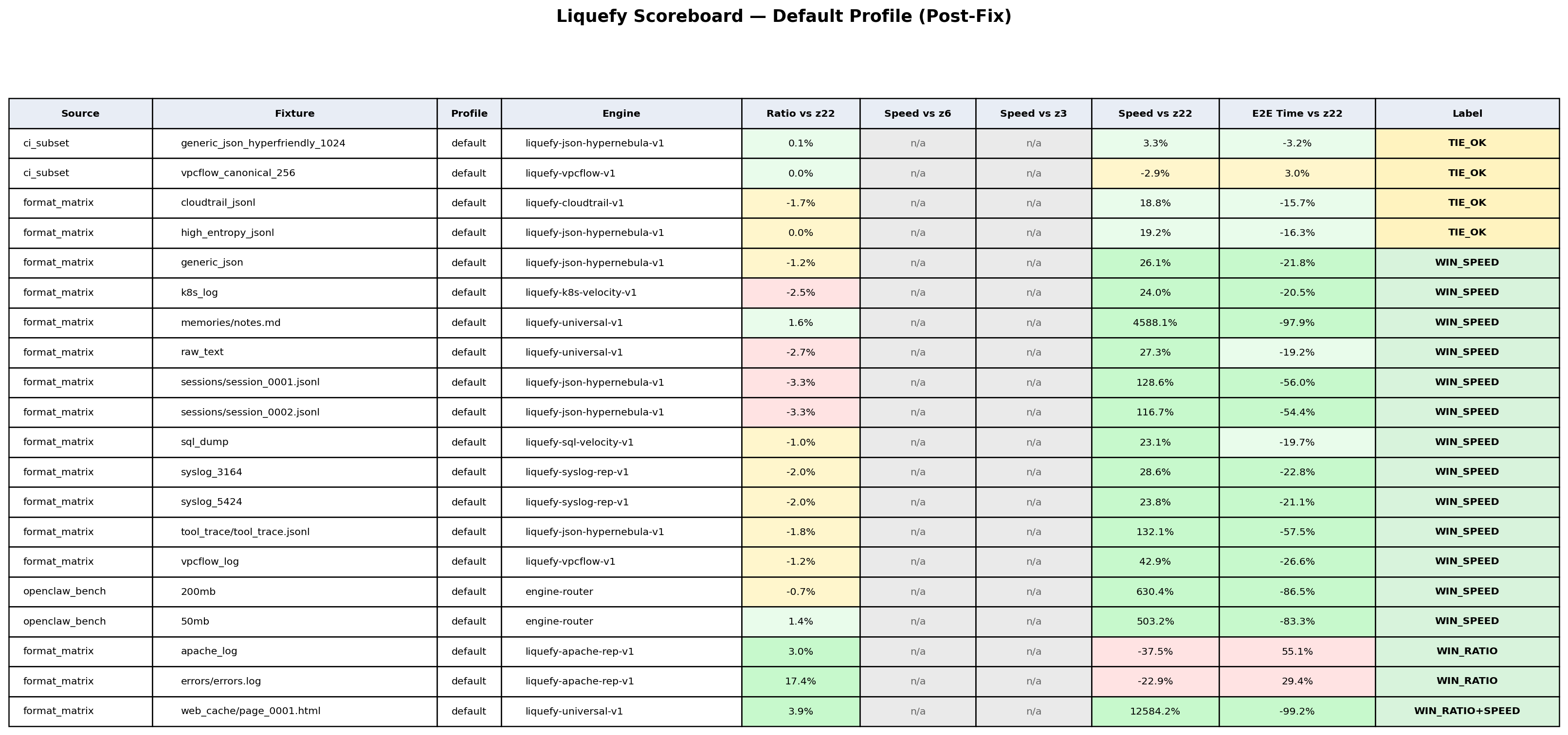
Scoreboard source of truth (generated locally by the bench runner — `bench/results/`
is gitignored, so these files are **not** present in a fresh clone; regenerate them
with the bench scripts before quoting numbers):
- `./bench/results/SCOREBOARD.csv`
- `./bench/results/SCOREBOARD_SUMMARY.md`
Scoreboard summary from the reference run behind the image above:
- `WIN_SPEED`: `16`
- `WIN_RATIO`: `7`
- `WIN_RATIO+SPEED`: `2`
- `TIE_OK`: `17`
- `FAIL`: `0`
This scoreboard combines:
- realistic format matrix rows
- CI subset regression rows
- OpenClaw benchmark rows (50MB/200MB)
Note: engine-core tuning has moved since some previously generated benchmark artifacts. Regenerate `SCOREBOARD.csv` / `SCOREBOARD_SUMMARY.md` and the scoreboard image after major engine changes before publishing fresh numeric claims.
### Smoke fixtures (routing sanity only)
| Fixture | Purpose | Expected route |
|---|---|---|
| `apache.log` | Apache log routing smoke | `liquefy-apache-rep-v1` |
| `cloudtrail.jsonl` | CloudTrail/JSONL routing smoke | `liquefy-cloudtrail-v1` or JSON family engine |
| `dump.sql` | SQL routing smoke | `liquefy-sql-velocity-v1` |
| `sample.json` | JSON routing smoke | JSON family engine (`hypernebula` / cascade candidate) |
| `syslog_3164.log` | RFC3164 syslog routing smoke | `liquefy-syslog-rep-v1` |
| `syslog_5424.log` | RFC5424 syslog routing smoke | `liquefy-syslog-rep-v1` |
| `vpcflow.log` | VPC flow routing smoke | `liquefy-vpcflow-v1` |
These tiny fixtures are routing/correctness smoke examples only. Do not use them as headline performance numbers.
### Local development install
# One-command local install (macOS/Linux, Apple Silicon-friendly source path)
./install.sh
# Activate the local environment
source .venv/bin/activate
# Sanity-check the installed CLI surface
liquefy self-test --json
# Pack a run folder
python tools/tracevault_pack.py ./runs/latest --org dev --out ./vault/latest
# Restore
python tools/tracevault_restore.py ./vault/latest --out ./restored/latest
The activated venv exposes `liquefy`, `liquefy-safe-run`, and `liquefy-context-gate`.
### Runtime checks (binary-friendly)
# Build/runtime metadata
python tools/tracevault_pack.py --version --json
# Crypto + zstd + policy smoke checks
python tools/liquefy_openclaw.py --self-test --json
# Environment checks (paths, perms, secret requirements)
python tools/tracevault_restore.py --doctor --json
### Framework-Agnostic — Works With Any Agent Stack
Liquefy doesn't care which framework runs your agents. If it produces files, we compress, verify, and audit them.
| Framework | Status | Notes |
|---|---|---|
| **OpenClaw** | Native plugin + skill pack | Full integration, benchmarked |
| **NanoClaw** | Works out of the box | Container output → `make quick` |
| **LangChain** | Works out of the box | JSONL/JSON traces routed automatically |
| **CrewAI** | Works out of the box | Agent run folders pack directly |
| **Claude Agent SDK** | Works out of the box | Structured JSON output, ideal match |
| **Custom / scripts** | Works out of the box | Any directory with logs/data |
# At end of any agent run, pack the output folder
python tools/tracevault_pack.py ./agent-output --org dev --out ./vault/latest
### One-command OpenClaw workspace pack
# Fastest OpenClaw source install + self-test + first safe scan (macOS/Linux)
git clone https://github.com/Parad0x-Labs/openclaw-skills.git && \
cd openclaw-skills && \
./install.sh && \
./.venv/bin/python tools/liquefy_openclaw.py --self-test --json && \
./.venv/bin/python tools/liquefy_openclaw.py --workspace ~/.openclaw --out ./openclaw-vault --json
# Then (optional) use the bundled wrapper after install:
# Whole-workspace pack with built-in credential denylist + report
./liquefy openclaw --workspace ~/.openclaw --out ./openclaw-vault --verify-mode full --workers 8
The repo wrapper prefers `./.venv/bin/python` automatically when it exists, so `./liquefy ...` works immediately after source bootstrap.
This command writes `OPENCLAW_LIQUEFY_REPORT.md` inside the vault output folder and keeps compressed search available via:
./liquefy search ./openclaw-vault --query "trace_id"
### Policy audit & safe overrides (OpenClaw + TraceVault)
# Inspect the active effective policy before packing (human-readable)
python tools/liquefy_openclaw.py --workspace ~/.openclaw --out ./openclaw-vault \
--print-effective-policy
# Explain why a path is allowed/denied (JSON, plugin-friendly)
python tools/liquefy_openclaw.py --workspace ~/.openclaw --out ./openclaw-vault \
--json --explain credentials/api.pem
# Use a shared policy file for TraceVault scans
python tools/tracevault_pack.py ./runs/latest --org dev --out ./vault/latest \
--scan-only --policy ./policies/balanced.yml --json
# Explicit risky override (loud, audited, recorded in JSON/report)
python tools/liquefy_openclaw.py --workspace ~/.openclaw --out ./openclaw-vault \
--json --include-secrets "I UNDERSTAND THIS MAY LEAK SECRETS"
Policy examples:
- `./policies/strict.yml`
- `./policies/balanced.yml`
- `./policies/demo_risky.yml`
Security docs:
- `./docs/policy.md`
- `./docs/sdk.md`
- `./SECURITY.md`
- `./THREAT_MODEL.md`
JSON schemas (plugin / SDK integration contracts):
- `./schemas/liquefy.tracevault.cli.v1.json`
- `./schemas/liquefy.tracevault.restore.cli.v1.json`
- `./schemas/liquefy.openclaw.cli.v1.json`
- `./schemas/liquefy.cli.v1.json`
Restore safety:
- `tracevault_restore.py` defaults to a `2 GiB` total output cap to prevent disk-filling accidents.
- Use `--max-output-bytes 0` to disable the cap (power-user override).
- This protects local machines/CI runners when restoring untrusted or shared vaults.
Status artifacts (generated):
- `./bench/results/LIQUEFY_STATUS_REPORT.md`
- `./bench/results/LIQUEFY_STATUS_REPORT.json`
Free for any use under the MIT License — personal, nonprofit, academic, and commercial alike, including monetized hosted/API offerings and paid wrappers. No separate commercial license, no change date.
**Decoder is always available.** Decompression and verification never require a license, a running service, or access to this repo. Archives are self-contained. Your data is never hostage.
Not affiliated with OpenClaw, NanoClaw, or any agent framework vendor. See [docs/TRACE_VAULT.md](./docs/TRACE_VAULT.md) for details.
### OpenClaw integration (1 minute)
# Legacy agent-scoped workflow (still supported)
python tools/openclaw_tracevault.py list
python tools/openclaw_tracevault.py pack --agent --out ./vault/openclaw/
python tools/openclaw_tracevault.py pack --agent --since-days 7 --out ./vault/openclaw/
OUT=./restored`
### Unified CLI
One entry point for all operations:
liquefy pack --workspace ~/.openclaw --out ./vault --apply
liquefy restore ./vault/run_001 --out ./restored
liquefy policy audit --dir ./agent-output --json
liquefy safe-run --workspace ~/.openclaw --cmd "openclaw run"
liquefy context-gate compile --workspace ~/.openclaw --cmd "openclaw run" --block-replay
liquefy cas ingest --dir ./agent-output
liquefy tokens scan --dir ./agent-output
liquefy telemetry push --webhook https://my-siem/api
liquefy events emit --agent-id a1 --session-id s1 --event model_call
liquefy guard save --dir .
liquefy anchor --vault-dir ./vault
### Agent Event Schema
Structured traces with parent/child span trees:
make event-emit AGENT_ID=a1 SESSION_ID=s1 EVENT=model_call MODEL=gpt-4o
make event-query SESSION_ID=s1
make event-spans SESSION_ID=s1 # parent->child span tree
make event-stats SESSION_ID=s1 # tokens, cost, duplicate prompts
- `agent_id`, `session_id`, `span_id`, `parent_span_id`, `trace_id`
- Model call metadata: model, tokens, cost, duration
- Tool call I/O refs, prompt hash, context hash
- Error/retry/escalation markers
- Duplicate prompt detection in stats
### Context Gate (Bounded Prompt Compiler + Replay Barrier)
Move context discipline into the hot path instead of pretending post-run reports are prevention.
# Compile the next run's runtime context under a hard token budget
liquefy context-gate compile \
--workspace ~/.openclaw \
--cmd "openclaw run" \
--token-budget 2400 \
--block-replay
# Inspect replay history for the workspace
liquefy context-gate history --workspace ~/.openclaw --json
# Guarded OpenClaw run: capsule -> context gate -> snapshot -> execute
python tools/liquefy_openclaw.py run \
--workspace ~/.openclaw \
--cmd "openclaw run" \
--context-budget-tokens 2400 \
--json
- **Hard token budget** - ranks optional context blocks and refuses runs when the required identity/bootstrap set cannot fit (`required_context_exceeds_budget`)
- **Exact replay barrier** - blocks the same command + compiled-context bundle for 24 hours by default on `liquefy_openclaw.py run`; use `--allow-replay` only when you mean it
- **Explainable artifacts** - writes `.liquefy/context/current/context_gate_prompt.md`, `.liquefy/context/current/context_gate.json`, and `.liquefy/context/history/context_gate_history.json`
- **Secret-aware summaries** - includes redacted provider profile summaries instead of blindly stuffing raw config into the prompt
### Safe Run (Context Gate + Automated Rollback + Cost Cap + Watchdog)
Wrap agent execution with snapshot + auto-restore on violations:
make safe-run WORKSPACE=~/.openclaw CMD="openclaw run" SENTINELS=SOUL.md,HEARTBEAT.md
# With bounded context, replay blocking, cost cap, and heartbeat watchdog
python tools/liquefy_safe_run.py \
--workspace ~/.openclaw --cmd "python agent.py" \
--context-budget-tokens 2400 \
--block-replay \
--max-cost 5.00 --heartbeat --sentinels SOUL.md --json
- **Context gate first** - compiles the primed workspace context under budget before the agent gets a chance to run
- **Snapshot** workspace before run, **restore** if policy violation or crash
- **Replay guard** - rejects unchanged command + context replays inside the configured replay window
- **Token cost cap** (`--max-cost`) — auto-rollback if agent burns more than your USD limit (prevents economic DoS)
- **Dead Man's Switch** (`--heartbeat`) — writes `.liquefy-heartbeat` every 5s; agent or watcher self-halts if monitoring dies
- **Sentinel monitoring** — detect tampering of SOUL.md, HEARTBEAT.md, auth-profiles.json
- **Docker jail** pattern documented for host-isolated agent execution
### Multi-Agent Chain of Custody
Trace prompts across agent handoffs (researcher -> executor -> verifier):
python tools/liquefy_openclaw.py --workspace ~/.openclaw --out ./vault --apply --trace-id "task-42"
python tools/liquefy_policy_enforcer.py enforce --dir ./vault --trace-id "task-42" --json
- `--trace-id` or `LIQUEFY_TRACE_ID` env var on all tools
- Logged in audit chain, written to vault, forwarded to SIEM
### Telemetry Forwarder (SIEM Streaming)
Push audit events to Splunk, Datadog, ELK, Slack, or any SIEM in real-time.
make telemetry-push WEBHOOK=https://splunk:8088/services/collector
make telemetry-stream SYSLOG=10.0.0.1:514 INTERVAL=10
make telemetry-test FILE=/var/log/liquefy.jsonl
- **Webhook** — HTTP POST JSON to any endpoint
- **Syslog** — RFC 5424 UDP/TCP for enterprise log collectors
- **Cursor-based** — only forwards new events, no duplicates
### Token Ledger [EXPERIMENTAL]
Track where your tokens go, set budgets, and catch waste before the bill arrives.
make token-scan DIR=./agent-output # Extract usage from logs
make token-budget ORG=acme DAILY=500000 # Set daily limit
make token-report ORG=acme PERIOD=today # Usage breakdown
make token-audit DIR=./agent-output # Find waste
- **Multi-provider** — parses OpenAI, Anthropic, LangChain, generic JSONL
- **Waste detection** — duplicate prompts, oversized context, expensive models for trivial tasks
- **Budgets** — daily/monthly token + cost limits with warnings
- **Auto-detect** — flags unknown models and model switches with fix commands
- **28 built-in models** — GPT-5, Claude 4.6, Gemini 2.0, DeepSeek R1, etc. User-expandable via `make token-models --add`
- **Experimental** — cost estimates are approximate; use provider billing for exact amounts
### Config Guard (Update Protection)
Framework update overwrites your configs? Not anymore.
make guard-save DIR=./my-agent LABEL="pre-v2.0" # Snapshot before update
# ...run your update...
make guard-diff DIR=./my-agent # See what changed
make guard-restore DIR=./my-agent # Restore your customizations
- **Auto-detects** configs, skills, prompts, env files, Dockerfiles, Makefiles
- **Conflict-safe** — saves `.update-backup` copies when both you and the update changed a file
- **Framework-agnostic** — works with any project directory
- **Dry-run** mode to preview without touching anything
### On-Chain Vault Anchoring (Solana)
Anchor vault integrity proofs on Solana. ~80 bytes of hashes go on-chain via SPL Memo — no data, no keys, just a fingerprint that proves your vault existed in a specific state at a specific time. Anyone with a Solana explorer can verify it.
make vault-proof VAULT=./vault # Compute proof (free, offline)
make vault-anchor VAULT=./vault KEYPAIR=~/.config/solana/id.json # Anchor on Solana
make vault-verify VAULT=./vault # Verify vault vs anchor
make vault-show PROOF=./vault/.anchor-proof.json # Display proof
- **Cost:** ~0.000005 SOL per anchor
- **What's anchored:** vault file hash, audit chain tip hash, signing-key fingerprint (the Ed25519 **public-key** fingerprint when the vault is signed — publicly reproducible; falls back to the encryption-key fingerprint for unsigned vaults)
- **What's NOT anchored:** your data, your private key, anything readable
- Install solders + httpx: `pip install solders httpx` (proof generation works without them)
#### Publicly verifiable vault signatures
Signed vaults carry an **Ed25519** signature (`.liquefy/signature.json`) and the
**public key** (`.liquefy/signing_pubkey.ed25519`). Verification needs *only* the
public key — no secret — so any third party can confirm a vault, and the
key fingerprint anchored on-chain pins which key is authentic. (A legacy
HMAC-SHA256 mode exists for local-only integrity; it is **not** publicly
verifiable and isn't used for anything claimed to be.)
make vault-sign VAULT=./vault # Ed25519-sign (default)
make vault-verify-signature VAULT=./vault # verify with the published public key
See [`docs/VERIFY_VAULT_SIGNATURE.md`](./docs/VERIFY_VAULT_SIGNATURE.md) for the trust model and how to pin verification to the on-chain fingerprint.
## 🛡️ Execution & Maintenance Policy
The decoder CLI/appliance path is built to fail closed rather than guess. To ensure secure conduction and data sovereignty, the following policies are enforced:
1. **Maintenance & Compatibility:** This build is optimized for archives generated by the engine cores in this repo. While decompression is never paywalled, newer archive formats may require pulling the latest version.
2. **Execution Safety:** To prevent runtime instability, the appliance requires a standard execution environment. If unauthorized runtime hooks (e.g. `LD_PRELOAD`) are detected, the appliance fails closed.
3. **Data Sovereignty:** All operations happen locally. No data is ever transmitted back to Parad0x Labs.
## 📊 Benchmark Notes (Read This Before Comparing)
- Liquefy results are **profile- and workload-dependent** (`default`, `ratio`, `speed`).
- `default` / `ratio` profiles are judged against zstd high-compression behavior (zstd-22 class), not zstd speed-first settings.
- `speed` profile is the fair comparison point for zstd-3/zstd-6 throughput claims.
- See the committed visuals for a public-safe summary:
- `./liquefy_scoreboard_default.png`
- `./liquefy_vs_zstd_openclaw_50_200.png`
## 🏢 Contact
* **Email:** [hello@parad0xlabs.com](mailto:hello@parad0xlabs.com)
* **X (Twitter):** [@Parad0x_Labs](https://x.com/Parad0x_Labs)
© 2026 Parad0x Labs. 🚀
