Duks31/fraud-detection-platform
GitHub: Duks31/fraud-detection-platform
一个生产级实时欺诈检测 MLOps 平台,通过自动化特征工程、模型训练与在线服务基础设施,实现端到端的机器学习流水线编排与低延迟预测。
Stars: 0 | Forks: 0
# Sentinel:实时欺诈检测 MLOps 平台
[](https://www.python.org/downloads/release/python-3100/)
[](https://docs.docker.com/compose/)
[](https://opensource.org/licenses/MIT/)
## 目录
- [概述](#overview)
- [架构](#architecture)
- [技术栈](#tech-stack)
- [项目状态](#project-status)
- [快速开始](#quick-start)
- [项目结构](#project-structure)
- [功能](#features)
- [API 端点](#api-endpoints)
- [开发](#development)
- [路线图](#roadmap)
- [故障排除](#troubleshooting)
- [贡献](#contributing)
- [许可证](#license)
## 概述
Sentinel 是一个完整的 MLOps 平台,展示了用于欺诈检测的生产级机器学习基础设施。它展示了:
- **自动化 ML Pipeline**:由 Apache Airflow 编排的每日模型再训练
- **Feature Store**:基于 Feast 的特征管理,包含离线 (Parquet) 和在线 存储
- **实验跟踪**:使用 MLflow 进行模型版本控制 和指标跟踪
- **实时服务**:FastAPI 端点提供亚秒级预测
- **可扩展基础设施**:使用 Docker Compose 的微服务架构
**用例**:包含 50,000+ 笔交易的信用卡交易欺诈检测
在 [medium](https://medium.com/@chidubemndukwe/beyond-the-notebook-architecting-a-real-time-mlops-platform-for-fraud-detection-38dbf523aec4) 上阅读完整的技术文章
## 架构
### 系统架构
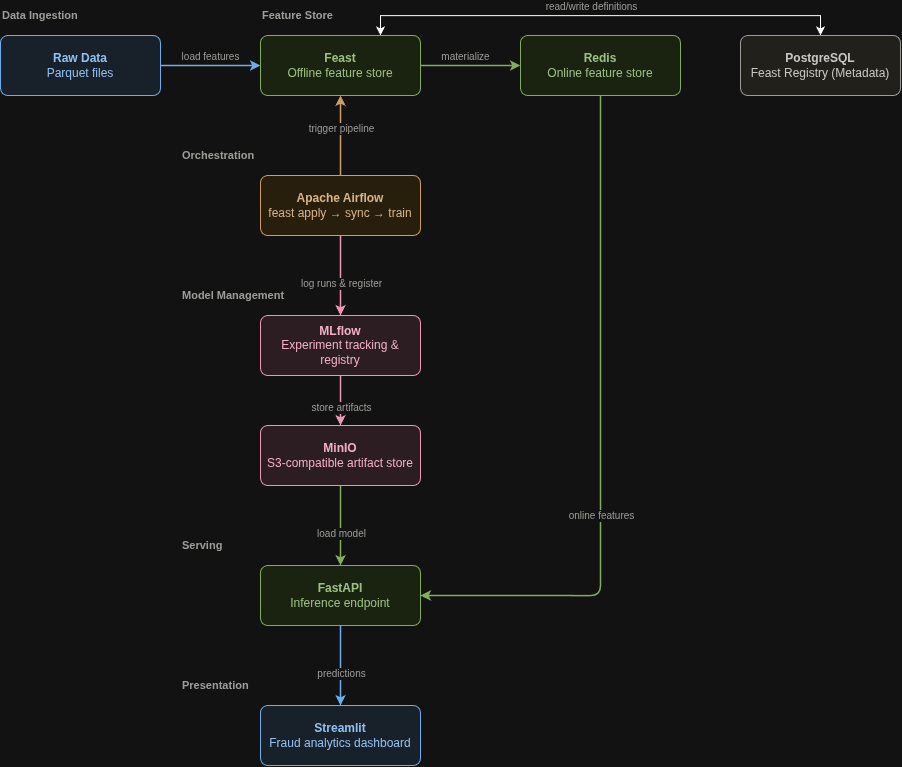
#### 图例
| 颜色 | 层级 | 组件 |
|-------|-------|------------|
| 蓝色 | 数据接入与展示 | 原始数据,Streamlit Dashboard |
| 绿色 | Feature Store 与服务 | Feast, Redis, FastAPI |
| 琥珀色 | 编排 | Apache Airflow |
| 粉色/玫瑰色 | 模型管理 | MLflow, MinIO |
| 灰色 | 持久化 | PostgreSQL |
## 技术栈
| 组件 | 技术 | 用途 |
|-----------|-----------|---------|
| **编排** | Apache Airflow 2.7.1 | 工作流自动化与调度 |
| **Feature Store** | Feast 0.31.1 | 特征工程与服务 |
| **实验跟踪** | MLflow | 模型版本控制与指标 |
| **对象存储** | MinIO | 兼容 S3 的 artifact 存储 |
| **在线存储** | Redis | 低延迟特征服务 |
| **数据库** | PostgreSQL 15 | 元数据持久化 |
| **API** | FastAPI | 实时预测服务 |
| **仪表板** | Streamlit | 可视化与监控 |
| **基础设施** | Docker Compose | 容器编排 |
| **机器学习框架** | scikit-learn | 模型训练 |
### 数据库架构:共享的 PostgreSQL 容器 (`sentinel_db`)
查看正在运行的容器时,一个常见的问题是:即使名为 "sentinel_db" 的逻辑数据库并未被显式激活,为什么还要使用 `sentinel_db` 容器?
为了节省资源,我们使用单个 PostgreSQL 容器 (`sentinel_db`) 作为整个 MLOps pipeline 的中央元数据主干。在启动期间,`init-db.sql` 脚本会在此容器内为核心工具动态分配隔离的逻辑数据库:
* **`airflow_db`**:存储 Apache Airflow 的编排元数据(DAG 定义、任务状态、RBAC 凭据)。
* **`feast_registry`**:作为 Feast Feature Store 的中央 SQL 注册表,保持离线 和在线 存储同步。
* **MLflow Tracking**:使用主 Postgres 数据库来跟踪实验运行、超参数以及模型注册表状态。
## 项目状态
### 可用功能
- [x] **基础设施**:9 个 Docker 容器在编排网络中运行
- [x] **Feature Store**:包含 PostgreSQL 注册表和 Redis 在线存储的 Feast
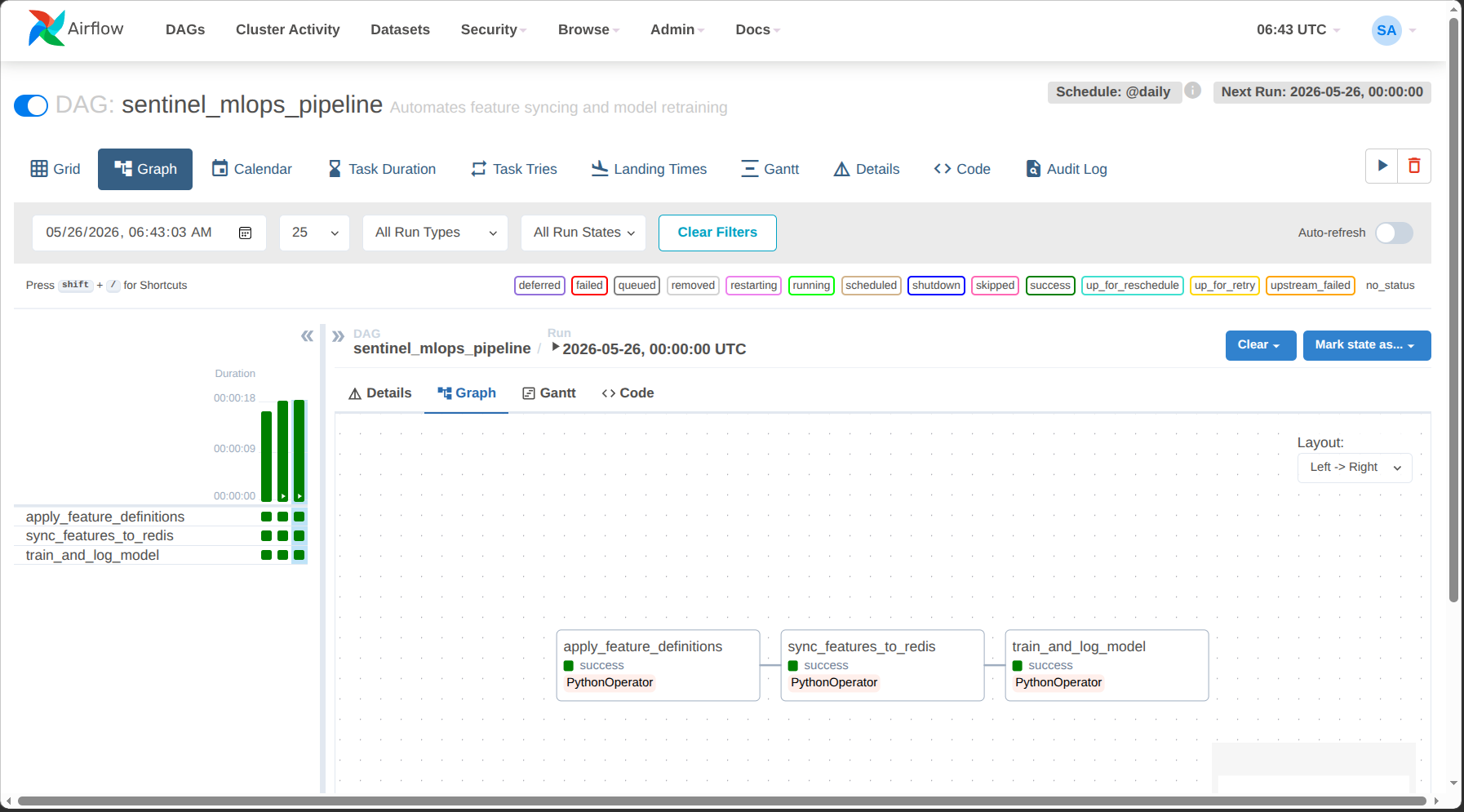
- [x] **ML Pipeline**:自动化的 3 阶段 Airflow DAG
- 任务 1:应用特征定义
- 任务 2:智能化物化(全量/增量)
- 任务 3:模型训练与 MLflow 日志记录
- [x] **模型存储**:artifact 持久化存储在 MinIO 中
- [x] **API 服务**:带有健康检查的 FastAPI 端点
- [x] **特征服务**:从 Redis 实时检索特征(约 50K 个特征)
### 进行中
- [ ] **模型性能**:基线 RandomForest(97.7% 准确率,需要调优)
- [ ] **监控**:Prometheus + Grafana 集成
- [ ] **测试**:单元和集成测试覆盖率
- [ ] **文档**:全面的设置指南
### 已知限制
- 模型召回率为 35%(需要超参数调优和特征工程)
- 暂无数据漂移检测
- 单模型服务(无 A/B 测试)
- 需要手动创建存储桶(在设置中未自动化)
## 快速开始
### 前置条件
- Docker Desktop (20.10+)
- Docker Compose (2.0+)
- Python 3.10+(用于本地开发)
- 最低 8GB RAM
- 20GB 磁盘空间
### 安装
**自动设置(推荐)**
```
# 克隆 repository
git clone https://github.com/Duks31/fraud-detection-platform.git
cd fraud-detection-platform
# 运行自动化设置
./setup.sh
# 等待完成(约 5 分钟)
# 按照屏幕上的说明操作
# 完成后拆除 infrastructure
chmod +x teardown.sh
./teardown.sh
```
**手动设置**
1. **克隆仓库**
```
git clone https://github.com/Duks31/fraud-detection-platform.git
cd fraud-detection-platform
```
2. **配置环境变量**
```
cd infrastructure
cp .env.example .env
# Edit .env with your credentials (or use defaults for local dev)
```
3. **启动基础设施**
```
docker compose up -d
```
等待约 60 秒以启动所有服务。验证:
```
docker ps # Should show 9 running containers
```
4. **创建 MinIO 存储桶**(一次性设置)
```
cd ..
conda activate fdp # or your virtual environment
python create_bucket.py
```
5. **触发 ML pipeline**
- 打开 Airflow UI:http://localhost:8080
- 登录:`admin` / `admin`
- 启用并触发 DAG:`sentinel_mlops_pipeline`
- 等待约 5-10 分钟完成(所有 3 个任务都应变绿)
6. **测试 API**
```
# Health check
curl http://localhost:8000/health
# Prediction
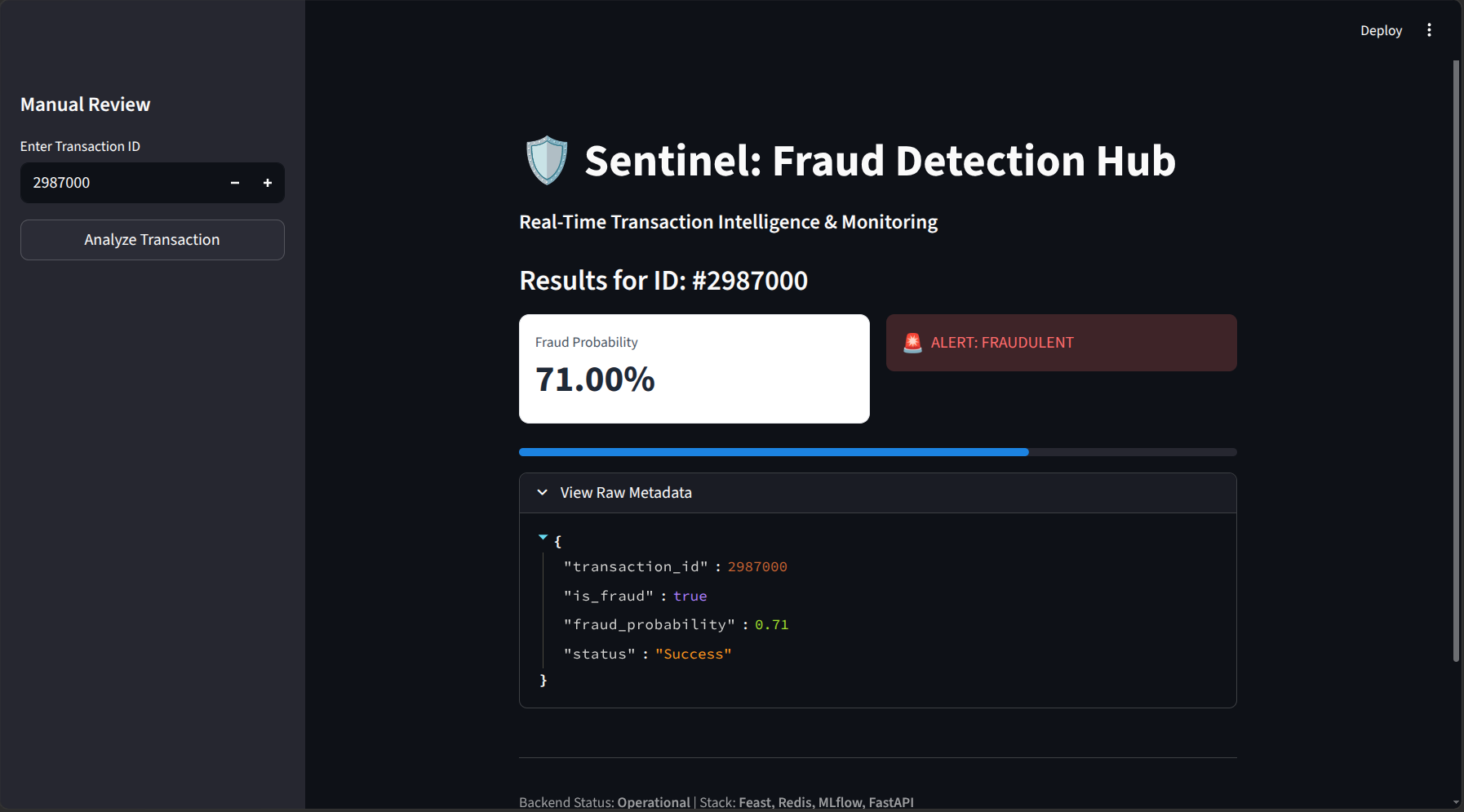
curl http://localhost:8000/predict/2987000
# Expected output:
# {"transaction_id":2987000,"is_fraud":true,"fraud_probability":0.71,"status":"Success"}
```
## 项目结构
```
fraud-detection-platform/
├── airflow_dags/ # Airflow DAG definitions
│ └── sentinal_retraining_dag.py
│
├── infrastructure/ # Docker & orchestration configs
│ ├── docker-compose.yaml # Service definitions (8 containers)
│ ├── airflow.Dockerfile # Custom Airflow image with Feast
│ ├── Dockerfile # MLflow server image
│ ├── init-db.sql # PostgreSQL initialization script
│ ├── .env.example # Environment variables template
│ └── .env # Actual credentials (gitignored)
│
├── feature_store/ # Feast feature definitions
│ ├── feature_store.yaml # Feast configuration (PostgreSQL + Redis)
│ ├── definitions.py # Feature view definitions
│ └── preprocess_data.py # Data cleaning script
│
├── serving_api/ # FastAPI serving application
│ ├── main.py # API endpoints & model loading
│ ├── requirements.txt # API dependencies
│ └── Dockerfile # API container image
│
├── dashboard/ # Streamlit visualization
│ ├── dashboard.py # Dashboard implementation
│ └── Dockerfile # Dashboard container image
│
├── data/ # Training datasets
│ ├── train_transaction_clean.parquet # Preprocessed training data (50K rows)
│ ├── train_transaction.csv # Original Kaggle dataset
│ ├── train_transaction.parquet # Intermediate format
│ ├── test_transaction.csv # Test set
│ ├── train_identity.csv # Identity features
│ ├── test_identity.csv # Test identity features
│ ├── sample_submission.csv # Kaggle submission format
│ └── scratch.ipynb # Exploratory analysis
│
├── tests/ # Test suite
│ └── test_main.py # API unit tests
│
├── .github/ # CI/CD workflows
│ └── workflows/
│ └── main.yml # GitHub Actions pipeline
│
├── monitoring/ # Monitoring configs (TODO)
│
├── train_model.py # Model training script (executed by Airflow)
├── create_bucket.py # MinIO bucket initialization
├── convert_data.py # Data format conversion utilities
├── verify_setup.sh # System health check script
├── mlflow.db # Local MLflow metadata (for development)
├── README.md # This file
├── .gitignore # Git ignore patterns
└── .vscode/ # VS Code workspace settings
```
### 关键文件说明
| 文件 | 用途 |
|------|---------|
| `train_model.py` | 由 Airflow 调用的主训练脚本。从 Feast 加载特征,训练 RandomForest,记录到 MLflow |
| `sentinal_retraining_dag.py` | 包含 3 个任务的 Airflow DAG:应用特征、物化到 Redis、训练模型 |
| `definitions.py` | Feast 特征定义(TransactionAmt、card1、card2、addr1) |
| `feature_store.yaml` | Feast 配置,指向 PostgreSQL 注册表和 Redis 在线存储 |
| `serving_api/main.py` | 从 MinIO 加载模型并从 Redis 加载特征的 FastAPI 应用 |
| `docker-compose.yaml` | 编排 9 个服务:Airflow、MLflow、Feast、Redis、PostgreSQL、MinIO、API、Dashboard |
| `verify_setup.sh` | 用于验证所有服务和连接的健康检查脚本 |
## 功能
### 自动化 ML Pipeline
该 pipeline 每日运行,包括:
1. **特征定义**:将 Feast 特征视图应用到 PostgreSQL 注册表
2. **智能化物化**:
- 首次运行:全量物化(50K 笔交易 → Redis)
- 后续运行:仅增量更新
3. **模型训练**:
- 从 Feast 离线存储获取历史特征
- 训练 RandomForestClassifier (n_estimators=100, max_depth=10)
- 将指标和模型记录到 MLflow
- 将 artifact 保存到 MinIO S3 存储桶
**当前性能:**
- 准确率:97.74%
- 精确率:65.07%
- 召回率:35.19%(需要改进)
### Feature Store
**特征:**
- `TransactionAmt`:交易金额 (Float32)
- `card1`:主卡标识符 (Int64)
- `card2`:辅助卡标识符 (Int64)
- `addr1`:账单地址代码 (Float32)
**架构:**
- **离线存储**:用于批量训练的 Parquet 文件
- **在线存储**:用于实时服务的 Redis(<10ms 延迟)
- **注册表**:用于元数据和特征定义的 PostgreSQL
### 实时服务 API
**端点:**
- `GET /`:服务信息
- `GET /health`:健康检查(返回模型和 Feature Store 状态)
- `GET /predict/{transaction_id}`:获取交易的欺诈预测
- `GET /docs`:交互式 API 文档 (Swagger UI)
**响应格式:**
```
{
"transaction_id": 2987000,
"is_fraud": true,
"fraud_probability": 0.71,
"status": "Success"
}
```
## 服务端点
| 服务 | URL | 凭据 |
|---------|-----|-------------|
| **Airflow UI** | http://localhost:8080 | admin / admin |
| **MLflow UI** | http://localhost:5000 | - |
| **API 文档** | http://localhost:8000/docs | - |
| **API 预测** | http://localhost:8000/predict/{id} | - |
| **仪表板** | http://localhost:8501 | - |
| **MinIO 控制台** | http://localhost:9001 | minio_admin / minio_secure_pass |
| **PostgreSQL** | localhost:5432 | sentinel_user / sentinel_secure_pass |
| **Redis** | localhost:6379 | - |
## 开发
### 本地设置(不使用 Docker)
用于本地开发和测试:
```
# 创建虚拟环境
conda create -n fdp python=3.10
conda activate fdp
# 安装 dependencies
pip install -r serving_api/requirements.txt
pip install feast apache-airflow mlflow scikit-learn
# 设置环境变量
export MLFLOW_TRACKING_URI=http://localhost:5000
export FEAST_REPO_PATH=./feature_store
# 本地运行 API
cd serving_api
uvicorn main:app --reload
```
### 运行测试
```
# 运行所有测试
pytest tests/
# 运行 coverage
pytest --cov=serving_api tests/
# 运行特定测试
pytest tests/test_main.py::test_health_endpoint
```
### 修改特征
1. 编辑 `feature_store/definitions.py` 以添加/修改特征
2. 应用更改:
```
docker exec -it sentinel_scheduler bash
cd /app/feature_store
feast apply
```
3. 重新物化:
```
feast materialize 2026-01-08T00:00:00 2026-01-14T23:59:59
```
### 再训练模型
**自动**:DAG 每天 UTC 午夜运行
**手动**:
1. 转到 Airflow UI (http://localhost:8080)
2. 点击 `sentinel_mlops_pipeline`
3. 点击“Trigger DAG”(播放按钮)
4. 监控任务进度(应在约 5 分钟内完成)
### 查看日志
```
# Airflow scheduler 日志
docker logs sentinel_scheduler -f
# API 日志
docker logs sentinel_api -f
# MLflow 日志
docker logs sentinel_mlflow -f
# 所有服务
docker compose logs -f
```
## 待办事项(_或许可以提交 PR_)
- [ ] 模型评估指标
- [ ] 超参数调优
- [ ] 特征重要性跟踪
- [ ] 添加适当的单元测试
- [ ] Airflow 电子邮件警报
- [ ] 模型仓库 集成
- [ ] API 中的模型版本控制
- [ ] 添加监控
- [ ] 数据漂移检测
- [ ] 使用 GitHub Actions 添加 CI/CD pipeline
- [ ] 部署到云端
- [ ] A/B 测试框架
- [ ] 在线学习
- [ ] 可解释性
- [ ] 多模型服务
## 故障排除
### 验证脚本
运行自动化健康检查:
```
./verify_setup.sh
```
此项检查:
- 所有 Docker 容器正在运行
- 数据库连接
- MinIO 存储桶存在
- Feast 注册表可访问
- Redis 已填充特征
## 贡献
欢迎贡献!请:
1. Fork 该仓库
2. 创建功能分支 (`git checkout -b feature/AmazingFeature`)
3. 提交更改 (`git commit -m 'Add AmazingFeature'`)
4. 推送到分支 (`git push origin feature/AmazingFeature`)
5. 发起 Pull Request
### 开发指南
- 遵循 PEP 8 风格指南
- 为新功能添加测试
- 更新文档
- 在提交 PR 之前确保所有测试通过
## 许可证
该项目基于 MIT 许可证授权 - 有关详细信息,请参阅 [LICENSE](LICENSE) 文件。
## 致谢
- **数据集**:[IEEE-CIS Fraud Detection](https://www.kaggle.com/c/ieee-fraud-detection) (Kaggle)
- **灵感来源于**:Netflix、Uber 和 Airbnb 的生产级 MLOps 最佳实践
- **构建基于**:Feast、MLflow、Airflow、FastAPI 以及令人惊叹的开源机器学习社区
## 联系方式
**Chidubem** - [@Duks31](https://github.com/Duks31)
**项目链接**:[https://github.com/Duks31/fraud-detection-platform](https://github.com/Duks31/fraud-detection-platform)
标签:Apache Airflow, Apex, Kubernetes, MLOps, 搜索引擎查询, 机器学习, 模型推理服务, 欺诈检测, 测试用例, 版权保护, 特征工程, 逆向工具