chrbailey/SAP-Transaction-Forensics
GitHub: chrbailey/SAP-Transaction-Forensics
面向SAP、Salesforce和NetSuite的跨系统ERP交易取证工具,通过结构化数据与非结构化文本的关联分析发现业务异常与合规违规。
Stars: 6 | Forks: 4
# SAP Transaction Forensics
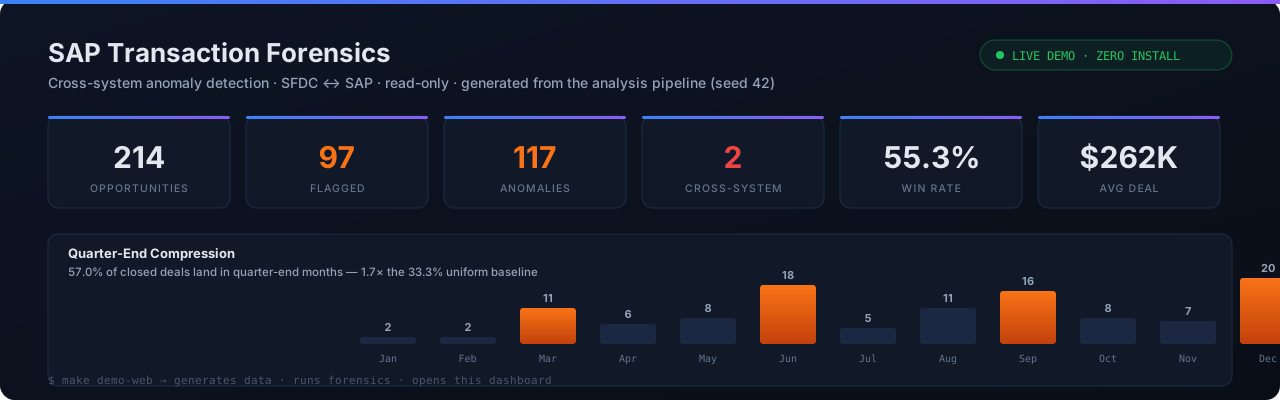
### **[▶ Open the live demo — no install →](https://chrbailey.github.io/SAP-Transaction-Forensics/)**
[](https://chrbailey.github.io/SAP-Transaction-Forensics/)
## The Core Insight
Every enterprise system generates two kinds of data. Structured transactions —
timestamps, amounts, stage changes, user IDs — tell you the official story.
Unstructured text — the emails, Slack threads, tickets, meeting notes, timesheets,
SOWs, and order notes that surround those transactions — tell you what *actually*
happened. **The gap between them is where fraud, waste, and dysfunction hide.**
| Structured data says | Unstructured text reveals |
|---|---|
| "Deal in Negotiation for 6 months" | *"Customer said not ready — Sales moved it forward anyway. No sign-off."* |
| "Purchase Order created 03/15" | *"Requisition wasn't approved yet. Create the PO now, paperwork later."* |
| "Phase 2: On Track, Green" | *"We're 3 weeks behind. Tell the client we're on track while we figure it out."* |
This tool correlates both sides and surfaces the contradictions. It has been used
on real engagements — see **[Field Case Studies](docs/CASE_STUDIES.md)** (3M+ ERP
records, $103K in waste found, ITGC/SOX violations) — and ships a synthetic demo so
you can watch the same detector classes fire without touching a real system.
## The Problem
Existing forensic tools ship with hardcoded rules. "Flag invoices over $X." "Alert on vendor master changes." These rules miss new patterns and fire on irrelevant ones. Every ERP is different. Every client's fraud signature is different. A static rule engine cannot keep up.
## The Approach
This project has two layers:
1. **Detection layer** — 18 analysis/data MCP tools plus 9 governance tools implementing well-known forensic checks (SoD conflicts, conformance deviations, journal anomalies). Deterministic, tested, callable from Claude Code.
2. **Discovery layer** — a Worker/Critic/Ralph loop that proposes *new* patterns from your data, validates them against evidence, and grows a persistent pattern library. See [pattern-discovery/](pattern-discovery/).
The detection layer finds things you know to look for. The discovery layer finds things you didn't.
## ▶ See It Working — No Install
**[Open the live demo dashboard →](https://chrbailey.github.io/SAP-Transaction-Forensics/)**
A read-only forensic pass over **214 Salesforce opportunities** and their linked
**SAP sales orders** surfaces **117 anomaly instances across 10 categories** —
plus the contradictions between what CRM and ERP each claim happened. Click any
finding to inspect the underlying records. Nothing to install; it runs in your browser.
### Run the same dashboard locally (≈60 seconds)
No SAP access required. Synthetic data included.
git clone https://github.com/chrbailey/SAP-Transaction-Forensics.git
cd SAP-Transaction-Forensics
pip install numpy pandas scipy scikit-learn faker click # one-time
make demo-web # generate data → run forensics → open dashboard
`make demo-web` generates synthetic Salesforce + SAP data, runs the full forensic
analysis, and opens the dashboard at `http://localhost:8000`. To rebuild the data
without serving, use `make bake-demo`. To open the dashboard with zero setup, just
open `demo/index.html` in a browser — the findings are baked in.
### Drive it from Claude Code (the full toolset)
make demo # generates synthetic data + runs analysis
cd mcp-server && npm install && npm run build && cd ..
claude # opens Claude Code with 27 registered tools
Then ask Claude: *"Run a conformance check against the o2c-simple reference model."*
Full walkthrough: **[QUICKSTART.md](QUICKSTART.md)** · Five-question demo: **[scripts/demo-walkthrough.md](scripts/demo-walkthrough.md)** · Pattern discovery: **[pattern-discovery/README.md](pattern-discovery/README.md)**
### Full portfolio dashboard — 6 analysis lenses
Beyond the synthetic demo, the **[portfolio dashboard](demo/portfolio/index.html)**
(live at `/portfolio/`) presents six forensic lenses over **real** datasets. It was
consolidated here from the now-archived `transaction-forensics` repo so everything
lives in one place.
| Lens | Data source | Scale | Key finding |
|---|---|---|---|
| **Overview** | Architecture + thesis | — | Structured-vs-unstructured gap analysis |
| **CRM Pipeline** | Kaggle CRM Sales Opportunities | 8,800 opportunities | Win rates, velocity, quarter-end compression |
| **BPI Challenge** | BPI Challenge 2019 (4TU.ResearchData) | 251,734 POs · 1.6M events | 57K payment blocks, resource concentration |
| **IDES Compliance** | SAP IDES demo system | 3,132 cases (O2C + P2P) | **7 compliance violations** in SAP's own reference data |
| **Client Cases** | 3 anonymized engagements | 3M+ ERP records | $103K savings, credit-hold overrides, SOD violations |
| **NLP Patterns** | Salesforce/HERB (HuggingFace) | 37,064 documents | 11 communication clusters, approval bottlenecks |
The NLP pipeline behind the last tab lives in **[`herb-nlp/`](herb-nlp/)**
(TF-IDF + KMeans, optional BERTopic, network + temporal analysis).
## Proven in the Field
Three real consulting engagements motivated this tool. Anonymized, but the figures
are actual. Full write-ups in **[docs/CASE_STUDIES.md](docs/CASE_STUDIES.md)**.
| Engagement | What structured data showed | What the text/forensics revealed | Result |
|---|---|---|---|
| **Healthcare — NetSuite license audit** (289 users) | A clean user list | 8 dormant full-access licenses, ~53 departed employees still licensed, 4 "approve-only" users | **$103,896/yr** savings · 14.4× ROI · 0.8-mo payback |
| **MedTech — ticket forensics during acquisition** (2,525 tickets) | Normal operations | Dummy MRP transactions, mutating item numbers, "URGENT" escalation culture, 257 access-request tickets | Organizational stress invisible in the ERP, surfaced from text |
| **Connected hardware — high-growth ERP + ITGC** (3M+ records) | Orders shipped, invoiced, cleared | Credit holds overridden to ship anyway, **28.6%** account return rate, 7 admin users (one terminated), broken approval chains | SOX-relevant control gaps documented with evidence |
Each maps to a detector class in this repo (segregation-of-duties, policy override,
temporal impossibility, reality-gap). The synthetic demo plants these same patterns
so you can see them fire with no access to a real system.
## What This Is Not
- **Not a governance tool.** For pre-execution approval of AI agent actions, see [PromptSpeak](https://github.com/chrbailey/promptspeak-mcp-server).
- **Not a self-healing system.** It finds problems. Humans decide what to do.
- **Not a commercial product.** MIT licensed. Built by an independent consultant (Christopher Bailey, ERP Access Inc, 29 years in ERP — SAP, NetSuite, Oracle, Workday).
[](https://opensource.org/licenses/MIT)
[](https://nodejs.org/)
[](https://www.python.org/)
[](https://github.com/chrbailey/SAP-Transaction-Forensics/actions/workflows/ci.yml)
## What's New: Evidence Infrastructure
Full evidence lifecycle from extraction through reviewer handoff, with cryptographic verification at every step.
| Feature | Description |
|---------|-------------|
| **Provenance Graph** | Field-level DAG tracing every finding to system/table/record/field/value/timestamp |
| **Extraction Registry** | 19 named, versioned, deterministic extraction paths across SAP, Salesforce, and NetSuite |
| **Contradiction Engine** | 12-category typed taxonomy with risk scoring and type-specific weights |
| **Schema Validator** | 19-table IDES reference schema (438 fields) with pre-flight validation and customization detection |
| **Reality-Gap Detector** | Three-way gap analysis: reference models vs documented business rules vs actual event logs |
| **Finding Lifecycle** | 8-state machine with SQLite persistence, transition history, and deduplication |
| **Reviewer Handoff** | Self-contained audit artifacts verifiable without model access |
| **2,048 Passing Tests** | 1,611 MCP + 367 pattern engine + 44 synthetic data + 24 discovery + 2 viewer; 42 skipped |
The evidence infrastructure is implemented and tested as source modules. Its nine
tool definitions are not yet registered in the live MCP tool list; see
[QUICKSTART.md](QUICKSTART.md) for the currently callable tools.
### Sample Evidence Chain
Finding: AMOUNT_DIVERGENCE on Sales Order 0000045123
Evidence:
Left: SAP.VBAK.0000045123.NETWR = 125,000.00 (extracted 2025-09-15T14:22:00Z)
Right: SFDC.Opportunity.006R00000123.Amount = 118,750.00 (extracted 2025-09-15T14:22:01Z)
Delta: 5.3% ($6,250.00)
Provenance:
Extraction Path: sap-o2c-order-headers v1.0
Replay Hash: sha256:a7f3b2...
State: CONFIRMED → REMEDIATION (transitioned 2025-09-16 by reviewer@corp.com)
## Alternative Paths (Without Claude Code)
If you're not using Claude Code, the underlying tools can still be run directly:
### Option A: Docker Compose (Browser UI)
docker-compose up --build
# Open browser to http://localhost:8080
### Option B: Analyze Your CSV Exports
# Export from SE16: VBAK, VBAP, LIKP, LIPS, VBRK, VBRP, STXH/STXL
# Place files in ./input-data/
docker-compose run pattern-engine --input-dir /app/input-data --output-dir /app/output
### Option C: Live RFC Connection
# Copy and edit configuration
cp .env.rfc.example .env.rfc
# Edit .env.rfc with your SAP connection details
# Run with RFC adapter
docker-compose --profile rfc up mcp-server-rfc
See [Installation Guide](docs/adapter_guide.md) for detailed setup instructions.
### Option D: Analyze Salesforce Data
# 1. Generate synthetic SFDC data (200 Opportunities, 10 planted anomaly patterns)
cd synthetic-data
python3 src/generate_sfdc.py --count 200 --accounts 50 --output sfdc_output/ --seed 42
# 2. Run the forensic analysis
cd ../pattern-engine
python3 scripts/analyze_sfdc.py
# Or bring your own SFDC export:
# Place Opportunity, Account, StageHistory CSVs in ./data/sfdc/
# python3 scripts/analyze_sfdc.py --data-dir ../data/sfdc
## Evidence Infrastructure
The evidence infrastructure provides a complete chain of custody from raw system data through forensic findings to reviewer-ready audit packets.
### Provenance Graph
Every finding traces back to specific fields in specific records in specific systems through a directed acyclic graph (DAG). Each extraction record captures:
- **System** - SAP, Salesforce, or NetSuite
- **Table** - Source table (e.g., VBAK, Opportunity)
- **Record ID** - Specific document or record
- **Field** - Individual field name
- **Value** - Extracted value at time of extraction
- **Timestamp** - When the extraction occurred
- **Replay Hash** - SHA-256 hash for independent re-verification
Export formats: DAG JSON (full graph), flat (tabular), Markdown (human-readable).
### Extraction Registry
19 named, versioned, deterministic extraction paths ensure reproducible data collection:
| Domain | Path | Description |
|--------|------|-------------|
| **SAP O2C** | `sap-o2c-order-headers` | Sales order header fields (VBAK) |
| | `sap-o2c-order-items` | Line item details (VBAP) |
| | `sap-o2c-doc-flow` | Document flow chain (VBFA) |
| | `sap-o2c-delivery-timing` | Requested vs actual delivery (LIKP/LIPS) |
| | `sap-o2c-invoice-timing` | Invoice creation and posting (VBRK/VBRP) |
| **SAP FI/CO** | `sap-fico-journal-entries` | Journal entry headers (BKPF) |
| | `sap-fico-line-items` | Journal line items (BSEG) |
| | `sap-fico-sod-conflicts` | Segregation of duties analysis |
| | `sap-fico-gl-balances` | GL account balances |
| **SAP P2P** | `sap-p2p-purchase-orders` | Purchase order data (EKKO/EKPO) |
| | `sap-p2p-requisitions` | Purchase requisitions (EBAN) |
| | `sap-p2p-goods-receipts` | Goods receipt documents (MKPF/MSEG) |
| | `sap-p2p-invoice-verification` | Invoice verification (RBKP/RSEG) |
| **Salesforce** | `sfdc-opportunities` | Opportunity pipeline data |
| | `sfdc-stage-history` | Stage transition history |
| | `sfdc-activities` | Tasks and events on records |
| **NetSuite** | `netsuite-user-activity` | User activity audit trail |
| | `netsuite-transaction-summary` | Transaction summaries |
| | `netsuite-login-history` | Login and access history |
Each path is versioned and produces deterministic output for the same input, enabling SHA-256 replay verification.
### Contradiction Engine
Cross-system contradiction detection with a 12-category typed taxonomy:
| Category | What It Detects |
|----------|----------------|
| `AMOUNT_DIVERGENCE` | Dollar amounts that differ beyond tolerance across systems |
| `DATE_CONFLICT` | Dates that disagree between matched records |
| `STATUS_INCOMPATIBLE` | Status fields that cannot logically coexist |
| `ENTITY_MISMATCH` | Customer/vendor/material IDs that do not match across systems |
| `QUANTITY_DIVERGENCE` | Quantities that differ beyond tolerance |
| `APPROVAL_BYPASS` | Transactions that bypassed required approval steps |
| `TEMPORAL_IMPOSSIBILITY` | Events that occur in an impossible sequence |
| `DUPLICATE_REFERENCE` | Multiple records claiming the same reference number |
| `ORPHAN_RECORD` | Records in one system with no counterpart in the other |
| `RETROACTIVE_CHANGE` | Changes made to records after they were finalized |
| `SOD_VIOLATION` | Same user performing conflicting duties |
| `SCHEMA_GHOST` | Fields or values that reference non-existent schema elements |
Risk scoring uses type-specific weights. Severity levels: CRITICAL, HIGH, MEDIUM, LOW, INFO.
### Schema Validator
Pre-flight validation of extraction paths against client schemas before any data is pulled.
- **Reference schema**: 19 tables, 438 fields from an actual SAP IDES dump
- **Path validation**: Verifies that every field referenced by an extraction path exists in the client schema
- **Customization detection**: Identifies Z-tables, Z-fields, and custom namespaces
- **Gap reporting**: Shows exactly which fields are missing and which paths are affected
### Reality-Gap Detector
Three-way gap analysis comparing what should happen, what is documented, and what actually happens:
| Gap Type | Comparison | Example |
|----------|-----------|---------|
| **Design Gap** | Reference model vs documented rules | SoD policy exists but no enforcing control configured |
| **Compliance Gap** | Documented rules vs actual events | Three-way match required but invoices posted without GR |
| **Shadow Process** | Actual events vs all documented models | Goods receipts posted on weekends with no approval workflow |
Includes a rule parser with standard rulesets for SAP, NetSuite, and Salesforce.
### Finding Lifecycle Manager
8-state machine tracking every finding from detection through resolution:
DETECTED → TRIAGED → INVESTIGATING → CONFIRMED → REMEDIATION → RESOLVED
↘ ↘ ↗
FALSE_POSITIVE ACCEPTED_RISK
- SQLite persistence with full transition history (who, when, from-state, to-state)
- Deduplication prevents the same finding from being logged twice
- Four finding sources: contradiction, reality_gap, conformance, fi_co_anomaly
- Risk scores (0.0-1.0) computed from finding type and severity
### Reviewer Handoff Packets
Self-contained audit artifacts that can be verified without model access:
- **Executive Summary** - Scope, systems analyzed, key metrics, risk distribution
- **Rendered Findings** - Each finding with severity, evidence tables, and provenance chain
- **Extraction Manifest** - Every extraction path used, with parameters and SHA-256 replay hashes
- **Reproduction README** - Step-by-step instructions to re-run the analysis independently
- **Reviewer Checklist** - 25-item verification checklist covering completeness, accuracy, and methodology
## SFDC Forensic Analysis
The Salesforce adapter maps Opportunity pipeline data through the same pattern engine used for SAP:
### Field Mapping (SFDC → SAP Normalized)
| SFDC Concept | SAP Equivalent | Mapping |
|---|---|---|
| Opportunity.Id | VBELN | Padded to 10 chars |
| RecordType.Name | AUART | New Business→ZNEW, Renewal→ZREN, Upsell→ZUPS |
| Account.Id | KUNNR | Padded to 10 chars |
| Opportunity.Amount | NETWR | Direct |
| Stage transitions | VBFA (doc flow) | Each stage change → flow entry |
| Task/Event | STXH/STXL (texts) | Activity subject + description → doc text |
| Account (safe fields) | KNA1 | Industry, State, Country only (no PII) |
### Cross-System Correlation
When both SFDC and SAP data are loaded, the entity resolver matches records using:
1. **Explicit ID** (confidence 0.99) — `Opportunity.SAP_Order_Number__c == VBAK.VBELN`
2. **Proximity** (confidence 0.50-0.95) — Account name similarity + amount tolerance + date proximity
3. **Temporal sequence** (Phase 2) — Monotonic SFDC→SAP event chain validation
Anomalies detected across matched pairs:
- **Timing gaps** — SFDC close to SAP order creation > 30 days
- **Amount discrepancies** — SFDC Amount vs SAP NETWR > 5% tolerance
- **Sequence violations** — SAP order created before SFDC close
- **Missing handoffs** — SFDC Closed Won with no corresponding SAP order
### Planted Anomaly Patterns (Synthetic Data)
The SFDC generator plants 10 detectable patterns at controlled rates:
| Pattern | Rate | What It Tests |
|---|---|---|
| Stage skip | 5% | Conformance: mandatory stages bypassed |
| Quarter-end compression | 40% of won | Temporal: period-end deal clustering |
| Ghost pipeline | 10% of late-stage | Correlation: zero activities on active deals |
| Stage regression | 3% | Conformance: backward stage movement |
| Amount inflation | 8% | Correlation: >50% amount increase at close |
| Split deal | 6% | Cross-entity: same account, duplicate deals within 7 days |
| Speed anomaly | 5% | Temporal: created to closed in <3 days |
| Stale pipeline | 15% of open | Temporal: no movement for >90 days |
| Owner swap at close | 4% of won | Conformance: owner changes in final stage |
| Cross-system gap | 6% of SAP-linked | Cross-system: >30 day SFDC→SAP timing gap |
## What You Get
+-----------------------------------------------------------------------------------+
| Pattern Discovery Report |
+-----------------------------------------------------------------------------------+
| Pattern: "Credit Hold Escalation" |
| ----------------------------------------------------------------------------------|
| Finding: Orders with 'CREDIT HOLD' in notes have 3.2x longer fulfillment cycles |
| |
| Occurrence: 234 orders (4.7% of dataset) |
| Sales Orgs: 1000 (64%), 2000 (36%) |
| Confidence: HIGH (p < 0.001) |
| |
| Caveat: Correlation only - does not imply causation |
+-----------------------------------------------------------------------------------+
**Key Features:**
- **Text Pattern Discovery** - Find hidden patterns in order notes, rejection reasons, and delivery instructions
- **Document Flow Analysis** - Trace complete order-to-cash chains with timing at each step
- **Outcome Correlation** - Identify text patterns that correlate with delays, partial shipments, or returns
- **Evidence-Based Reporting** - Every pattern links to specific documents with field-level provenance
- **Privacy-First Design** - PII redaction enabled by default, shareable output mode for external review
## v2.0 Features
### Natural Language Interface
Ask questions about your SAP processes in plain English:
User: "Why are orders from sales org 1000 taking longer to ship?"
System: Based on analysis of 5,234 orders:
- Average delay: 4.2 days vs 1.8 days for other orgs
- Root cause: 73% have "CREDIT HOLD" in notes
- Recommendation: Review credit check thresholds for org 1000
Confidence: HIGH | Evidence: 847 documents analyzed
Supports multiple LLM providers:
- **Ollama** (local, private) - Default for air-gapped environments
- **OpenAI** (GPT-4) - For cloud deployments
- **Anthropic** (Claude) - Alternative cloud option
### OCEL 2.0 Export
Export to the [Object-Centric Event Log](https://www.ocel-standard.org/) standard for advanced process mining:
{
"ocel:version": "2.0",
"ocel:objectTypes": ["order", "item", "delivery", "invoice"],
"ocel:events": [...],
"ocel:objects": [...]
}
- Captures multi-object relationships (order → items → deliveries → invoices)
- Compatible with PM4Py, Celonis, and other OCEL tools
- Export formats: JSON, XML, SQLite
### Conformance Checking
Compare actual SAP processes against expected Order-to-Cash models:
Conformance Report: 94.2% (4,712 / 5,000 cases)
Deviations Detected:
├── CRITICAL: Invoice before Goods Issue (23 cases)
├── MAJOR: Skipped Delivery step (187 cases)
└── MINOR: Duplicate Order Created (78 cases)
- Pre-built O2C reference models (simple and detailed)
- Severity scoring: Critical / Major / Minor
- Deviation types: skipped steps, wrong order, missing activities
### Visual Process Maps
Generate process flow diagrams with bottleneck highlighting:
graph LR
A[Order Created] -->|2.1 days| B[Delivery Created]
B -->|0.5 days| C[Goods Issued]
C -->|3.2 days| D[Invoice Created]
style C fill:#f8d7da
- Output formats: Mermaid (Markdown), GraphViz (DOT), SVG
- Color-coded bottleneck severity (green/yellow/red)
- Timing annotations between process steps
### Predictive Monitoring
ML-based prediction for process outcomes:
Order 0000012345 - Risk Assessment:
├── Late Delivery: 78% probability (HIGH RISK)
│ └── Factors: credit_block, order_value > $50k
├── Credit Hold: 45% probability (MEDIUM RISK)
└── Est. Completion: 8.2 days
**Prediction Types:**
- **Late Delivery** - Probability based on case age, progress, stalls, rework
- **Credit Hold** - Likelihood based on credit check status, complexity
- **Completion Time** - Estimated hours remaining based on progress/pace
**29 Extracted Features:**
- Temporal: case age, time since last event, avg time between events
- Activity: milestones reached, rework detection, loop count, backtracks
- Resource: unique resources, handoff count
- Risk indicators: stalled cases, credit holds, rejections, blocks
## Why This Instead of S/4HANA?
| Consideration | S/4HANA Migration | Transaction Forensics |
|--------------|-------------------|---------------------|
| **Timeline** | 18-36 months | Hours to first insights |
| **Cost** | $10M-$100M+ | Free (MIT license) |
| **Risk** | Business disruption | Zero - read-only access |
| **Data Location** | Cloud/hosted | On-premise only |
| **Prerequisites** | Greenfield/brownfield project | Works with existing ECC 6.0 |
| **Process Visibility** | After migration | Before any changes |
| **Use Case** | Full transformation | Process discovery & optimization |
**This tool does not replace S/4HANA.** It helps you understand your current processes *before* making migration decisions - or find optimization opportunities in your existing ECC system.
## Installation
### Prerequisites
- Docker & Docker Compose (recommended)
- OR Node.js 20-25 and Python 3.10+ for local development
### Quick Install
git clone https://github.com/chrbailey/SAP-Transaction-Forensics.git
cd transaction-forensics
docker-compose up --build
### Detailed Setup
See [docs/adapter_guide.md](docs/adapter_guide.md) for:
- RFC adapter configuration for ECC 6.0
- OData adapter configuration for S/4HANA
- CSV import from SE16 exports
- Air-gapped installation options
### LLM Configuration (v2.0)
Configure the natural language interface in `.env`:
# Option 1: Local Ollama (default, private)
LLM_PROVIDER=ollama
OLLAMA_HOST=http://localhost:11434
LLM_MODEL=llama3
# Option 2: OpenAI
LLM_PROVIDER=openai
LLM_API_KEY=
LLM_MODEL=gpt-4
# Option 3: Anthropic
LLM_PROVIDER=anthropic
LLM_API_KEY=
LLM_MODEL=claude-3-sonnet-20240229
For air-gapped environments, use Ollama with locally downloaded models.
## Demos
Interactive demos for all v2.0 process mining tools. No SAP connection required - all demos use synthetic data.
cd mcp-server
# Natural Language Interface - ask questions in plain English
npx tsx ../demos/ask_process_demo.ts
npx tsx ../demos/ask_process_demo.ts --interactive # Interactive mode
# OCEL 2.0 Export - export to process mining standard format
npx tsx ../demos/export_ocel_demo.ts
# Conformance Checking - compare against O2C reference model
npx tsx ../demos/check_conformance_demo.ts
# Visual Process Maps - generate Mermaid flowcharts
npx tsx ../demos/visualize_process_demo.ts
# Predictive Monitoring - ML-based risk predictions
npx tsx ../demos/predict_outcome_demo.ts
| Demo | Description |
|------|-------------|
| `ask_process_demo.ts` | Natural language queries with LLM integration |
| `export_ocel_demo.ts` | OCEL 2.0 export with object/event breakdown |
| `check_conformance_demo.ts` | Deviation detection and severity scoring |
| `visualize_process_demo.ts` | Mermaid diagrams with bottleneck highlighting |
| `predict_outcome_demo.ts` | Risk predictions and alerts |
| `salt_adapter_demo.ts` | Real SAP O2C data from SALT dataset |
| `visualize_process_bpi_demo.ts` | Process maps with real P2P data (BPI 2019) |
| `predict_outcome_bpi_demo.ts` | Risk predictions with real P2P data (BPI 2019) |
| `ask_process_bpi_demo.ts` | Natural language queries on P2P data |
## Real SAP Data
### BPI Challenge 2019 (P2P)
Use real SAP Purchase-to-Pay data from the [BPI Challenge 2019](https://data.4tu.nl/articles/dataset/BPI_Challenge_2019/12715853) for testing with authentic business patterns.
# Download and convert BPI 2019 data
python scripts/convert-bpi-xes.py
# Run demos with real P2P data
npx tsx demos/visualize_process_bpi_demo.ts 50
npx tsx demos/predict_outcome_bpi_demo.ts 30
npx tsx demos/ask_process_bpi_demo.ts
**Dataset Statistics:**
| Metric | Value |
|--------|-------|
| Total cases | 251,734 |
| Total events | 1.5M+ |
| Unique activities | 39 |
| Process type | Purchase-to-Pay (P2P) |
| Source | Multinational coatings company |
**Activities include:** SRM workflows, Purchase Orders, Goods Receipts, Service Entries, Invoice Processing, Vendor interactions
### SALT Dataset (O2C)
Use real SAP ERP data from SAP's [SALT dataset](https://huggingface.co/datasets/SAP/SALT) on HuggingFace for testing with authentic business patterns.
### Quick Start
# 1. Install Python dependencies
pip install datasets pyarrow
# 2. Download SALT dataset
python scripts/download-salt.py
# 3. Run demo with real data
cd mcp-server
npx tsx ../demos/salt_adapter_demo.ts
### What's Included
SALT (Sales Autocompletion Linked Business Tables) contains:
| Table | Description | Records |
|-------|-------------|---------|
| I_SalesDocument | Sales order headers | ~1M+ |
| I_SalesDocumentItem | Order line items | ~5M+ |
| I_Customer | Customer master data | ~100K |
| I_AddrOrgNamePostalAddress | Address data | ~100K |
### Using the SALT Adapter
import { SaltAdapter } from './adapters/salt/index.js';
const adapter = new SaltAdapter({
maxDocuments: 10000, // Limit for memory management
});
await adapter.initialize();
// Get real sales order data
const header = await adapter.getSalesDocHeader({ vbeln: '0000012345' });
const items = await adapter.getSalesDocItems({ vbeln: '0000012345' });
// Get dataset statistics
const stats = adapter.getStats();
console.log(`Loaded ${stats.salesDocuments} sales documents`);
### Limitations
SALT contains **sales orders only** (no deliveries or invoices). For full Order-to-Cash testing:
- Use SALT for sales order analysis and ML training
- Use synthetic adapter for complete O2C flow testing
- Combine both for comprehensive validation
### Why Use Real Data?
| Aspect | Synthetic Data | SALT Real Data |
|--------|---------------|----------------|
| Patterns | Random/artificial | Authentic business patterns |
| ML Training | Limited accuracy | Real-world feature distributions |
| Demos | Good for UI testing | Compelling for stakeholders |
| Validation | Functional testing | Business logic validation |
### Analysis Results
We've validated the MCP tools against real SAP datasets. View the detailed analysis:
| Dataset | System | Cases | Events | Key Findings | Report |
|---------|--------|-------|--------|--------------|--------|
| **SFDC Synthetic** | Salesforce | 214 | 2,417 | 10 anomaly patterns, 57% QE compression, 2 cross-system gaps | Run: `python3 pattern-engine/scripts/analyze_sfdc.py` |
| **BPI Challenge 2019** | SAP P2P | 251,734 | 1.6M | 42 activities, 64-day median throughput | [View →](docs/analysis/bpi-challenge-2019.md) |
| **SAP IDES O2C** | SAP O2C | 646 | 5,708 | 158 variants, bottlenecks identified | [View →](docs/analysis/order-to-cash.md) |
| **SAP IDES P2P** | SAP P2P | 2,486 | 7,420 | 7 compliance violations detected | [View →](docs/analysis/procure-to-pay.md) |
**Process Diagrams**: [Mermaid flowcharts for O2C and P2P](docs/analysis/process-diagrams.md)
**Validation baseline**: 2,048 tests pass and 42 are skipped — 1,611 MCP
server, 367 pattern engine, 44 synthetic data, 24 pattern discovery, and 2
viewer tests. CI also builds the server, runs the demos, and scans JavaScript,
TypeScript, Python, and Actions with CodeQL.
## Security & Compliance
**This system is designed for enterprise security requirements.**
| Concern | How We Address It |
|---------|-------------------|
| **Data Access** | Read-only BAPIs only - no write operations, no arbitrary SQL |
| **Data Location** | Local by default; cloud LLM and SaaS adapters are opt-in |
| **Network** | No telemetry or phone-home; configured cloud providers require outbound access |
| **PII Protection** | Automatic redaction of emails, phones, names, addresses |
| **Audit Trail** | Every query logged with parameters, timestamps, row counts |
| **Row Limits** | Default 200 rows per query, max 1000 - prevents bulk extraction |
| **Provenance** | SHA-256 replay hashing on every extraction for independent verification |
| **Handoff Integrity** | Reviewer packets are self-contained and verifiable without model access |
**See [SECURITY.md](SECURITY.md) for complete security documentation.**
## For SAP Basis Administrators
### Required Authorizations
The RFC user requires **display-only** access to SD documents:
Authorization Object: S_RFC
RFC_TYPE = FUGR
RFC_NAME = STXR, 2001, 2051, 2056, 2074, 2077
ACTVT = 16 (Execute)
Authorization Object: V_VBAK_VKO
VKORG = [Your Sales Organizations]
ACTVT = 03 (Display)
Authorization Object: V_VBAK_AAT
AUART = * (or specific document types)
ACTVT = 03 (Display)
**Copy-paste ready role template:** See [docs/SAP_AUTHORIZATION.md](docs/SAP_AUTHORIZATION.md)
### BAPIs Used (All Read-Only)
| BAPI | Purpose | Tables Accessed |
|------|---------|-----------------|
| `BAPI_SALESORDER_GETLIST` | List sales orders | VBAK |
| `SD_SALESDOCUMENT_READ` | Read order header/items | VBAK, VBAP |
| `BAPI_SALESDOCU_GETRELATIONS` | Document flow (VBFA) | VBFA |
| `BAPI_OUTB_DELIVERY_GET_DETAIL` | Delivery details | LIKP, LIPS |
| `BAPI_BILLINGDOC_GETDETAIL` | Invoice details | VBRK, VBRP |
| `READ_TEXT` | Long text fields | STXH, STXL |
| `BAPI_CUSTOMER_GETDETAIL2` | Customer master (stub) | KNA1 |
| `BAPI_MATERIAL_GET_DETAIL` | Material master (stub) | MARA |
No direct table access. No RFC_READ_TABLE unless explicitly enabled.
## Architecture
+------------------------------------------------------------------+
| Your Network |
| +------------------------------------------------------------+ |
| | | |
| | +----------------+ +-------------------+ | |
| | | SAP ECC 6.0 | | Transaction | | |
| | | | | Forensics Server | | |
| | | +----------+ | | | | |
| | | | SD/MM | | RFC | +-------------+ | | |
| | | | Tables |<--------->| MCP Server | | | |
| | | +----------+ | (R/O)| +-------------+ | | |
| | | | | | | | |
| | +----------------+ | v | | |
| | | +-------------+ | | |
| | +----------------+ | | Evidence | | | |
| | | Salesforce | | | Engine | | | |
| | | | API | | +---------+ | | | |
| | | Opportunities |<------>| |Provenance| | | | |
| | | Activities | | | |Registry | | | | |
| | +----------------+ | | |Findings | | | | |
| | | | +---------+ | | | |
| | +----------------+ | +-------------+ | | |
| | | NetSuite | | | | | |
| | | | API | v | | |
| | | Users/Txns |<--->| +-------------+ | | |
| | +----------------+ | | Pattern | | | |
| | | | Engine | | | |
| | | +-------------+ | | |
| | | | | | |
| | +----------------+ | +-------------+ | | |
| | | Browser |<------>| Web Viewer | | | |
| | | (localhost) | | +-------------+ | | |
| | +----------------+ +-------------------+ | |
| | | |
| +------------------------------------------------------------+ |
| |
| EXTERNAL CONNECTIONS ONLY WHEN CONFIGURED |
+------------------------------------------------------------------+
**Data Flow:**
1. MCP Server connects to SAP via RFC, Salesforce via API, NetSuite via API (all read-only)
2. Extraction Registry executes named, versioned extraction paths
3. Provenance Graph records field-level evidence for every extraction
4. Contradiction Engine and Reality-Gap Detector analyze cross-system data
5. Finding Lifecycle Manager tracks findings from detection through resolution
6. Handoff Generator produces self-contained reviewer packets
7. Web Viewer displays findings on localhost
With local adapters and a local LLM, data remains on your network. Salesforce,
NetSuite, OpenAI, and Anthropic integrations require outbound connections when
explicitly configured.
## FAQ
### Is this tool officially supported by SAP?
No. This is an independent open-source project. It uses standard SAP BAPIs that are publicly documented.
### Will this impact SAP system performance?
Minimal impact. All queries are:
- Read-only (no locks)
- Row-limited (200 default, 1000 max)
- Rate-limited (configurable)
- Use standard BAPIs (not direct table access)
We recommend running initial analysis during off-peak hours.
### What SAP modules are supported?
SD (Sales & Distribution), MM (Materials Management), and FI/CO (Financial Accounting / Controlling) document flows. Cross-system analysis with Salesforce CRM and NetSuite is also supported.
### Does this work with SAP on any database?
Yes. The tool uses BAPIs which are database-agnostic. Works with HANA, Oracle, DB2, SQL Server, MaxDB.
### Can I run this in an air-gapped environment?
Yes. The Docker images can be built offline and transferred. No external dependencies at runtime.
### How do I validate the findings?
Every finding includes:
- Field-level provenance tracing to system/table/record/field/value/timestamp
- SHA-256 replay hashes for independent re-verification
- Sample document numbers for verification in SAP (VA03, VL03N, VF03)
- Statistical confidence intervals
- Explicit caveats about correlation vs. causation
For formal review, the handoff module can produce a self-contained audit
artifact with a 25-item reviewer checklist. The `generate_handoff_packet` MCP
definition exists in source but is not yet registered in the live server.
### What about GDPR/data protection?
- PII redaction is enabled by default
- No data leaves your network
- Shareable mode applies additional redaction
- See [SECURITY.md](SECURITY.md) for compliance considerations
### Can I contribute or request features?
Yes. See [CONTRIBUTING.md](CONTRIBUTING.md) for guidelines. Feature requests via GitHub Issues.
## Governance (PromptSpeak Integration)
The MCP server includes a governance layer based on **PromptSpeak symbolic frames** for pre-execution blocking and human-in-the-loop approval workflows.
### Why Governance?
When AI agents access SAP data, you need controls to:
- **Prevent bulk extraction** - Hold requests for large date ranges or row counts
- **Protect sensitive data** - Require approval for searches containing PII patterns
- **Halt rogue agents** - Circuit breaker to immediately stop misbehaving agents
- **Audit everything** - Complete trail of all operations for compliance
### PromptSpeak Frames
Every operation has a symbolic frame indicating mode, domain, action, and entity:
Frame: ⊕◐◀α
│ │ │ └── Entity: α (primary agent)
│ │ └──── Action: ◀ (retrieve)
│ └────── Domain: ◐ (operational)
└──────── Mode: ⊕ (strict)
| Symbol | Category | Meaning |
|--------|----------|---------|
| `⊕` | Mode | Strict - exact compliance required |
| `⊘` | Mode | Neutral - standard operation |
| `⊖` | Mode | Flexible - allow interpretation |
| `⊗` | Mode | **Forbidden** - blocks all actions |
| `◊` | Domain | Financial (invoices, values) |
| `◐` | Domain | Operational (orders, deliveries) |
| `◀` | Action | Retrieve data |
| `▲` | Action | Analyze/search |
| `●` | Action | Validate |
| `α` `β` `γ` | Entity | Primary/secondary/tertiary agent |
### Hold Triggers
Operations are automatically held for human approval when:
| Trigger | Threshold | Example |
|---------|-----------|---------|
| Broad date range | >90 days | `date_from: 2024-01-01, date_to: 2024-12-31` |
| High row limit | >500 rows | `limit: 1000` |
| Sensitive patterns | SSN, credit card, password | `pattern: "social security"` |
### Governance Workflow
Agent Request
│
▼
┌─────────────┐ ┌─────────────┐
│ Circuit │────▶│ BLOCKED │ (if agent halted)
│ Breaker │ └─────────────┘
└─────────────┘
│ OK
▼
┌─────────────┐ ┌─────────────┐
│ Frame │────▶│ BLOCKED │ (if ⊗ forbidden)
│ Validation │ └─────────────┘
└─────────────┘
│ OK
▼
┌─────────────┐ ┌─────────────┐ ┌─────────────┐
│ Hold │────▶│ HELD │────▶│ Human │
│ Check │ │ (pending) │ │ Approval │
└─────────────┘ └─────────────┘ └─────────────┘
│ OK │
▼ ▼
┌─────────────┐ ┌─────────────┐
│ EXECUTE │◀────────────────────────│ APPROVED │
└─────────────┘ └─────────────┘
### Governance Tools
| Tool | Purpose |
|------|---------|
| `ps_precheck` | Dry-run: check if operation would be allowed |
| `ps_list_holds` | List pending holds awaiting approval |
| `ps_approve_hold` | Approve a held operation |
| `ps_reject_hold` | Reject a held operation with reason |
| `ps_agent_status` | Check circuit breaker state for an agent |
| `ps_halt_agent` | Immediately halt an agent (blocks all ops) |
| `ps_resume_agent` | Resume a halted agent |
| `ps_stats` | Get governance statistics |
| `ps_frame_docs` | Get PromptSpeak frame reference |
### Example: Hold and Approval Flow
// 1. Agent makes a request that triggers hold
const result = await mcp.callTool('search_doc_text', {
pattern: 'delivery',
date_from: '2024-01-01',
date_to: '2024-12-31', // >90 days triggers hold
});
// Returns: { held: true, hold_id: 'hold_abc123', reason: 'broad_date_range' }
// 2. Supervisor reviews pending holds
const holds = await mcp.callTool('ps_list_holds', {});
// Returns: [{ holdId: 'hold_abc123', tool: 'search_doc_text', severity: 'medium' }]
// 3. Supervisor approves
const approved = await mcp.callTool('ps_approve_hold', {
hold_id: 'hold_abc123',
approved_by: 'supervisor@example.com'
});
// Returns: { allowed: true, auditId: 'audit_xyz789' }
### Example: Emergency Agent Halt
// Immediately block a misbehaving agent
await mcp.callTool('ps_halt_agent', {
agent_id: 'agent-123',
reason: 'Excessive query rate detected'
});
// All subsequent requests from this agent are blocked
const result = await mcp.callTool('get_doc_text', {
doc_type: 'order',
doc_key: '0000000001',
_agent_id: 'agent-123' // Identifies the agent
});
// Returns: { error: 'Governance Blocked', message: 'Agent halted: Excessive query rate' }
// Resume when issue is resolved
await mcp.callTool('ps_resume_agent', { agent_id: 'agent-123' });
## MCP Tools Reference
### SAP Data Tools
| Tool | Purpose | Returns |
|------|---------|---------|
| `search_doc_text` | Find documents by text pattern | doc_type, doc_key, snippet, match_score |
| `get_doc_text` | Get all text fields for a document | header_texts[], item_texts[] |
| `get_doc_flow` | Get order-delivery-invoice chain | chain with keys, statuses, dates |
| `get_sales_doc_header` | Order header details | sales_org, customer, dates, values |
| `get_sales_doc_items` | Order line items | materials, quantities, values |
| `get_delivery_timing` | Requested vs actual delivery | timestamps, variance analysis |
| `get_invoice_timing` | Invoice creation/posting | invoice dates, accounting refs |
| `get_master_stub` | Safe master data attributes | hashed IDs, categories (no PII) |
### Process Mining Tools (v2.0)
| Tool | Purpose | Returns |
|------|---------|---------|
| `ask_process` | Natural language queries | answer, confidence, evidence, recommendations |
| `export_ocel` | Export to OCEL 2.0 format | OCEL JSON/XML with objects and events |
| `check_conformance` | Compare against O2C model | conformance_rate, deviations, severity_summary |
| `visualize_process` | Generate process diagrams | Mermaid/DOT/SVG with bottleneck highlighting |
| `predict_outcome` | ML-based outcome prediction | predictions, alerts, risk_levels, factors |
### FI/CO Forensic Tools
| Tool | Purpose | Returns |
|------|---------|---------|
| `analyze_journal_entries` | Journal entry anomaly detection | anomalies, risk_scores, patterns |
| `analyze_sod` | Segregation of duties analysis | conflicts, violation_count, users |
| `analyze_gl_balances` | GL account balance analysis | balance_anomalies, trends |
| `get_fi_document` | Retrieve FI document details | header, line_items, amounts |
| `generate_fi_assessment` | FI/CO risk assessment report | assessment, findings, recommendations |
### Evidence Infrastructure Modules (Not Yet MCP-Registered)
These definitions and executors are implemented and tested in source, but they
are not included in the current `allTools` registry. They are not callable from
Claude Code until registration and adapter routing are completed.
| Tool | Purpose | Returns |
|------|---------|---------|
| `query_provenance` | Trace evidence chain for a finding | DAG/flat/Markdown with field-level provenance |
| `list_extraction_paths` | List available extraction paths | path definitions with system, version, fields |
| `run_extraction` | Execute a named extraction path | extracted records with provenance and replay hash |
| `detect_contradictions` | Cross-system contradiction detection | typed contradictions with severity and evidence |
| `validate_schema` | Pre-flight schema validation | path compatibility, missing fields, customizations |
| `analyze_reality_gaps` | Three-way gap analysis | design gaps, compliance gaps, shadow processes |
| `manage_finding` | Create/transition/query findings | finding state, history, risk score |
| `get_finding_summary` | Aggregated finding statistics | counts by state, source, severity, avg risk |
| `generate_handoff_packet` | Produce reviewer handoff packet | executive summary, findings, manifest, checklist |
### Governance Tools
| Tool | Purpose | Returns |
|------|---------|---------|
| `ps_precheck` | Check if operation would be allowed | wouldAllow, wouldHold, reason |
| `ps_list_holds` | List pending holds | Array of hold requests |
| `ps_approve_hold` | Approve a held operation | Execution result with auditId |
| `ps_reject_hold` | Reject a held operation | Success boolean |
| `ps_agent_status` | Get agent circuit breaker state | isAllowed, state, haltReason |
| `ps_halt_agent` | Halt an agent immediately | halted, agent_id |
| `ps_resume_agent` | Resume a halted agent | resumed, agent_id |
| `ps_stats` | Get governance statistics | holds, haltedAgents, auditEntries |
| `ps_frame_docs` | Get PromptSpeak documentation | Frame format reference |
## License
MIT License - See [LICENSE](LICENSE)
This is enterprise-friendly open source:
- Use commercially without restriction
- Modify and distribute freely
- No copyleft obligations
- No warranty (provided as-is)
## Support
- **Documentation**: [docs/](docs/)
- **Issues**: GitHub Issues
- **Security**: See [SECURITY.md](SECURITY.md) for vulnerability reporting
## AI Authorship
This project was built with Claude Code (Anthropic). All commits are co-authored as reflected in git history. The architecture, design decisions, and analysis methodology are the author's; the implementation was pair-programmed with AI assistance.
## Disclaimer
This tool is provided as-is for process analysis purposes. It does not modify SAP data. Users are responsible for:
- Ensuring compliance with organizational data access policies
- Validating findings before making business decisions
- Proper configuration of SAP authorizations
**Correlation does not imply causation.** All pattern findings should be verified against actual business processes.
标签:ERP系统, SAP, 代码示例, 企业资源计划, 审计与合规, 异常检测, 数据分析, 自动化攻击