Kim-Hammar/llm_incident_response_ndss26

GitHub: Kim-Hammar/llm_incident_response_ndss26

利用轻量级大型语言模型实现应急响应规划。

Stars: 16 | Forks: 0

# 使用轻量级大型语言模型降低幻觉的应急响应规划 本存储库包含与论文 *"使用轻量级大型语言模型降低幻觉的应急响应规划"* 相关的工件,该论文已被 The Network and Distributed System Security (NDSS) Symposium 2026 接受。 我们介绍了一种新颖的方法,该方法使大型语言模型 (LLM) 能够有效地用于为应急响应规划提供决策支持。我们的方法使用 LLM 将系统日志转换为有效的响应计划,并通过微调、信息检索和决策理论规划来解决其局限性。与以往依赖于前沿模型提示工程的工作不同,我们的方法轻量级且可在通用硬件上运行。
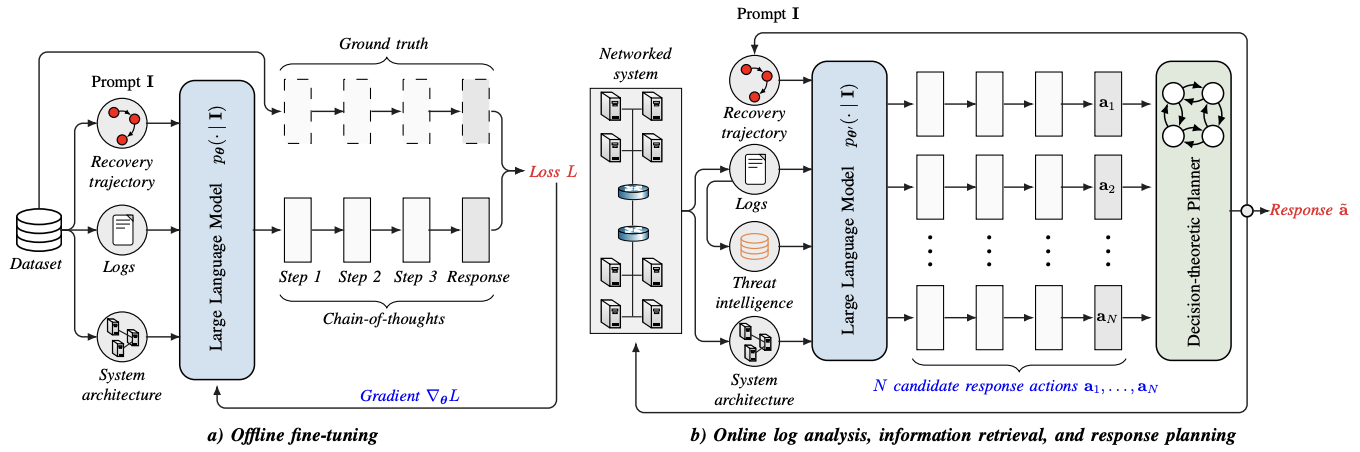
## NDSS 2026 论文和演示。 论文:[NDSS 2026 会议论文集](https://www.ndss-symposium.org/ndss-paper/incident-response-planning-using-a-lightweight-large-language-model-with-reduced-hallucination/). 视频:[NDSS 2026 演示](https://www.youtube.com/watch?v=TGuNgPEFnwk). ## 工件 - 第一个公开的应急事件和响应动作微调数据集。这是我们用于生成论文中结果的数据库。数据集可以在此处下载[这里](https://huggingface.co/datasets/kimhammar/CSLE-IncidentResponse-V1). - 微调模型的权重,可以在此处下载[这里](https://huggingface.co/kimhammar/LLMIncidentResponse). - 下载训练数据集的 Python 代码 (`load_training_dataset.py`). - 下载微调模型并使用它生成应急响应计划的 Python 代码 (`load_fine_tuned_llm.py`). - 生成应急响应计划的 Python 代码 (`response_generation.py`). - 基于我们的数据集微调新模型的 Python 代码 (`fine_tune_llm.py`). - [我们的基于 LLM 的应急响应决策支持系统演示视频](https://www.youtube.com/watch?v=SCxq2ye-R4Y&). ## 要求 - Python 3.8+ - `load_training_dataset.py` 需要 1 GB 的存储空间和一个通用 CPU。 - `load_fine_tuned_llm.py`: 需要 15 GB 的存储空间和一个通用 CPU。 - `response_generation.py`: 需要一个通用 GPU,例如 RTX 8000。 - `fine_tune_llm.py`: 需要 RTX 8000 等通用 GPU。 我们已经测试了以下平台上的 Python 脚本: - MacOs Sequoia,Python 3.9, 3.10, 3.11, 3.12 和 3.13。 - Ubuntu 22.04,Python 3.9, 3.10, 3.11, 3.12 和 3.13。 ## 安装 要下载此存储库,请运行以下命令: ``` git clone https://github.com/Limmen/llm_incident_response_ndss26 ``` 要安装所需的 Python 库,请运行以下命令 ``` pip install llm_recovery==0.0.13 ``` **注意** 如果您使用的是 Python 3.9 或更早版本,请运行以下命令: ``` pip install llm_recovery==0.0.7 ``` ## 执行 ### 加载微调的 LLM 命令: ``` python load_fine_tuned_llm.py ``` 预期输出: ``` ⋊> kim@gpu1 ⋊> ~/llm_incident_response_ndss26 on main ◦ python load_fine_tuned_llm.py (base) 19:25:01 Loading the fine-tuned incident response LLM. adapter_config.json: 100%|████████████████████████████████████████████████████████████| 797/797 [00:00<00:00, 4.08MB/s] Loading checkpoint shards: 100%|█████████████████████████████████████████████████████████| 4/4 [00:59<00:00, 14.78s/it] /home/kim/anaconda3/lib/python3.11/site-packages/torch/cuda/__init__.py:734: UserWarning: Can't initialize NVML warnings.warn("Can't initialize NVML") adapter_model.safetensors: 0%| | 0.00/201M [00:00 kim@gpu1 ⋊> ~/llm_incident_response_ndss26 on main ◦ python load_training_dataset.py (base) 19:26:24 Loading training dataset. README.md: 100%|█████████████████████████████████████████████████████████████████████| 33.0/33.0 [00:00<00:00, 187kB/s] examples_16_june.json: 100%|█████████████████████████████████████████████████████████| 536M/536M [00:03<00:00, 145MB/s] Generating train split: 1 examples [00:06, 6.32s/ examples] Training dataset loaded successfully. ``` ### 响应生成 命令: ``` python response_generation.py ``` 预期输出(示例): ``` ⋊> kim@gpu1 ⋊> ~/llm_incident_response_ndss26 on main ◦ python response_generation.py (base) 19:28:50 Loading checkpoint shards: 100%|█████████████████████████████████████████████████████████| 4/4 [00:05<00:00, 1.47s/it] /home/kim/anaconda3/lib/python3.11/site-packages/torch/cuda/__init__.py:734: UserWarning: Can't initialize NVML warnings.warn("Can't initialize NVML") /home/kim/anaconda3/lib/python3.11/site-packages/torch/cuda/__init__.py:734: UserWarning: Can't initialize NVML warnings.warn("Can't initialize NVML") Setting `pad_token_id` to `eos_token_id`:151643 for open-end generation. I recognize that while the attack is contained, I do not yet have enough information to fully understand or eradicate it. Therefore, I choose to acquire full disk and memory images along with relevant logs, preserving evidence in a forensically sound manner to support analysis. { "Action": "Acquire full disk and memory images of 10.20.11.42 and export DNS, firewall, and NetFlow logs to write-protected storage.", "Explanation": "Capturing images and logs secures evidence for later analysis and legal requirements." }⏎ ``` ### 在我们的应急响应数据集上微调 DeepSeek-R1-Distill-Qwen-14B 命令: ``` python fine_tune_llm.py ``` 预期输出: ``` ⋊> kim@gpu1 ⋊> ~/llm_incident_response_ndss26 on main ⨯ python fine_tune_llm.py (base) 20:14:06 Loading checkpoint shards: 100%|█████████████████████████████████████████████████████████| 4/4 [00:35<00:00, 8.85s/it] Trainable parameters: 50331648 No label_names provided for model class `PeftModelForCausalLM`. Since `PeftModel` hides base models input arguments, if label_names is not given, label_names can't be set automatically within `Trainer`. Note that empty label_names list will be used instead. `use_cache=True` is incompatible with gradient checkpointing. Setting `use_cache=False`. Step: 1, Epoch: 0.5000, Progress: 50.0%, Avg_loss=0.5480, LR=0.00095000, Grad_norm=0.3354, minutes: 0.7959 Step: 2, Epoch: 1.0000, Progress: 100.0%, Avg_loss=0.7036, LR=0.00047500, Grad_norm=0.4813, minutes: 1.2205 ⋊> kim@gpu2 ⋊> ~/llm_incident_response_ndss26 on main ⨯ ``` ## DOI:数字对象标识符 https://doi.org/10.5281/zenodo.17459636 ## 作者 Kim Hammar,Tansu Alpcan 和 Emil Lupu。 联系方式:kimham@kth.se ## 🔖 版权和许可

Creative Commons (C) 2025, Kim Hammar, Tansu Alpcan 和 Emil Lupu

Made with ❤   at     and  

标签:Apex, Hugging Face, IaC 扫描, NDSS, Python, 人工智能, 代码示例, 信息检索, 决策支持, 凭据扫描, 大型语言模型, 安全事件, 库, 应急响应, 开源, 技术栈, 数据分析, 无后门, 机器学习, 模型微调, 模型权重, 用户模式Hook绕过, 网络安全, 视频演示, 逆向工具, 隐私保护
