frangelbarrera/phishing-detection-rnn-cnn
GitHub: frangelbarrera/phishing-detection-rnn-cnn
基于 URL 词法特征的离线钓鱼检测模型,提供 Flask Web UI 与 CLI,支持在无网络环境下进行完全可复现的训练与推理。
Stars: 11 | Forks: 0
# 网站离线钓鱼检测模型
[](https://phishing-detection-rnn-cnn.onrender.com/)
[](https://colab.research.google.com/github/frangelbarrera/phishing-detection-rnn-cnn/blob/main/URL_Phishing_Detection.ipynb)
[](LICENSE)
[](https://github.com/frangelbarrera/phishing-detection-rnn-cnn/stargazers)
[](https://github.com/frangelbarrera/phishing-detection-rnn-cnn/commits)
[](https://github.com/frangelbarrera/phishing-detection-rnn-cnn/issues)
[](https://github.com/frangelbarrera/phishing-detection-rnn-cnn)
[](https://github.com/frangelbarrera/phishing-detection-rnn-cnn/graphs/contributors)
[](https://github.com/frangelbarrera/phishing-detection-rnn-cnn)
## 描述
一个轻量级的**离线**钓鱼 URL 检测模型。所有特征均从 URL 字符串本身中提取——在推理阶段不会发起任何网络请求,因此该模型可以在物理隔离的环境中使用。
该分类器是一个小型的双隐藏层 MLP(约 5,300 个参数),基于 49 个标准化的词法和结构化 URL 特征(长度、特殊字符计数、数字比例、TLD 标志、词统计等),使用 `binary_crossentropy` 和 `Adam` 进行训练。一个在训练集上拟合的 `StandardScaler` 会与模型一同发布,以确保推理时能完全复现训练阶段的预处理流程。在训练和推理阶段,特征均会从 URL 字符串中重新计算,从而消除了训练/服务阶段的数据偏差。
## 分支
此仓库包含两个分支:
- **`main`**(当前分支)—— 论文完成后的工程化演进版本,使用在相同 URL 特征上训练的更简单的双隐藏层 MLP 替换了原有的 CNN+LSTM 架构。包含 Flask Web UI、CLI、可复现的训练脚本以及已提交的模型制品。测试准确率 89.94%,AUC-ROC 0.965。
- **`thesis-original`** —— 答辩通过的学术论文(2025 年 7 月),使用了原始的 CNN+LSTM 混合架构(Conv1D + LSTM,138,898 个参数)。完全按照答辩时的状态保留,并在事后应用了可复现性修复(修正了输入形状、softmax 输出头、特征标准化、早停机制以及基于概率的 AUC)。测试准确率 88.67%,AUC-ROC 0.946。
要在分支之间切换:
```
git checkout main # post-thesis MLP evolution (this branch)
git checkout thesis-original # defended CNN+LSTM thesis
```
## 模型结果
| 指标 | 数值 |
| --- | --- |
| 测试准确率 | **89.94 %** |
| AUC-ROC | **0.965** |
| 平均精确率 | 0.965 |
| F1 分数(调整阈值后) | 0.900 |
| Brier 分数 | 0.072 |
| 决策阈值 | 0.499 |
在保留的 20% 测试集划分上的混淆矩阵(行 = 真实标签,列 = 预测标签):
```
legit phishing
legit 1024 119
phishing 111 1032
```
所有指标均在预测概率(非 argmax)上计算,并且可以通过 `train.py` 在种子 `42` 下完全复现。请查看 `training_metadata.json` 获取完整的训练配置,以及 `metrics.json` 获取 ROC / PR 曲线。
## 仓库结构
```
phishing-detection-rnn-cnn/
├── phishing_detector/ # Python package (feature extractor + detector)
│ ├── __init__.py
│ ├── features.py # 49-feature offline URL featurizer
│ └── detector.py # PhishingDetector: load model + predict
├── web/ # Minimal Flask web UI for interactive testing
│ ├── app.py
│ └── templates/index.html
├── tests/
│ └── test_features.py # Feature + detector unit tests
├── train.py # Reproducible training script
├── predict.py # CLI for classifying URLs
├── URL_Phishing_Detection.ipynb # Notebook wrapper around train.py
├── dataset_phishing.csv # Source dataset (11,430 rows)
├── my_model.keras # Trained model (97 KB)
├── scaler.pkl # Fitted StandardScaler
├── feature_names.json # Canonical feature order
├── metrics.json # Full evaluation report (ROC, PR, etc.)
├── history.json # Training history
├── training_metadata.json # Versions, seed, architecture, metrics digest
├── SHA256SUMS # Integrity checksums for all artifacts
├── requirements.txt
├── LICENSE
└── README.md
```
## 快速开始
```
git clone https://github.com/frangelbarrera/phishing-detection-rnn-cnn.git
cd phishing-detection-rnn-cnn
pip install -r requirements.txt
# 从 command line 分类 URL
python predict.py "https://www.google.com"
python predict.py "http://secure-account-verify-login.tk/login.html"
```
有关交互式 Web UI,请参阅下方的 [Web UI](#web-ui) 部分。
## Web UI
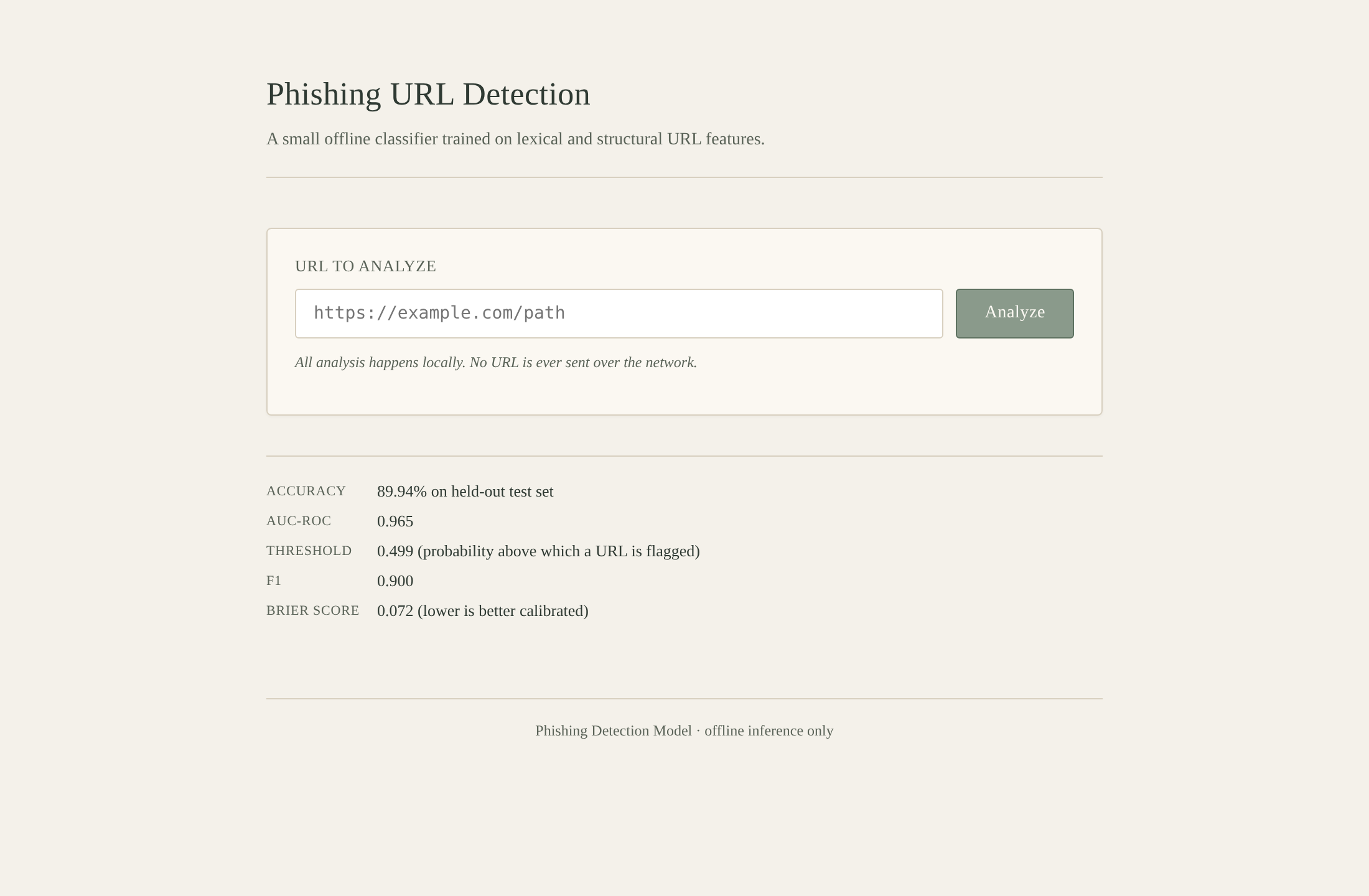
位于 `web/` 目录下的一个极简 Flask 应用,允许你粘贴 URL 并在干净、柔和色调的页面中查看模型的判定结果。通过以下命令启动:
```
python -m web.app --host 127.0.0.1 --port 5000
# 然后在浏览器中打开 http://localhost:5000
```
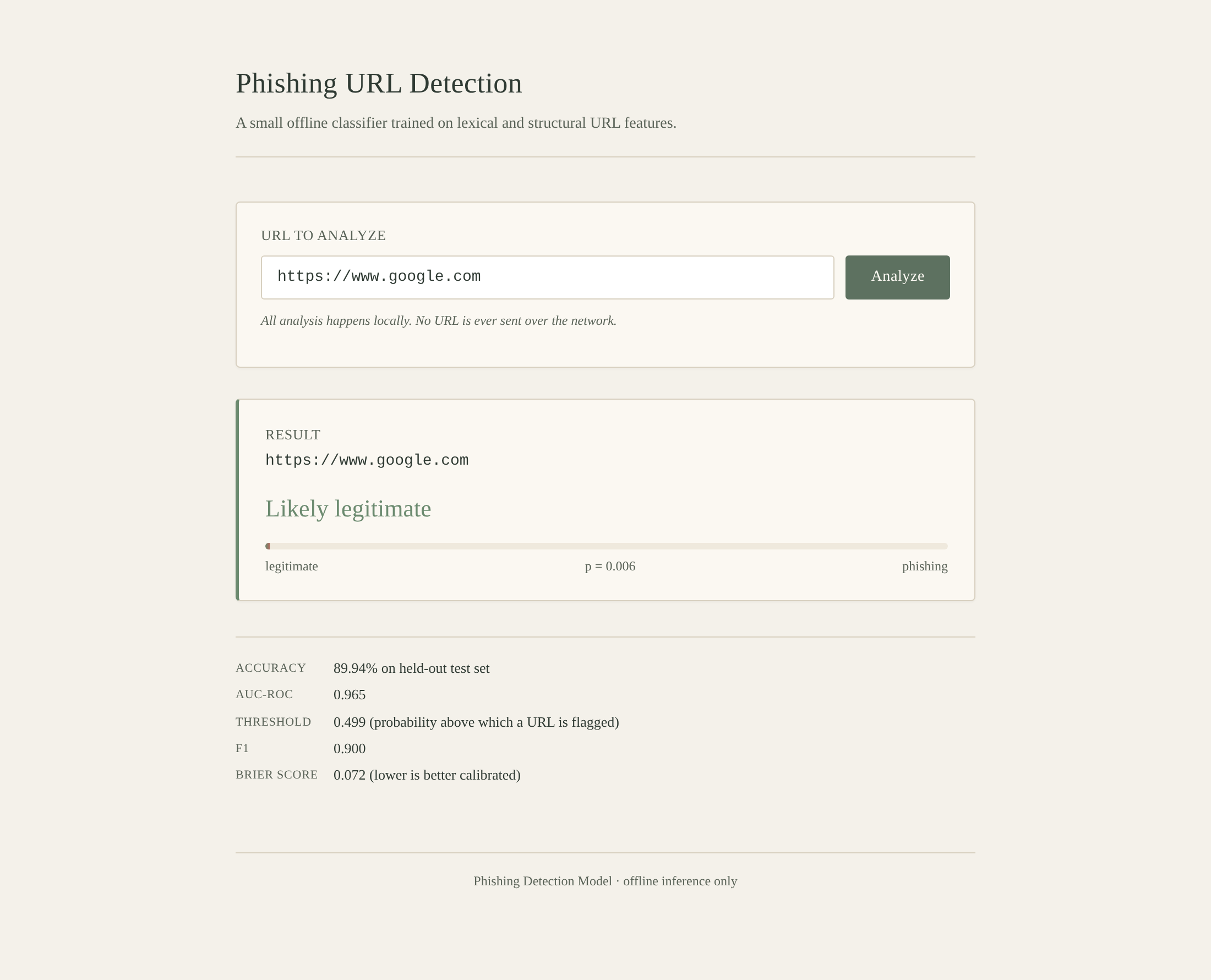
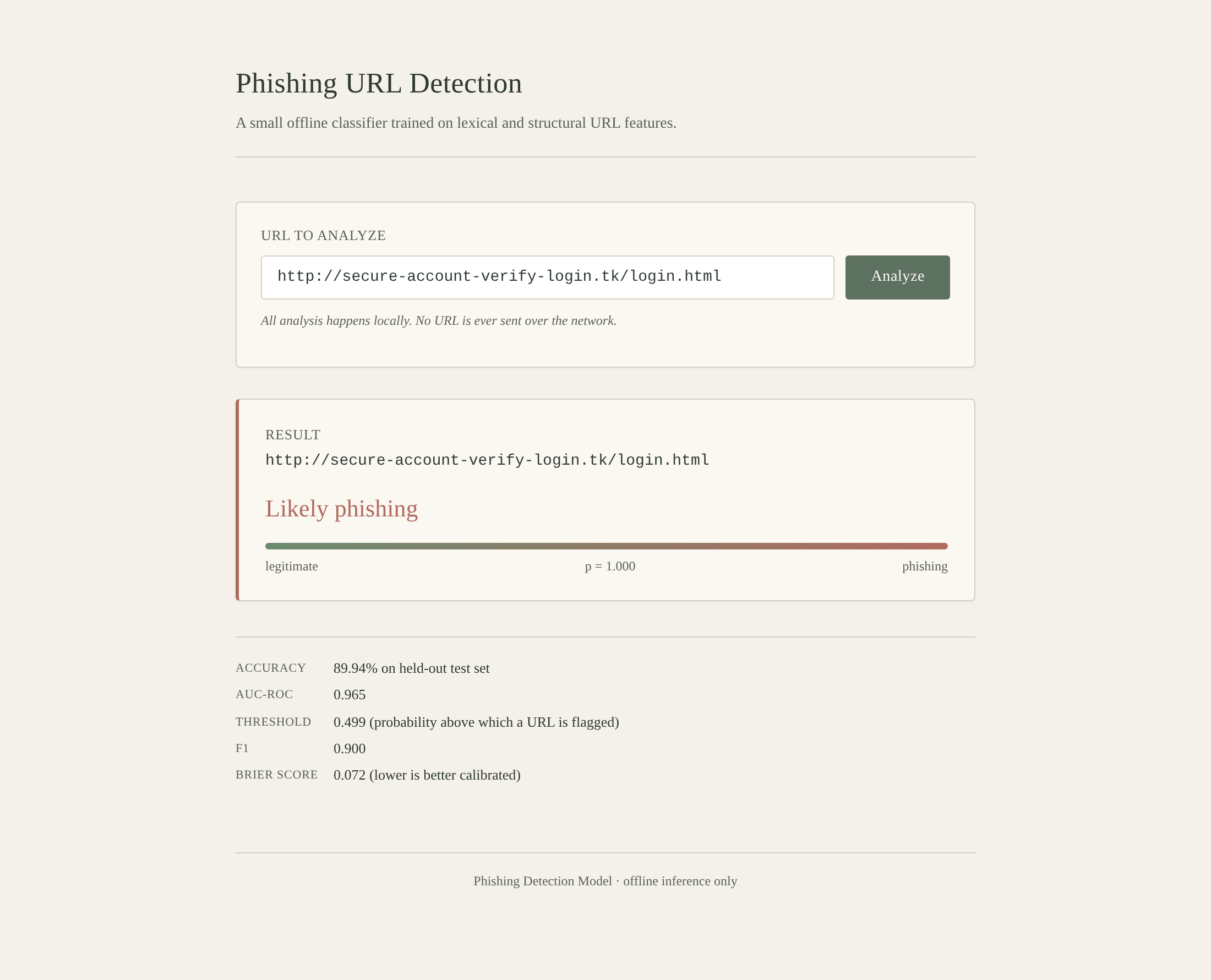
表单会在输入框下方显示模型的核心指标,结果面板会展示预测的标签、钓鱼概率以及一个从“合法”到“钓鱼”的渐变指示条。
**初始状态** —— 输入表单与模型指标:
**合法 URL** —— `https://www.google.com` 被判定为合法,概率为 0.006:
**钓鱼 URL** —— 一个可疑的 URL 被判定为钓鱼,概率为 1.000:
## 重新训练
要在 Google Colab 上从头重新训练(例如使用新数据集):
1. 将所有仓库文件上传到你的 Google Drive 中名为 `phishing-detection-rnn-cnn` 的文件夹中。
2. 在 Colab 中打开 `URL_Phishing_Detection.ipynb` 并运行所有单元格。该 notebook 会挂载 Drive,安装依赖项,运行 `train.py`,并原地覆盖模型制品。
3. 训练完成后,将新生成的 `my_model.keras`、`scaler.pkl`、`metrics.json`、`history.json` 和 `training_metadata.json` 同步回仓库并进行提交。
在本地,只需运行:
```
python train.py
```
该脚本会将所有制品写入仓库根目录,并打印最终的测试指标。
## 环境要求
- Python 3.10+
- TensorFlow ≥ 2.15
- scikit-learn ≥ 1.3
- pandas, numpy, matplotlib
- Flask ≥ 3.0(仅用于 Web UI)
使用 `pip install -r requirements.txt` 进行安装。
## 注意事项与局限性
- 特征纯粹基于词法/结构。该模型**不**检查 SSL 证书、DNS 记录或页面内容,因此它无法检测托管在原本合法域名上的钓鱼页面(例如被攻陷的 WordPress 站点)。
- 原始数据集中的五个特征(`random_domain`、`domain_in_brand`、`brand_in_subdomain`、`brand_in_path`、`nb_external_external_redirection`)需要精心维护的品牌列表或实时的网络访问权限,为了保证一致性,已在训练和推理阶段将其舍弃。
- 少数启发式特征(`https_token`、`prefix_suffix`、`abnormal_subdomain`)在现代互联网环境中存在较大噪声——许多合法网站也使用 HTTPS、连字符或多层子域名。模型已尝试规避此问题,但在多层级的合法域名上仍可能出现偶尔的误报。
## 许可证
MIT —— 详见 [LICENSE](LICENSE)。
标签:Apex, Flask, Python, 无后门, 机器学习, 离线分类器, 网络安全, 逆向工具, 钓鱼检测, 隐私保护